Skip to content
←Back to the radar

SOTA · agents

Agents

Multi-step tool use, web/OS tasks, long-horizon autonomy

Agents is the core domain because it measures not what a model knows but whether it can finish something on its own: read the environment, choose tools, execute across many steps, recover after failure. Its link to AGI is the most direct of any domain here - one operational definition of AGI is completing economically valuable tasks without a human steering each step. Judging this domain requires two rulers, and using only one misleads you. The first is task completion: the Arena Agent board (2026-09-22) measures net improvement, led by Claude Fable 5.1 at 13.71 and GPT-6 Astra at 11.54, and it reports praise alongside confirmed_success (31.83 / 19.83 for Fable 5.1); confirmed_success matters more than praise because it separates "looked useful" from "actually got the thing done". The second ruler is the scaffold: the same model behind a different harness produces very different results, since the top of SWE-bench Verified is Sonar Foundation Agent + Claude 4.5 Opus at 79.2%, live-SWE-agent with that same model is also 79.2%, and TRAE + Doubao-Seed-Code reaches 78.8% - which says "which combination is best" is an engineering question, not a model question. Agents and harness therefore have to be treated as two separate domains: this one collects things that finish tasks, the harness domain collects what agents run on.

RULERWebArena, OSWorld, GAIA, multi-step tool tasks

The ladder

13
MathResearchTopB

AlphaEvolve: pointing a model at problems that come with an objective scoring function

Google DeepMind's coding-agent-driven evolutionary search: Gemini Flash proposes candidates in volume and Gemini Pro in quality, automatic evaluators score them, and high scorers stay in the population as next-round context, i.e. evolutionary search with an LLM as the mutation operator; it applies only where an automatic evaluator exists, hence the math and agents filing. An evolved scheduling heuristic has run in production in Google data centres (Borg) for over a year, recovering 0.7% of Google's global compute (Google's compute, not all compute on earth), the card reading and the only result validated by long-running production. An evolved matmul kernel is 23% faster at specific sizes, and about 20% of 50+ open maths problems improved, including 4x4 complex matrix multiplication in 48 multiplications against Strassen's 1969 record of 49. Verification differs from the prover line: a Lean check is mathematical correctness, "23% faster" is an empirical reading on specific hardware. No public weights, Early Access is a waitlist, and the precondition is an evaluator you write yourself. Graded B (contested): a year of production behind the Borg result, nothing reproduced.

0.7%Google global compute recovered (production-verified)Contested · 2025-05
ProductionGoogle DeepMindSite
AlphaEvolve: pointing a model at problems that come with an objective scoring function
MultimodalDocs & SlidesTopC

Gamma: the orchestration tool that turns a body of source material into a presentable deck

What Gamma does is not "prompt for one slide" but reorganise existing material into something presentable: it ingests long documents, PDFs, pasted text or a URL, and returns a full deck with outline, pagination, imagery and layout, in a card-based structure where each page can be reordered, rewritten or re-illustrated on its own. It represents the kind of AI that is genuinely useful in the documents vertical - the value is in orchestration and editorial selection, not in generation quality. Its ceiling is equally clear: the output lives in Gamma's own layout system, and exporting to pptx loses a layer of fidelity - which happens to be a hard requirement for most organisations.

Web / pptx / pdfOutput formatsVendor Claim · 2025-01
ProductGamma TechSite
Gamma: the orchestration tool that turns a body of source material into a presentable deck
AgentsDocs & SlidesC

WorkBuddy: Tencent's all-scenario AI office workbench

Tencent's office agent: state the requirement and it plans, calls tools and generates files, leaving both process and result for review — connected to Tencent's IM, docs, mail, meetings and knowledge base.

15 minDeep-research turnaround (vendor claim)Vendor Claim · 2026-10
ProductTencentSite
WorkBuddy: Tencent's all-scenario AI office workbench
AgentsDocs & SlidesC

Doubao Work: ByteDance's productivity agent, from decks to computer control

ByteDance's August 2026 productivity agent: PPT, documents and sheets, deep research, scheduled tasks — plus reading and writing local files, filling forms across pages, and phone-based task dispatch.

Docs, decks, sheets + computer controlWhat it delivers (vendor claim)Vendor Claim · 2026-08
ProductByteDanceSite
Doubao Work: ByteDance's productivity agent, from decks to computer control
Agents

Hermes Agent: the open-source agent that turns self-improvement into a closed learning loop

The self-improving agent from Nous Research (248k+ stars). Its learning loop has five mechanisms: periodic memory nudges, autonomous skill creation after tasks, skills that self-improve in use, FTS5 session search with LLM summarization, and Honcho user modeling. One TUI, seven terminal backends (local/Docker/SSH/Singularity/Modal/Daytona/Vercel Sandbox), six chat platforms from a single gateway, no model lock-in. It doubles as a trajectory data-production apparatus. Self-improvement is falsifiable and no controlled experiment has been run, so this is graded as needing reproduction.

248kGitHub stars
Hermes Agent: the open-source agent that turns self-improvement into a closed learning loop
Agents

DeerFlow 2.0: ByteDance's super agent harness

ByteDance's open-source super agent harness (82k+ stars). 2.0 is a ground-up rewrite sharing no code with 1.x: sub-agents, extensible skills, sandbox and file system, long-term memory, session goals, plus Manual Context Compaction that hands context management back to the operator. Positioning lifted from a deep-research framework to a runtime for any task. Not independently benchmarked; graded needs-reproduction.

83kGitHub stars
DeerFlow 2.0: ByteDance's super agent harness
Agents

Paperclip: run a company with a team of AI agents

Open-source orchestration for teams of AI agents: a Node.js server and React UI where you bring your own agents, set goals, and track work and spend from one dashboard. It looks like a task manager; underneath sit org charts, budgets, governance, goal alignment and agent coordination. It manages business goals, not pull requests. MIT, self-hostable.

81kGitHub stars
Paperclip: run a company with a team of AI agents
Agents

Orca: the ADE that grounds parallel agents in git worktrees

Orca calls itself an ADE (Agentic Development Environment), the AI orchestrator for 100x builders (75k+ stars, MIT/TypeScript, YC-backed). Central mechanism: fan one prompt across Codex, Claude Code, OpenCode and Pi, each isolated in its own git worktree, then compare results and merge the winner. Also WebGL terminals, Design Mode (click a UI element to send its HTML/CSS/screenshot into the prompt), native GitHub and Linear integration, diff annotations routed back to the agent, SSH worktrees and mobile notifications. Not independently benchmarked; graded needs-reproduction.

76kGitHub stars
Orca: the ADE that grounds parallel agents in git worktrees
Agents

Multica: AI coding agents that show up on the board

An open-source, self-hostable workspace where you assign issues to AI coding agents the way you would to a teammate: they pick up the work, run on a runtime you control, comment as they go, and hand results back for review. Works with 26 agent CLIs and keeps intent, runs, decisions and diffs on one issue, with code never leaving your machine.

51kGitHub stars
Multica: AI coding agents that show up on the board
Agents

LangGraph: agents as long-running processes that must persist, interrupt and resume

A low-level stateful-graph orchestration framework from LangChain, MIT licensed, with Python and JS/TS implementations, and Klarna, Replit and Elastic named as production users in the README. Its lineage is stated in the acknowledgements - inspired by Google Pregel and Apache Beam, interface borrowing from NetworkX - which means the BSP graph-computation model applied to agents: nodes are model calls or tool executions, edges are control flow, state is an explicit object. The value is not in the loop-the-model-with-tools layer but in four runtime capabilities: durable execution (resume exactly where it stopped after a crash), human-in-the-loop interrupts (approval can stay suspended for hours or days), separate short-term and long-term memory, and LangSmith execution-path tracing. Its actual claim is that agent reliability is a runtime problem, not a model problem. Usable without LangChain; any CompiledStateGraph can be handed to Deep Agents above it as a sub-agent. 42.1k stars. Not run yet, and checkpoint-resume consistency is unverified, so this is graded as pending reproduction.

42kGitHub stars
LangGraph: agents as long-running processes that must persist, interrupt and resume
Agents

DeepTutor

DeepTutor is HKUDS's open-source "lifelong personalized tutoring" platform (Apache-2.0, Python 3.11+ / Next.js 16, arXiv 2604.26962, 40.6k stars): chat, multi-engine RAG knowledge bases, living books, writing and practice unified in one learning workspace. Highlights: (1) Subagents & Partners — consult real agent harnesses on your machine (Claude Code, Codex, Grok CLI, Kimi, opencode, Hermes, DeepSeek and more) from inside a chat turn, streaming their work into the conversation, plus persistent IM companions; (2) multi-engine knowledge — versioned RAG libraries across LlamaIndex, PageIndex, GraphRAG, LightRAG (incl. remote server), self-hosted WeKnora, Tencent IMA, MarginNote 4, Kiwix ZIM archives and Obsidian vaults, with pluggable parsing (MinerU/Docling/Tika/markitdown/PyMuPDF4LLM/LiteParse) and KBs that track GitHub repos and doc sites with 24h hash-diffed sync; (3) Book compiles sources into editable typed blocks (text/quizzes/flashcards/timelines/concept graphs/interactive HTML), exports Markdown, and long compiles pause-and-resume; (4) personalized learning (Mastery Path, immersive reading with verified citations, read-aloud/quiz/translation) and a Co-Writer split-view Markdown workspace with KaTeX live preview; (5) an office-skills code sandbox running model-generated code over docx/pdf/pptx/xlsx; (6) an agent-native CLI — the open SKILL.md format is picked up automatically by Claude Code/Codex, and deeptutor run wraps into LangChain/AutoGen loops. Led by Bingxi Zhao, fully open source with no paid online products.

41kGitHub stars
DeepTutor

Latest demos

60

Papers & deep reads

71
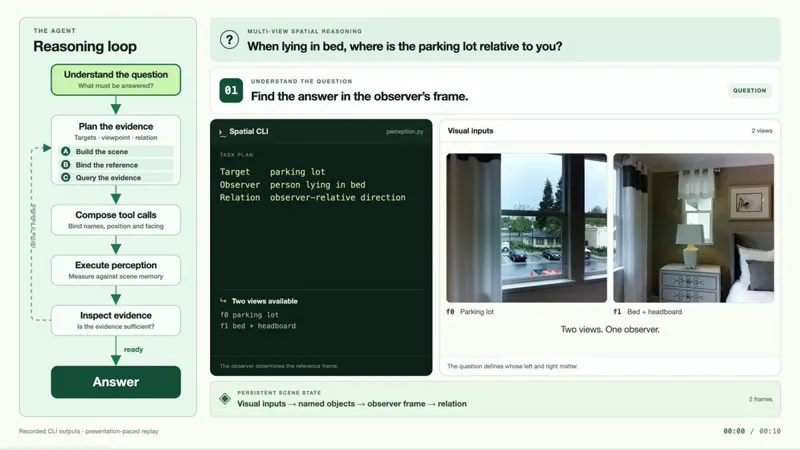
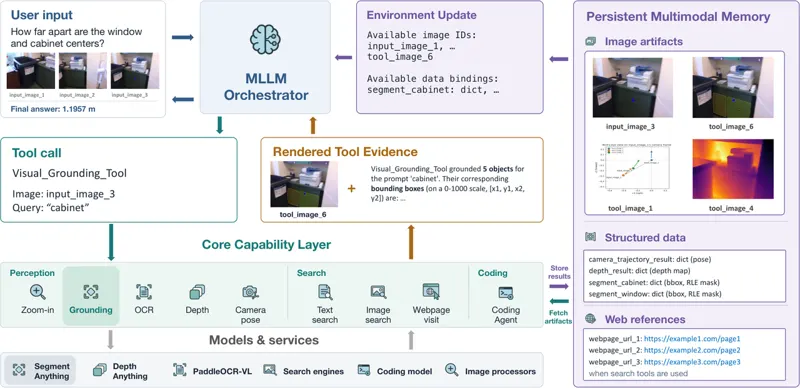
OpenVLHarness: Real World Visual Agentic Tool-Use with Multimodal Memory2026-10-19OpenVLHarness: Real World Visual Agentic Tool-Use with Multimodal MemoryMultimodal large language models (MLLMs) have made rapid progress on visual reasoning, yet many tasks require evidence that is difficult to obtain through internal reasoning alone: our controlled study on 22 benchmarks shows that simply increasing the inference budget of the base model yields only modest gains. Such tasks demand grounded perception, external knowledge, and numerical measurements obtained through heterogeneous tools, whose outputs must be made interpretable to the model and retained across reasoning steps. We introduce OpenVLHarness, a multimodal reasoning harness organized around a capability layer and persistent multimodal memory. The capability layer combines task-level tool interfaces with evidence rendering, providing consistent access to heterogeneous backends and converting their outputs into model-readable observations. Persistent multimodal memory retains the corresponding images, structured data, and web references as addressable artifacts throughout each query. A coding interface executes generated programs over stored data, enabling computations that combine results from multiple tools. Together, these mechanisms support an iterative process of acquiring, inspecting, and composing multimodal evidence. Evaluated on 22 benchmarks with eight open and proprietary backbones, OpenVLHarness improves average scores by 9.7-12.6 points over matched no-tool baselines, including +11.2 with Qwen3-VL-8B, +9.7 with Kimi K3, and +9.9 with GPT-6 Astra. With GPT-6 Luna at medium reasoning effort, OpenVLHarness outperforms the base model, Codex, and Visual Sketchpad at maximum effort by 7.7-8.5 points while incurring at most 37% of their model-token cost.
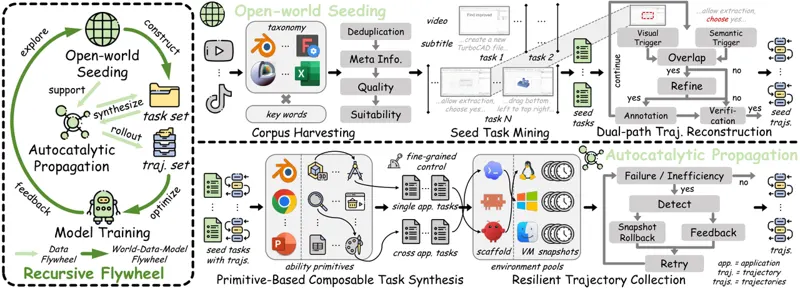
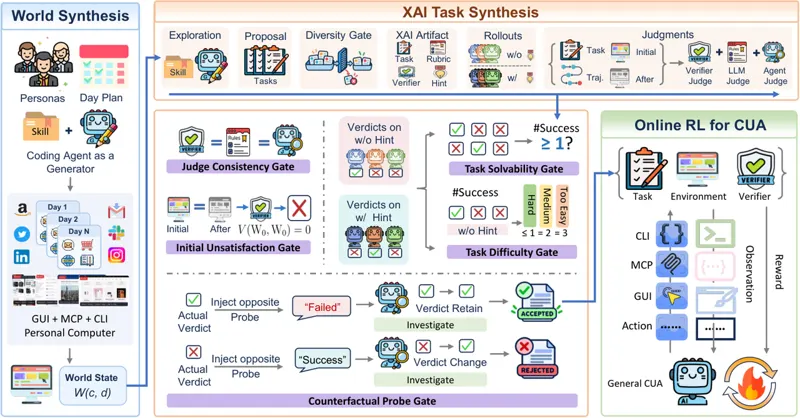
Agent World Model in the Wild: Computer-Use Agent Environment Synthesis2026-10-19Agent World Model in the Wild: Computer-Use Agent Environment SynthesisAgent learning is shifting from learning from human data toward learning through interaction with the world. However, scaling such learning directly in real-world computer systems is challenging and can introduce substantial security risks. We therefore propose Agent World Model in the Wild (WildAWM), a scalable pipeline for synthesizing controllable environments and tasks for training general computer-use agents (CUAs). Whereas existing approaches typically specialize in a single agent interaction interface, we construct executable environments that jointly support graphical user interfaces, model context protocol services, and command-line interfaces, allowing agents to flexibly combine visual interaction, tool use, and code execution. WildAWM is entirely powered by open-source models, demonstrating that high-quality computer-use environments can be generated without proprietary frontier models. Beyond environments, we address three recurring challenges in task synthesis: ensuring solvability, maintaining sufficient difficulty, and producing reliable verifiers, by introducing execution-based quality gates that combine heterogeneous agent rollouts, cross-judge consistency checks, and counterfactual probes of judgment robustness. The resulting pipeline synthesizes 341 long-horizon environment-task pairs that can require over 100 agent steps to solve and remain challenging even for frontier models, with GPT-6-Astra solving only 60% of them. We train two Qwen models of different sizes exclusively in these synthetic worlds. Both models achieve substantial gains across 8 out-of-distribution benchmarks spanning web, claw, and computer-use agents, demonstrating that learning in WildAWM's synthesized worlds generalizes broadly to unseen computer-use tasks. The code is publicly available at https://github.com/MSR-Orchard/WildAWM.
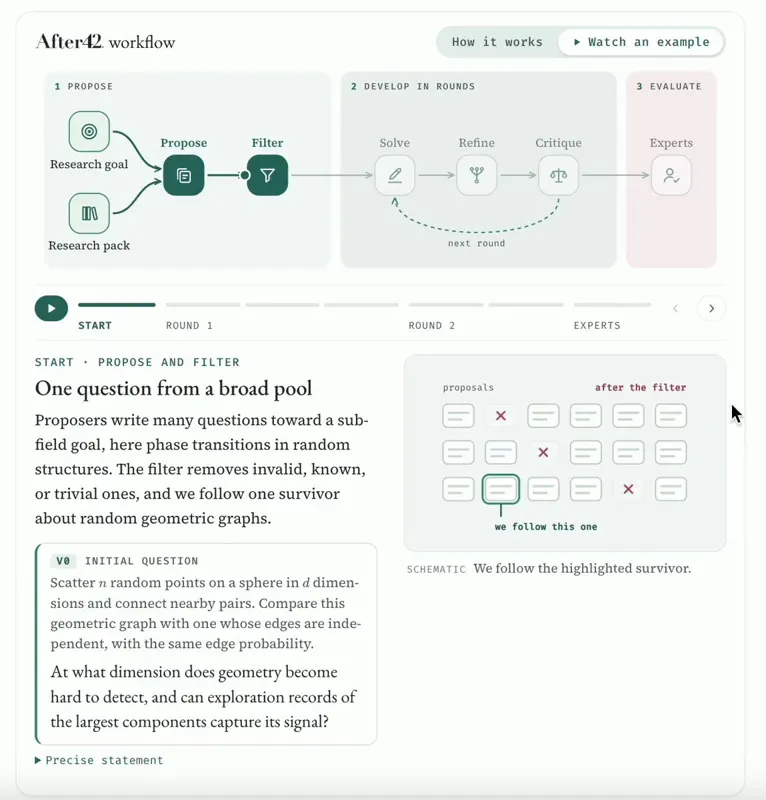
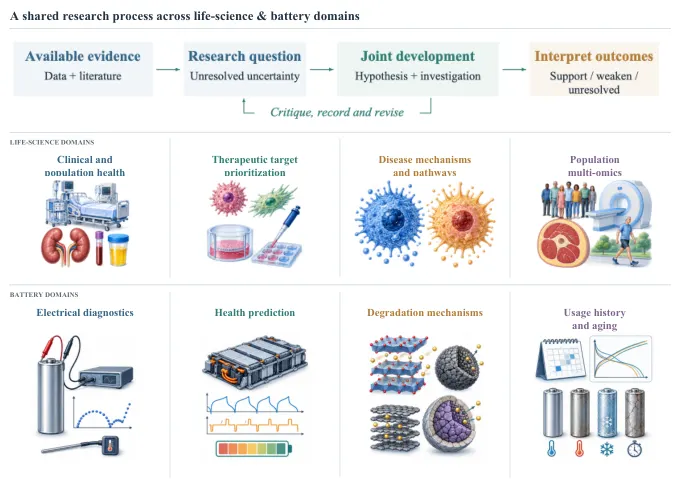
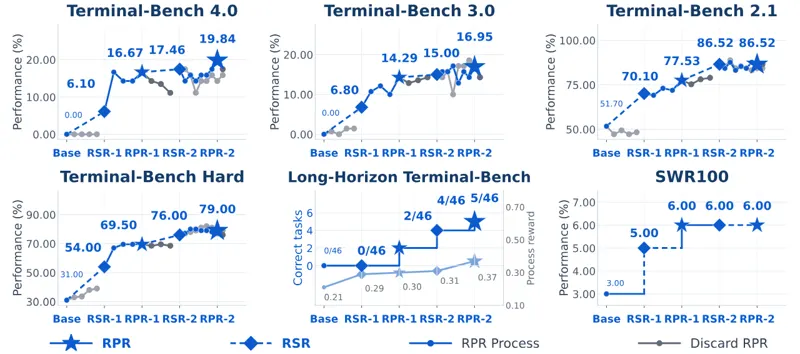
DiscoveryRSI: Recursively Learning to Discover Valuable Hypotheses2026-10-16DiscoveryRSI: Recursively Learning to Discover Valuable HypothesesScientific discovery requires developing worthwhile hypotheses into practical investigations, yet learning from this evolving research process remains challenging. We introduce an operational definition of valuable and testable research hypotheses: evidence-grounded claims about consequential uncertainties, coupled with feasible investigations, explicit decision criteria, and alternative explanations. Our DiscoveryRSI framework develops hypothesis trees through multi-agent evolutionary search, compiles selected investigations into executable Harbor tasks, and recursively learns through three mechanisms: hypothesis credit optimization attributes scientific assessments to documented research contributions; harness replay identifies productive strategies and recurring failures to refine research workflows; and rediscovery applies accepted improvements to new investigations, generating further experience for subsequent learning. We also introduce DFM-Bench, which provides comprehensive assessment of hypothesis quality and cumulative research progress at the levels of hypotheses, revisions, development paths and research runs. Across four life-science domains, automated evaluation shows that hypothesis quality rises from 4.86 for the base model to 5.39 after two rounds of self-improvement, with the large gains in falsifiability and data resolvability. We further validate hypothesis quality through expert review, comparing our DiscoveryRSI-27B with other research agents. Preliminary human assessments show that DiscoveryRSI-27B scores higher than GPT-6 Luna on hypothesis importance and whether claims are plausible and evidence-bounded. DiscoveryRSI-27B achieved a 6.3% rate of hypothesis correspondence with research published after the model cutoff, largely outperform GPT-6 with 2.5% and Claude Opus 5 with 2.3%, while delivering greater human-rated improvement along research paths.
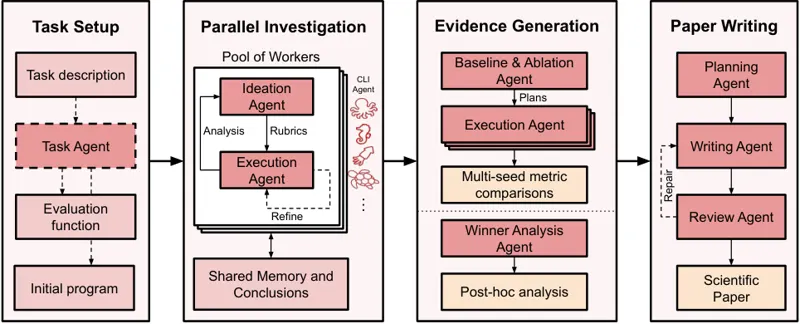
The Agentic Scientist: Orchestrating Coding Agents for Automated Scientific (Co-)Discovery2026-10-13The Agentic Scientist: Orchestrating Coding Agents for Automated Scientific (Co-)DiscoveryModern coding agents are fundamentally reshaping the role of human input for computational research: they write code, launch in silico experiments, analyze their results, and autonomously operate with ever-increasing time horizons. Despite these developments, fully autonomous research agents suffer from a limited ideation radius and myopic hill-climbing search dynamics. To bridge this gap, we introduce The Agentic Scientist, an end-to-end distributed pipeline for human researchers to conduct computational research alongside modern coding agents. Building on its predecessor, our system decomposes research into task drafting, idea generation, planning, sandboxed experimentation, result aggregation, baseline and ablation construction, post-hoc analysis, and report writing. Importantly, each step in the pipeline is powered by the next generation of coding agents and leverages agentic self-verification. The overall research process is driven by a meta-controller that manages parallel research agents and enforces rubric verification at each stage. This design enables the same orchestration layer to be reused across heterogeneous domains with different execution environments, agentic coding harnesses, and evaluation metrics. Our system can be used across a spectrum of autonomy: either as a co-scientist tool or to perform end-to-end scientific investigation. Within the co-scientist setting, we leveraged a development version of our system to submit a single research paper, which got accepted for publication at ALIFE 2026. We further apply The Agentic Scientist fully autonomously to open problem-solving tasks in machine learning, and demonstrate the system's capability of scientific discovery across different domains of computational research. Our ablations suggest that reliable scientific autonomy depends not only on base model capabilities, but also on the cross-agent orchestration layer.
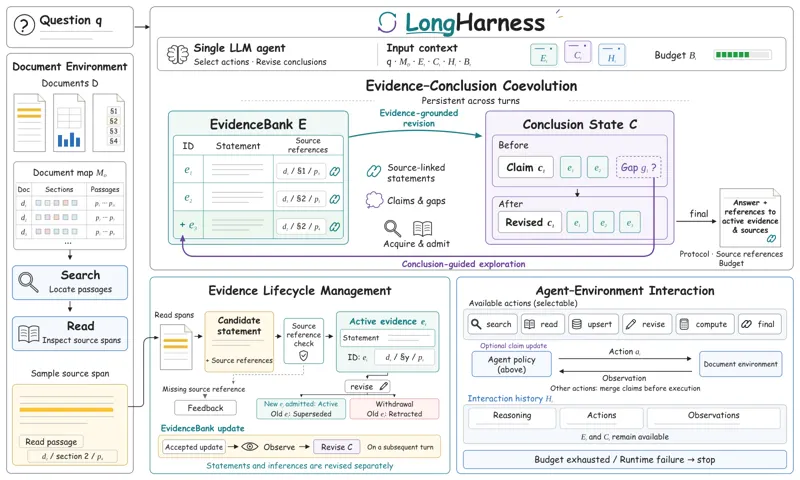
LongHarness: Stateful Evidence Management for Agentic Reasoning over 100M-Token Corpora2026-10-09LongHarness: Stateful Evidence Management for Agentic Reasoning over 100M-Token CorporaCorpus-level long-context reasoning requires agents to acquire and integrate evidence across document collections that exceed their context windows. Existing agent harnesses enable incremental access to these corpora, but acquired evidence and evolving conclusions often remain entangled in a growing interaction history. This implicit state management can lead to two coupled failure modes: unbounded exploration, where retrieval expands the interaction history without resolving decision-relevant information gaps, and evidence-state drift, where previously acquired evidence or subsequent corrections fail to inform the current conclusion. We present LongHarness, a model-agnostic harness that makes the interaction between acquired evidence and evolving conclusions explicit. Its core mechanism, Evidence-Conclusion Coevolution, uses unresolved conclusions to guide exploration toward missing information, while newly acquired evidence strengthens or revises the conclusions that directed the search. LongHarness couples this process with Evidence Lifecycle Management, which keeps accumulated evidence current and traceable throughout the interaction. Together, these mechanisms focus retrieval on remaining information needs and keep conclusions aligned with current evidence. We evaluate LongHarness on OfficeQA Pro V1 and V2, AA-LCR, and LongBench v2 using GLM-5.3-Flash and Qwen3.8-Flash. Compared with direct reasoning using the same backbone, LongHarness improves GLM-5.3-Flash exact match on OfficeQA Pro from 15.8% to 60.2% on V1 and from 4.4% to 61.1% on V2. Against state-of-the-art agent harnesses, it surpasses Claude Code by 12.0 percentage points on V1 and Codex by 18.9 points on V2. With Qwen3.8-Flash, LongHarness reaches 61.7% on V1, outperforming Claude Code by 8.3 points and Codex by 12.0 points.
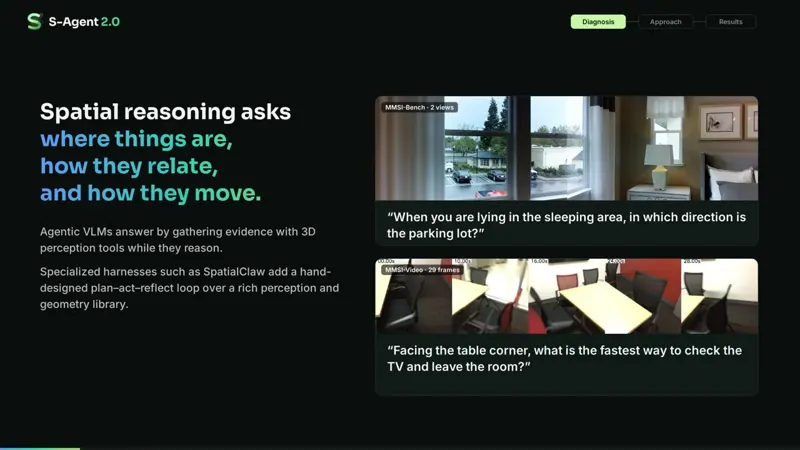
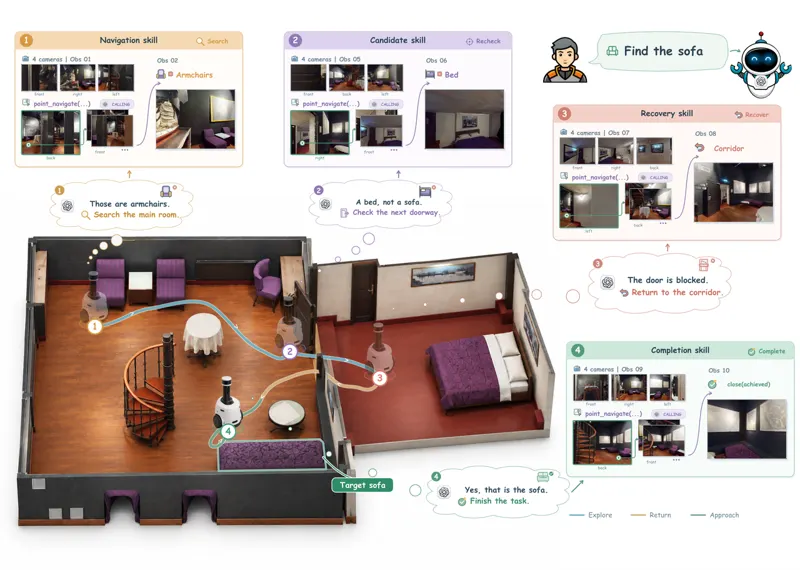
SuperNav: An Agentic Navigation System for Any Task in Any Scene2026-10-08SuperNav: An Agentic Navigation System for Any Task in Any SceneGeneral-purpose service robots need navigation systems that can handle diverse human requests in unfamiliar environments, combining task generality with scene generality. Some existing methods fine-tune multimodal large language models (MLLMs) to predict navigation actions, making their behavior dependent on the coverage of navigation training data and potentially limiting generalization to new requests and environments. Our key insight is to let the MLLM focus on interpreting requests, understanding scenes, and making decisions while preserving its general-purpose capabilities and delegating motion execution to navigation tools. To realize this idea, we introduce SuperNav, which equips a pretrained MLLM with a specialized agent harness without navigation-specific fine-tuning of the MLLM. Our harness supports these decisions with Navigation Skills, agent-oriented Tools for physical interaction, and task-progress and context management. A unified visual-point interface connects decision-making to motion by allowing the model to specify destinations directly in images and revise its decisions from execution feedback. Together, these components support sustained navigation across different task requirements and environments. SuperNav outperforms four evaluated baselines on instance-level, multi-object, and demand-driven tasks. Category-level evaluation on HM3D and deployment on a real quadruped robot further demonstrate its applicability across environments. Project Page: https://zju3dv.github.io/SuperNav/
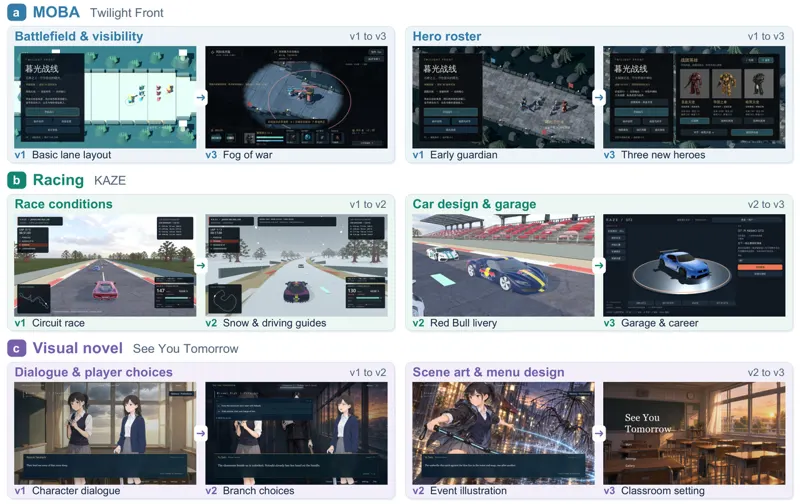
Recursive Game Creator: An Agentic Product-Level Experience-Oriented Game Harness2026-10-06Recursive Game Creator: An Agentic Product-Level Experience-Oriented Game HarnessRecent game design agents have made substantial progress in generating playable games. However, program correctness does not ensure an enjoyable experience for players. We present Recursive Game Creator, an experience-oriented harness to advance agentic game development from rough game prototypes into entertaining games. Recursive Game Creator organizes recursive development around four components: Designer, Builder, Player, and Reviewer. The Designer translates user instructions and Reviewer's feedback into detailed plans. The Builder turns these plans into candidate games. The coding-native Player creates and executes reusable policies through programmatic interfaces to efficiently collect diverse gameplay trajectories, mitigating evaluation bias caused by slow GUI-based collection. The Reviewer uses carefully designed trajectory-based metrics to induce player preferences, integrating with visual evidence and explicit textual preferences to evaluate games against game-specific criteria. Finally, the Reviewer accepts the better version and provides improvement reviews for the next round, closing the recursive loop. Our method achieves state-of-the-art overall performance of 77.89 on GameCraft-Bench. On GameASG-Bench, it achieves a strict task success rate of 53.2%, a 34.1% improvement over the same-model baseline, and the highest mean runtime-check pass rate at 93.4% among compared methods. A user study shows longer playtime and higher ratings. Code is coming soon.
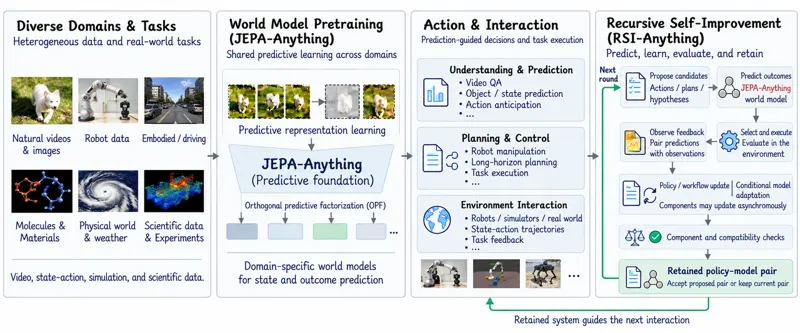
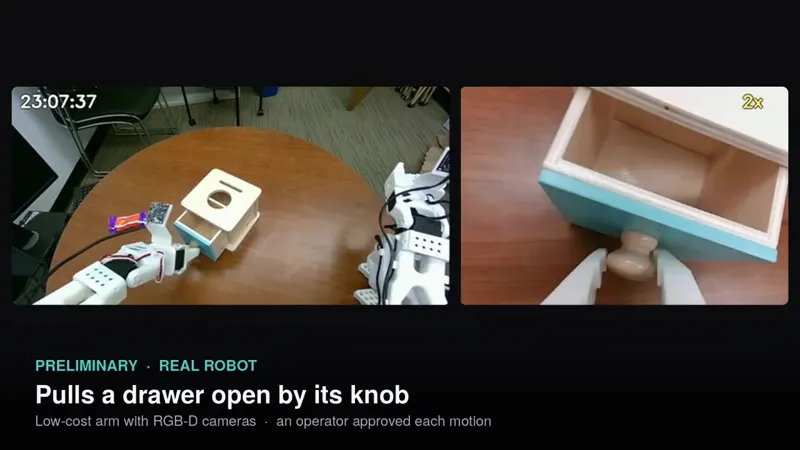
ASENA: Self-evolving Agents for Embodied Navigation2026-09-30ASENA: Self-evolving Agents for Embodied NavigationWe present ASENA, an embodied agent system that enables general-purpose coding agents to program humanoid navigation, manipulation, and interaction. Through a unified robot harness, agents read sensor data, write and execute programs, inspect recorded outcomes, repair failures, and reuse notes and executable skills while keeping their model weights fixed. We also introduce ASENA-VLN, a 4B monocular navigation policy that serves as an optional tool within this programmable system. ASENA-VLN predicts body-frame trajectories for both extended routes and short-horizon behaviors. Its shared vision-language decoder is trained on route instructions, visual question answering, and a newly curated dataset of geometry-derived atomic navigation tasks. As a standalone policy, ASENA-VLN achieves state-of-the-art success rates of 68.7% on R2R and 70.2% on RxR. When integrated with a coding agent, learned navigation improves ASENA's success rate by 11 percentage points on both agentic benchmarks and reduces execution time. Persistent workspace evolution uses simulator feedback to improve success over ten passes through recurring 100-task subsets. Success increases from 72% to 98% on R2R and from 65% to 89% on RxR. On embodied question answering, ASENA achieves state-of-the-art accuracy with fewer interaction steps. On a Unitree G1, we demonstrate search, visual inspection, spatial reasoning, synthesized gestures, and mobile manipulation combining object pickup, carrying, and handoff without a pre-built map. These demonstrations illustrate how online programming extends robot behavior beyond route following and predefined skills.

Open source

36

Boundaries & failure modes

Failures in this domain are almost all silent, so they need to be named one by one. One, completion rate decays exponentially with steps: at 95% per step, twenty steps leave 36%, and the Terminal-Bench leader's 58.18% accuracy corresponds to a pass@5 of 0.7121, meaning a substantial share of success is bought by retrying; real long-horizon tasks are not "a bit harder", they are a different order of magnitude. Two, the confirmation signal is unreliable: the large gap between praise and confirmed_success (31.83 versus 19.83 for Fable 5.1) shows that user satisfaction and task completion are different things, and an agent will hand back something well-formatted that did not solve the problem. Three, side effects are irreversible: code can be rolled back with git, but sending a message, placing an order, deleting data or changing production configuration cannot; the vast majority of agents today have no transaction boundary and no rehearse-then-commit mechanism, and that is their biggest production risk, ahead of accuracy. Four, environment and tool errors propagate: when an API returns HTML instead of JSON, or times out, or rate-limits, the agent often treats that as fact and keeps reasoning, freezing the error into every later step. Five, permissions and audit gaps: an agent operates with a person's credentials, so an overreaching action looks identical to a human action in the logs, and attribution cannot be separated at the system level. Cost and latency: the true cost of a long task is tokens times retries times tool-call latency, and the mini-SWE-agent + Claude 4.5 Opus row on the SWE-bench board is the only publicly comparable per-task price anchor at $376.95 for 76.8%; budget production agents on that order, not on the cost of one conversation.

As an Amazon Associate, we earn from qualifying purchases.