Skip to content
←Back to all verticals

APPLICATIONS · Create & Design

Game Making

Levels, assets, gameplay prototypes, engine workflows

Game making has the widest water-level gap of any field here: the asset pipeline has been substantially rewritten, gameplay has barely been touched. What changed is 3D assets, textures, concept art, icons and scene prototypes - a mid-sized indie title used to need an art team, and one person can now cut first-draft asset cost by one to two orders of magnitude. What did not change is level design, numerical balance, game feel and pacing, all of which depend on the judgement that comes from playing; AI can neither play nor tell you whether something is fun. So the real use in this field is to spend AI on volume and variation on the asset side, and reinvest the human time saved from modelling and texturing into gameplay iteration. What improves is how big a game one person can make, not what kind of game AI can make. The ladder here is ranked by whether the asset enters an engine: usable topology, UVs and PBR channels come first; preview-render-only tools come last.

Tracked assets
3
Installable skills
0
Capability domains
10

SOTA applications

3
3D & World ModelsGame MakingTopC

Meshy 7: the 3D asset platform that finishes what comes after generation, from topology and PBR to rigging, printability, and MCP

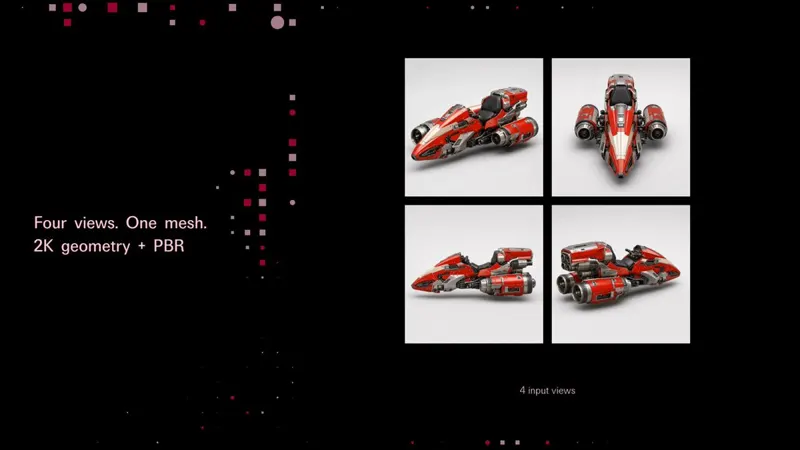
Meshy headlines Meshy 7 (2026) and its "true-to-reference" claim, meaning alignment between the generated model and your input image, with image-to-3D stated at under a minute. The real differentiator is not generation but finishing the engineering constraints that follow it: Smart Topology returns clean topology with a controllable poly count in about ten seconds, one-click PBR delivers the full albedo, normal, metallic, and roughness set at HD 4K with no shader setup, auto-rigging covers humanoid and quadruped with 600+ motion presets, and on the print side meshes come out watertight with auto-repair before export. It exports GLB, FBX, OBJ, STL, USDZ, and 3MF straight into OrcaSlicer and Bambu Studio. The agent surface is complete too: a REST endpoint per generation capability, an MCP server that connects into Claude or Cursor, and a CLI that turns one command into a finished model. Stated scale is 100M+ models and 12M+ users, with 100 free credits a month. Boundaries: no public quantitative benchmark (the quality stars are self-assigned), credit pricing per tier undisclosed, and "under a minute" excludes post-processing.
<1minVendor claim: single image → 3D modelVendor Claim · 2026
ProductMeshySite
Meshy 7: the 3D asset platform that finishes what comes after generation, from topology and PBR to rigging, printability, and MCP
3D & World ModelsGame MakingTopC

Tripo: image-to-engine-ready-asset compressed into a ten-second step

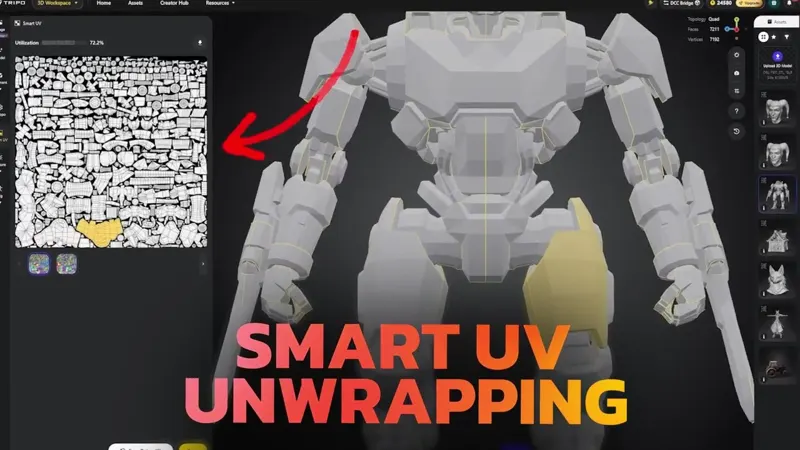
VAST's Tripo is the most productionised commercial text/image-to-3D service tracked here: meshes with UVs and PBR materials, quad remeshing, an API plus Blender/Unity plugins that drop straight into game and e-commerce asset pipelines. Its weakness is equally clear - strong on single objects, weak on complex assemblies and exact dimensions - and the sub-10-second figure is the vendor's own claim, which has not been re-measured.

<10sVendor claim: single image → usable meshVendor Claim · 2025-06
ProductVASTSite
Tripo: image-to-engine-ready-asset compressed into a ten-second step
Image GenerationGame MakingC

Scenario: style-consistent asset volume for game art, not one beautiful picture at a time

Scenario packages image generation as an asset line for game studios: train a stylised generator on your own art, then produce icons, props, characters and set pieces in volume, wiring generation into tools like Blender through MCP and plugins. Its claim is consistency and throughput - precisely the two things general text-to-image models are worst at.

ProductScenarioSite
Scenario: style-consistent asset volume for game art, not one beautiful picture at a time

Skills you can install

0

No installable agent skill collected for this vertical yet. We list skill packs that run inside Claude Code / Codex / Cursor, not concept write-ups.

Open source

4
ahujasid/mcp-for-blenderMIT

MCP for Blender: 32 tools that make Blender a 3D workspace an LLM can drive

Formerly blender-mcp, a third-party community plugin (the README states on its first screen that it is not made by Blender), MIT licensed, Python, and the highest-starred entry among 3D MCP servers. The PyPI package is now mcp-for-blender, yet uvx blender-mcp still runs and existing configs need no change. Two components only: an addon inside the Blender process runs a socket server that actually executes commands (the only place with bpy, the current scene and the UI thread), while a separate MCP server process translates protocol, joined by JSON over TCP on localhost:9876 by default. The source defines 32 @mcp.tool() decorators across four layers - perception (get_scene_info, get_object_info, get_viewport_screenshot returning an MCP Image, closing an act-then-look loop), reference lookup (bpy_api_lookup and describe_node_type so the model queries instead of guessing socket order and enum names), execution (execute_blender_code as the escape hatch, set_texture, export_scene to GLB/FBX), and asset retrieval and generation (Poly Haven with semantic search, importing the .blend source and writing attribution properties; Poly Pizza with about 10,600 low-poly models, size normalisation and automatic CC-BY credit; Sketchfab; Hyper3D Rodin text-to-3D and image-to-3D; Tencent Hunyuan3D distinguishing the mainland ai3d endpoint from the international hunyuan one). On security, arbitrary code execution is the design rather than a bug: an optional safe mode (BLENDER_MCP_SAFE_MODE=1) statically validates scripts before running, blocking file access, subprocesses, network and persistent code while modelling, rendering, saving, import and export pass normally, and blocked scripts return to the model with the reason so it can retry. Content telemetry is off by default, and a dedicated disable_telemetry tool can only turn collection off. 29.2k stars. Not run with Blender locally yet, so this is graded as pending reproduction.

MCPBlender
Python29k2.7k202

Demo videos

39

Papers & deep reads

3
Recursive Game Creator: An Agentic Product-Level Experience-Oriented Game Harness2026-10-06Recursive Game Creator: An Agentic Product-Level Experience-Oriented Game HarnessRecent game design agents have made substantial progress in generating playable games. However, program correctness does not ensure an enjoyable experience for players. We present Recursive Game Creator, an experience-oriented harness to advance agentic game development from rough game prototypes into entertaining games. Recursive Game Creator organizes recursive development around four components: Designer, Builder, Player, and Reviewer. The Designer translates user instructions and Reviewer's feedback into detailed plans. The Builder turns these plans into candidate games. The coding-native Player creates and executes reusable policies through programmatic interfaces to efficiently collect diverse gameplay trajectories, mitigating evaluation bias caused by slow GUI-based collection. The Reviewer uses carefully designed trajectory-based metrics to induce player preferences, integrating with visual evidence and explicit textual preferences to evaluate games against game-specific criteria. Finally, the Reviewer accepts the better version and provides improvement reviews for the next round, closing the recursive loop. Our method achieves state-of-the-art overall performance of 77.89 on GameCraft-Bench. On GameASG-Bench, it achieves a strict task success rate of 53.2%, a 34.1% improvement over the same-model baseline, and the highest mean runtime-check pass rate at 93.4% among compared methods. A user study shows longer playtime and higher ratings. Code is coming soon.

Capabilities it draws on

10

As an Amazon Associate, we earn from qualifying purchases.