Skip to content
OmniBrain-0: A Unified Agentic Model for Embodied Intelligence

OmniBrain-0: A Unified Agentic Model for Embodied Intelligence

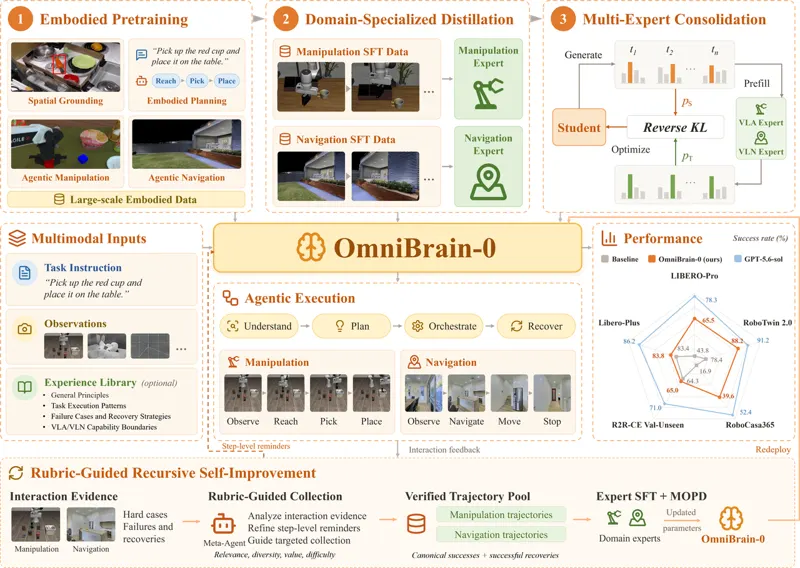
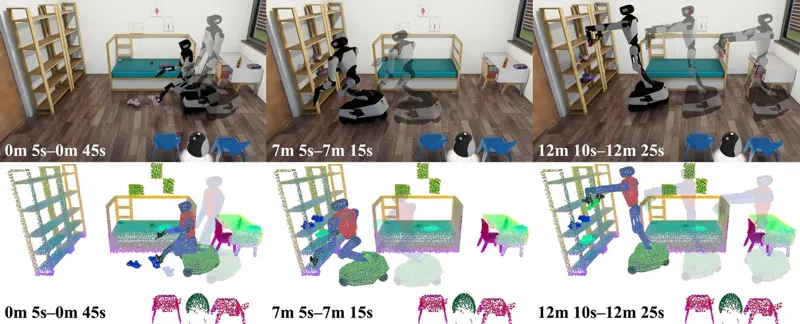
General-purpose embodied intelligence requires robots to coordinate diverse skills over long horizons, track task progress, and recover from failures. Specialist policies alone do not ensure task-level reliability, while powerful multimodal agents rely on costly reasoning and external experience that compact models struggle to reproduce. We introduce OmniBrain-0, a lightweight unified embodied agent that coordinates manipulation and navigation through a shared high-level decision model, integrating task understanding, planning, progress tracking, and feedback-driven recovery. Our progressive training framework combines embodied pretraining, domain-specialized agent distillation, and multi-teacher on-policy distillation (MOPD). It distills powerful teachers' interaction experience into manipulation and navigation experts, then consolidates their decision capabilities into OmniBrain-0. Unification therefore occurs within the learned decision model rather than only at the tool interface. We further introduce Rubric-Guided Recursive Self-Improvement (RSI), a data flywheel in which a Meta-Agent turns execution evidence into refined rubrics, step-level reminders, and verified trajectories for domain-expert updates before their reconsolidation into OmniBrain-0 through MOPD. We evaluate OmniBrain-0 on LIBERO-Pro, LIBERO-Plus, RoboCasa365, RoboTwin 2.0, and R2R-CE Val-Unseen, as well as multiple real-world manipulation tasks. OmniBrain-0 combines strong cross-domain task performance with substantially lower inference and execution overhead than its closed-source teacher, demonstrating efficient transfer and consolidation of embodied capabilities into a compact unified agent.

Embodied AIVLA
Xiaomi Embodied Intelligence Team, Yuechen Luo, Chong He · 81 views · Oct 26, 2026
Reinforcement Learning Enables Scaling Generalist Robot Policy Improvement

Reinforcement Learning Enables Scaling Generalist Robot Policy Improvement

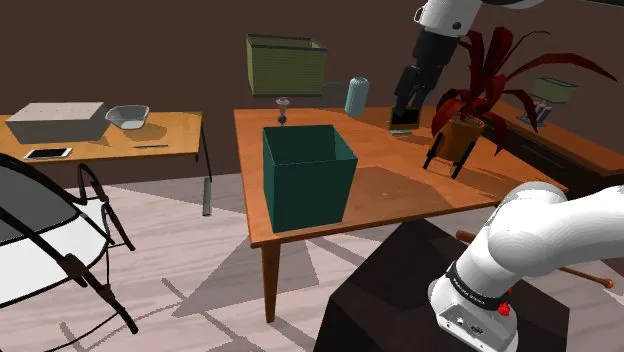
The introduction of generalist robot policies has enabled a single, large model to learn to perform a variety of tasks from a vast pre-training corpus. While these models often exhibit powerful zero-shot generalization capabilities, they typically require an adaptation phase to achieve sufficient performance in deployment. Iterated self-improvement via reinforcement learning (RL) has demonstrated promise in enabling this adaptation, yet such approaches have been largely explored in single-task settings - where the goal is to simply improve on a narrow deployment task - which lies in stark contrast to the multi-task capabilities of the base policy. In this work we ask whether generalist robot policies are capable of multi-task, generalist improvement in deployment - targeting many diverse tasks simultaneously - and what algorithmic recipe enables this. To answer this question, we first develop a set of structured evaluations to test generalist improvement capabilities, and systematically evaluate algorithmic and practical design choices regarding value estimation, policy extraction and resource allocation. We show that not only can generalist policies be improved online across diverse tasks, but that the right recipe can enable generalization and increase performance on tasks not considered during online training. We characterize when this generalization occurs and show that both the training task distribution and the use of value-based RL are critical. To the best of our knowledge, this is among the first evidence for online generalist improvement for robot foundation models.

Vision-language-action (VLA)Reinforcement Learning
Michal Korniak, Marco Bagatella, Ralf Römer · 69 views · Nov 4, 2026

As an Amazon Associate, we earn from qualifying purchases.