PAPER DEEP DIVE
Future Representation Distillation for Imagination-Free World Action Models
DreamFree turns a pretrained video diffusion model into a predictive visual encoder. A frozen teacher observes current and future frames, while a student predicts the teacher future representation from the current observation alone, so deployment avoids future-video denoising. Two-stage training combines future representation distillation with native flow matching, then learns an action readout and an action DiT. The 14B model reaches strong results on LIBERO, RoboCasa-Kitchen, and real DROID manipulation while running closed-loop control at 11 Hz, 17.8 times faster than DreamZero.
Paper Metadata
Authors: Jaehyeong Jo and collaborators at KAIST.
Paper: https://arxiv.org/abs/2611.04527
Project page: https://harryjo97.github.io/dreamfree/
Code: https://github.com/harryjo97/dreamfree. At the time of this reading, the public repository only stated that code would be released soon. No implementation was available for source-level analysis, so this article does not invent file or function mappings.
One-Sentence Summary
DreamFree removes iterative future-video generation from robot inference by distilling a frozen video teacher's future-aware representations into a student encoder that sees only the current observation. An action readout and a 1B action diffusion transformer then generate action chunks, enabling 11 Hz closed-loop control with a 14B video backbone.
Why This Problem Matters
A world action model tries to turn the physical dynamics learned by a video generator into robot control. The common recipe is straightforward: observe the current scene, predict future frames conditioned on a language instruction, and decode actions from the imagined video. This gives humans something visible to inspect and gives the policy an explicit representation of what may happen next.
Explicit imagination is nevertheless expensive and fragile inside a control loop. Producing a high-quality future clip requires multiple denoising passes through a large diffusion network. A robot must instead observe, decide, and move under a tight latency budget. More importantly, a visually convincing future can still be physically wrong: objects may drift, contacts may be misrepresented, and the predicted arm may move along a trajectory the real controller cannot execute.
Fast-WAM and related systems showed that future-video denoising can be omitted at deployment by reusing features from a video backbone. That saves inference time, but it does not guarantee that the features are useful to an action head. In the paper's RoboCasa-Kitchen comparison, Fast-WAM improves only from 44.4% to 44.7% when moving from a 5B to a 14B backbone. A stronger video prior is therefore not automatically a stronger control prior.
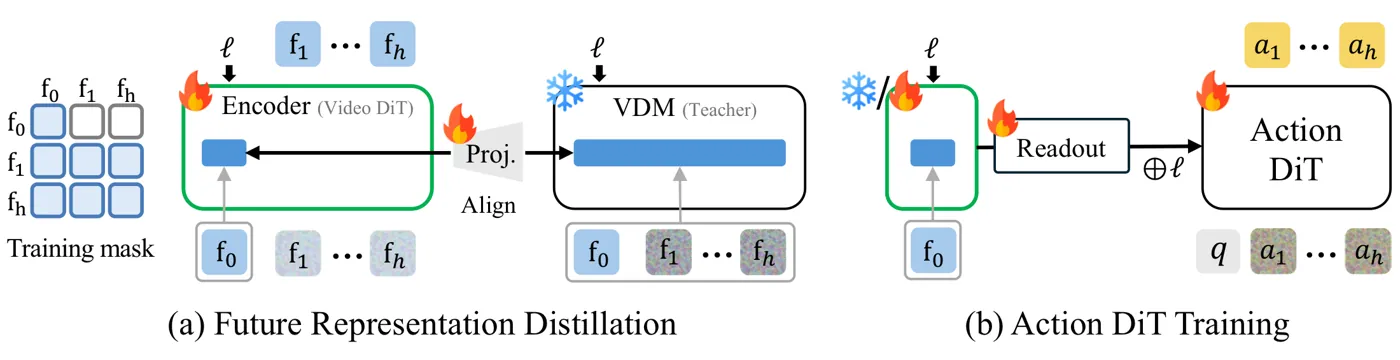
DreamFree starts from a different premise: the policy does not need a playable future. It needs a compact representation of how the scene is likely to change. A frozen teacher may inspect current and future frames during training, while a student learns to infer the teacher's future-aware hidden state from the current frame alone. This turns future prediction from a deployment-time generation problem into a representation-learning problem.
Preliminaries
DreamFree describes video generation with flow matching. Given a clean video latent $\mathbf{x}_{*}$, Gaussian noise, and a timestep, the training input is an interpolation between data and noise:
$$ \mathbf{x}_{t_d}=(1-t_d)\mathbf{x}_{*}+t_d\boldsymbol{\epsilon}_d $$The teacher noise level $t_d$ determines how much future information is obscured. The teacher is not asked to expose clean future pixels. It must produce a stable predictive hidden state under perturbation. The authors use 0.7 for simulation benchmarks and 0.8 for the real DROID data, reflecting the larger appearance and scene variation in physical recordings.
The distillation idea is related to REPA, but the target is not an image feature from the same observation. The student sees only the current frame, while the teacher sees the current and future frames and returns a spatiotemporal representation for the whole clip. Aligning these states teaches the student to encode consequences of the current scene without reconstructing future textures.
This distinction matters for robotics. Background lighting, camera noise, and irrelevant texture consume capacity in a pixel-reconstruction objective. A teacher's intermediate representation has already abstracted many of those factors and is more likely to preserve object state, contact relations, and task progress. The paper tests this hypothesis through both action probing and future-latent probing.
Method
A frozen teacher supplies future supervision
The teacher is a pretrained video diffusion model whose parameters remain frozen. It receives the video, language instruction, timestep, and noisy latent, and returns a hidden representation at layer $j$. The student is initialized from the same video backbone but is conditioned only on the clean current frame and instruction. Its layer $i$ representation is projected into the teacher's spatial and temporal token layout.
No future video is required as a direct reconstruction target for the control representation. The student only has to match the teacher's internal state. Because the teacher was pretrained on large video corpora, its hidden state contains learned structure about motion and object interaction that would be difficult to specify with handcrafted pixel losses.
Structured attention prevents information leakage
A video diffusion transformer normally allows attention across all spatial and temporal tokens. If the current-frame tokens could attend to future tokens during distillation, the student would appear predictive while secretly reading the answer. DreamFree applies a structured mask so that current-frame tokens attend only to other current-frame tokens. Future tokens may still participate in the generative objective, but they cannot contaminate the representation used for action prediction.
This aligns training and deployment. The student's current representation must be computable without future frames at both stages. The mask is therefore not an implementation detail; it protects the causal claim of the method.
A two-layer projector bridges student and teacher token spaces
The student produces a current-frame token set, while the teacher target contains multiple future positions and image patches. A lightweight two-layer transformer projector expands the student representation and maps it into the teacher's feature dimension. Layer normalization and cosine similarity are then used for alignment. The projector is discarded after training, so it adds no cost to the deployed control path.
The future representation distillation loss is:
$$ \mathcal{L}_{\mathrm{distill}}(\theta,\psi)= \mathbb{E}_{\mathbf{x}_{*},\boldsymbol{\epsilon}_d} \left[-\operatorname{sim}\left(\mathbf{p}_\psi(\mathbf{h}_i), \mathbf{g}_j(\mathbf{x}_{t_d},t_d,\boldsymbol{\ell})\right)\right] $$Here $\mathbf{h}_i$ is the student's layer $i$ hidden state, $\mathbf{p}_\psi$ is the trainable projector, $\mathbf{g}_j$ is the frozen teacher, and $\boldsymbol{\ell}$ is the instruction. For the 5B model, the student and teacher layers are both 25; for the 14B model, the distillation and action-readout layers are all 31.
The native video objective is retained
Distillation alone could cause the student to forget the generative dynamics learned during video pretraining. DreamFree therefore keeps the original flow-matching loss. The current frame remains clean, future frames are noised, and the student predicts the flow from noise toward data:
$$ \mathcal{L}_{\mathrm{gen}}(\theta)= \mathbb{E}_{\mathbf{x}_{*},\boldsymbol{\epsilon},t} \left[\left\|\mathbf{u}_\theta(\mathbf{x}_t,t,\boldsymbol{\ell}) -(\boldsymbol{\epsilon}-\mathbf{x}_{*})\right\|_2^2\right] $$The two terms form the complete visual-encoder objective:
$$ \mathcal{L}(\theta,\psi)= \mathcal{L}_{\mathrm{gen}}(\theta)+ \mathcal{L}_{\mathrm{distill}}(\theta,\psi) $$These losses serve different roles. The generative loss preserves broad video-model knowledge, while the distillation loss converts the teacher's future awareness into a representation that can be computed from one observation. The ablation later shows that removing either term hurts control, although removing distillation hurts much more on RoboCasa-Kitchen.
A Perceiver-style readout extracts action-facing tokens
A dense video representation is not directly convenient for an action transformer. DreamFree uses 64 learned queries, applies self-attention among the queries, and then cross-attends to the visual hidden state. The resulting fixed-size tokens summarize the visual context that matters for action. The readout layer is 19 for the 5B model and 31 for the 14B model.
This is more selective than global pooling. Learned queries can focus on task-relevant objects, spatial relations, and temporal cues while discarding background detail. The probing experiment supports this interpretation: features after the action readout are easier to decode into actions than the raw encoder features.
The action decoder predicts chunks with flow matching
The action module conditions a 1B cross-attention DiT on action-facing tokens, language, proprioceptive state, and optional action history. A clean action chunk is interpolated with noise:
$$ \mathbf{a}_t=(1-t)\mathbf{a}_{*}+t\boldsymbol{\epsilon} $$The decoder is trained to predict the corresponding flow:
$$ \mathcal{L}_{\mathrm{act}}= \mathbb{E}_{\mathbf{a}_{*},\boldsymbol{\epsilon},t} \left[\left\|\mathbf{u}_\phi( \mathbf{a}_t,t\mid\mathbf{c},\mathbf{q},\mathbf{s},\boldsymbol{\ell}) -(\boldsymbol{\epsilon}-\mathbf{a}_{*})\right\|_2^2\right] $$Here $\mathbf{c}$ denotes action-facing visual tokens, $\mathbf{q}$ is proprioception, and $\mathbf{s}$ is optional history. Each chunk contains 32 actions. LIBERO executes 10 actions per chunk, RoboCasa executes all 32, and DROID executes 24 before replanning. DROID also includes the previous eight actions to reduce unintended gripper reopening. The history is dropped with probability 0.2 during training so that the policy cannot rely on copying its previous command.
Inference has no future-video denoising
At deployment, the visual encoder performs a single forward pass on the current observation and instruction. The readout creates action-facing tokens, and the action decoder samples a chunk with 10 Euler steps for LIBERO and RoboCasa or 16 steps for DROID. Action sampling uses no classifier-free guidance, requiring one conditional decoder evaluation per step. The action-flow update is:
$$ \mathbf{a}_{t_{n+1}}= \mathbf{a}_{t_n}+(t_{n+1}-t_n)\hat{\mathbf{v}}_n $$The future video never enters the control loop. There is no explicit imagination phase and no video diffusion pass between observations. This is the system-level reason a 14B visual backbone can still support real-time control: the large model is evaluated once per action chunk, while the expensive video denoising path has been removed.
flowchart LR
    A[Current observation and instruction] --> B[Student video encoder]
    B --> C[Structured current-only attention]
    C --> D[Layer i predictive representation]
    D --> E[Two-layer Transformer projector]
    F[Frozen VDM teacher with future frames] --> G[Teacher layer j representation]
    E --> H[Future representation distillation]
    G --> H
    B --> I[Video flow-matching loss]
    D --> J[Perceiver action readout]
    J --> K[64 action-facing tokens]
    K --> L[1B action DiT]
    M[Proprioception and optional action history] --> L
    N[Language instruction] --> L
    L --> O[32-action chunk]
    O --> P[Closed-loop robot control]
Evidence
The learned representation is more predictive and more actionable
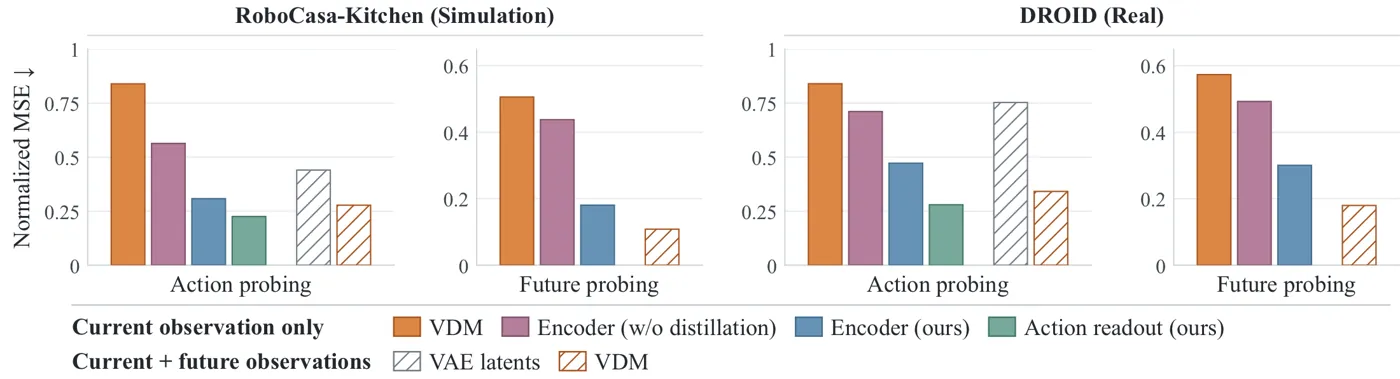
The authors freeze each visual representation and train lightweight probes. They compare a video diffusion model with only the current observation, a student encoder without distillation, DreamFree's encoder, and the teacher with access to ground-truth future frames. For action probing, DreamFree's encoder has lower normalized mean squared error than the current-only teacher and the non-distilled student. It also beats probing VAE latents from both current and future frames.
The future probe reconstructs VAE latent patches of a held-out future frame. DreamFree approaches the future-aware teacher on RoboCasa-Kitchen, while a gap remains on DROID. This is evidence that the current representation absorbs useful future structure, but real-world video is harder to compress into a deterministic prediction. The action readout is even more decodable than the raw encoder, showing that the query mechanism extracts control-relevant information rather than merely preserving it.
LIBERO and RoboCasa-Kitchen results
DreamFree reaches 98.6% average success across the four LIBERO suites, narrowly exceeding LingBot-VA at 98.5% and Fast-WAM at 97.6%. The result shows that current-frame representation distillation covers spatial, object, goal, and long-horizon manipulation without cross-embodiment pretraining. The margin over the strongest baseline is only 0.1 percentage point, so LIBERO supports parity with the leading group rather than a decisive advantage.
RoboCasa-Kitchen separates the methods more clearly. DreamFree reaches 71.7% with a 14B backbone and 74.4% after additional action-free RoboCasa365 videos. Cosmos Policy reaches 67.1%, FLARE reaches 66.4%, and Fast-WAM 14B reaches only 44.7%. The gap is consistent with the paper's claim that a video prior must be explicitly aligned to control features; simply sharing a generative backbone is not enough.
| Method | LIBERO average success rate |
|---|---|
| π0 | 94.1% |
| π0.5 | 96.9% |
| OpenVLA-OFT | 97.1% |
| Fast-WAM | 97.6% |
| LingBot-VA | 98.5% |
| DreamFree | 98.6% |
| Method | RoboCasa-Kitchen average success rate |
|---|---|
| π0 | 62.5% |
| Cosmos Policy | 67.1% |
| Fast-WAM 14B | 44.7% |
| DreamFree 5B | 58.5% |
| DreamFree 14B | 71.7% |
| DreamFree 5B with extra videos | 68.8% |
| DreamFree 14B with extra videos | 74.4% |
Scaling and ablation
Moving from 5B to 14B improves DreamFree by 13.2 percentage points on RoboCasa-Kitchen, while Fast-WAM improves by only 0.3 points. This comparison is central to the paper. A bigger video network contains more predictive capacity, but the action pathway must be trained to expose that capacity. Future representation distillation provides the required interface.
The ablation shows the full model at 98.6% on LIBERO and 71.7% on RoboCasa. Removing the generative loss reduces these values to 98.0% and 55.6%. Removing distillation produces a larger collapse to 94.6% and 47.2%. On RoboCasa, distillation is the dominant route from video knowledge to control, while the native generative loss preserves the broad dynamics prior and regularizes the student.
| Visual-encoder objective | LIBERO | RoboCasa-Kitchen |
|---|---|---|
| Full DreamFree | 98.6% | 71.7% |
| Without generative loss | 98.0% | 55.6% |
| Without distillation loss | 94.6% | 47.2% |
Real-world DROID evaluation
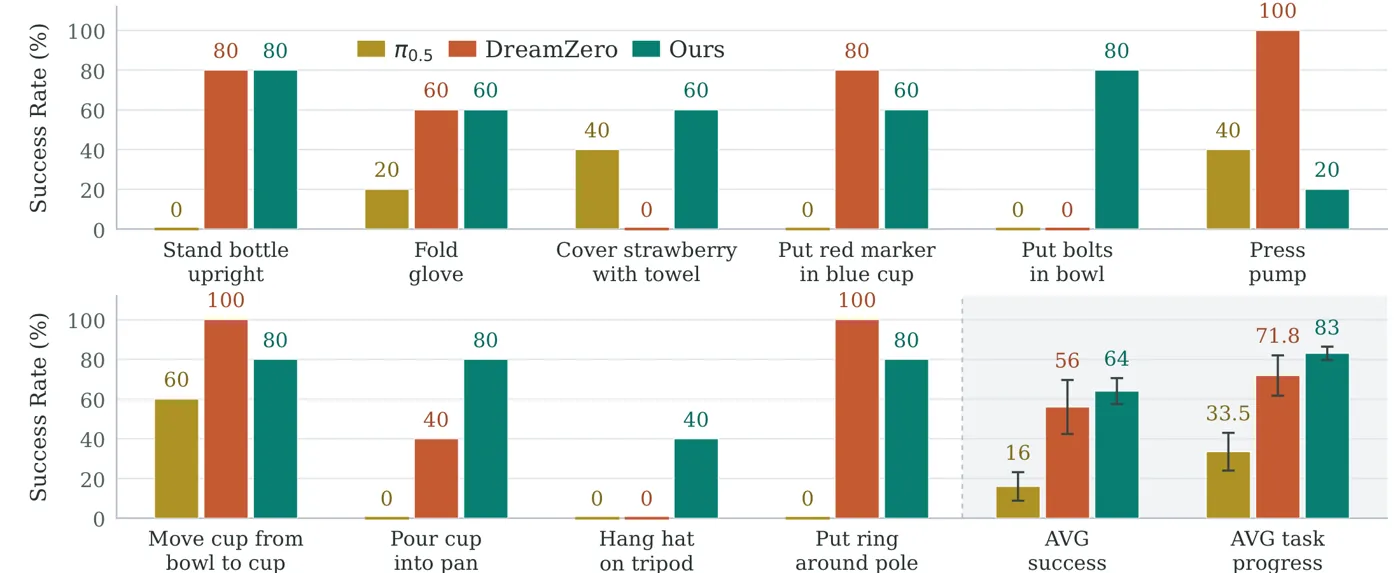
The DROID study covers 10 tasks with five trials per task, spanning push, cover, press, fold, pour, and composite skills. DreamFree reaches 64% average success, compared with 56% for DreamZero and 16% for π0.5. Average task progress is 83%, 71.8%, and 33.5%, respectively. Leading both metrics indicates that DreamFree completes more intermediate subgoals and fails less often overall.
The qualitative analysis is equally informative. DreamZero fails all trials on cover-strawberry-with-towel, hang-hat-on-tripod, and put-bolts-in-bowl. The authors attribute most failures to inaccurate future-video predictions and note that DreamZero often continues an unsuccessful action after an initial error. DreamFree more often adjusts and recovers. This supports the practical argument that an imperfect implicit future representation can be safer than a crisp but physically wrong imagined video.
DreamFree is not uniformly successful. In the press-pump task it makes contact in all five trials but completes the task only once. Sustained force, end-effector posture, and termination remain difficult. With only five trials per task, the real-world averages also have wide uncertainty. The result strongly supports superiority over the two tested checkpoints, not a claim that general manipulation is solved.
Latency and action-chunk execution
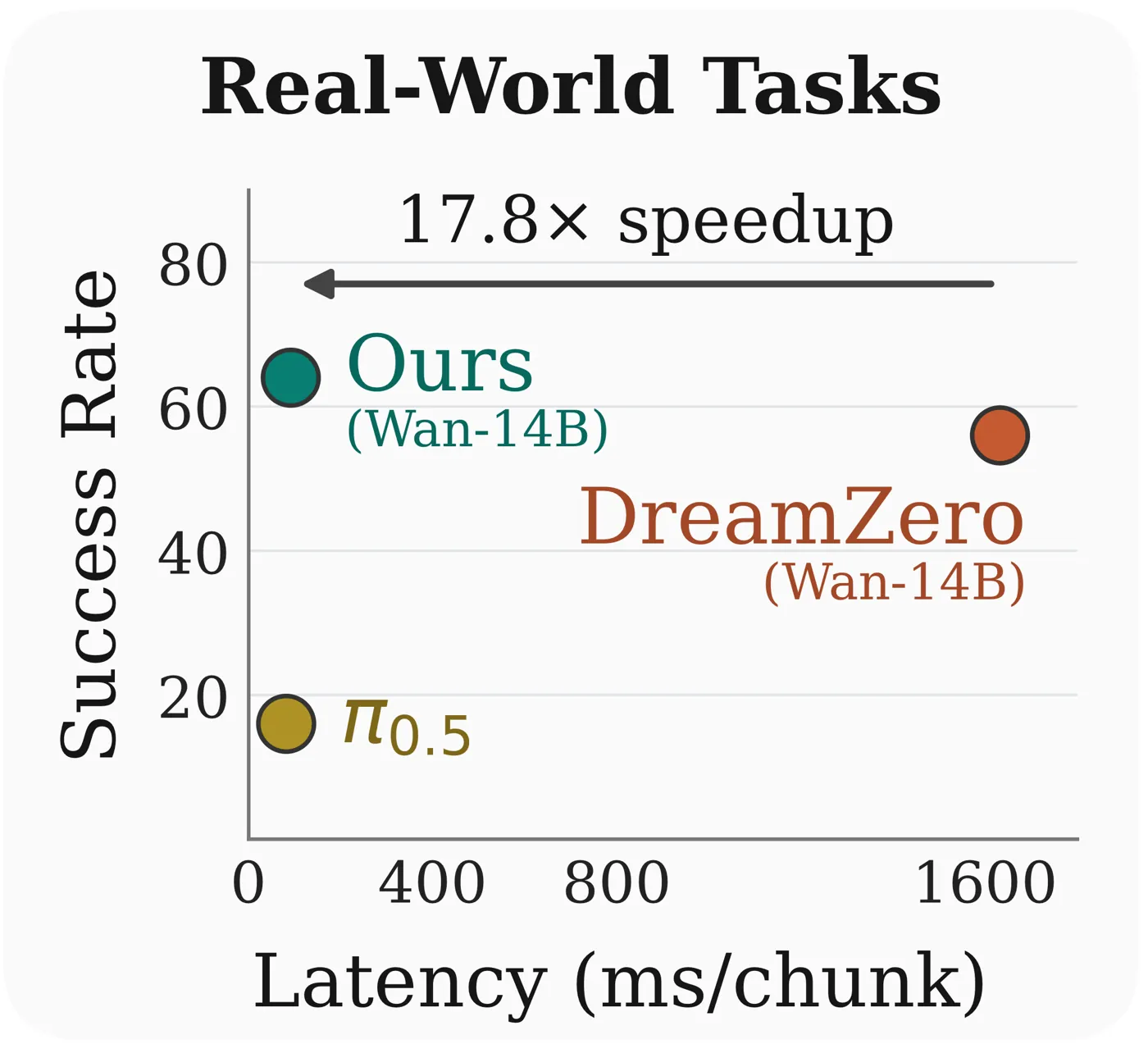
DREAMFree runs closed-loop control at 11 Hz on H200 hardware, a 17.8 times speedup over DreamZero. Relative to π0.5, it delivers about four times the average success rate with 1.1 times the latency. The visual encoder is evaluated once per chunk, while only the small action transformer is iterated for action sampling. The expensive future-video diffusion path is absent.
Longer chunks reduce replanning frequency and can improve throughput, but they also delay correction when the scene changes. DROID executes 24 actions per chunk, whereas LIBERO executes only 10. The paper does not provide a complete sensitivity study of chunk length under external disturbances. Deployers should retune this value for their controller, gripper latency, and safety envelope.
Learning new tasks from video alone
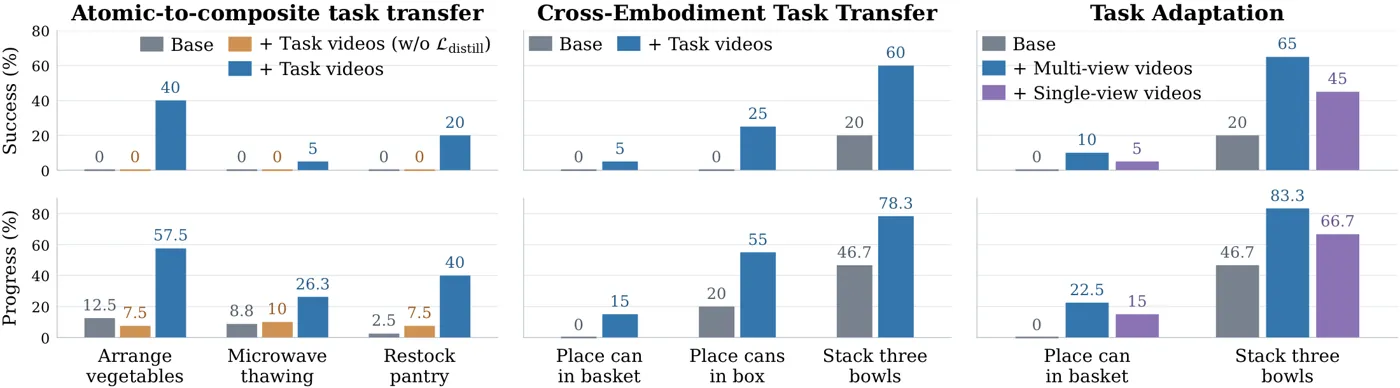
The first transfer setting supplies action labels only for atomic RoboCasa tasks and adds action-free videos of composite tasks. The base model fails all three composites. Generative training plus distillation raises average success from 0% to 21.7%, with at least one success on every task. The variant with generative loss but no distillation remains at 0%.
The second setting transfers composite videos recorded with a different dual-arm embodiment to an ALOHA-AgileX policy. The base succeeds only on bowl stacking and averages 6.7%. Adding cross-embodiment videos improves average success to 30%. The gain shows that the learned representation captures task progress beyond the source robot, but the remaining gap reflects differences in viewpoint, kinematics, and end effectors.
The third setting freezes the action module and fine-tunes only the visual encoder with 10 videos per task. Adaptation takes about 10 minutes per task on one H200. Multi-view videos outperform a single head view. The boundary is clear: if the base policy cannot open a cabinet, video-only fine-tuning cannot make it place an object inside. Video can transfer task knowledge, but it cannot conjure an atomic motor skill that the frozen action pathway never learned.
Limitations
Author-stated limitation one: Additional embodied or video pretraining was tested on RoboCasa but not on DROID because of computational constraints. The real-world evidence therefore does not establish how the method scales with larger action-free datasets, larger backbones, and more embodiments in physical environments.
Author-stated limitation two: The training pipeline has three stages: video-backbone adaptation, predictive visual encoding, and action-module learning. Joint training under the same compute budget was not evaluated. A multi-stage recipe complicates optimization and makes it harder to attribute errors to the teacher, student, or action decoder.
Author-stated limitation three: Video-only adaptation cannot reliably add a new atomic motor skill. The cabinet-insertion failure occurs because the base policy does not open the cabinet, and adapting the frozen action module through visual features alone cannot produce the missing motion.
Additional assessment: DROID evaluates only five rollouts per task, with new objects or arrangements drawn from seen tasks. The evidence therefore supports in-distribution robustness more than open-world generalization. Teacher noise, distillation layer, readout layer, and action horizon all depend on model scale and data. A deployment on another robot should expect to recalibrate these choices. The paper also leaves open the risk that the current-frame encoder exploits environment or camera shortcuts; cross-embodiment gains are encouraging but not sufficient to rule this out.
Conclusion
DreamFree changes the interface between video pretraining and robot control. Instead of generating a future video and asking the policy to interpret it, the method trains the current-frame encoder to match the hidden future-aware state of a frozen video teacher. A query-based readout then turns the representation into action-facing tokens, and a compact action DiT produces a chunk through flow matching. This preserves the video model's predictive knowledge while removing video denoising from deployment.
Three findings are especially useful for robot-learning teams. First, larger video models help control only when their representations are explicitly aligned with the action path. Second, a single current-frame encode can carry enough predictive information for good manipulation without explicit imagination. Third, action-free video transfer is real but bounded by the atomic skills already available to the action module.
The next step is to test whether the scaling trend survives larger embodied corpora, multiple embodiments, long-horizon tasks, and joint rather than staged training. If it does, DreamFree offers a practical architecture for using expensive video foundation models during training while deploying a fast, imagination-free policy for real-time control.
Golden Quote
A robot does not need a playable future video; it needs a current observation that already encodes the future state information required for the next action.