Skip to content
← Tags

#Robot Manipulation (103)

T2-z: Test-Time Optimization of Environment Latents for Robotic World Models

T2-z: Test-Time Optimization of Environment Latents for Robotic World Models

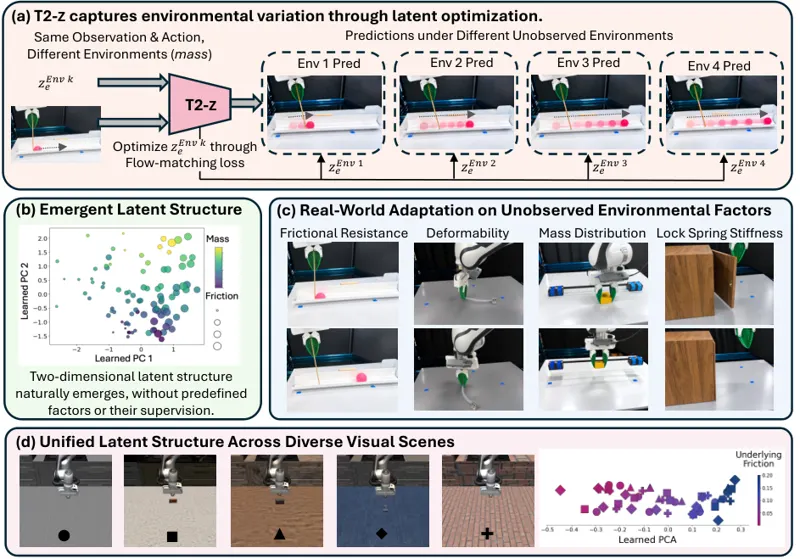
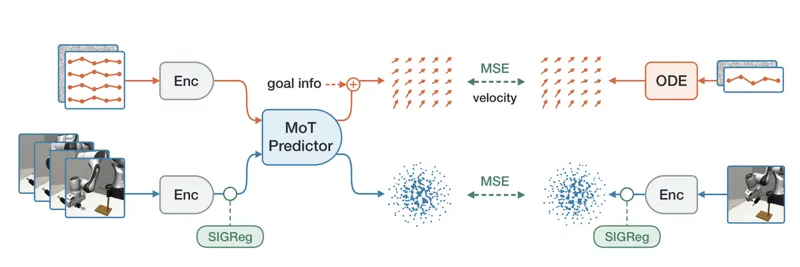
Predicting how the world responds to an action requires more than what can be seen: robots must account for environmental factors that are neither directly observable nor explicitly specified, from physical properties such as friction and mass to human-defined environmental rules. We introduce T2-Z for test-time optimization of environment latents, which augments a robotic world model with a learnable environment latent to condition world predictions. This compact latent captures underlying environmental variation without supervision of what environmental factors exist or what values they take. During training, T2-Z alternates between two stages: a world-model optimization stage that fixes the latents and learns general action-conditioned dynamics across environments; and an environment-latent optimization stage that freezes the world model and optimizes the conditioning latents, allowing latent structure to emerge purely through world prediction. At test time, the world model remains frozen and a newly initialized environment latent is optimized from one or more test-time interactions, adapting the model to previously unseen environmental configurations. Across 7 simulated settings and 4 real-world robotic tasks, T2-Z reduces object prediction error metric from 15.20 to 7.00 and raises action success from 33.73% to 72.96%. Its emergent latents capture structured representations of individual and compounded factors across diverse visual scenes. Ablations further show that T2-Z can efficiently infer environment latents from as little as a single test-time interaction trajectory.

Chenyuan Zhou, Yining Hong, Huang Huang · 61 views · Oct 15, 2026
Robotic World ModelsTest-Time Optimization
Oct 15, 2026
PACE: Temporal-Role Tactile Conditioning for Chunk-Based Insertion Policies

PACE: Temporal-Role Tactile Conditioning for Chunk-Based Insertion Policies

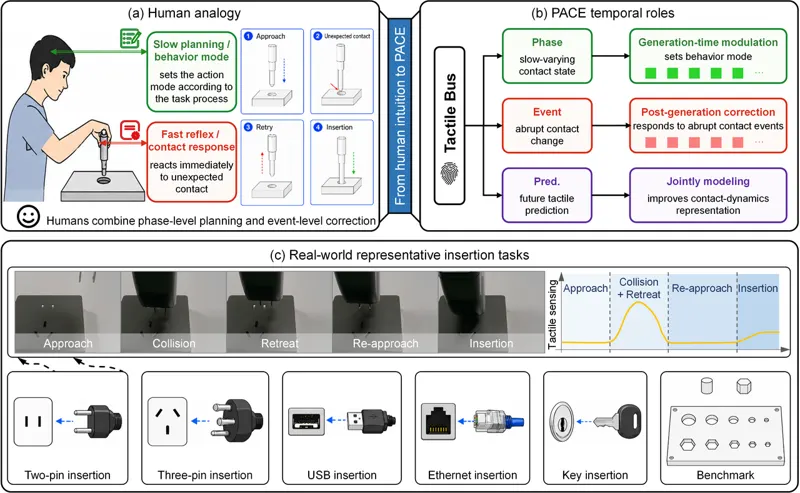
Contact-rich insertion requires a robot to combine visual alignment with tactile adjustment. Existing visuotactile chunk-based policies often collapse tactile feedback into one generation-time pathway, so persistent contact state, abrupt contact events, and the future contact consequences of an action are modeled implicitly in a single representation. PACE assigns one tactile stream three temporal roles. An exponential-smoothed contact state modulates action-chunk generation through layer-wise feature conditioning. A short-window tactile difference forms an event cue and drives a gated residual correction over only the first steps of the chunk. A training-only head predicts future tactile increments from decoder states as an auxiliary representation-learning objective. This preserves chunk-level action continuity while giving slowly varying contact phases and fast collision or jamming events separate pathways. Across five real insertion tasks, PACE reaches 90.7 percent average success, more than 44 percentage points above vision-only and single-path tactile-fusion baselines. It also averages 88.7 percent on six ManipulationNet geometry and clearance settings, including 0.1 mm clearance. Ablations show complementary contributions from Phase, Event, and Pred., while cross-signal and cross-architecture tests extend the principle to force/torque, joint current, and diffusion-policy backbones.

Zhiyuan Chen, Shixiong Xu, Shuai Chen · 242 views · Oct 12, 2026
Tactile SensingRobot Manipulation
Oct 12, 2026
Agentic World Action Models

Agentic World Action Models

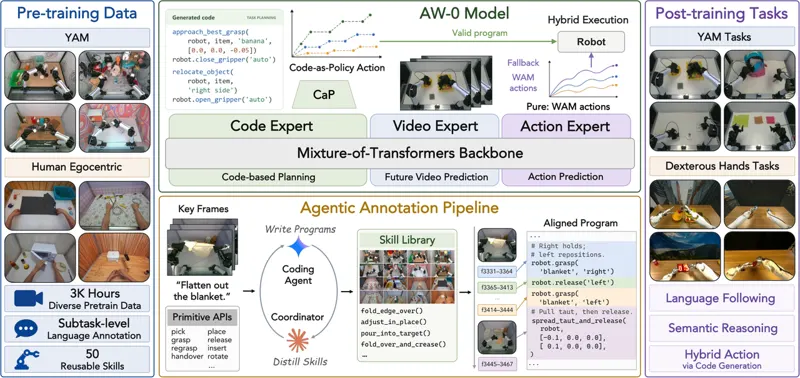
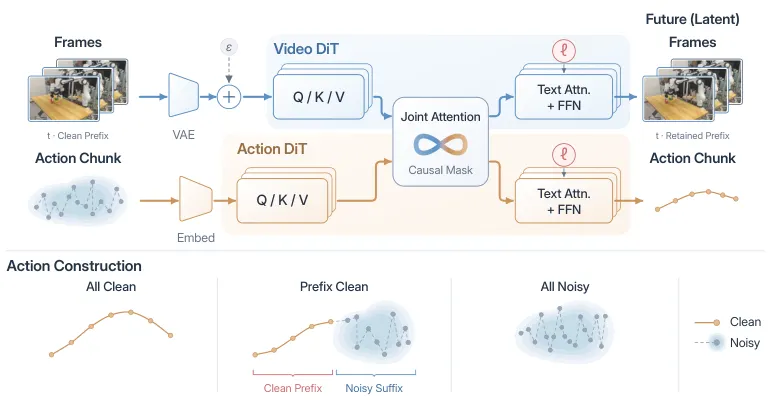
Recent world action models provide visual foresight and future prediction for robot manipulation, but lack explicit mechanisms for compositional skill reuse. Agentic robotics combines code-based planning and reasoning with reusable skills, but often lacks predictive grounding in physical dynamics. We introduce AW-0, an agentic world action model framework that integrates code-based planning with joint video and action prediction. We jointly model code, future video, and robot actions as three coupled generative streams within a unified mixture-of-transformers architecture. Within this architecture a code expert generates parameterized skill routines and control logic while video and action experts generate future visual states and low-level motor commands. Code serves two complementary roles: it structures multi-step prediction and control within the world model and represents skills as reusable programs for subsequent agentic execution. We further introduce an automated curation pipeline that labels robot and human video trajectories with aligned programs and consolidates recurring routines into reusable skill libraries. Evaluations on RoboTwin 2.0 and physical bimanual manipulation tasks show improved task performance over VLA and WAM baselines, alongside gains in language following, semantic reasoning and robustness, demonstrating that agentic code enables connection between planning, prediction and execution within WAMs.

Liu, Zhuoyang, Niu, Dantong, Zhang, Botong · 242 views · Oct 21, 2026
World-action modelsVision-language-action (VLA)
Oct 21, 2026

As an Amazon Associate, we earn from qualifying purchases.