PAPER DEEP DIVE
PACE: Temporal-Role Tactile Conditioning for Chunk-Based Insertion Policies
Contact-rich insertion requires a robot to combine visual alignment with tactile adjustment. Existing visuotactile chunk-based policies often collapse tactile feedback into one generation-time pathway, so persistent contact state, abrupt contact events, and the future contact consequences of an action are modeled implicitly in a single representation. PACE assigns one tactile stream three temporal roles. An exponential-smoothed contact state modulates action-chunk generation through layer-wise feature conditioning. A short-window tactile difference forms an event cue and drives a gated residual correction over only the first steps of the chunk. A training-only head predicts future tactile increments from decoder states as an auxiliary representation-learning objective. This preserves chunk-level action continuity while giving slowly varying contact phases and fast collision or jamming events separate pathways. Across five real insertion tasks, PACE reaches 90.7 percent average success, more than 44 percentage points above vision-only and single-path tactile-fusion baselines. It also averages 88.7 percent on six ManipulationNet geometry and clearance settings, including 0.1 mm clearance. Ablations show complementary contributions from Phase, Event, and Pred., while cross-signal and cross-architecture tests extend the principle to force/torque, joint current, and diffusion-policy backbones.
Paper metadata: Zhiyuan Chen, Shixiong Xu, Shuai Chen, and Yangwei You, Beijing Xiaomi Robot Technology Co., Ltd. arXiv:2610.16308v1. Project page: pace-insertion.github.io.
Code status: No public implementation is available at the time of this analysis. The project page states that code, models, and datasets will be released later. This review therefore does not infer source files, class names, or function-level mappings. All implementation descriptions come from the paper and its figures.
One-Sentence Summary
PACE separates a single tactile stream into three temporal roles, using a slow contact state to condition the action-chunk encoder, a short-window event signal to correct the first actions in a predicted chunk, and a training-only tactile forecast to shape the decoder representation. This decomposition turns a vision-only ACT or Diffusion Policy into a contact-aware controller that can correct high-precision insertion within the lifetime of one action chunk.
Why This Problem Matters
Precision insertion is a deceptively difficult robotic task. A peg, connector, USB plug, or key may look nearly aligned while its tip is still resting on the wrong edge of a hole. The remaining motion must be resolved through contact: the robot has to feel a small lateral force, detect a change in resistance, adjust orientation, and avoid applying enough force to jam or damage the object. Cameras provide useful global context, but occlusion, reflection, calibration error, and tiny clearances make vision unreliable exactly when the tolerance becomes tight.
Action-chunking policies have become a strong foundation for manipulation because they generate several future actions at once. ACT uses a Transformer with a conditional variational autoencoder, while Diffusion Policy denoises a trajectory. Both architectures reduce decision jitter and exploit history. Yet a standard action-chunk policy usually treats additional sensing as another vector in the conditioning input. The network may receive force or tactile values, but it is not told which values describe the current phase, which values signal an abrupt contact event, and which parts of the chunk should be revised immediately.
This distinction matters because tactile information operates at several time scales. Contact depth and load evolve gradually over an insertion. An edge crossing, stick-slip transition, or sudden angular correction may last only a few control ticks. A forecast of the next contact change can also serve as a learning signal even when it is not needed at inference. Compressing all three phenomena into one homogeneous context makes it easy for slow signals to dominate, for brief events to be averaged away, or for an auxiliary prediction task to interfere with action generation.
PACE starts from the observation that these roles should not be mixed at the same representational stage. The phase state has to influence the context used to generate the whole chunk. An event has to interfere with only the near-future actions, because forcing a complete replanning for every tactile spike would sacrifice chunk stability. A forecast should shape the internal state during training without becoming an extra online module. The method is therefore an information-routing design rather than a larger tactile encoder.
The engineering motivation is practical. A robot operating at 20 Hz has 50 ms between control decisions. A long network pass, a large video model, or a full diffusion rollout can consume a meaningful portion of that budget. PACE keeps the base policy intact and adds a small set of adapters that act on the chunk. The reported inference-only addition is 0.575M parameters with less than 0.3 ms of latency. This makes the method relevant to real insertion cells, where reaction time and controller determinism are as important as average benchmark accuracy.
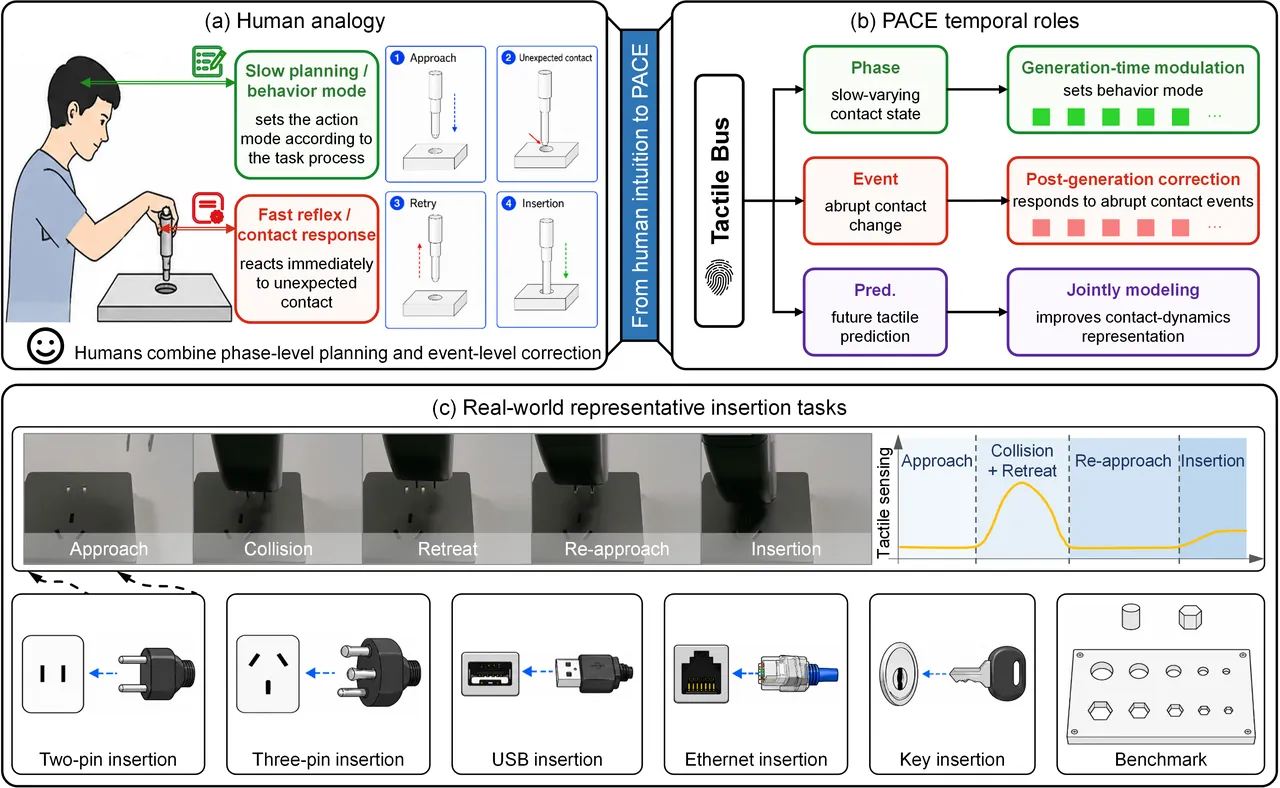
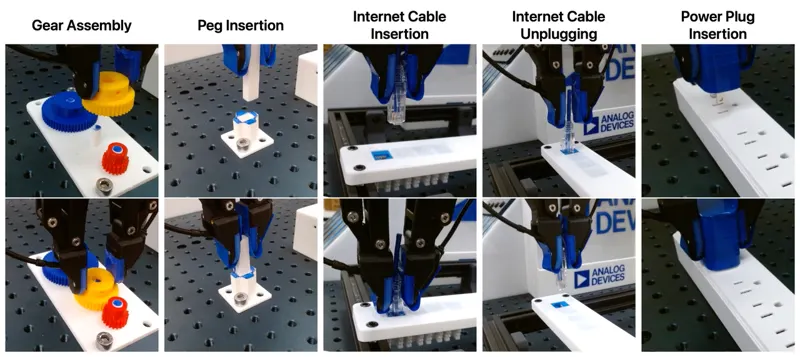
Figure 1: PACE organizes tactile conditioning into phase, event, and prediction roles and evaluates them on real insertion hardware.
Background and Notation
Let the policy observe visual features, robot state, action history, and a tactile vector at each control step. The policy outputs an action chunk of length $H$. For the main ACT experiments, $H=20$, the action dimension is 7, and control runs at 20 Hz, so one generated chunk spans roughly one second. The robot may execute only an initial portion before requesting a new observation, but the chunk remains a useful prior for smooth motion.
The tactile stream is denoted by $\mathbf{w}_t$. The principal experiment uses a six-dimensional tactile signal. The authors also test a six-axis force/torque signal and a seven-dimensional joint-current signal to examine whether PACE depends on a particular sensor. The representation must preserve absolute contact magnitude, rapid changes over a short history, and future changes relative to the current moment. PACE assigns these quantities to the phase, event, and prediction branches, respectively.
ACT supplies the main backbone. Its encoder integrates vision and robot state, while its decoder combines encoded context with a latent variable and produces the action chunk. PACE leaves this backbone structure in place. It modifies encoder features through layer-wise affine conditioning and modifies the decoded chunk through a gated residual. The auxiliary prediction head is attached to decoder hidden states only during training. The method therefore changes how the existing policy uses information rather than replacing its sequence model.
The paper also applies PACE to Diffusion Policy. This second backbone matters because ACT and DP construct action chunks differently. ACT predicts a chunk directly through a Transformer decoder, whereas DP obtains actions by iteratively denoising them. A mechanism that helps both architectures is less likely to be a narrow artifact of one decoder. The cross-architecture result is one of the strongest pieces of evidence that PACE addresses action-chunk conditioning as a general interface.
Method
A policy with three temporal routes
The high-level PACE pipeline receives a history of vision, robot state, previous actions, and tactile readings. The phase route smooths the tactile history and conditions every encoder layer. The event route computes a tactile difference over a short window and creates a gate plus residual for the first part of the generated action chunk. The prediction route uses decoder states to regress future normalized tactile changes during training. At inference, the prediction route is removed.
These routes are not three independent policies voting on an action. They operate at different points in the action-generation process. Phase changes the context that produces the chunk. Event changes selected actions after the chunk has been generated. Prediction changes the weights through an auxiliary objective. This arrangement lets each temporal role affect the representation at the location where it can be most useful, while keeping the online path compact.
flowchart TD
  T[Tactile history] --> S[EMA contact state]
  T --> D[Short-window delta Tw=4]
  S --> F[Layer-wise FiLM on encoder]
  V[Vision and robot state] --> E[ACT encoder]
  F --> E
  E --> B[Action chunk decoder H=20]
  B --> G[Generated action chunk]
  D --> R[Event embedding and gate]
  R --> C[Residual correction on first 5 actions]
  G --> C
  C --> A[Executed corrected chunk]
  B --> P[Training-only tactile delta head]
  P --> L[Auxiliary prediction loss]
  L --> E
The figure highlights the difference between PACE and a conventional tactile fusion layer. A fusion layer might concatenate the latest tactile vector with visual tokens and hope that attention learns every temporal distinction. PACE directly exposes the distinctions through separate pathways and limits where each pathway can act. The phase is global to the chunk, the event is local to its near-term actions, and the forecast is restricted to training.
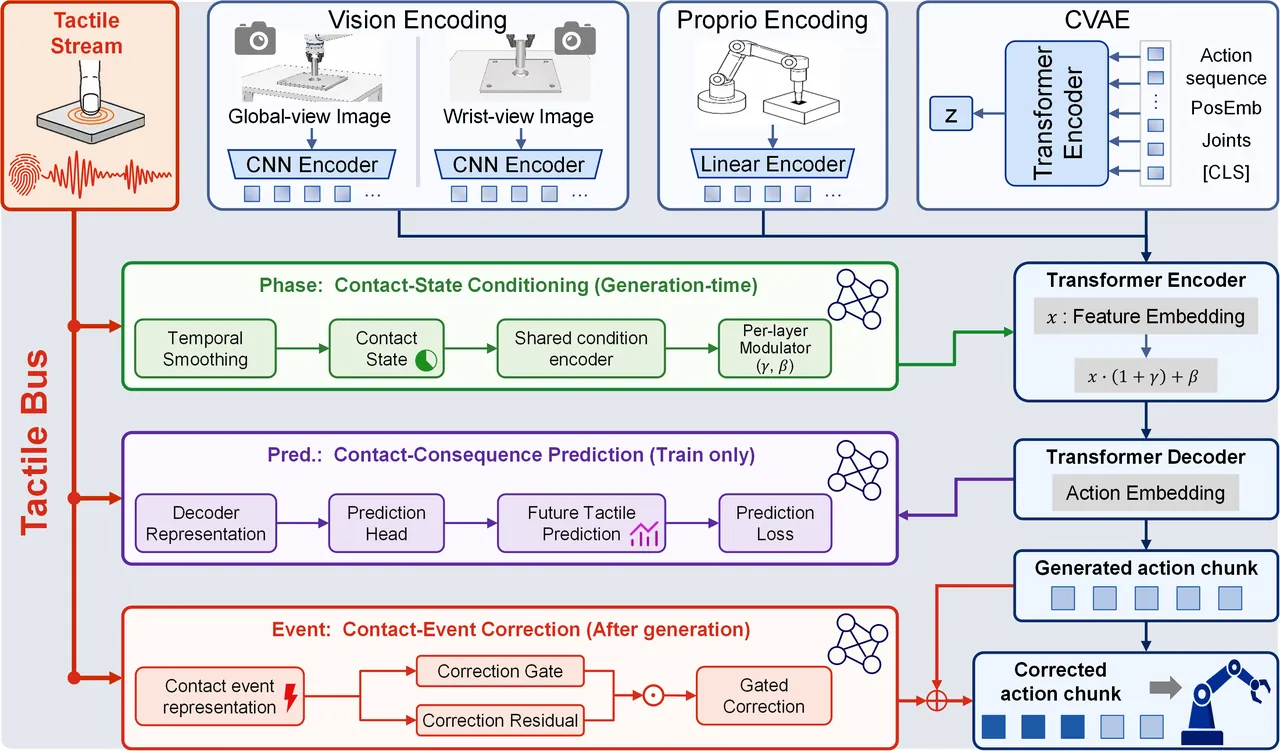
Figure 2: The complete architecture combines phase conditioning, event-based residual correction, and training-time tactile prediction.
Phase: a slow state that conditions the encoder
Phase is meant to answer a coarse but persistent question: where is the robot in the insertion process? Raw tactile readings contain friction noise, vibration, sensor quantization, and transient spikes. If every reading is passed directly to the encoder, the policy may react to contact noise as if it were a new task stage. PACE applies an exponential moving average so the phase state reflects sustained contact rather than a single sample.
$$ \mathbf{w}^{\text{state}}_{t}=(1-\alpha)\mathbf{w}^{\text{state}}_{t-1}+\alpha\mathbf{w}_{t} $$Here, $\mathbf{w}^{\text{state}}_t$ is the filtered contact state, $\mathbf{w}_t$ is the current tactile vector, and $\alpha$ controls the update rate. The default value is $\alpha=0.05$, which gives a strongly smoothed state. The small value is deliberate: rapid change detection belongs to the event route. Giving phase a similarly fast response would make the two routes redundant and could let contact spikes destabilize the entire chunk.
The smoothed state is mapped into scale and shift parameters for each encoder layer. This is a layer-wise FiLM-style modulation. Instead of appending one tactile token to a long visual sequence, phase changes how normalized features are transformed at several depths. The policy can use the same contact stage to emphasize different visual and proprioceptive evidence in low-level texture features, object-level features, and task-relevant context.
$$ (\gamma^{l}_{s},\beta^{l}_{s})=\phi^{l}_{\text{phase}}(\mathbf{w}^{\text{state}}_{s}) $$ $$ \widetilde{\mathbf{h}}_{l}=(1+\gamma^{l}_{s})\odot\mathrm{LN}(\mathbf{h}_{l})+\beta^{l}_{s} $$In these equations, $l$ indexes an encoder layer, $\mathrm{LN}$ is layer normalization, $\gamma$ is the scale, $\beta$ is the shift, and $\odot$ is element-wise multiplication. The subscript $s$ identifies the decision or chunk being conditioned. The use of $1+\gamma$ starts from an identity scale, which makes it easy for the network to preserve the base policy when tactile evidence is not informative.
Phase does not directly rewrite the action chunk. This limitation is important. A smooth contact state can indicate that the peg is near the hole or already partly inserted, but it cannot precisely locate a sudden edge collision within the next 100 ms. If phase were the only tactile pathway, the policy would have to wait for another full chunk generation to respond. The ablation confirms that a phase-only design reaches only 60.0% average success, and shortening the chunk to $H=10$ lowers it further to 49.3%.
Event: a short difference that buys reaction time
The event route detects changes that require immediate action. Examples include a peg tip catching on a rim, a connector rotating after one side enters first, or an object slipping inside a compliant gripper. These changes are brief and can be hidden by the moving average used for phase. PACE computes a normalized tactile difference over a four-step window and appends the norm of that difference as an explicit change-magnitude feature.
At 20 Hz, a four-step window covers about 0.15 seconds. The event route then predicts a residual for the first five actions in the chunk, covering about 0.25 seconds. This scope is a compromise between responsiveness and stability. It gives the controller a chance to alter the actions that will be executed before the next full policy query, while leaving the later part of the chunk under the original policy's long-horizon plan.
$$ \bar{\mathbf{w}}_{s}=\mathcal{N}(\mathbf{w}_{s}) $$ $$ \Delta\mathbf{w}_{s}=\bar{\mathbf{w}}_{s}-\bar{\mathbf{w}}_{s-T_{w}+1} $$ $$ \mathbf{e}_{s}=[\Delta\mathbf{w}_{s},\|\Delta\mathbf{w}_{s}\|_{2}] $$$\mathcal{N}$ denotes normalization using training statistics, $T_w$ is the window length, and $\mathbf{e}_s$ is the event embedding. The norm provides a scalar summary of overall change even if individual sensor channels cancel or rotate. The gate network processes this embedding and outputs a per-dimension sigmoid. The residual network processes the generated action chunk. Their product is added to the first $h_{\text{corr}}$ actions.
$$ \mathbf{g}_{s}=\sigma(\phi_{\text{gate}}(\mathbf{e}_{s})) $$ $$ \mathbf{R}_{s,0:h_{\text{corr}}-1}=\phi_{\text{res}}(\mathbf{W}_{s}) $$ $$ \mathbf{A}^{\text{corr}}_{s,0:h_{\text{corr}}-1}=\mathbf{A}^{\text{gen}}_{s,0:h_{\text{corr}}-1}+\mathbf{g}_{s}\odot\mathbf{R}_{s,0:h_{\text{corr}}-1} $$$\mathbf{A}^{\text{gen}}$ is the uncorrected chunk produced by the base policy, $\mathbf{R}$ is the learned residual, and $\mathbf{g}$ controls how much of each residual dimension is admitted. The gate does not have to be binary. It can suppress corrections when the tactile difference resembles noise and increase them when the event is strong. The residual formulation also means the event branch starts close to an identity operation, preserving the ACT prior unless the new contact evidence justifies a change.
This local correction is best understood as a reflex layer inside the action chunk. Visual context and phase provide the nominal trajectory. The event branch checks whether the last few tactile samples contradict that trajectory and changes only the imminent actions. The policy can therefore react faster than a full replanning cycle without abandoning the chunk-level smoothness that motivated ACT in the first place.
The fixed values $T_w=4$ and $h_{\text{corr}}=5$ are one of the method's main design assumptions. They are effective in the paper's hardware and task set, but they are not derived from a universal physical law. A softer object, faster insertion speed, slower sensor, or different controller frequency may need a different horizon. The authors acknowledge this limitation and propose adaptive temporal scales as future work.
Prediction: shaping the decoder with future contact
The third route treats future tactile change as a representation-learning target. For each training transition, PACE computes the normalized difference between adjacent tactile frames. A prediction head receives decoder hidden states associated with the action chunk and regresses the future sequence of tactile differences. This objective does not change the action label itself, but it penalizes hidden states that describe an action without anticipating the contact consequences of that action.
$$ \Delta\mathbf{w}^{\text{gt}}_{t}=\mathcal{N}(\mathbf{w}_{t})-\mathcal{N}(\mathbf{w}_{t-1}) $$ $$ \mathcal{L}_{\text{pred}}=\left\|\phi_{\text{pred}}(\mathbf{z}_{s:s+H-1})-\Delta\mathbf{W}^{\text{gt}}_{s:s+H-1}\right\|_{2}^{2} $$$\mathbf{z}$ is the decoder hidden state, $\Delta\mathbf{W}^{\text{gt}}$ is the ground-truth future tactile-delta sequence, and $H$ is the chunk length. The loss is computed over the same time region as the generated actions. This alignment encourages the decoder to maintain a state from which the contact evolution can be inferred, rather than waiting until a new observation arrives.
The training objective combines the action loss, the original ACT KL regularization, and the auxiliary prediction loss. The paper reports default weights $\lambda_{\text{kl}}=10$ and $\lambda_{\text{pred}}=0.05$. The relatively small prediction weight keeps it as an auxiliary signal. The gain from removing it is a 5.4 percentage-point drop, from 90.7% to 85.3%, which suggests that the forecast is useful but not the dominant source of success.
$$ \mathcal{L}=\mathcal{L}_{\text{act}}+\lambda_{\text{kl}}\mathcal{L}_{\text{KL}}+\lambda_{\text{pred}}\mathcal{L}_{\text{pred}} $$The prediction head is removed at inference. This decision avoids forcing the controller to choose among hypothetical futures or to run an extra rollout during a tight control cycle. It also means the online system does not directly use forecast uncertainty. The learned representation may be better prepared for contact, but the event residual remains the only mechanism that can modify a chunk after generation.
Small enough to retain a real-time path
The ACT backbone has 83.87M parameters. The full PACE additions contain 0.841M parameters, approximately 1.0% of the base model. After removing the prediction modules at inference, 0.575M parameters remain. The reported extra latency is below 0.3 ms. These numbers are small relative to the sensor, image encoder, and Transformer pass, but the exact latency depends on hardware and implementation.
When PACE is attached to Diffusion Policy, the base model has 310.5M parameters and the PACE addition contains 3.6M, about 1.2% of the total. The paper reports an increase from 18.3% to 88.3% average success, a 70.0 percentage-point gain. The effect is larger than a minor adaptation would suggest, and it shows that the temporal-role interface can coexist with an iterative denoising action head.
How PACE differs from common tactile fusion
A tactile concatenation baseline gives the network access to the same information but leaves temporal routing implicit. The network could learn to smooth one part of the signal and differentiate another, yet nothing in the architecture guarantees that separation. A tactile cross-attention baseline lets action tokens query tactile tokens, which is more flexible, but the slow phase and the rapid event still compete inside one attention pool.
PACE imposes a stronger inductive bias. The phase is forced to affect encoder context, the event is forced to act on the near-term chunk, and future prediction is assigned a separate training objective. The experiments show that this bias is useful: concatenation reaches 46.0% and cross-attention reaches 39.3%, while PACE reaches 90.7%. Every individual task also improves, so the average is not carried by a single unusually easy object.
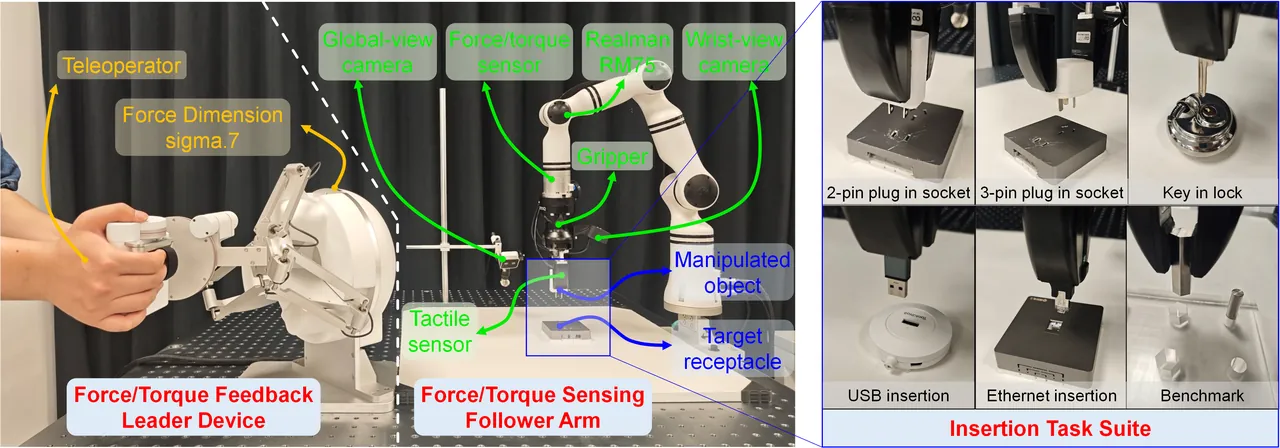
Figure 3: The experimental platform includes force-feedback teleoperation, five physical insertion tasks, and the ManipulationNet evaluation.
Experimental Results
The primary benchmark contains five real insertion tasks: 2-pin, 3-pin, USB, Ethernet, and Key. Each method is evaluated for 30 trials per task. Demonstrations are collected through force-feedback teleoperation, and policies operate at 20 Hz. The comparison includes vision-only ACT, vision-only Diffusion Policy, the π0 policy, ACT with tactile cross-attention, ACT with tactile concatenation, and full PACE.
| Method | 2-pin | 3-pin | USB | Ethernet | Key | Average |
|---|---|---|---|---|---|---|
| Vision-only ACT | 4/30 | 4/30 | 2/30 | 1/30 | 4/30 | 10.0% |
| Vision-only DP | 5/30 | 6/30 | 4/30 | 3/30 | 5/30 | 15.3% |
| π0 | 6/30 | 8/30 | 4/30 | 4/30 | 6/30 | 18.7% |
| ACT + tactile cross-attention | 10/30 | 15/30 | 11/30 | 9/30 | 14/30 | 39.3% |
| ACT + tactile concatenation | 13/30 | 17/30 | 12/30 | 13/30 | 14/30 | 46.0% |
| PACE | 27/30 | 29/30 | 28/30 | 27/30 | 25/30 | 90.7% |
The gap between vision-only policies and all tactile policies confirms that final insertion phases require contact information. ACT and DP see the same objects and receive the same task-level context, yet average 10.0% and 15.3%. The π0 model reaches 18.7%, showing that stronger general visual priors do not solve a problem whose decisive signal is hidden from the camera. Simply adding tactile data helps substantially: cross-attention reaches 39.3% and concatenation reaches 46.0%.
The larger gap between those fusion baselines and PACE is the paper's main empirical claim. It is not caused by using a much larger tactile encoder; the online addition is 0.575M parameters. It is also not limited to one easy task. PACE exceeds 25 successes out of 30 on every physical task. The hardest result is Key at 25/30, where compliant grasping and narrow geometry introduce slip and rotation. The best result is 3-pin at 29/30, suggesting that the event correction is particularly effective when contact points arrive in a predictable sequence.
The Ethernet task is informative because a cable needs both a connector pose and a flexible body to be managed. Vision-only ACT succeeds once in 30 trials, whereas PACE succeeds 27 times. Tactile concatenation reaches 13/30, still far below PACE. A reasonable interpretation is that phase conditioning provides a stable estimate of insertion progress while event correction catches the connector catching on the port edge. The result combines gross alignment with local contact recovery.
The paper extends evaluation to ManipulationNet with cylindrical and hexagonal pegs and clearances of 3 mm, 1 mm, and 0.1 mm. This experiment is closer to an industrial assembly spectrum. At 0.1 mm, visual calibration and open-loop positioning have very little tolerance, so the policy must use contact to estimate how the peg is seated.
| Peg geometry | 3 mm clearance | 1 mm clearance | 0.1 mm clearance |
|---|---|---|---|
| Cylindrical | 25/25 | 22/25 | 21/25 |
| Hexagonal | 24/25 | 22/25 | 19/25 |
The average across the six geometry-clearance conditions is 88.7%. Cylindrical and hexagonal pegs perform similarly at 1 mm, but the hexagonal peg loses two additional successes at 0.1 mm. This is consistent with the added angular constraints of a hexagonal fit. A cylindrical peg can rotate about its insertion axis without changing the cross-section, whereas a hex peg must align both position and orientation. A tactile event can reveal contact but may not fully identify the required rotation from a single brief history.
One limitation of the evaluation is that all tasks remain insertion-centric and use a common hardware family. The authors are explicit that wiping, pushing, pulling, deformable-object manipulation, and bimanual assembly have not been tested. The ManipulationNet cases improve geometric coverage, but they do not establish that the same temporal roles will cover contact tasks where friction is dominant, the object changes shape, or both arms must coordinate. The paper's claim should be read as strong evidence for precision insertion rather than universal contact manipulation.
Ablations and Alternative Signals
The ablation study removes each temporal role from the full system. Removing the prediction head lowers average success from 90.7% to 85.3%. Removing phase conditioning lowers it to 78.7%. Removing the event residual causes the largest drop, to 66.7%. These numbers do not imply that event is the only useful component. They show that if the network must choose one fast correction path, event correction has the highest marginal value in this insertion benchmark.
| Configuration | Average success | Change from full PACE |
|---|---|---|
| Full PACE | 90.7% | Reference |
| Without Pred. | 85.3% | -5.4 points |
| Without Phase | 78.7% | -12.0 points |
| Without Event | 66.7% | -24.0 points |
| Phase only | 60.0% | -30.7 points |
| Phase only, H=10 | 49.3% | -41.4 points |
The phase-only H=10 result is especially useful for interpreting action-chunk length. A shorter chunk creates more opportunities to replan, which sounds beneficial for feedback control. Yet without an explicit event route, phase-only performance falls from 60.0% to 49.3%. Frequent replanning does not help if the conditioning signal has been smoothed and the local action interface does not provide a strong path for the latest contact change. PACE is not merely a way to shorten the effective horizon.
The method also transfers across tactile representations. The default six-dimensional tactile input reaches 93.3%, a six-axis force/torque signal reaches 90.0%, and a seven-dimensional joint-current signal reaches 88.3%. The ordering is plausible: dedicated tactile sensors provide the cleanest local contact evidence, wrist force/torque provides a broader force summary, and joint current is coupled to gravity, friction, transmission, and payload. Even the weakest signal remains competitive, which suggests that PACE's separation of time scales is more important than a specific sensor layout.
Cross-architecture evidence is similarly strong. Vision-only Diffusion Policy succeeds 18.3% of the time on the evaluated aggregate, while DP with PACE reaches 88.3%. The action-generation mechanisms and parameter counts differ substantially from ACT, so the gain cannot be explained solely by ACT's CVAE latent or Transformer decoder. The temporal roles appear to be a reusable conditioning interface for chunk-based policies.
PACE is also compared with RDP. It reports 29/30 on 2-pin and 27/30 on Key, while RDP reports 19/30 and 12/30 on the same tasks. RDP is intended to incorporate additional feedback, so this comparison is more relevant than a purely visual baseline. The difference indicates that not all reactive information is equally useful. Restricting corrections to the chunk head and using a separate smooth state for context appears to produce a better balance than a less structured reactive path.
Does the Network Use the Intended Roles?
The paper goes beyond success rates and analyzes the learned representations. Phase embeddings differ significantly across bins of contact intensity, with $F=8.36$, $p<10^{-4}$, and $\eta^2=0.236$. The effect size is not overwhelming, but it shows that the phase representation is sensitive to contact magnitude. A constant or task-label-only embedding would not produce this pattern.
The event gate also correlates with the rate of contact change. The correlation between correction strength and contact-change rate is $r=0.356$ with $p<0.001$. This is a moderate association rather than proof of a causal mechanism, but it is consistent with the intended behavior: stronger changes tend to produce more correction. Combined with the large drop when event is removed, the analysis supports the claim that the gate is doing task-relevant work.
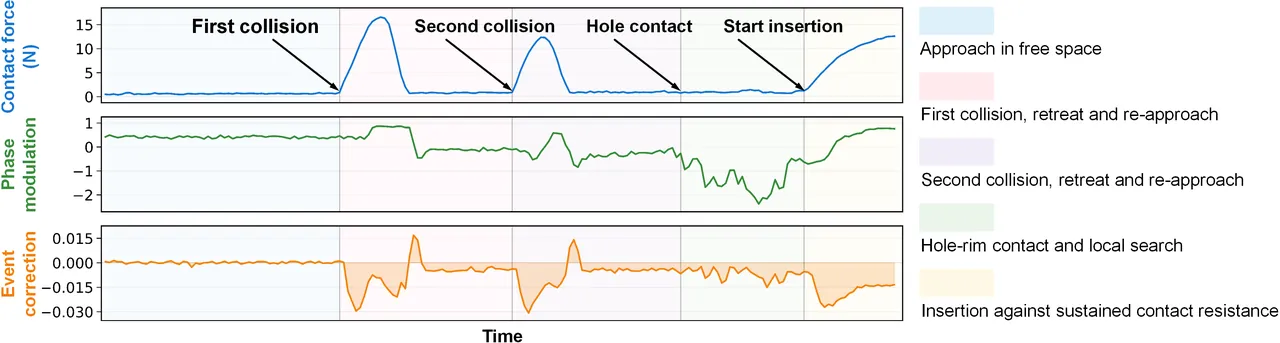
Figure 4: Force, phase, and event traces over an insertion, showing the different time scales used by the two online routes.
The time-series figure clarifies why a single tactile representation is awkward. Contact force is not monotonic. It rises at initial contact, changes as the peg searches for the hole, may dip during alignment, and can spike when a corner catches. The phase trace follows the broad progression, while the event signal reacts more sharply around local transitions. The architecture mirrors this visual pattern: phase provides context for the chunk, and event provides a short correction window.
There are still unanswered questions. The paper does not report whether the learned phase embedding corresponds to human-interpretable states such as approach, edge contact, alignment, and seating. Nor does it test whether the event gate can distinguish an intentional contact spike from an accidental collision. These questions matter for safety. A high success rate on trained tasks does not guarantee that the gate behaves correctly under an unexpected object or adversarial force pattern.
Teaching Quality Is Part of the System
PACE also studies how force feedback during teleoperation affects the collected demonstrations. On 2-pin, PACE trained with feedback-enabled demonstrations reaches 29/30, compared with 21/30 when feedback is disabled. ACT plus tactile concatenation reaches 17/30 with feedback and 7/30 without it. The stronger policy benefits less in absolute policy structure but still depends heavily on demonstration quality.
The differences extend beyond success. Turning off force feedback increases force variance from 4.8 to 12.7 N², raises inter-trajectory deviation from 1.07 to 1.92 N, and increases peak force from $10.0\pm2.2$ N to $16.7\pm7.1$ N. These are not cosmetic effects. High variance and large peak forces make demonstrations harder to imitate and increase the chance of hardware wear or object damage. Force feedback helps the operator feel the hole edge before visual alignment is precise.
This result complicates the common assumption that a tactile policy can compensate for poor teaching data. If demonstrations are collected by blind visual trial and error, the tactile stream may contain many corrective collisions, force spikes, and inconsistent recovery patterns. The event branch can learn those patterns, but it has no external signal that says which contact is desirable and which is a failure. Data collection, interface design, and policy architecture are therefore coupled.
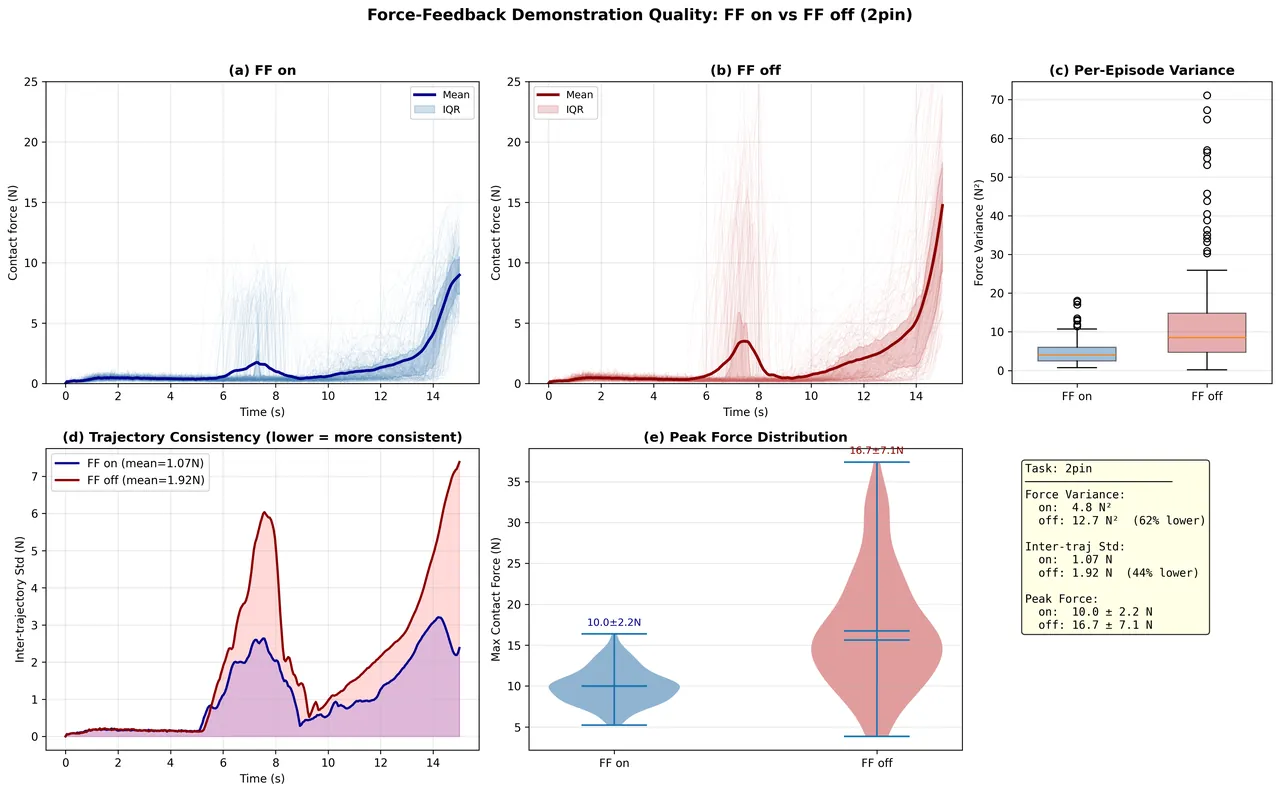
Figure 5: Demonstration quality with and without force feedback, including success, force variance, and peak force.
The force-variance distribution reinforces the same point. With feedback, single-episode variance is concentrated in a lower range. Without feedback, the distribution develops a longer high-variance tail. The policy may still complete many trials, but the underlying contact behavior is less repeatable. For a production insertion process, repeatability and controlled force matter even when a task is ultimately marked successful.
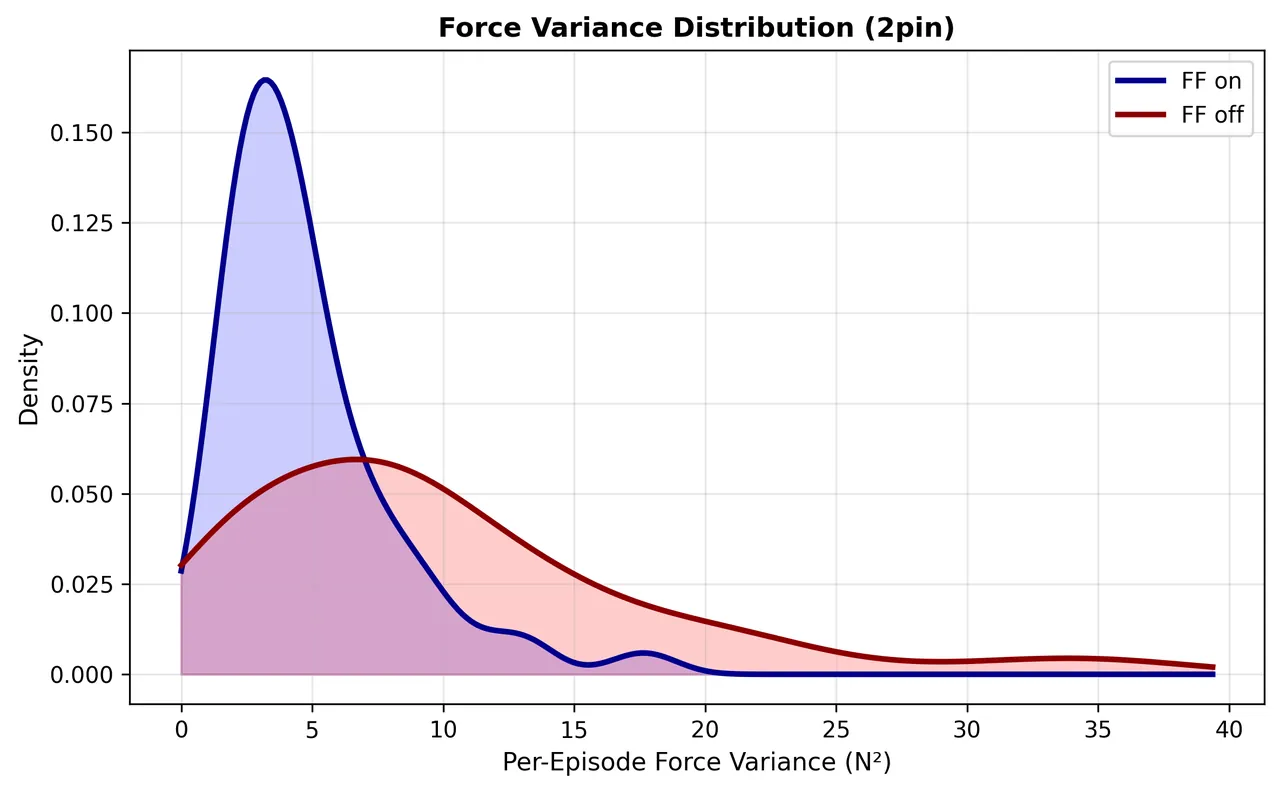
Figure 6: Kernel density estimate of per-episode force variance. Force-feedback teaching produces a tighter distribution.
Observed Failure Modes
The first failure mode occurs when the robot does not retract high enough before translating laterally. The peg tip can remain trapped against the hole rim, turning the rim into a pivot. The robot follows a diagonal motion that combines lifting and sideways movement, but the geometric constraint prevents the peg from clearing the edge. Tactile feedback reveals force, yet the action plan has already removed the clearance needed to recover. A short residual may not be enough if the correct recovery requires a larger retreat followed by a new approach.
The second failure mode is accumulated correction. PACE can revise the first five actions whenever a contact event is detected. If successive corrections keep moving the peg without re-establishing a stable contact pose, the contact point can migrate around the rim while the tilt angle grows. Eventually the peg jams. This suggests that an event gate should eventually request a reset behavior, not only a local velocity correction. Possible safeguards include limiting repeated same-direction corrections, detecting contact-point persistence, or triggering a controlled retract after a sequence of low-progress events.
The third failure mode is slip between the object and a compliant gripper. The silicone gripper can resist compression while offering relatively little lateral shear resistance to narrow flat objects. A side contact may rotate or slide the object inside the fingers. The external tactile signal detects that contact has changed, but a single wrist-level stream may not distinguish object motion relative to the gripper from object motion relative to the hole. More complete finger tactile sensing or a wrist force/torque signal could help disambiguate the two.
These failures show where local reaction reaches its limit. Event correction is designed to recover small trajectory errors, not to solve gross geometric mistakes or hidden state changes. A production system would need progress monitoring. If force changes but insertion depth does not increase, the controller should stop repeating the same local policy and enter an explicit recovery mode.
Limitations
First, the authors explicitly limit the empirical scope to precision insertion. Tasks such as wiping, pushing, pulling, deformable-object manipulation, and bimanual assembly are not tested. These tasks have different contact topology and may require sensing modes that PACE does not model, such as distributed contact across a large surface, friction-state estimation, or coordination between two end effectors.
Second, the event dynamics are fixed. The smoothing coefficient, four-step difference window, and five-action correction horizon are manually chosen. The authors identify adaptive temporal scales as future work. Until those parameters can be inferred from contact state, new hardware or higher-speed manipulators may require careful retuning. A policy that works at 20 Hz and moderate stiffness cannot be assumed to work unchanged at a much higher control rate or on a softer interface.
Third, the prediction head is not used online. It improves representation learning but does not enumerate candidate actions, estimate risk, or reject a chunk whose predicted contact force is unsafe. Integrating the forecast into planning could reduce impacts, but it would also raise latency and introduce the problem of calibrating predicted forces. The paper does not establish that its auxiliary forecast is accurate enough to serve as a runtime safety signal.
Fourth, PACE assumes that the physical feedback is informative and reasonably calibrated. Weak contact may be buried in noise, and a drifting sensor may shift the phase embedding or produce spurious events. The method has no dedicated sensor-health estimator, uncertainty threshold, or online calibration loop. This is particularly relevant at 0.1 mm clearance, where small forces carry the decisive information.
Finally, the evaluation does not prove broad robustness to object appearance, socket geometry, material compliance, or workspace changes. The paper includes several tasks and two insertion geometries, but a deployment-oriented claim would require distribution-shift tests, long-duration drift tests, and an explicit measure of recovery from unfamiliar contact events. Those are natural extensions, not flaws in the reported narrow benchmark, but they remain necessary before treating PACE as a general assembly policy.
Conclusion and Outlook
PACE reframes tactile conditioning as a temporal allocation problem. Contact state, contact event, and future contact change are not interchangeable features. The method gives each one a distinct route: FiLM modulation of encoder layers, gated residuals on the first actions of a chunk, and a training-only prediction loss. The routes are small, but they change the causal path by which tactile evidence reaches the controller.
The empirical case is strong for the stated domain. Across five physical tasks, PACE reaches 90.7% average success, compared with 46.0% for tactile concatenation and 39.3% for tactile cross-attention. It achieves 88.7% across the tested ManipulationNet geometry-clearance combinations. Removing the event path causes the largest ablation drop, phase and prediction provide further gains, and PACE transfers from ACT to Diffusion Policy as well as from tactile arrays to force/torque and joint-current signals.
The most useful next step is adaptive timing. A controller could estimate whether it is approaching, searching along a rim, correcting orientation, or seating the object, and use that estimate to choose the event window and correction horizon. A second step is to turn future contact prediction into a runtime safety mechanism that can slow, retract, or request another observation before committing to a high-force chunk. A third is to treat teleoperation quality and sensor calibration as first-class parts of the learning system.
For roboticists, the central lesson is architectural. Adding tactile input is not enough if the policy has only one temporal pathway. A slow state should influence the context of a whole action chunk; a fast event should own a short, bounded correction path; and prediction should shape the representation before deployment. PACE demonstrates that assigning these roles explicitly can produce a large behavioral improvement without requiring a proportionally large model.
Golden Line
Tactile sensing is not one more input beside an action chunk; it is a set of control roles unfolding in time, where a slow state decides what the chunk should mean and a fast event decides whether its first steps must change.