Skip to content
Tags

#Tactile Perception (20)

N₀-Foundation: Towards the Age of Tactile Intelligence

N₀-Foundation: Towards the Age of Tactile Intelligence

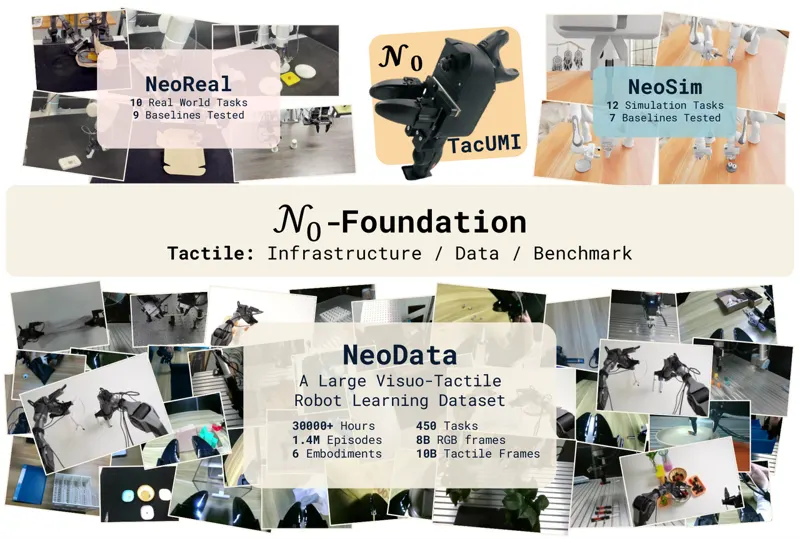
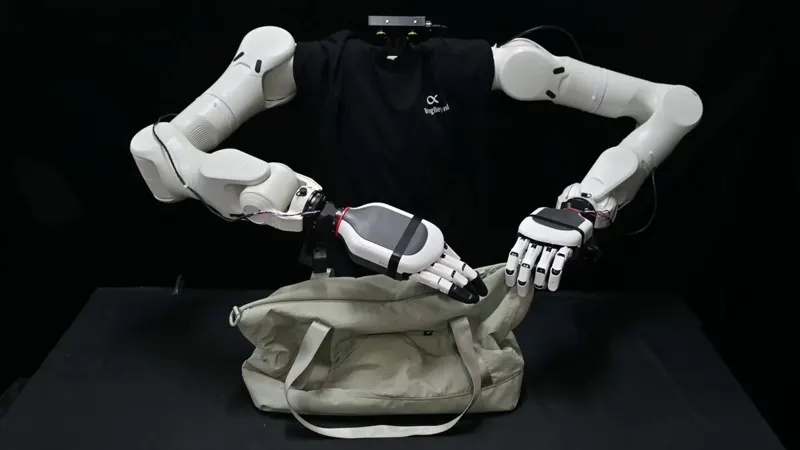
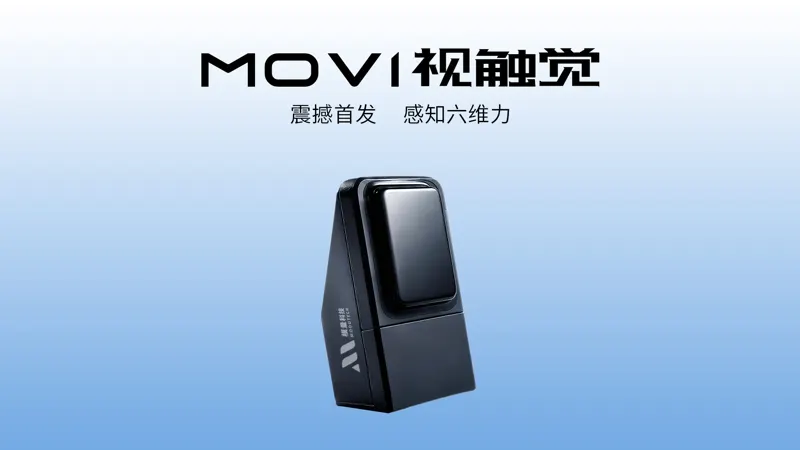
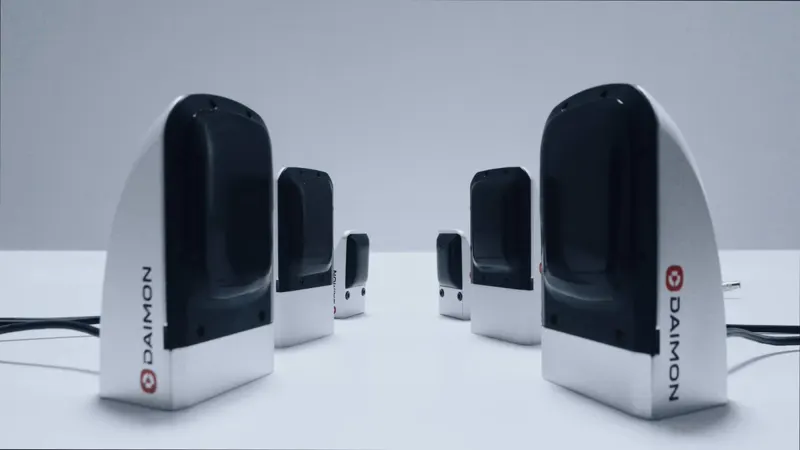
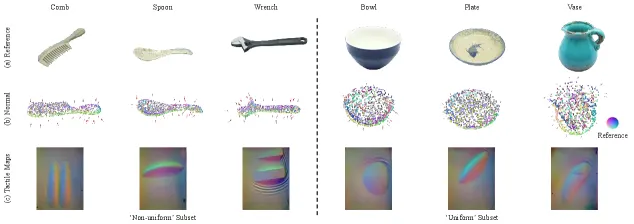
We present N₀-Foundation, a paradigm for tactile-enabled embodied manipulation, which integrates tactile sensing hardware, large-scale multimodal data, tactile representation learning, and standardized evaluation. First, we engineer the infrastructure for scalable data collection, including a vision-based tactile sensor, a tactile Universal Manipulation Interface (UMI), and a synchronized visuo-tactile data collection system supporting both robot embodiments and UMI-based demonstrations. Leveraging this infrastructure, we construct NeoData, which contains more than 30000 hours of synchronized visual and tactile demonstrations, spanning six embodiments, 450 tasks, and billions of paired RGB and tactile frames collected through a mixture of real-robot teleoperation and UMI-based demonstrations. To facilitate open research, we further release OpenNeoData, a 5000-hour open-source subset of NeoData. The dataset addresses a central limitation of existing manipulation corpora, critical for deformable-object manipulation, precise assembly, delicate force control, and sustained surface interaction. Capitalizing on the large-scale, heterogeneous tactile measurements, we propose NeoForce, a visuo-tactile representation model that learn transferable tactile representations across different sensor designs. To enable systematic evaluation of tactile embodied models built upon our infrastructure, datasets and tactile representations, we further propose a comprehensive benchmark, which combines the real-world NeoReal suite and the simulated NeoSim suite for standardized evaluation. Experiments across both suites show that policies benefit from the physical contact state rather than from the device-specific appearance of the tactile signal. We release the dataset, the representation, and the benchmark, aiming at supporting future work on tactile-enabled embodied manipulation.

NeoteAI Team, Fudan TEAI TeamAug 30, 2026
UMIVLATactile PerceptionAug 30, 2026
Tac4Loco: Learning Spatiotemporal Plantar Pressure Representations for Humanoid Locomotion

Tac4Loco: Learning Spatiotemporal Plantar Pressure Representations for Humanoid Locomotion

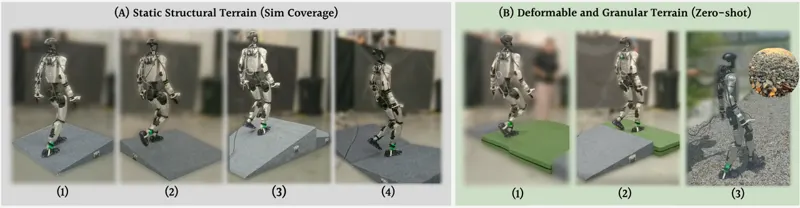
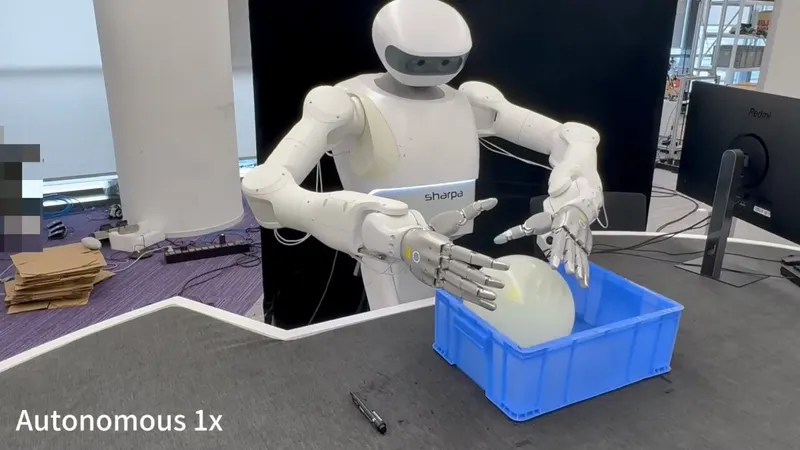
Humanoid robots are expected to traverse complex terrains, where the plantar support may vary dramatically due to foot placement errors, ground properties, and transient dynamics. To achieve robust locomotion, the robots are required to adapt to uneven terrain and uncertain foot–ground interactions. Existing locomotion policies rely primarily on proprioception or exteroceptive terrain perception, where the former provides only indirect evidence of plantar support, while the latter predicts contact conditions before touchdown but cannot observe the actual support in real-time. Although some studies incorporate plantar contacts as an auxiliary perception, they rely mainly on summary statistics, overlooking the spatial topology of plantar pressure, which provides a more direct characterization of the realized contact state. To bridge this gap, we present Tac4Loco, a tactile-perceptive framework that incorporates multi-array plantar pressure as direct feedback for humanoid locomotion. We formulate a topology-preserving ordinal representation to map simulated and physical sensor signals into a shared observation space, with a dual-branch encoder for extracting their spatial and temporal representations. Subsequently, the learned spatiotemporal features are integrated with augmented proprioception including terrain estimation cues, and provided to an asymmetric actor-critic architecture for policy learning. Extensive simulation and real-world experiments demonstrate improved tracking performance and support adaptation on terrains with inclined, partial, asymmetric, and changing support. We further demonstrate its zero-shot deployment on unseen compliant and unstructured terrains, including a foam platform and a gravel road. All code and experimental configurations will be released as open-source to facilitate reproducibility.

Ziyun Liu, Sikai Guo, Zheng LiAug 16, 2026
Tac4LocoLocomotionTactileAug 16, 2026
AC-VLA: Robust Out-of-Distribution Action Execution via Compositional Learning

AC-VLA: Robust Out-of-Distribution Action Execution via Compositional Learning

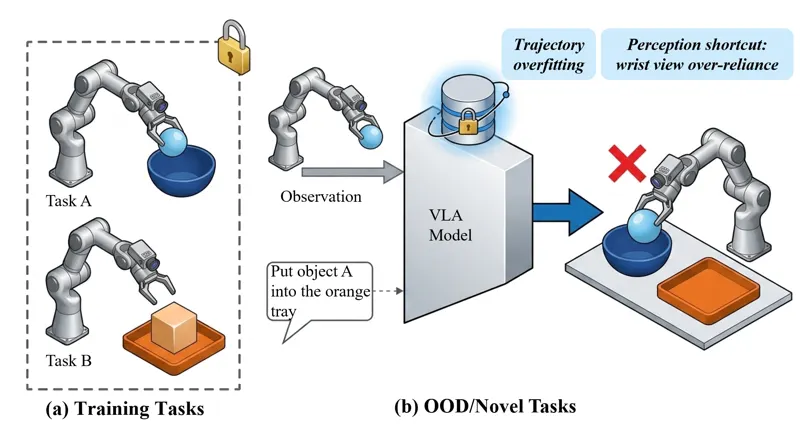
Vision-Language-Action (VLA) models excel at end-to-end robotic manipulation but struggle with out-of-distribution (OOD) generalization when familiar sub-tasks are recombined in unseen configurations. We identify two mutually reinforcing failure modes: trajectory overfitting, where models overfit to holistic trajectory patterns rather than compositional sub-skill semantics; and perceptual shortcut, where action tokens over-rely on wrist-view textures at the expense of global spatial grounding. To address both, we introduce AC-VLA, a plug-and-play Action Compositional learning framework comprising two architecture-agnostic components: (i) a compositional learning module that uses an LLM-driven instruction decomposer and a proprioceptive trajectory aligner to generate dense sub-task supervision, followed by mixed training on complete demonstrations and decomposed data to endow the model with compositional generalization; and (ii) a state-conditioned asymmetric masking strategy that suppresses wrist-view inputs during closed-gripper phases, enforcing global semantic grounding. All components are architectural modification-free and directly integrable into any VLA backbone. Instantiated on π_0.5 and evaluated on LIBERO and LIBERO-OOD benchmarks, AC-VLA achieves a ~28% absolute improvement on compositional OOD tasks while maintaining near-perfect in-distribution performance.

Xiaojiang Peng, Kai Peng, Jie LuJul 17, 2026
TactileSimulationManipulationJul 17, 2026