PAPER DEEP DIVE
Agile-WAM: An Agile Tactile World Action Model for Contact-Rich Robot Control
World Action Models (WAMs) advance beyond conventional visuomotor policies by jointly predicting future world states and robot actions, enabling the policy to learn phys- ical dynamics that support effective control. However, recent tactile WAMs often rely on large-scale pretrained generative backbones to capture contact-rich physical dynamics, which limit their inference efficiency and flexible deployment. In this paper, we present Agile-WAM, an agile tactile World Action Model for contact-rich robot control. Agile-WAM encodes visual and tactile observations into a shared latent that serves as the source of a direct vision-tactile-to-action flow-matching process, which can jointly generate latent representations of action chunks and future visual/tactile latents. A key observation is that vision and tactile signals evolve at inherently different timescales: adjacent visual frames are often highly similar, whereas tactile signals can change abruptly upon contact. We therefore introduce multi-horizon multimodal prediction in Agile-WAM, which provides supervision for visual latent at a larger temporal offset while predicting the tactile latent in the next frame to capture fine-grained contact dynamics. Across nine simulated and five real-world contact-rich ma- nipulation tasks, Agile-WAM demonstrates strong and robust performance, outperforming the strongest baseline in success rate while maintaining low inference latency. In particular, in five real-world experiments, Agile-WAM yields a relative gain of 29.4% in overall success rates while achieving inference latency of 11.9 ms. These results demonstrate that multimodal WAM can be achieved with an agile architecture suitable for precise and high-frequency robot control. More details are available on our project page.
Paper Metadata
Title: Agile-WAM: An Agile Tactile World Action Model for Contact-Rich Robot Control
Authors: Hanchu Zhou, Brendan Lynch, Raman Goyal, Dechen Gao, Begum Kasap, Boqi Zhao, Junshan Zhang (UC Davis and Analog Devices; work completed during an internship at Analog Devices)
Links: arXiv:2609.20761 · project page
Code status: at the time of ingestion the authors had not released the code; the project page lists it as "Code (coming soon)". Its direct backbone VITA is open source (ucd-dare/VITA), and the simulation benchmark ManiFeel is open source as well (purdue-mars/manifeel), so both serve as reference implementations for reproducing the method.
One-sentence summary: Agile-WAM trains a compact flow-matching backbone from scratch, with no cross-attention, that uses the fused observation latent as the source distribution of the flow and generates an action chunk together with future visual and tactile latents in one pass, supervising vision at a long horizon and touch at the next frame, and reaches the best success rates on nine simulated and five real contact-rich tasks at roughly ten milliseconds of inference latency.
Background and Motivation
World action models (WAMs) are a distinct thread that emerged in robot learning over the last two years. Instead of learning an observation-to-action mapping alone, the policy also predicts what the world will look like next and what it should do about it. Predicting future observations forces the representation to encode dense motion and interaction information in the scene, and modelling future state jointly with action teaches the representation to connect the evolution of physical dynamics with control. The policy therefore acquires a structured form of foresight: the actions it emits agree with where it expects the world to go, rather than being an immediate reflex to the current frame.
Vision alone, however, cannot see a physical interaction all the way through. This gap is sharpest in contact-rich manipulation. Two frames that look nearly identical can correspond to entirely different physical states: an end effector pressing on the same rigid object with different forces produces almost no visual difference, yet the corrective action required is fine-grained and decisive. Tactile sensing supplies exactly that channel, since it measures local contact, force and slip directly. Tactile feedback has consequently become an increasingly important input for learning dexterous manipulation policies.
A recent line of work connects touch to world action models, typically by extending a large pretrained video-generation backbone with tactile and action branches. That route demonstrates that explicitly modelling tactile dynamics does help contact-rich manipulation, but the cost is direct too: a big backbone brings substantial compute and memory overhead at inference time, which makes it hard to deploy on robot platforms that are resource-constrained on-board and still demand a high control frequency. The question then becomes fundamental rather than incremental: can one build a tactile-centric world action model that is agile enough to be deployed flexibly across platforms while keeping the predictive benefits of a world model?
The authors answer starting from a physical fact that is routinely ignored: vision and touch already live on different time scales. Consecutive visual frames are highly redundant and appearance changes smoothly and slowly, whereas a tactile force field (TacFF) can jump the instant contact is made or blocked. Imposing a single prediction horizon on both is both lazy and mismatched. If vision is supervised too close, neighbouring frames barely differ, the target is nearly trivial and no meaningful dynamics are learned; if touch is supervised too far ahead, the high-frequency contact details that decide success are smeared away. This horizon mismatch is precisely what the paper sets out to fix.
Two design threads follow. First, instead of fine-tuning a large video model, train a compact flow-matching backbone from scratch and let the fused observation latent be the sole source distribution of the flow. Conditioning modules such as cross-attention, which would otherwise re-inject observations repeatedly during generation, disappear entirely, and complexity drops with them. Second, introduce multi-horizon multimodal prediction: visual latents are supervised at a larger offset, tactile latents at the next frame, so each modality's supervision lands on the time scale where that modality is actually informative. Together these give a world action model that predicts the future and still runs at control frequency.
Preliminaries
World action models and tactile world action models. The core of a WAM is joint modelling of future observations and actions. Existing tactile extensions (Tactile-WAM, VTAM, Dream-Tac) mostly sit on top of large pretrained generative backbones and attach touch through mechanisms such as asymmetric attention. Agile-WAM's disagreement with them is not about whether to predict a tactile future but about the size of the skeleton used to predict it.
Tactile force fields (TacFF). The tactile observation here is not a scalar force reading but a spatially structured force-field image: in simulation a 10x14 grid of sensing points, each measuring force magnitude and its x and y components, forming a 10x14x3 tensor; on real hardware a 32x32 piezoresistive array from Analog Devices. Because it is image-like in structure, the authors simply use a ResNet-18 trained from scratch as the tactile encoder, in parallel with the vision encoder.
Flow matching and noise-free flow policies. Flow matching learns a continuous vector field that transports samples from a source distribution to a target distribution; inference only requires integrating an ordinary differential equation over a few steps, with high sample quality, which suits continuous action generation. More recent work (VITA, FlowPolicy) shows that replacing the Gaussian source with an informative representation derived from observations yields a noise-free flow policy and greatly reduces the number of sampling steps. Agile-WAM inherits that idea and generalises "the source is the observation latent" from action-only generation to simultaneous generation of actions and multimodal futures.
Method
Problem formulation: predicting actions and future latents jointly
At environment step $t$ the robot receives multimodal observations $O_t=\left[O_t^{\mathrm{vis}},\,O_t^{\mathrm{tac}},\,q_t\right]$, where $O_t^{\mathrm{vis}}$ is the visual observation, $O_t^{\mathrm{tac}}$ the tactile force field and $q_t$ the proprioceptive state. Rather than emitting actions only, the policy models a joint distribution $\pi\left(a_{t:t+H},\,z_t^{\mathrm{future}}\mid O_t\right)$: one forward pass yields an action chunk $a_{t:t+H}$ of length $H$ (only the first $h$ actions are executed before replanning) together with latent representations of future observations $z_t^{\mathrm{future}}=\left[z_{t+h_{\mathrm{vis}}}^{\mathrm{vis}},\,z_{t+h_{\mathrm{tac}}}^{\mathrm{tac}}\right]$. The authors' argument is explicit: jointly predicting the future and the action forces the representation to capture the subtle physical dynamics that matter for contact-rich control, instead of degenerating into a shallow observation-to-action map.
Vision-tactile-action flow matching: observations as the source, conditioning removed
Conventional flow policies start from Gaussian noise and re-inject observations during denoising through conditioning modules such as cross-attention. Agile-WAM does the opposite. Learned encoders process the image and the TacFF separately; their outputs are concatenated with the proprioception $q_t$ and fused by a linear projection into an observation latent $z_0$, which serves directly as the sole source distribution of the flow. The flow target is split into three blocks $z_1=\left[z_1^{a},\,z_1^{\mathrm{vis}},\,z_1^{\mathrm{tac}}\right]$, corresponding to the action latent, the future visual latent and the future tactile latent; source and target are constructed with identical dimensionality as flow matching requires. Along the flow time $\tau\in[0,1]$ a linear interpolation is defined as
$$z_{\tau}=(1-\tau)\,z_0+\tau\,z_1,$$whose target velocity field is $z_1-z_0$. A lightweight flow network $v_\theta$ learns this vision-tactile-action velocity field through
$$\mathcal{L}_{\mathrm{FM}}=\mathbb{E}_{\tau,\,z_0,\,z_1}\left[\left\|v_\theta(z_\tau,\tau)-(z_1-z_0)\right\|_2^2\right].$$Because all perceptual information is already embedded in the source $z_0$, $v_\theta$ needs no additional observation-conditioning module during ODE integration. At inference time the current observation is encoded exactly once into $z_0$, and the model integrates
$$\frac{dz_\tau}{d\tau}=v_\theta(z_\tau,\tau),\qquad z_{\tau=0}=z_0,$$from $\tau=0$ to $\tau=1$ with explicit Euler over six steps, obtaining the joint latent $\hat z_1=\left[\hat z_1^{a},\,\hat z_1^{\mathrm{vis}},\,\hat z_1^{\mathrm{tac}}\right]$. The action decoder then produces the action chunk for execution. This is the structural reason inference latency lands in the ten-millisecond range: observations enter once, and generation contains no expensive attention-based conditioning.
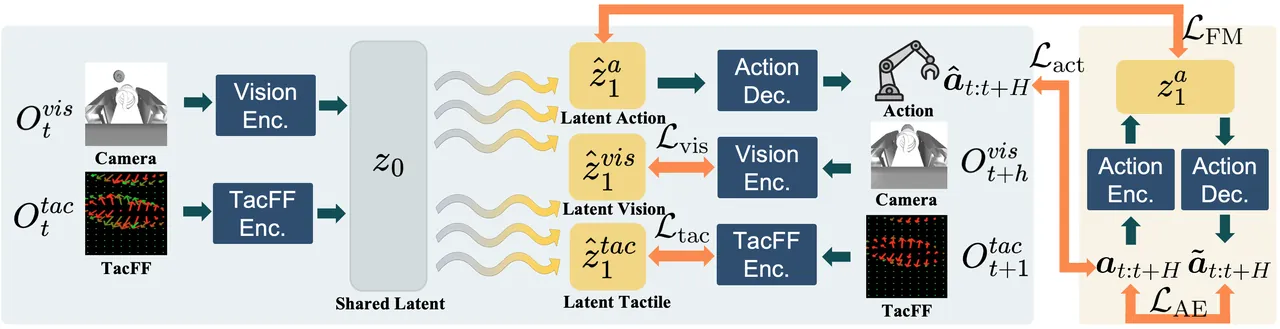
Figure 1: Agile-WAM overview. Visual and TacFF observations are encoded and fused into a shared source latent z0; the flow-matching backbone generates the action latent, the future visual latent and the future tactile latent in one pass; an action autoencoder provides a structured action latent space, and multi-horizon supervision places vision at t+h and touch at t+1.
Action autoencoder and dual action supervision
The flow target contains an action latent $z_1^a$, but an unconstrained latent space easily collapses or drifts. Following VITA, the authors introduce an action encoder $E_a$ and decoder $D_a$ to build a structured action latent space
$$z_1^{a}=E_a(a_{t:t+H}),\qquad \tilde a_{t:t+H}=D_a(z_1^{a}),$$trained end to end with a reconstruction loss
$$\mathcal{L}_{\mathrm{AE}}=\left\|a_{t:t+H}-D_a(E_a(a_{t:t+H}))\right\|_1.$$The crucial detail is that at inference the decoder consumes not the encoder-produced target $z_1^a$ but the ODE-generated $\hat z_1^a$. To bridge the gap between training-time target latents and inference-time generated latents, the authors additionally feed the ODE output into the decoder during training and supervise it in action space
$$\mathcal{L}_{\mathrm{act}}=\left\|a_{t:t+H}-D_a(\hat z_1^{a})\right\|_1.$$Gradients from this term flow through the action decoder and the whole ODE integration, anchoring generated latents directly to executable ground-truth actions. Equations (1) and (2) together stabilise the action representation and shrink the train/inference latent distribution gap, which is the most easily overlooked yet most deployment-relevant part of a noise-free flow policy.
Multi-horizon multimodal prediction: vision looks far, touch looks near
A central difficulty in multimodal world modelling is that modalities live on different time scales. Consecutive visual frames are redundant, so next-frame prediction supplies almost no learning signal; touch, in contrast, can change violently within a very short interval when contact is made or motion is blocked, and a long horizon averages those details away. The authors therefore construct target latents at different offsets
$$z_1^{\mathrm{vis}}=E_{\mathrm{vis}}\left(O_{t+h_{\mathrm{vis}}}^{\mathrm{vis}}\right),\qquad z_1^{\mathrm{tac}}=E_{\mathrm{tac}}\left(O_{t+h_{\mathrm{tac}}}^{\mathrm{tac}}\right),$$where touch takes the next frame $h_{\mathrm{tac}}=1$ and vision takes the longer offset $h_{\mathrm{vis}}=h$ that matches the number of actions executed at inference (8 in the experiments). The long visual horizon forces the model to capture meaningful scene evolution instead of collapsing onto copying the current frame, while the short tactile horizon preserves abrupt contact information. After the ODE is solved, the joint latent is split into three branches and supervised in latent space
$$\mathcal{L}_{\mathrm{vis}}=\left\|\hat z_1^{\mathrm{vis}}-z_1^{\mathrm{vis}}\right\|_2^2,\qquad \mathcal{L}_{\mathrm{tac}}=\left\|\hat z_1^{\mathrm{tac}}-z_1^{\mathrm{tac}}\right\|_2^2.$$Note that supervision happens in latent space rather than pixel space. This provides a compact learning objective, letting the shared flow representation capture task-relevant evolution in both modalities without paying the cost of generating high-dimensional observations. The complete training objective is a weighted sum of five terms
$$\mathcal{L}_{\text{Agile-WAM}}=\lambda_{\mathrm{FM}}\mathcal{L}_{\mathrm{FM}}+\lambda_{\mathrm{AE}}\mathcal{L}_{\mathrm{AE}}+\lambda_{\mathrm{act}}\mathcal{L}_{\mathrm{act}}+\lambda_{\mathrm{vis}}\mathcal{L}_{\mathrm{vis}}+\lambda_{\mathrm{tac}}\mathcal{L}_{\mathrm{tac}}.$$flowchart LR CAM["Camera O_t^vis
wrist RGB"] --> VENC["Vision Encoder
ResNet-18 pretrained"] TAC["TacFF O_t^tac
force field grid"] --> TENC["Tactile Encoder
ResNet-18 from scratch"] PRO["Proprioception q_t"] --> FUSE["Concat + Linear
source latent z0"] VENC --> FUSE TENC --> FUSE FUSE --> FLOW["Flow matching v_theta
6-step Euler ODE
no cross-attention"] FLOW --> ZA["action latent z1^a"] FLOW --> ZV["visual latent z1^vis"] FLOW --> ZT["tactile latent z1^tac"] ZA --> ADEC["Action Decoder D_a
chunk H=16 run h=8"] AENC["Action Encoder E_a
on ground truth a"] --> ZAT["target z1^a"] ZAT --> FLOW ADEC --> LACT["L_act vs a_t:t+H"] AENC --> LAE["L_AE reconstruction"] FV["Future camera O vis t+8"] --> VENC2["Vision Enc"] --> LV["L_vis"] ZV --> LV FT["Next TacFF O tac t+1"] --> TENC2["TacFF Enc"] --> LT["L_tac"] ZT --> LT
Supplementary diagram drawn from the paper's method: the source latent z0 is encoded once; the flow emits three latent branches in a single pass; visual supervision lands at t+8 and tactile supervision at t+1; action supervision runs along both the encoder path (L_AE) and the ODE-generated path (L_act).
Experiments
Simulation: nine contact-rich tasks on ManiFeel
Simulation runs on the ManiFeel benchmark with a 7-DoF Franka Emika Panda whose gripper carries a TacFF sensor (10x14x3). Training and evaluation use only the 256x256 wrist camera; the wrist view is frequently occluded once the gripper contacts an object, which is exactly the condition that amplifies the value of touch. Each task is trained on 20 to 50 demonstrations from the official dataset. Comparisons include the vision-only diffusion policy DP, the vision-plus-tactile diffusion policy DP-VT, Tactile-WAM (reimplemented by the authors from its core component, Tactile Asymmetric Attention, inside the official ManiFeel tactile diffusion codebase), and the vision-only VITA together with its tactile variant VITA-VT. The action chunk is $H=16$ with $h=8$ executed; the VITA family and Agile-WAM use a six-step ODE, while the DP family uses 100 denoising steps.
| Simulation task | Agile-WAM | VITA-VT | VITA | Tactile-WAM | DP-VT | DP |
|---|---|---|---|---|---|---|
| Bulb Screw | 92.67±2.49 | 87.33±0.94 | 71.33±0.94 | 4.00±0.00 | 4.67±2.49 | 5.33±0.94 |
| Gear Assembly | 70.67±2.49 | 68.67±1.89 | 68.33±0.47 | 68.00±1.63 | 58.67±6.18 | 58.67±1.89 |
| Power Plug Insertion | 59.33±0.94 | 63.33±3.27 | 54.67±3.40 | 61.33±2.49 | 58.00±3.27 | 53.67±1.25 |
| Peg Reorientation | 42.00±1.63 | 28.67±0.94 | 41.33±4.11 | 34.67±2.49 | 28.00±2.83 | 22.00±1.63 |
| Peg Insertion | 49.33±0.94 | 47.33±2.49 | 44.00±1.67 | 40.00±9.80 | 20.67±13.20 | 21.33±18.86 |
| USB Insertion | 62.00±5.89 | 59.33±9.43 | 55.33±4.11 | 44.67±8.06 | 38.00±2.83 | 41.33±5.25 |
| Ball Sorting | 92.00±0.00 | 90.00±3.27 | 72.00±7.12 | 45.33±0.94 | 74.67±5.25 | 38.67±3.40 |
| Object Search | 50.67±2.49 | 36.00±2.83 | 40.00±3.27 | 33.33±2.49 | 13.33±0.94 | 14.67±3.40 |
| Nut Bolt Threading | 92.67±2.49 | 92.00±2.83 | 86.67±4.71 | 13.33±2.49 | 72.00±3.27 | 4.67±0.94 |
Table 1: simulation success rates (%). Agile-WAM leads on eight of nine tasks; the single loss is Power Plug Insertion, where VITA-VT edges ahead at 63.33. Note that Tactile-WAM nearly collapses on Bulb Screw and Nut Bolt Threading (4.00 and 13.33), which shows that bolting touch onto a large backbone does not automatically pay off.
Real world: five tasks and corrective behaviour
The real-robot experiments use a 7-DoF Flexiv Rizon 4 with a wrist-mounted Intel RealSense D405 (320x240, 30 FPS) and an Analog Devices 32x32 piezoresistive tactile array on the gripper (30 Hz). Fifty expert demonstrations per task are teleoperated with Meta Quest 3, and each policy is evaluated over 20 episodes per task. The authors deliberately mix in demonstrations where the first attempt misses and must be corrected: with the wrist view occluded, the policy has to maintain enough contact to gather informative touch while avoiding damage to the object or the gripper.
| Policy | Gear Assembly | Peg Insertion | Power Plug Insertion | Internet Cable Insertion | Internet Cable Unplugging |
|---|---|---|---|---|---|
| Agile-WAM | 0.80 (16/20) | 0.55 (11/20) | 0.65 (13/20) | 0.30 (6/20) | 0.85 (17/20) |
| VITA-VT | 0.55 (11/20) | 0.60 (12/20) | 0.35 (7/20) | 0.15 (3/20) | 0.75 (15/20) |
| VITA | 0.75 (15/20) | 0.25 (5/20) | 0.25 (5/20) | 0.20 (4/20) | 0.20 (4/20) |
Table 2: real-world success rates. Agile-WAM totals 63/100 across the five tasks, against 48/100 for VITA-VT and only 33/100 for vision-only VITA. The 29.4% relative gain quoted in the abstract matches the per-task-relative-to-strongest-baseline averaging (about 29.5%).
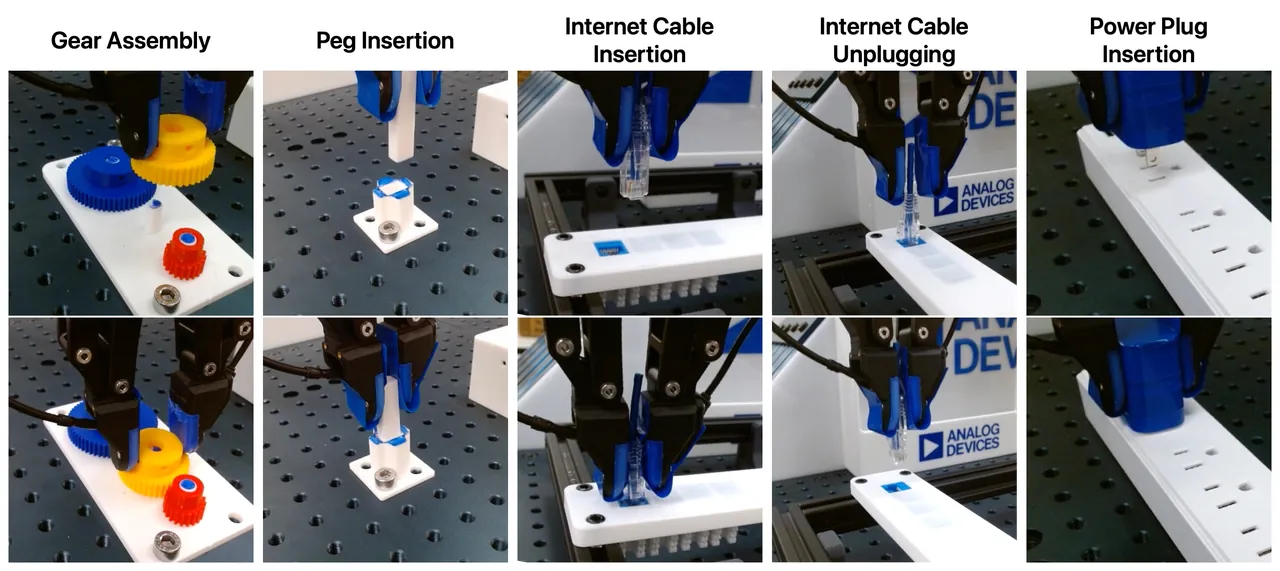
Figure 2: the five real-world contact-rich tasks: gear assembly, peg insertion, internet cable insertion, internet cable unplugging and power plug insertion.
The corrective behaviour is the most convincing part of the real experiments. Take peg insertion: as the peg approaches the base, the wrist view is partially occluded by the peg itself, so vision can hardly tell whether the peg is aligned with the hole or pressing against its rim. Agile-WAM uses tactile feedback to slide the peg along the surface and search toward the hole until insertion succeeds. In gear assembly, when the middle gear jams and cannot mesh, the policy detects the stall and performs a corrective twist until the gear aligns and seats. By comparison, vision-only VITA is nearly blind to contact state, and VITA-VT, despite having tactile input, often fails to learn a stable recovery: after the first miss it either freezes or pushes blindly. This is direct evidence that joint action-future modelling lets the representation capture visual evolution and local contact dynamics at the same time.
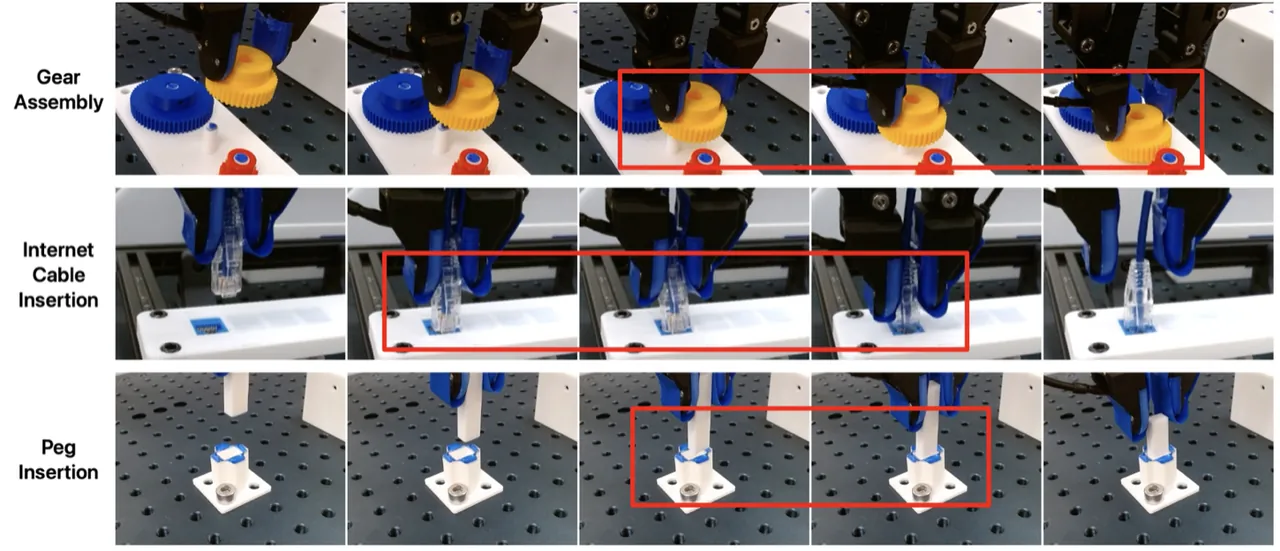
Figure 3: corrective behaviour sequence. Red boxes mark the correction phase: after the initial misalignment, Agile-WAM keeps light contact and searches for the correct insertion pose using touch while vision is occluded.
Inference efficiency: a world model that runs at control frequency
Efficiency is measured on a single RTX 4090 in FP32 at batch size 1, with an action chunk of 16, averaged over 50 runs. Agile-WAM takes 10.35±0.14 ms per inference, corresponding to a control frequency of 96.62 Hz. For reference, VITA runs at 9.71 ms / 102.99 Hz and VITA-VT at 10.52 ms / 95.06 Hz, while DP, DP-VT and Tactile-WAM (TAAM) take 408.59, 420.34 and 636.34 ms respectively, i.e. control frequencies of only 2.45, 2.38 and 1.57 Hz. Agile-WAM therefore runs roughly 40 times faster than the diffusion policies and about 60 times faster than Tactile-WAM. The authors note that although Agile-WAM shares the same lightweight flow-matching backbone as VITA, it adds a tactile encoder and a larger joint latent space, and that this overhead is negligible because the model stays compact and parallelises on the GPU. That is the quantitative meaning of "agile", and it hints at on-board edge deployment.
| Model | Inference time (ms) | Relative | Control frequency (Hz) | Relative |
|---|---|---|---|---|
| Agile-WAM | 10.35±0.14 | 1.07× | 96.62 | 0.94× |
| VITA | 9.71±0.11 | 1.00× | 102.99 | 1.00× |
| VITA-VT | 10.52±0.14 | 1.08× | 95.06 | 0.92× |
| DP | 408.59±0.47 | 42.08× | 2.45 | 0.02× |
| DP-VT | 420.34±0.36 | 43.29× | 2.38 | 0.02× |
| TAAM (Tactile-WAM) | 636.34±0.90 | 65.53× | 1.57 | 0.02× |
Table 3: inference efficiency (RTX 4090, FP32, batch 1, averaged over 50 runs). One caveat worth flagging: the abstract quotes 11.9 ms while Table 3 reports 10.35 ms, and the paper does not reconcile the two. When citing, the Table 3 measurement protocol should be treated as authoritative.
Ablations: world modelling, modality mixtures and horizon design
The ablations address three questions. First, does the gain come from jointly modelling the future, or merely from a larger latent space? Keeping the enlarged prediction head but switching off $\mathcal{L}_{\mathrm{vis}}$ and $\mathcal{L}_{\mathrm{tac}}$ drops success from 92.7±2.5 to 86.7±4.1, which is even below the 87.3±0.9 obtained by removing the prediction head altogether. The improvement therefore comes from joint action-future modelling itself rather than from extra capacity. Second, which modalities are most useful to predict? With vision-plus-tactile input, predicting vision only (87.3±1.9), touch only (86.0±1.6) or neither (87.3±0.9) all underperform predicting both jointly (92.7±2.5); with vision-only input, predicting the visual future (90.7±2.5) is far better than predicting nothing (71.3±0.9). The conclusion is that world modelling is most effective when the predicted modality matches the available observation modality. Third, how should the horizons be set? The multi-horizon configuration "+8 vision, +1 touch" reaches 92.7±2.5, beating "+1, +1" at 90.7±2.5 and "+8, +8" at 88.7±2.5, which validates the motivation directly. For the prediction loss weight, $\lambda=1.0$ at 92.7±2.5 clearly outperforms 0.0 at 86.7±4.1 and 0.1 at 87.3±3.4.
| Ablation axis | Setting | Success rate (%) |
|---|---|---|
| Prediction head | head + prediction losses (full) | 92.7±2.5 |
| Prediction head | no prediction head | 87.3±0.9 |
| Prediction head | head but no prediction losses | 86.7±4.1 |
| Predicted modalities | VT input + VT prediction (full) | 92.7±2.5 |
| Predicted modalities | VT input + V prediction only | 87.3±1.9 |
| Predicted modalities | VT input + T prediction only | 86.0±1.6 |
| Predicted modalities | V input + V prediction | 90.7±2.5 |
| Predicted modalities | V input + no prediction | 71.3±0.9 |
| Prediction horizon (vis, tac) | (+8, +1) multi-horizon (full) | 92.7±2.5 |
| Prediction horizon (vis, tac) | (+1, +1) | 90.7±2.5 |
| Prediction horizon (vis, tac) | (+8, +8) | 88.7±2.5 |
| Prediction loss weight | 1.0 (full) | 92.7±2.5 |
| Prediction loss weight | 0.0 | 86.7±4.1 |
Table 4: ablation results read from Figure 5 of the paper. The full model's 92.7±2.5 coincides with the Bulb Screw entry of Table 1, so the ablations are most plausibly reported on that representative simulation task.
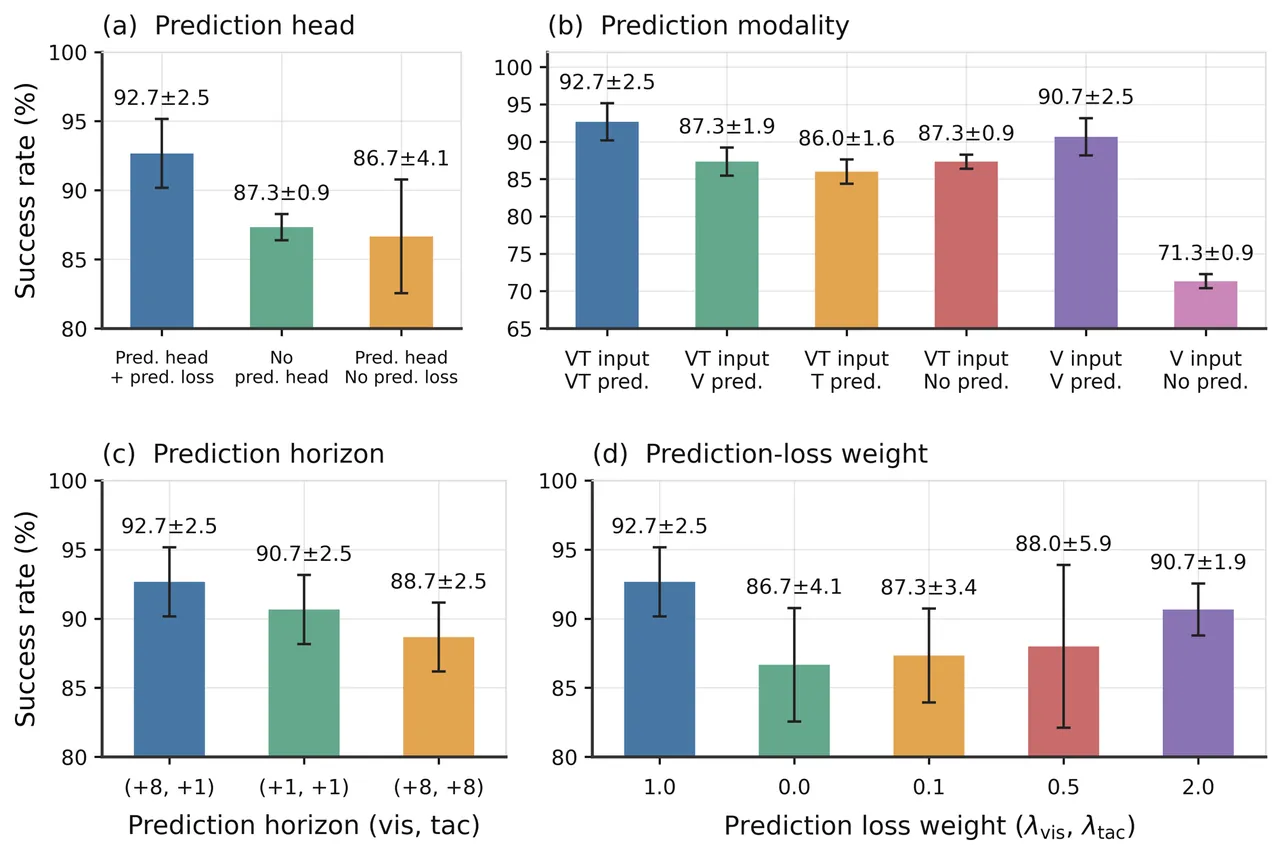
Figure 4: four ablation groups. (a) prediction head and prediction losses; (b) predicted modality combinations; (c) prediction horizons; (d) prediction loss weight.
Limitations
First, the world exists only in latent space. Agile-WAM supervises future prediction at the level of latents and never generates pixel-level future frames. That buys efficiency, but it also means the model cannot output a visualised future that a human could inspect or that downstream visual planning and imagination-based reasoning could consume. Calling it a "world model" is generous; more precisely it is an action-policy representation regularised by future prediction.
Second, the experimental surface is narrow and tied to specific tactile hardware. By the authors' own account the experiments concentrate on ManiFeel simulation and a single real platform (Flexiv Rizon 4 plus an Analog Devices 32x32 piezoresistive array), with only 20 evaluation episodes per real task. The tactile encoder is designed for image-like force fields such as TacFF, and the paper offers no evidence that it transfers directly to other tactile sensing modalities such as optical GelSight sensors or single-axis force/torque readings. On the hardest real task, Internet Cable Insertion, success is still only 0.30, so robust deployment remains a distance away.
Third, reproducibility and reporting consistency. The code is not public, and two key baselines (Tactile-WAM and VITA-VT) are the authors' own reimplementation or adaptation, which third parties cannot check. The 11.9 ms in the abstract disagrees with the 10.35 ms in Table 3, and the ablations do not state the task explicitly, which weakens the traceability of the numbers. The policies are also single-task, with no language or high-level instruction conditioning, so a clear step remains before this becomes a general manipulation policy.
Conclusion and Outlook
The contribution of Agile-WAM is not "yet another world action model" but a counter-intuitive path that the data supports: a world model does not have to sit on a huge pretrained generative backbone. When the source distribution is the fused observation itself, when conditioning modules are removed altogether, and when each modality's future supervision lands on the time scale where that modality carries information, a compact flow-matching backbone trained from scratch achieves both the highest success rate and millisecond-level latency. Nine simulation tasks plus five real tasks, together with ablations that separate capacity from joint modelling, make the conclusion hold up. For robotics practitioners the practical lesson is clear: in contact-rich, high-frequency control, getting perceptual fusion and supervision horizons right pays more than making the model bigger. If the code is released, the tactile encoder is generalised to more sensing modalities, and latent-space futures are connected to visualisable ones, this agile world model route could become one of the default choices for on-board deployment.
Golden line: a world model does not have to be large; when the source of the flow is the observation itself, predicting the future and generating actions can share one stream light enough to run at control frequency.