Skip to content
Tags

#Flow Matching (16)

Memory as Plans: World-Action Modeling with Memory-Grounded Planning

Memory as Plans: World-Action Modeling with Memory-Grounded Planning

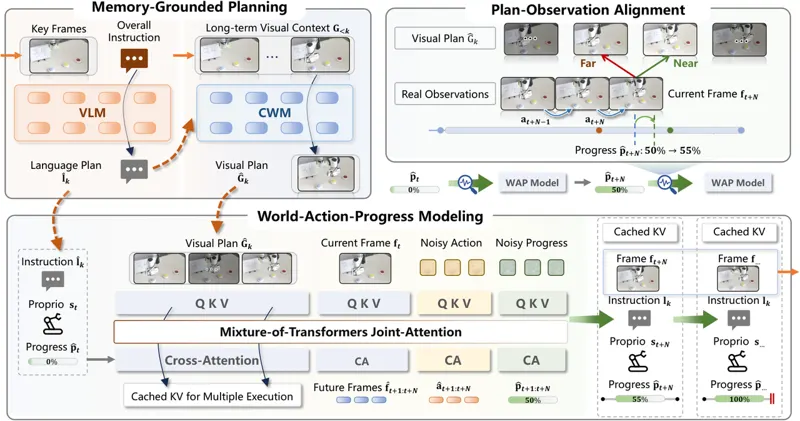
Most robot policies predict actions from the current observation or a short fixed window, yet long-horizon manipulation is non-Markovian: the evidence a decision needs may already be out of view. MaP-WAM treats memory as planning-time evidence instead of executor input. Completed segments are stored as structured multimodal records pairing a language instruction with sparse visual context (8 uniformly sampled frames per segment); a fine-tuned Qwen3.5-4B language planner proposes the next segment-level language plan, and a causal world model initialized from WAN-2.2-5B turns the long-term visual context into a matching visual plan. The two form a memory-grounded plan that conditions a World-Action-Progress executor, a Mixture-of-Transformers extension of a video DiT that jointly predicts action chunks, future visual latents, and execution progress, with progress as a first-class modality. Because the executor only sees a fixed-length plan prefix, its context stays constant as history grows, and block-causal attention makes both planning and execution KV-cacheable; plan-observation alignment calibrates recursively predicted progress against visual-plan frames, and a progress gate (threshold 0.95) triggers segment transitions that write resampled real observations back into memory. On RMBench MaP-WAM reaches 83.3% average success over nine memory-dependent tasks (best baseline LingBot-VA 77.1%), and 78.0% on two real Franka Research 3 tasks (88% Find Button, 68% Press Buttons), while a full-context executor runs out of memory at 1700 history frames and WAP holds an approximately constant 827 ms per action chunk. Limitations: segment structure is taken from benchmark annotations rather than discovered automatically, and plan-observation alignment uses a lightweight training-free pixel-difference metric.

Sizhe Zhao, Haozhe Xie, Weiyu ZhaoSep 10, 2026
World-action modelsLong-Horizon MemoryMemory-Grounded PlanningSep 10, 2026
IMLE-VLA: Fast Single-Step Action Generation for Vision-Language-Action Policies

IMLE-VLA: Fast Single-Step Action Generation for Vision-Language-Action Policies

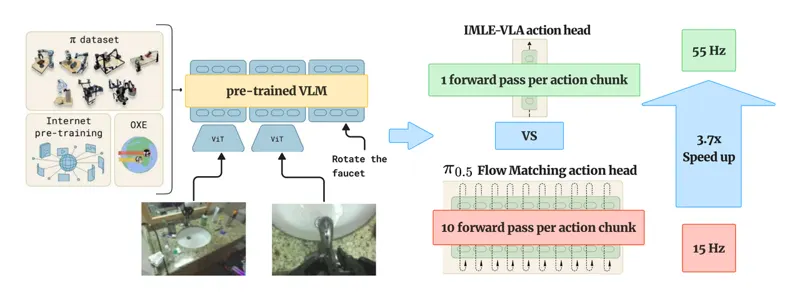
Vision-language-action (VLA) policies leverage pretrained vision-language backbones to achieve strong cross-task generalization. A leading design couples this backbone with a dedicated continuous action head trained via diffusion or flow matching. However, such heads rely on iterative multi-step sampling, for example 10 Euler steps in π_0.5. This creates an inference bottleneck that produces stop-and-go movement in the robot and slower task completion. We introduce IMLE-VLA, which replaces the iterative action head with a single-step conditional generator trained via conditional Implicit Maximum Likelihood Estimation (cIMLE). The cIMLE objective promotes multimodal action coverage, avoiding the mode collapse of naive regression heads while eliminating multi-step sampling entirely. When IMLE-VLA is applied to π_0.5, it increases inference frequency 3.67x (55 Hz vs. 15 Hz), enabling up to 11x higher action throughput. On the 40-task LIBERO benchmark, IMLE-VLA achieves the highest average success rate (98.0%) among all baselines while leading in inference frequency. Under the test-time perturbations of LIBERO-plus, IMLE-VLA retains π_0.5's robustness while other baselines degrade sharply, confirming that the cIMLE head preserves generalization. Real-world experiments on a Franka Emika Panda across four tasks demonstrate smoother motion (2.2x to 3.0x lower jerk) and faster task completion, with IMLE-VLA outperforming π_0.5 on every task and reducing average VLA inference time per episode by 3.9x to 6.6x. Videos and code are available at https://kianhk6.github.io/IMLE-VLA/

Hosseinkhani, Kian, Peng, Qinhe, Shramko, GeorgeSep 10, 2026
VLAEfficient InferenceSingle-Step Action GenerationSep 10, 2026
A4A: Cross-Embodiment Transfer of Action-Oriented 4D Affordances from Human Demonstrations

A4A: Cross-Embodiment Transfer of Action-Oriented 4D Affordances from Human Demonstrations

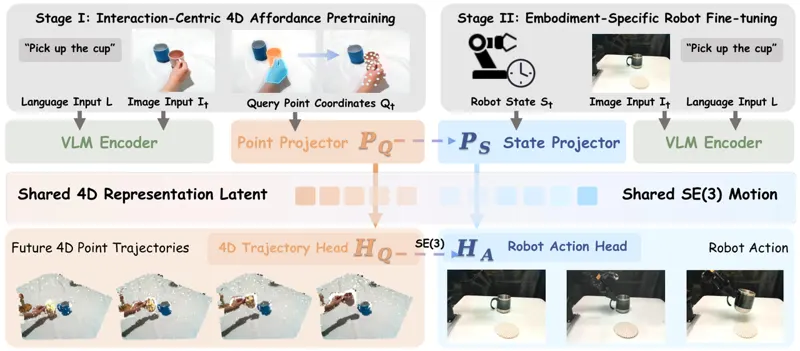
Human demonstrations contain rich manipulation knowledge, but it remains unclear what information can be transferred effectively to robot control. Existing affordance representations are typically formulated as 2D masks, 3D regions, contact points, or actionability scores, and therefore primarily identify where interaction may occur. However, effective manipulation also requires modeling how interaction-relevant geometry evolves during task execution. To bridge this gap, we introduce action-oriented 4D affordances, which represent the language-conditioned future trajectories of interaction-relevant 3D points. These trajectories capture task-conditioned geometric evolution rather than embodiment-specific actions, enabling transferable interaction priors across humans and robots. Based on this representation, we construct a large-scale action-oriented 4D affordance dataset from existing human–object interaction video data and complementary RGB-D demonstrations, and introduce A4A, an affordance-to-action framework that uses 4D affordance trajectory prediction to pretrain robot policies before manipulation fine-tuning. Experiments in both simulation and the real world validate the effectiveness of A4A, showing that pretraining with action-oriented 4D affordance data consistently improves the manipulation performance of diverse VLA policies. These results establish action-oriented 4D affordances as an effective cross-embodiment representation for transferring manipulation knowledge from human demonstrations to robot control.

Yifan Han, Litao Liu, Yuqi GuSep 5, 2026
VLAAffordance4D AffordanceSep 5, 2026
EgoWAM: World Action Models Beyond Pixels with In-the-Wild Egocentric Human Data

EgoWAM: World Action Models Beyond Pixels with In-the-Wild Egocentric Human Data

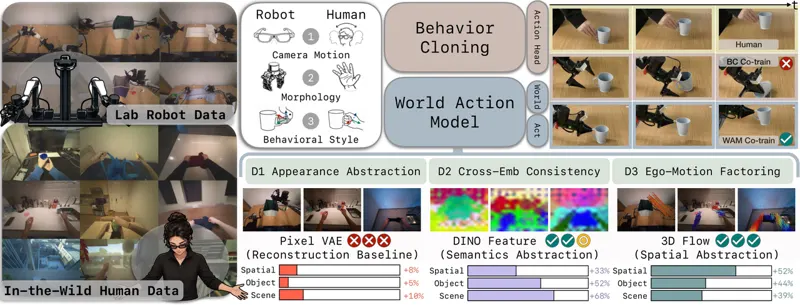
Egocentric human data offers scalable supervision for robot manipulation. However, behavior cloning entangles transferable content like objects, scenes, and task semantics, with non-transferable factors like human morphology, head motion, and behavioral style. We study whether World Action Models (WAMs) provide a better training signal by requiring policies to predict not only actions, but also how the scene evolves. The central question is what world representation best enables human-to-robot transfer. We hypothesize that an effective world target should abstract appearance, capture agent-invariant physical effects, and separate camera motion from environment change. We introduce EgoWAM, a controlled human-robot co-training framework that fixes the policy backbone, action head, and data mixture while varying only the world prediction target, comparing Pixel, DINO, and 3D motion flow. Across three real-world bimanual tasks, WAM co-training scales more effectively with in-the-wild egocentric human data than behavior cloning. Pixel-based prediction transfers weakly, while DINO and 3D flow yield substantial gains: DINO improves out-of-distribution object and scene generalization by up to 4x, and 3D flow improves in-domain performance by 20-30%. More details: https://gatech-rl2.github.io/egowam.github.io

Baoyu Li, Xinchen Yin, Mengying LinJul 8, 2026
World ModelsRobot ManipulationImitation LearningJul 8, 2026
Token-Wise Latent Streaming from Slow Reasoners to Fast Planners for Dynamic Vision Language Navigation

Token-Wise Latent Streaming from Slow Reasoners to Fast Planners for Dynamic Vision Language Navigation

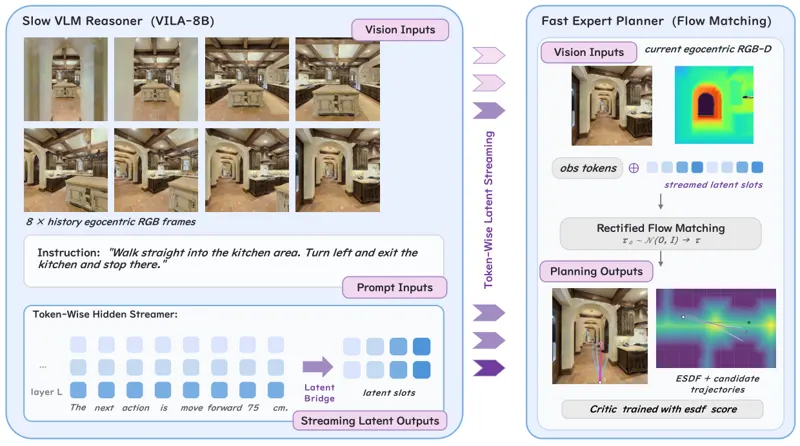
Vision-Language Navigation in dynamic, human-centric environments exposes a fundamental tension: linguistic reasoning is slow and deliberative, whereas safe, socially compliant planning should be instant and reactive. The resulting observation staleness is safety-critical: a maneuver chosen during inference can already be unsafe by the time it executes. We observe that, long before a VLM finishes its inference, its intermediate hidden states already encode action-relevant intent. We propose SPARK-VLN, a dual-system framework for dynamic social VLN that streams the slow VLM reasoner's knowledge to a fast flow-matching expert planner throughout token generation, providing fresh and evolving guidance during inference. This design is realized by three modules: a Token-Wise Hidden Streamer that extracts intermediate hidden states along the token generation process, a Sequence-to-Slot Latent Bridge that projects them into fixed-size latent slots, and an Evolving Latent Conditioner that infuses them into the expert planner. We also introduce a human-centric benchmark suite for dynamic social vision-language navigation that keeps pedestrians and the robot active throughout inference and reports navigation success, social compliance, human collisions, and explicit staleness statistics. Across these settings, SPARK-VLN mproves navigation success and social compliance while sustaining inference efficiency. Webpage: https://hutslib.github.io/SPARK-VLN/.

Tianshuai Hu, Yangyi Zhong, Zeying GongJul 18, 2026
Vision-language navigationSocial NavigationDual-SystemJul 18, 2026
VLA-Corrector: Lightweight Detect-and-Correct Inference for Adaptive Action Horizon

VLA-Corrector: Lightweight Detect-and-Correct Inference for Adaptive Action Horizon

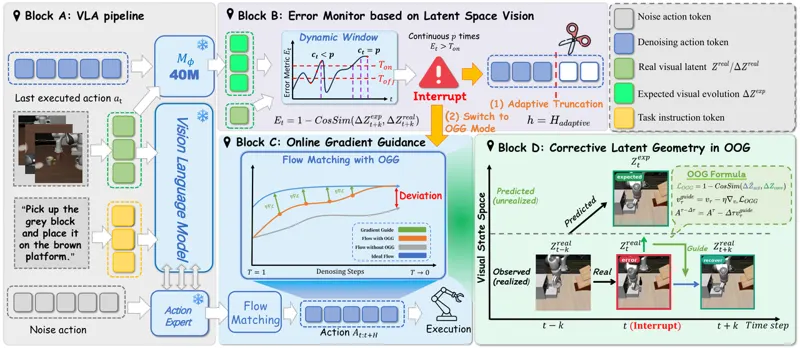
Vision-Language-Action (VLA) foundation models have recently achieved strong progress in embodied intelligence. To reduce policy-call frequency while preserving temporal coherence, most generative policies adopt an action chunk mechanism, executing multiple future actions in an open-loop manner under a fixed action horizon. However, this "predict-then-blindly-execute" paradigm sacrifices closed-loop reactivity: in contact-rich physical interactions, even small local perturbations can rapidly amplify within the open-loop blind spot, leading to compounding errors and ultimately task failure. To address this limitation, we propose VLA-Corrector, a lightweight corrective inference framework for action-chunked VLA policies. Without modifying the backbone policy weights, VLA-Corrector introduces a lightweight Latent-space Vision Monitor (LVM) that continuously compares predicted and actual visual feature evolution, enabling online detection of visual dynamics deviations. Once persistent deviation is detected, the system triggers a truncation event, discards the remaining stale actions, and invokes corrective replanning via Online Gradient Guidance (OGG). The detect-and-correct mechanism of VLA-Corrector naturally induces an event-triggered adaptive action horizon: it preserves long-horizon execution when the current chunk remains reliable, and invokes short-horizon corrective replanning when execution begins to drift. In doing so, VLA-Corrector mitigates the trade-off imposed by static horizons between execution robustness and policy-call frequency. It can be integrated into different VLA models without further retraining the VLA backbone, interrupting compounding errors while preserving much of the efficiency benefit of action chunking and substantially improving robustness in long-horizon, contact-rich robotic manipulation tasks.

Yi Pan, Miao Pan, Qi LuJul 2, 2026
VLARobotic ManipulationAction chunkingJul 2, 2026
FlashVLA: Streaming Action Decoding for Fast and Asynchronous VLA Inference

FlashVLA: Streaming Action Decoding for Fast and Asynchronous VLA Inference

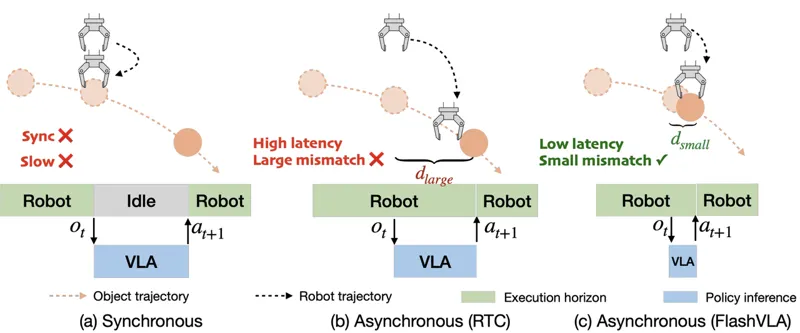
Vision-Language-Action (VLA) models are increasingly promising for robotic manipulation, yet their real-world deployment remains bottlenecked by high inference latency and unstable asynchronous execution. This challenge is particularly pronounced in flow-matching-based VLA models, where action decoding requires multiple iterative steps conditioned on the VLM context. While efficient inference methods improve control frequency and asynchronous methods reduce execution idle time, existing approaches often fail to jointly achieve low-latency inference and accurate, temporally consistent asynchronous execution. We introduce FlashVLA, a streaming action decoding framework that addresses both challenges in a unified formulation. FlashVLA maintains a streaming action buffer with multiple chunks at different noise levels and decodes them using chunk-wise causal attention. This design allows FlashVLA to produce one executable action chunk per inference step. Moreover, its chunk-wise autoregressive formulation implicitly preserves action continuity, enabling smooth asynchronous execution without extra future-state conditioning. Across extensive simulated and real-world experiments, FlashVLA substantially improves inference speed while maintaining strong task performance. It can achieve ≥30 Hz control frequency on a single GPU with smooth asynchronous inference in real-world deployment.

Zekai Li, Jiaming Tang, Zhijian LiuAug 27, 2026
VLAFlow MatchingNVIDIAAug 27, 2026
GigaBrain-0.7: Scaling Embodied Foundation Models to Emergent Capabilities with a Three-System Architecture

GigaBrain-0.7: Scaling Embodied Foundation Models to Emergent Capabilities with a Three-System Architecture

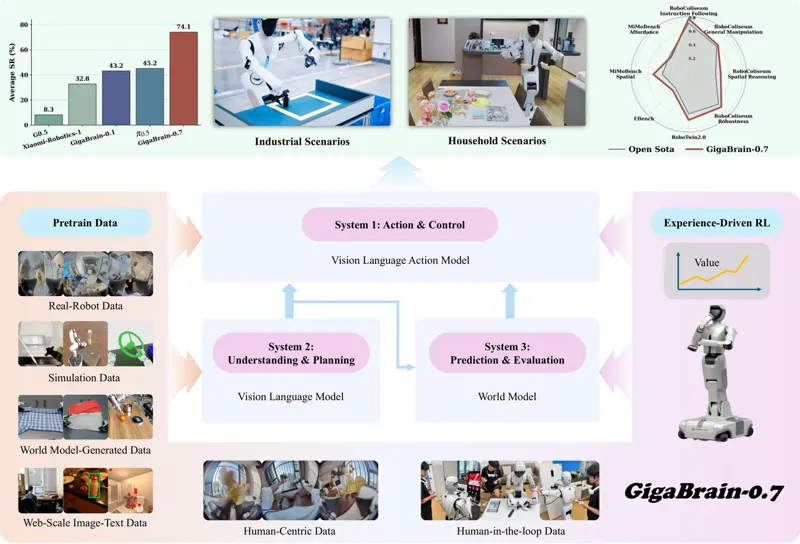
Vision-language-action (VLA) models have become a dominant paradigm for generalist embodied agents, demonstrating strong complex and long-horizon task completion in structured settings. Yet it remains an open question whether current VLA systems can benefit from more effective architectural design, scale to substantially larger and more heterogeneous data regimes, and achieve broader generalization across tasks and embodiments. To this end, we present GigaBrain-0.7, an embodied foundation model with substantially improved generalization across diverse robot embodiments. Specifically, GigaBrain-0.7 unifies understanding, prediction, and action through a three-system architecture, scales pretraining to over 37,000 hours of heterogeneous embodied data, and introduces one-stage alignment training that jointly optimizes vision-language understanding and multi-embodiment action generation. Compared with the preceding GigaBrain-0 series and prior state-of-the-art models including π_0.5, GigaBrain-0.7 achieves substantial improvements in foundation zero-shot capabilities, language-conditioned instruction following, and post-training task success rates. In particular, on our in-house Maker H01 platform and mainstream robot embodiments, GigaBrain-0.7 demonstrates strong task adaptability and completion ability across both home and industrial scenarios. All training code and pretrained model weights will be released.

GigaBrain Team, Angen Ye, Axiang SunAug 16, 2026
VLAGigaBrainFlow MatchingAug 16, 2026
HAF: Adapting Generalist VLAs to Humanoid Whole-Body Loco-manipulation via Hierarchical Action Flow and Spectral Latent RL

HAF: Adapting Generalist VLAs to Humanoid Whole-Body Loco-manipulation via Hierarchical Action Flow and Spectral Latent RL

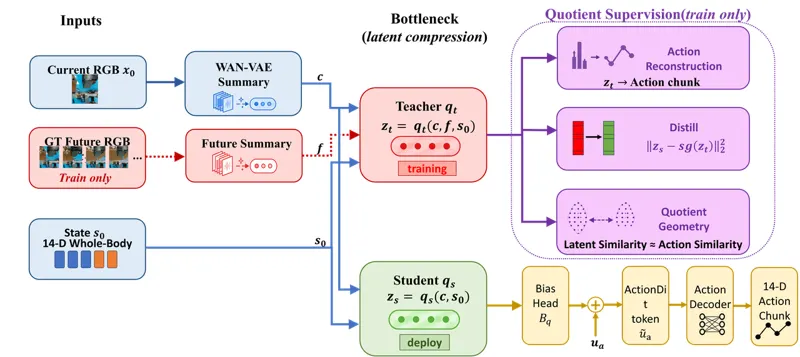
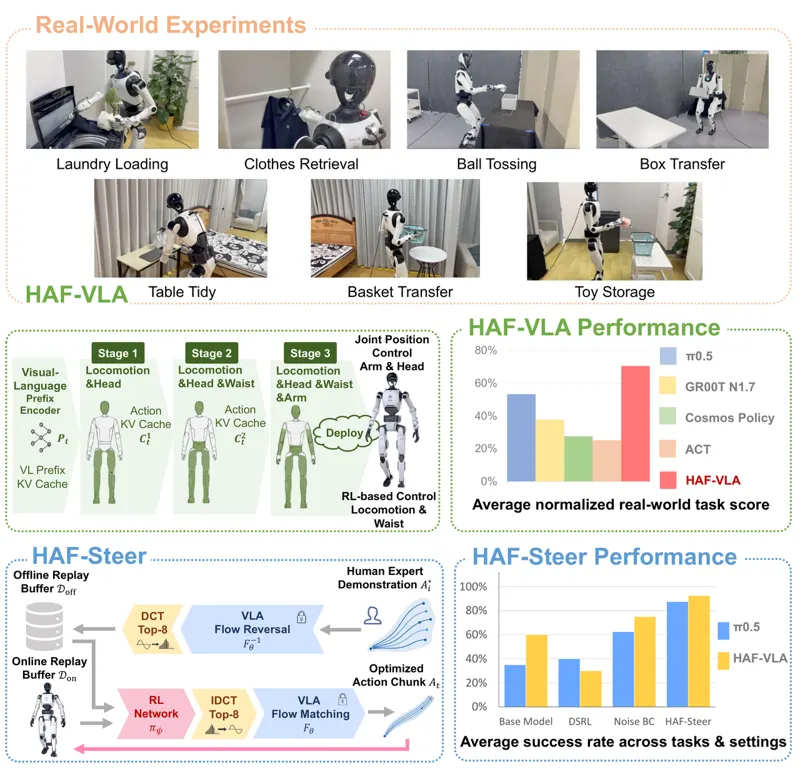
Humanoid robots hold great promise as general-purpose agents in human-centered environments, yet generalist vision-language-action (VLA) foundation models are not readily applicable to humanoid whole-body loco-manipulation. The high dimensionality and interdependence of humanoid motions make it challenging for conventional single-stage VLA architectures to coordinate locomotion, waist posture, and dual-arm manipulation effectively. Moreover, policies trained through offline behavior cloning can remain suboptimal during real-world deployment. Although online reinforcement learning can refine policies through real-world interaction, directly tuning large VLA backbones demands excessive computation and may introduce safety risks during real-robot exploration. To address these bottlenecks, we introduce HAF (Humanoid Adaptation Framework), a two-part framework consisting of HAF-VLA and HAF-Steer that transfers off-the-shelf generalist VLA foundation models to humanoid whole-body loco-manipulation. HAF-VLA is a hierarchical action-flow generator built on a pretrained flow-matching VLA. It splits full-body action denoising into three sequential stages with stage embeddings and cross-stage KV caches that retain kinematic dependencies, avoiding incoherent whole-body actions from one-shot generation. On top of the frozen HAF-VLA, HAF-Steer is a latent offline-to-online RL pipeline that leverages flow-matching invertibility and DCT-based dimensionality reduction to restrict RL optimization to a compact noise subspace and train a regularized SAC policy. This avoids updating the large VLA backbone and enables efficient real-world policy refinement. Evaluated on seven real-world humanoid loco-manipulation tasks, HAF surpasses vanilla single-stage VLA baselines and improves whole-body coordination and task performance. Project website: https://grange007.github.io/HAF .

Langzhe Gu, Chengkai Hou, Meng LiAug 17, 2026
VLAHumanoidWhole-bodyAug 17, 2026
SimWAM: A Simple World Action Model for End-to-End Autonomous Driving

SimWAM: A Simple World Action Model for End-to-End Autonomous Driving

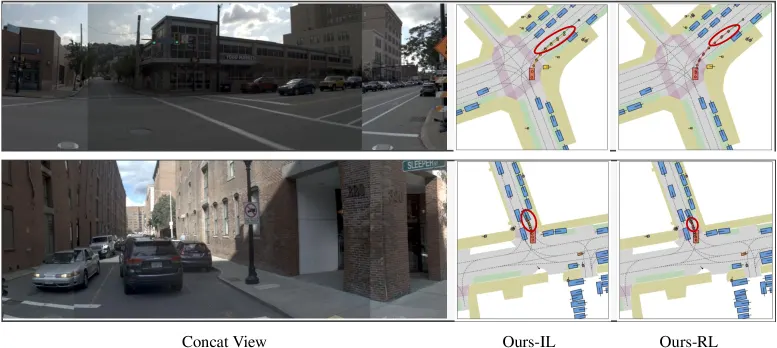
World-Action Models (WAMs) improve end-to-end autonomous driving by transferring video dynamics priors to action prediction, but existing methods require costly future generation at inference. We present SimWAM, a simple yet effective WAM that uses video generation purely as a training signal. It co-trains a pretrained video expert and a lightweight action expert with joint flow matching. An isolated attention mask keeps action prediction independent of future frames, allowing the video branch to be discarded after training and leaving a self-contained planner that directly predicts trajectories. Since the two experts share no parameters and interact only through a unified attention interface, the video backbone could be replaced and the action expert scaled independently without modifying the learning objective or inference pipeline. We further apply reinforcement learning to optimize a compositional driving reward beyond trajectory imitation. Our SimWAM achieves $91.5$ PDMS on NAVSIM, surpasses state-of-the-art WAM-based planners with substantially lower latency, and transfers zero-shot to nuScenes. These results position SimWAM as a simple yet solid baseline that could readily benefit from advances in video generation for efficient autonomous driving. The code and model weights are available at https://github.com/H-EmbodVis/SimWAM/

Zongchuang Zhao, Xin Zhou, Tianyang XuAug 7, 2026
NAVSIMSimWAMWorld-action modelsAug 7, 2026
RL²-VLA: Adaptive RL Latent Compositional Steering with Test-Time Scaling for Vision-Language-Action Models

RL²-VLA: Adaptive RL Latent Compositional Steering with Test-Time Scaling for Vision-Language-Action Models

Despite the impressive visuomotor capabilities enabled by Vision-Language-Action (VLA) models, their performance often degrades on challenging and out-of-domain tasks. Recent test-time steering and scaling methods improve performance without extensive data collection and retraining, but action samples often remain concentrated around similar behaviors and therefore inherit correlated failure modes. Moreover, existing methods apply the same intervention strategy at every timestep, regardless of whether the base policy is already likely to succeed. To address these limitations, we introduce RL², an adaptive inference-time steering framework that leverages Reinforcement Learning on VLA Latents. First, we train a lightweight offline RL policy conditioned on expressive latents extracted from the VLA action expert and compose its flow velocity with that of the frozen VLA during inference. This compositional steering strategy combines the behavioral priors of large-scale imitation learning with the action diversity induced by offline RL beyond dominant demonstration modes. We further discover that inference-time steering follows fundamentally different scaling laws under success and failure states, revealing that action diversity is most beneficial when the base VLA is likely to fail, but can unnecessarily perturb already-accurate actions when success is likely. Building on this insight, RL² activates compositional steering only when failure is predicted. Across the SIMPLER and PolaRiS benchmarks, RL² improves success rates by up to +17.3% in out-of-domain settings, while ablations and scaling studies demonstrate the importance of latent representations and RL training. Finally, real-world experiments demonstrate that these gains transfer beyond simulation, establishing RL² as a practical and modular steering framework for VLA deployment.

Derek Ming Siang Tan, Shailesh Shailesh, Srikrishna IyerJul 29, 2026
VLARL2-VLAReinforcement LearningJul 29, 2026