PAPER DEEP DIVE
BRACE: Adapting Whole-Body References for Force and Terrain Aware Humanoid Motion Tracking
Whole-body tracking has become the interface through which operators drive humanoid robots, yet the references it consumes are recorded on level ground and carrying nothing, so the tracker knows neither the forces the robot must exchange with objects nor the terrain it stands on. Existing controllers address one side of the gap: force-capable policies command an end-effector force but prescribe no whole-body pose, while terrain-adaptive trackers treat loads as disturbances to reject rather than wrenches to command. BRACE folds both into the reference the tracker follows: terrain conformance lifts footholds and root onto the local surface, and a wrench transformation resolves the hand displacement that produces a commanded force together with the center-of-mass and center-of-pressure shifts it induces, bounded by teacher-specific arm-effort limits. Separate exertion and compensation teachers are distilled by DAgger into one flow-matching student that runs on proprioception alone, without a height map or measured wrench, so a teleoperator can supply a flat-ground trajectory while the robot resolves slope and load onboard. On the Unitree G1, in simulation and on hardware, BRACE cuts global tracking error by 40% on average and improves success rate by 18.25 points.
Title: BRACE: Adapting Whole-Body References for Force and Terrain Aware Humanoid Motion Tracking
Authors: Sudarshan Harithas, Chen Yu, Juan Borbon, Shubhankar Mondal, Winston Zha, Srinath Sridhar, Dingqi Zhang, Jiuguang Wang (Multiply Labs, Brown University, University of New Mexico)
Links: arXiv:2610.07052v1 · project page · repository multiplylabs/brace
Code status: forthcoming. multiplylabs/brace currently hosts only the project page and teaser media, with the README stating "Code coming soon". The method is built on the open-source training framework ProtoMotions (NVLabs, Apache-2.0, ~2.4k stars), whose protomotions/agents/supervised/ package implements the student-rollout / expert-labeling / supervision-loss distillation loop BRACE relies on; real-robot deployment runs on RoboJuDo.
Platform: 29-DoF Unitree G1, simulated in Isaac Lab / Isaac Sim and deployed on the same hardware.
One-sentence summary
BRACE fixes the reference instead of the controller: terrain conformance and a wrench transformation are folded analytically into the whole-body reference being tracked, and two privileged teachers, one that exerts and one that compensates hand wrenches, are distilled by DAgger into a single flow-matching student that runs on proprioception alone, so an operator can hand over a flat-ground trajectory and the robot resolves slope and load onboard.
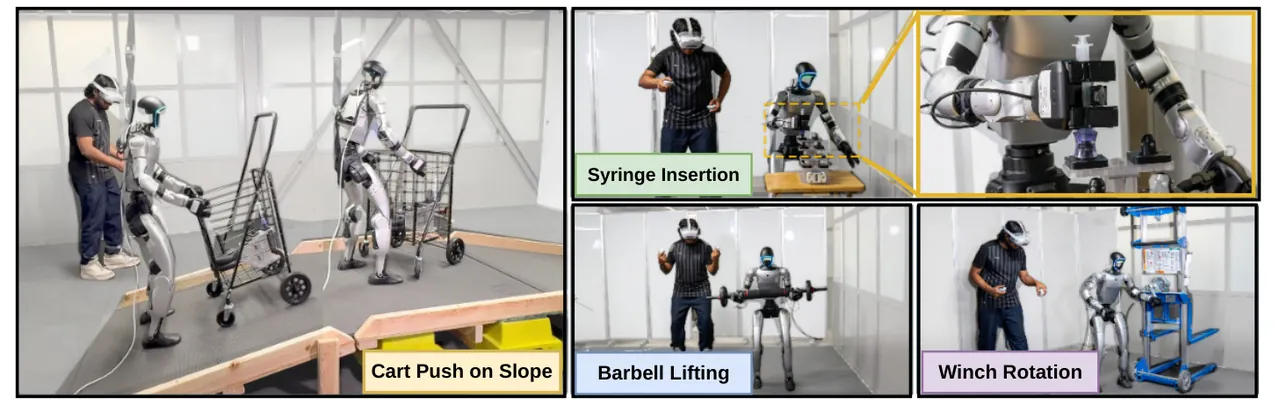
Figure 1: The task surface of BRACE. Left: pushing a cart up a slope. Right: syringe insertion (linear force), barbell lifting (heavy-load compensation) and winch rotation (angular torque).
Background and motivation
Whole-body tracking has become the standard route from human motion to humanoid motion: a trajectory retargeted from a demonstrator is followed by a controller that keeps the robot upright while it reproduces the reference. The approach scaled because its data scaled. Motion capture and in-the-wild video supply reference trajectories in quantity, and recent systems use the resulting trackers as teleoperation interfaces that collect demonstrations for downstream policies.
What those corpora do not contain is force. A demonstrator is recorded on level ground carrying nothing; the record preserves the path the body took but not the loads it bore or the reactions it absorbed. For locomotion and gesture little is lost. For the work humanoids are meant to do, what is lost is the specification: moving a payload, pulling a door against its closer, or steadying a workpiece while turning a tool is defined by the wrench $w=[F,\tau]$ the robot exchanges with its environment at least as much as by the trajectory it follows. Terrain is missing for the same reason, and under teleoperation the two omissions compound: the operator stands unloaded in a capture volume on level ground while the robot walks a ramp with a box in its hands.
Existing controllers address one side or the other. Force-capable legged systems accept an end-effector force alongside a base velocity, or impedance parameters in place of a force; because none prescribes a dense whole-body pose, the question of producing a force while holding a posture never arises. Terrain-adaptive controllers infer ground geometry from proprioception but treat loads and pushes as disturbances to reject rather than wrenches to command.
Combining the two inside one whole-body reference is hard because each signal contradicts that reference. A commanded wrench is conventionally realized by displacing the end effector; displace it without adjusting the rest of the body and the robot loses balance once the reaction arrives, while the pose the tracker is asked to hold diverges from the pose that would produce the force. The operator's support surface is likewise not the robot's, leaving reference footholds and root height systematically wrong, and no dataset pairs retargeted humanoid motion with the terrain it was executed on, so the correction cannot be learned directly.
BRACE (Body Reference Adaptation for Contact and Elevation) resolves the conflict at its source by correcting the reference rather than the controller. A flat-ground reference is adapted analytically to the terrain the robot stands on and to the wrench it is asked to exert, so tracking the adapted reference already yields the footholds, hand displacement and bracing the task requires. Two privileged teachers learn on these references, one exerting a commanded wrench and one holding the reference against an external one, and both are distilled into a single flow-based student that runs from proprioception and operator commands alone, inferring terrain and load on the fly.
Preliminaries
The first ingredient is goal-space redirection: the actor observes a goal derived from the flat-ground reference, $s_g$, rather than the adapted target $x^{\star}$ on which the reward is evaluated. Privileged information (terrain, load) therefore lives in the reward and in teacher training only, and the student never needs it.
The second is a spring-damper compliance model. Task-space force generation is modeled as spring-damper compliance along the force direction: the hand displaces by $\delta_p$ into the contact, and displacement times directional stiffness $k_F$ is the force produced. The directional stiffness is not a hand-set constant but is projected out of the joint-level PD gains through the Jacobian, so reaching the displaced target and producing the target force become the same event.
The third is flow matching with DAgger. When nearly identical proprioceptive states demand very different actions under different interaction modes, the conditional action distribution is multimodal; squared-error regression averages the modes into an action that matches none of them, while flow matching models the whole distribution. DAgger then labels the states the student's own rollouts reach with teacher actions, mitigating covariate shift in behavior cloning.
Method
Framework. BRACE takes exactly two operator inputs: a flat-ground kinematic reference $x_{\mathrm{ref}}$ retargeted from human motion capture, and a set of commanded hand wrenches $w_{\mathrm{cmd}}=\{w_h\}_h$ with $w_h=[F_h;M_h]\in\mathbb{R}^6$ giving the force and moment per hand. The reference conflicts with the terrain geometry $\mathcal{H}$ (it assumes a flat floor, causing foothold and root errors) and with $w_{\mathrm{cmd}}$ (exerting or resisting a wrench requires whole-body bracing and contact displacement, neither of which exists in unloaded human recordings). Training an RL policy to discover these corrections through auxiliary rewards creates a signal conflict, because trajectory-tracking rewards penalize exactly the pose deviations that are necessary. BRACE removes the conflict before policy learning by transforming $x_{\mathrm{ref}}$ analytically, reducing learning to tracking geometrically adapted, effort-limited targets:
$$x_{\mathrm{ref}}^{T}=\mathcal{T}(x_{\mathrm{ref}},\mathcal{H}),\qquad x_{E}^{\star}=\mathcal{F}(x_{\mathrm{ref}}^{T},w_{\mathrm{cmd}}),\qquad x_{C}^{\star}=x_{\mathrm{ref}}^{T}$$
The compensation teacher tracks $x_C^{\star}=x_{\mathrm{ref}}^{T}$ (terrain-adapted only); the exertion teacher tracks $x_E^{\star}$, which additionally carries the wrench adaptation.
Terrain adjustment $\mathcal{T}$. Kinematic retargeting ignores local surface height, producing foothold errors on slopes and steps. For each foot contact target $(x_f,y_f,z_f^{\mathrm{ref}})$, $\mathcal{T}$ preserves horizontal placement and lifts the elevation to $z_f^{T}=\mathcal{H}(x_f,y_f)+z_f^{\mathrm{ref}}$, maintaining swing clearance relative to the local ground. Root elevation follows the terrain beneath the base, and the local surface normal rotates the foot orientation targets while the root orientation stays aligned with the locomotion direction. A whole-body inverse-kinematics step then reconciles the foot and root adjustments with the upper-body pose, producing the terrain-adjusted reference $x_{\mathrm{ref}}^{T}$.
Wrench adjustment $\mathcal{F}$, in three moves. Generating external forces requires end-effector displacement into the contact plus a center-of-mass (COM) shift to counteract the reaction. $\mathcal{F}$ first caps the commanded wrench to a feasible wrench $w^{\star}=[F^{\star};M^{\star}]$, then converts $w^{\star}$ into coordinated hand leads and COM shifts, the three callouts in Figure 2.
(1) Feasibility limits. Both teachers must decide which wrenches the arms can support: Teacher-E to cap what it asks the robot to exert, Teacher-C to cap what it applies as a disturbance, and one limit serves both. Force and moment consume the same arm-joint effort, so they are constrained jointly rather than separately. Omitting the hand index and writing a single hand's force and moment as $F,M$, the translational and rotational arm Jacobians $J_p,J_r$ map the wrench to induced joint torques, which a teacher-specific margin $0<\gamma<1$ holds inside a joint-torque budget:
$$\bigl|\bigl(J_{p}^{\top}F+J_{r}^{\top}M\bigr)_{i}\bigr|\leq\gamma\,\tau_{i}^{\mathrm{budget}}$$
The budget itself differs by teacher: Teacher-E uses the actuator limit $\tau_i^{\mathrm{budget}}=\tau_i^{\max}$ evaluated at the terrain-adjusted reference, while Teacher-C uses a floored residual-effort proxy evaluated at the current robot configuration (Eq. 6). For Teacher-E this constraint, together with hand-excursion bounds, turns $w_{\mathrm{cmd}}$ into $w^{\star}$; the contact-weighted foot support polygon and its eroded inner margin bound center-of-pressure travel and the COM brace, and a shared support-based scale limits both hands' force and moment commands, smoothed and lower-bounded across gait transitions.
(2) Hand lead. Task-space force generation is modeled as spring-damper compliance along the force direction $\hat{n}=F^{\star}/\|F^{\star}\|$. Given diagonal joint stiffness $K_q$ and damping $D_q$, the directional stiffness $k_F$ and hand displacement $\delta_p$ satisfy
$$k_{F}^{-1}=\hat{n}^{\top}J_{p}K_{q}^{-1}J_{p}^{\top}\hat{n},\qquad d_{F}\dot{\delta}_{p}+k_{F}\delta_{p}=\|F^{\star}\|$$
with the directional damping $d_F$ defined analogously from $D_q$. Deriving $k_F$ from the joint gains matches the lead to the compliance of the PD-controlled arm, so reaching the displaced target produces $F^{\star}$. Rotational leads driven by the rotational stiffness $k_M$ and moment direction $\hat{m}=M^{\star}/\|M^{\star}\|$ follow the same formulation. Directions exist only for nonzero commands: commands below 1 N or 0.3 N·m are zeroed, the corresponding lead vanishes, and the directional stiffness and damping revert to their default constants.
(3) COM brace. Sustained hand wrenches generate overturning moments about the feet that must be counteracted by leaning the torso. Countering the reaction wrench $-w^{\star}$ requires a horizontal COM shift
$$\Delta c=\frac{\hat{z}\times\sum_{h}\bigl[(p_{h}-c_{\mathrm{cop}})\times(-F_{h}^{\star})-M_{h}^{\star}\bigr]}{mg}$$
where $p_h$ is the contacting hand position, $c_{\mathrm{cop}}$ the contact-weighted foot centroid approximating the center of pressure, $m$ the robot mass, $g$ gravitational acceleration and $\hat{z}$ the vertical unit vector. Center-of-pressure travel within the support polygon absorbs part of $\Delta c$; the bounded remainder forms the brace, half of which the hand targets inherit. A final whole-body IK step reconciles the displaced hand targets, the braced COM position and the terrain-adjusted foot positions into the kinematically valid adapted target $x_E^{\star}$.
Teacher-E: force exertion. Teacher-E observes the terrain-invariant goal $s_g^E$: the flat-ground reference offset by the hand leads and COM brace, with absolute root elevation removed. The wrench command reaches the policy only through this displacement. Tracking alone exerts nothing, because in an empty simulator the hand reaches its displaced target without producing force. A virtual wrench field anchored at the terrain-adjusted reference hand therefore supplies the reaction: for a hand translation $p$ along $\hat{n}$ and twist $\theta$ about $\hat{m}$, both measured relative to the torso pose,
$$f_{\mathrm{meas}}=k_{F}(\bar{p}+b/2)+d_{F}\dot{p},\qquad m_{\mathrm{meas}}=k_{M}\theta+d_{M}\dot{\theta}$$
where $\bar{p}$ is $p$ smoothly bounded to the allowed excursion and $b$ is the planned brace along $\hat{n}$. The $b/2$ term credits the half of the brace not inherited by the hand targets to the spring force, so leaning into the contact counts toward exertion. The simulator applies the reaction $-w_{\mathrm{meas}}$ at the hand. Rewards score tracking against $x_E^{\star}$, normalized wrench error and motion smoothness; the wrench error is measured against the feasible target $w^{\star}$ rather than $w_{\mathrm{cmd}}$, so the policy is judged by what the terrain and joint budget permit. The total is $r_{\mathrm{exert}}=r_{\mathrm{tracking}}+r_{\mathrm{wrench}}$.
Teacher-C: force compensation. Teacher-C tracks $x_C^{\star}=x_{\mathrm{ref}}^{T}$ while the simulator applies an external wrench $w_{\mathrm{ext}}$ at the hands. Resisting such wrenches requires holding the reference posture without collapsing under load or over-correcting when the load vanishes. Following the torque-aware curriculum of FALCON, loads are bounded by Eq. 2 evaluated at the current robot configuration with the floored residual-effort budget
$$\tau_{i}^{\mathrm{budget}}=\max\bigl(\tau_{i}^{\max}-|\tau_{i}|,\ \epsilon\,\tau_{i}^{\max}\bigr)$$
where $\tau_i$ is the torque already spent on gravity and tracking and $\epsilon>0$ preserves a minimum range. A random application offset $r_h$ in the hand frame adds the moment $r_h\times F_h$, so force and moment are constrained jointly. Load profiles sweep force and moment through randomized triangular pulses separated by unloaded intervals, exposing the policy to load release, and an adaptive curriculum raises each environment's load scale after sustained success and lowers it after falls. The privileged encoder receives a short history of the applied wrench, letting the teacher brace before a load peaks. Teacher-C receives tracking and regularization rewards only; compensation emerges from tracking-error minimization under load.
Shared teacher architecture. Both teachers use the same architecture. The actor observes a goal derived from the flat-ground reference ($s_g^E$ or $s_g^C$) rather than the adapted target $x^{\star}$ on which the reward is evaluated; its remaining inputs are proprioception (joint positions and velocities, base angular velocity, gravity direction), a short observation history and a privileged latent. The privileged encoder compresses the terrain height scan, the root height above terrain and teacher-specific channels (surface normal for Teacher-E, applied-wrench history for Teacher-C) into that latent. Two heads share the policy trunk: an action head commanding joint position targets for the 29 actuated joints, and an auxiliary reconstruction head predicting $x^{\star}$, which forces the trunk to represent the full-body pose corrections. Both teachers train with PPO and asymmetric critics that additionally observe the full simulator state; only the action head is retained afterwards.
Flow-based student distillation. The teachers depend on privileged terrain and wrench signals the robot lacks, so both are distilled into a single deployable student with DAgger. A mode flag $\mu\in\{E,C\}$ selects the active teacher during training rollouts; rollouts include regime-switching transitions (ramping the active load to zero, switching the mode flag, ramping the incoming wrench) so that mid-motion mode switches are covered. Note that the student consumes only the flat-ground goals $s_g^{E,C}$, which are available at inference and can be supplied by a teleoperator.
Three student blocks. Exerting a wrench and resisting an external load require different joint actions from nearly identical proprioceptive states, so the goal-free base's conditional action distribution is multimodal and flow matching represents it rather than averaging it. First, a flow-matching base maps Gaussian noise to a base joint position action conditioned on a 25-frame proprioceptive history $s_p$, with no goals or mode flags. Second, a deterministic task encoder maps proprioception and its history together with the flat-ground goals $s_g^{E,C}$, the mode flag $\mu$ and the wrench command $w_{\mathrm{cmd}}$ into a compact task latent. Third, an action decoder combines the base action and the task latent into the executed joint commands. Training uses behavior cloning on the selected teacher's actions, a flow-matching loss on the base, an exertion loss weighting action errors by their sensitivity to hand force, and the estimation regression below.
Terrain and load estimation. The student is deployed directly on the real robot, where onboard sensors observe neither terrain geometry nor external wrench, so it must infer both from proprioceptive dynamics. An auxiliary estimation head regresses the privileged simulator states (local hand positions, root velocity, external wrench, surface normal, root height above terrain) from the task latent during training; the head is discarded at export, and the deployed student observes only proprioception, goals, mode flag and wrench command.
Implementation and deployment. All policies command PD position targets for the 29-DoF Unitree G1 at 50 Hz, with the flow base integrated by four Euler steps per action. Teachers use an 8-frame observation history and the student a 25-frame history; the height scan is a 16 × 16 grid covering 2.0 m × 2.0 m in the base frame and the wrench history spans 3 frames. Both teachers use $\gamma=0.7$ in the shared arm-effort limit; in $\mathcal{F}$ the hand-excursion budget is 0.15 m and the support polygon is eroded by 0.02 m; directional stiffnesses are lower-bounded for numerical stability and the support-polygon scale is low-pass filtered to stay smooth across double-to-single support transitions. The compensation teacher is trained up to 20 N, the exertion teacher up to 9 N, and torque limits for both are 4 N·m, all within the physical limits of the G1's arms. Teachers and student are each trained on 8× NVIDIA RTX Pro 6000 GPUs with 2048 environments and batch size 8192 per GPU, in Isaac Lab via ProtoMotions; reference trajectories come from Bones-Seed, selected by text semantics for locomotion and object manipulation, yielding about 65k trajectories. Real-robot deployment infrastructure for the flow policy is built on RoboJuDo.
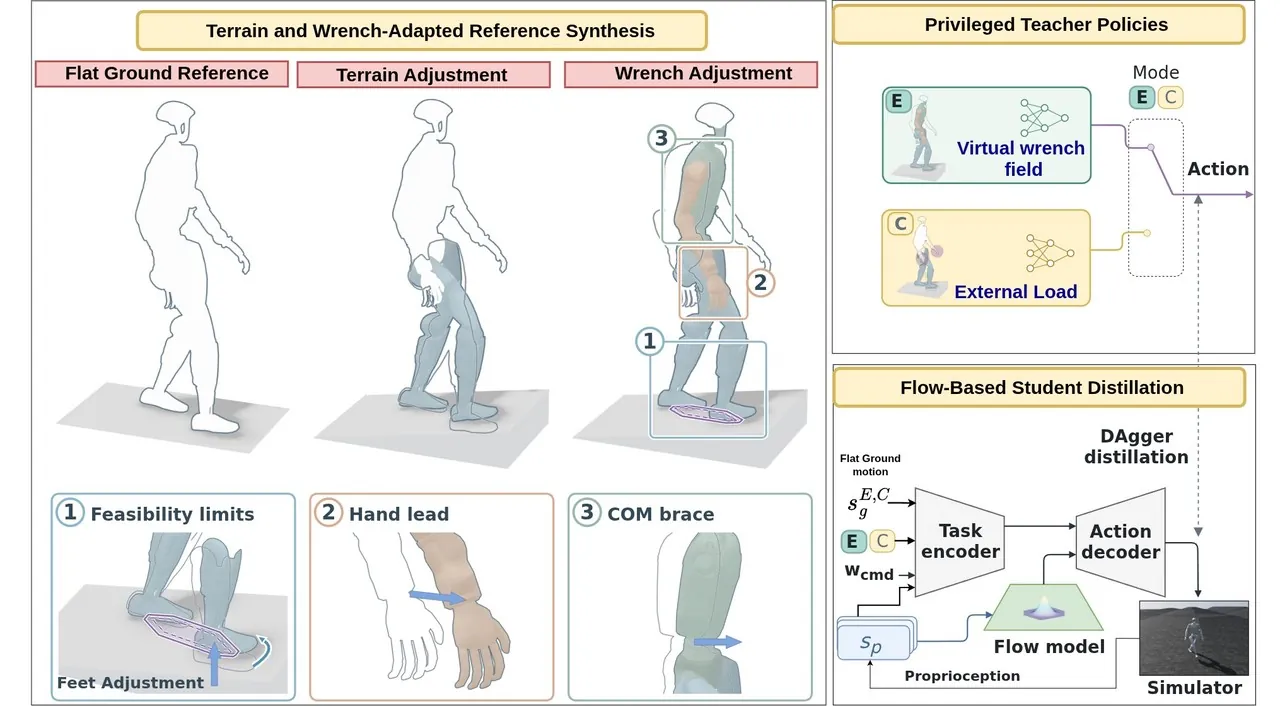
Figure 2: BRACE overview. Left: terrain- and wrench-adapted reference synthesis; the flat-ground reference becomes $x_{\mathrm{ref}}^{T}$ through foot alignment, then $x_E^{\star}$ through (1) feasibility limits, (2) hand lead and (3) COM brace. Top right: privileged teachers; Teacher-E learns exertion under a virtual wrench field, Teacher-C compensation under an external load, selected by the mode switch. Bottom right: DAgger distills both teachers into one student whose task encoder consumes flat-ground goals, mode and wrench command, whose flow-matching base models the action distribution from proprioceptive history, and whose action decoder fuses both.
flowchart TD
  A["flat-ground reference x_ref about 65k Bones-Seed trajectories"] --> B["terrain adjustment T lift feet and root onto local surface"]
  B --> C["x_ref^T terrain-adapted reference"]
  C --> D["wrench adjustment F"]
  D --> D1["1 feasibility limits Eq2 Eq6"]
  D --> D2["2 hand lead spring-damper Eq3"]
  D --> D3["3 COM brace Eq4"]
  D1 --> E["x_E star exertion target"]
  D2 --> E
  D3 --> E
  C --> F2["x_C star equals x_ref^T compensation target"]
  E --> G["Teacher-E virtual wrench field Eq5"]
  F2 --> H["Teacher-C external load triangular-pulse curriculum"]
  G --> I["DAgger distillation mode flag mu with switching transitions"]
  H --> I
  I --> J["task encoder flat goals mode wrench command"]
  I --> K["flow-matching base 25-frame proprioceptive history"]
  J --> L["action decoder"]
  K --> L
  L --> M["29 joint PD targets at 50 Hz proprioception-only deployment"]
Experiments and results
Protocol. Baselines are the state-of-the-art whole-body trackers SONIC, TWIST2 and Any2Track plus the payload-oriented HEFT; force-commanding controllers (UNIFP, FACET) are excluded because neither accepts a whole-body reference trajectory, so neither admits this protocol without redefining its command interface. Evaluation runs in parallel GPU simulation in Isaac Lab on the 29-DoF G1, with each baseline keeping its native observations, action decoding and joint gains; every BRACE number uses the deployed student, which observes neither the simulator height map nor the applied compensation wrench. Motions come from PHUMA and a held-out Bones-seed test split built from motions absent from training, identical for every method. Compensation holds the motion reference unchanged while each hand receives a constant 0-20 N load sampled uniformly on a sphere and held fixed for the episode; exertion commands 3-9 N per hand in the torso-heading frame and tracks the force-compensated reference; terrain uses slopes of nominal grade 4.6-17.7 degrees (realized grade varies along the trajectory), and in both terrain settings the policy receives only the flat-ground reference and must handle the slope blind from proprioception. Success criteria are identical for all methods: torso, wrist and ankle heights must each stay within 0.25 m of reference and torso orientation error within 1 rad throughout; flat ground additionally requires the torso's mean horizontal distance from reference to be at most 0.5 m, while terrain requires MPJPE-G at most 0.5 m.
Compensation on flat ground and slopes. Without load, all methods are comparable on flat ground, with SONIC keeping the lower local pose error, as expected for a tracker specialized for imitation. As the load grows every baseline degrades steadily while BRACE degrades gently, and the curves cross by 15 N; at the highest tested load of 20 N per hand BRACE leads the best baseline by 10.7 percentage points in success. The global-error panel shows where the baselines fail: their MPJPE-G more than doubles over the sweep whereas BRACE's rises far less and ends 40% lower than the best baseline, including HEFT, which is trained for payload compensation. Local error stays within 10% of SONIC's throughout, so the baselines are not losing pose fidelity; they are being pushed off their intended position. On slopes the ordering no longer depends on load: BRACE leads at every load, already without any hand load, and the gap widens to 22.9 percentage points at 20 N, twice the flat-ground margin, with global error ending 43% below the best baseline while local error is indistinguishable from SONIC's. All methods receive the same flat-ground reference and no terrain information, so the difference lies in how each policy reconciles that reference with the slope it feels: the baselines track the flat reference literally and slide away from the target, whereas BRACE's terrain-conformed training lets it hold position on the incline while also resisting the load.
Exertion on flat ground and slopes. On flat ground all models are fed the flat force-compensated reference $s_g^E$, and a virtual spring-mass-damper acts on the moving robot in simulation to supply the reaction of a real interaction. Baselines can exert small forces but not large ones: at the 3 N command SONIC and HEFT succeed on most motions with force errors within about 1 N of BRACE, but as the command increases SONIC's success drops by more than 20 points and its global error more than doubles while HEFT declines more gradually. BRACE's success and global error are nearly flat across the whole 3-9 N range; at 9 N it exceeds HEFT's success rate by 5.7 percentage points with 35% lower global error, and achieves the lowest force error at every command, a 34% reduction relative to the closest baseline at 9 N. The terrain setting combines both demands, exerting a commanded force from diverse poses while handling an unobserved slope: BRACE's success stays flat across the command range and matches its unloaded terrain tracking rate, while SONIC loses nearly 30 points from 3 to 9 N and HEFT starts lower and declines further. The resulting margin at 9 N is 33.7 percentage points, the largest of all four settings, with 42% lower global error and 47% lower force error than the closest baseline. The four panels agree: the harder the setting, the larger BRACE's advantage, and the advantage comes from retaining global position and force accuracy rather than from tighter pose imitation.
| Setting | Highest load / command (per hand) | Success vs. best baseline | Global error (MPJPE-G) | Force error |
|---|---|---|---|---|
| Compensation, flat | 20 N | +10.7 pp | 40% lower | - |
| Compensation, slope | 20 N | +22.9 pp | 43% lower | - |
| Exertion, flat | 9 N | +5.7 pp (vs. HEFT) | 35% lower | 34% lower |
| Exertion, slope | 9 N | +33.7 pp | 42% lower | 47% lower |
Torque analysis. Real tasks often require torque, or a complete wrench: rotating a forklift winch, as in Figure 1, needs torque control. The paper reports moment error for commanded torques of 0.5-2.5 N·m on flat and sloped terrain; BRACE has the lowest error at every command, 33% below the closest baseline on flat ground and 32% on the slope, showing that what it exerts is the commanded wrench and not merely a force.
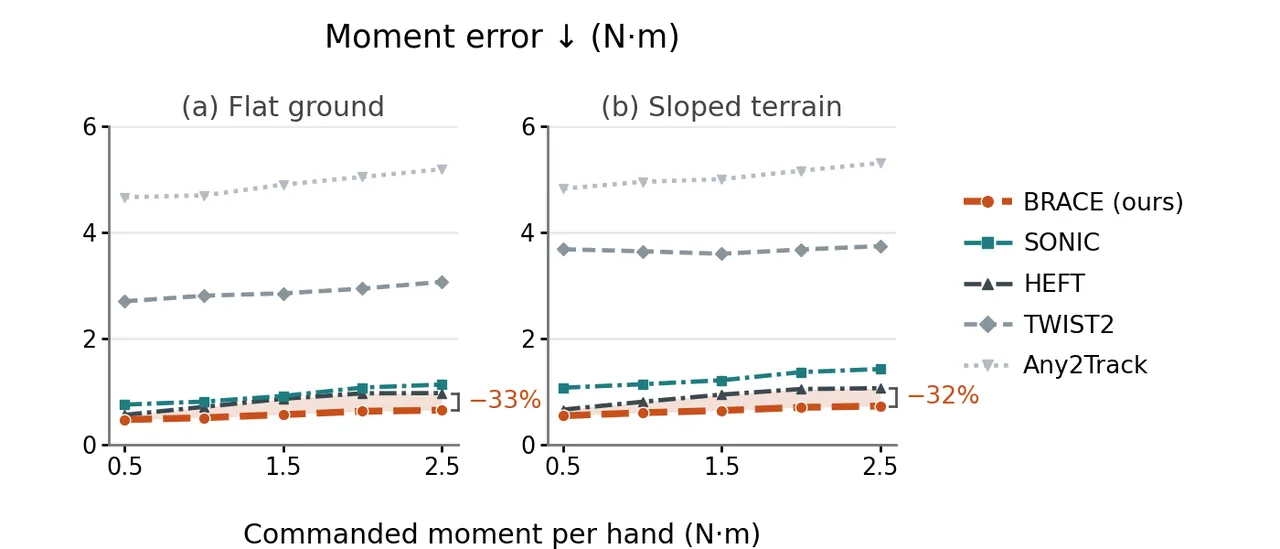
Figure 3: Moment exertion error for commanded torques of 0.5-2.5 N·m. Left: flat ground. Right: sloped terrain. BRACE is lowest at every command, 33% below the closest baseline on flat ground and 32% on the slope.
| Item | Configuration |
|---|---|
| Robot and control | 29-DoF Unitree G1, PD position targets at 50 Hz, flow base integrated with 4 Euler steps per action |
| Observation history | 8 frames for teachers, 25 frames for the student, 3 frames of wrench history |
| Privileged terrain input | 16 × 16 height scan covering 2.0 m × 2.0 m in the base frame |
| Arm-effort constraint | gamma = 0.7 shared by both teachers; hand-excursion budget 0.15 m; support polygon eroded by 0.02 m |
| Force / torque training caps | compensation teacher 20 N, exertion teacher 9 N, torque 4 N·m, within the G1 arm limits |
| Training scale | 8x NVIDIA RTX Pro 6000 per policy, 2048 environments and batch 8192 per GPU, Isaac Lab with ProtoMotions |
| Reference data | Bones-Seed filtered by text semantics for locomotion and object manipulation, about 65k trajectories |
| Success criteria | torso / wrist / ankle height deviation at most 0.25 m and torso orientation error at most 1 rad; flat: mean torso horizontal distance at most 0.5 m; terrain: MPJPE-G at most 0.5 m |
Hardware and applications. The BRACE policy is deployed directly on the Unitree G1, and four application surfaces are demonstrated. VLA integration: 362 teleoperated G1 demonstrations of transferring three bananas from a table into a container fine-tune GR00T N1.7 3B to predict whole-body and Dex3 hand commands from vision, proprioception and a fixed instruction, executing autonomously on hardware. Remote teleoperation: operation across sites roughly 1,000 miles apart, with BRACE adapting operator references to the robot's terrain. VR teleoperation: PICO controller poses stream through XRoboToolkit and are retargeted to the G1 with GMR, tracked by BRACE under varying terrain and loads. Interactive modes: gamepad root-velocity commands drive MotionBricks to generate whole-body G1 trajectories, and BRACE tracks both reference sources on hardware.
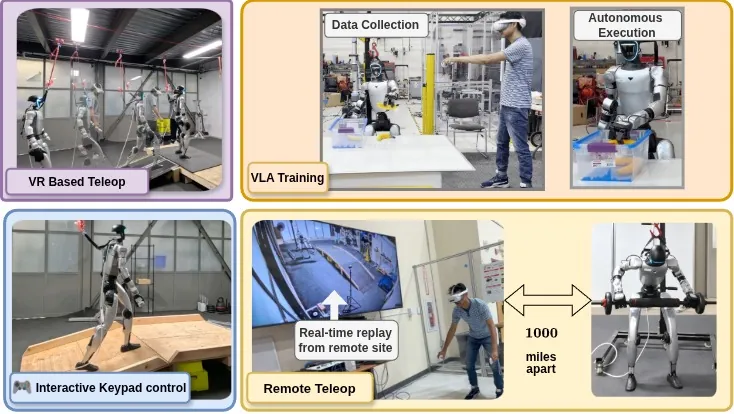
Figure 4: Application surface of BRACE. VR teleoperation and interactive keypad control supply references; teleoperated demonstrations feed VLA training and autonomous execution; in remote teleoperation across roughly 1,000 miles, BRACE adapts terrain and load on the robot side.
Limitations
First, stated by the authors: relative force accuracy against force-commanding controllers remains untested. BRACE is compared against motion and payload trackers; UNIFP and FACET are excluded because they do not accept a whole-body reference, so the question of how BRACE's force accuracy compares with dedicated force controllers is left open by the paper itself.
Second, a scope limit the authors state: BRACE focuses on proprioception-centric whole-body control and handles only non-flat terrain that proprioception can resolve, namely slopes, rough-surface inconsistencies and small platforms. Terrain that needs visual look-ahead, such as discrete steps, gaps or obstacles requiring foothold planning, is out of scope because the student has no exteroceptive input at all.
Third, the force and torque ranges are capped by the platform's physics: compensation is trained to 20 N, exertion to 9 N and torque to 4 N·m, deliberately conservative settings inside the G1 arm limits. Genuinely heavy payloads such as carrying crates or steadying heavy workpieces lie beyond the tested envelope, and every success-rate and error curve in the paper lives inside it.
Fourth, the adaptation is analytic and quasi-static: the hand lead uses a spring-damper steady-state relation and the COM brace a static $mg$ balance, so dynamic transients, contact friction cones and grasp stability are not modeled. All quantitative comparisons are in simulation with hardware shown qualitatively, and the success criteria (0.25 m height tolerance, 1 rad orientation tolerance) are comparatively loose, so fine-grained pose fidelity has to be read off MPJPE-L alongside the success numbers.
Conclusion and outlook
BRACE moves force and terrain, the two things missing from whole-body tracking corpora, from the controller side back to the reference side: terrain conformance lifts feet and root, the wrench transformation resolves hands and COM, two privileged teachers learn one interaction paradigm each, and DAgger distills them into a single flow-matching student that runs on proprioception alone. The operator keeps the simplest possible input, a flat-ground trajectory plus a wrench command, while slope and load are resolved onboard. At each setting's highest tested load or command BRACE cuts global tracking error by 40% on average and improves success by 18.25 percentage points, and on hardware it inserts syringes, turns winches, lifts barbells and pushes carts up slopes. Treating the reference as an adaptable interface rather than sacred ground truth pays off directly for teleoperation, VLA data collection and cross-site work; the natural next steps are pushing the envelope past the platform's arm limits, giving the student visual look-ahead, and meeting dedicated force controllers on a shared force-accuracy yardstick.
Golden line
The record preserves the path the body took but not the loads it bore or the reactions it absorbed, and for the work humanoids are meant to do, what is lost is the specification itself.