Skip to content
Tags

#Unitree G1 (45)

CAP: Continuously Adaptive Perception-Blind Humanoid Locomotion via Learned Denoising

CAP: Continuously Adaptive Perception-Blind Humanoid Locomotion via Learned Denoising

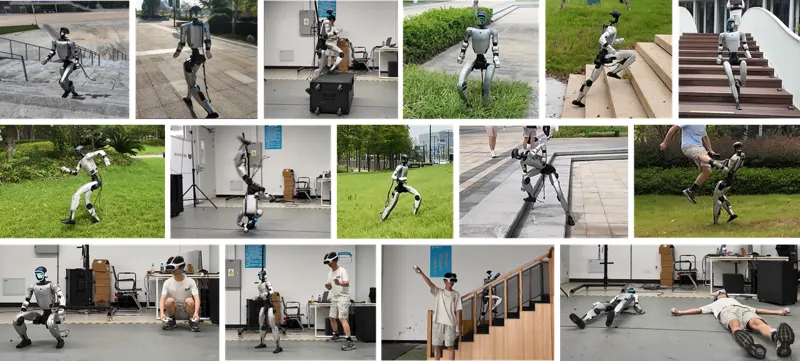
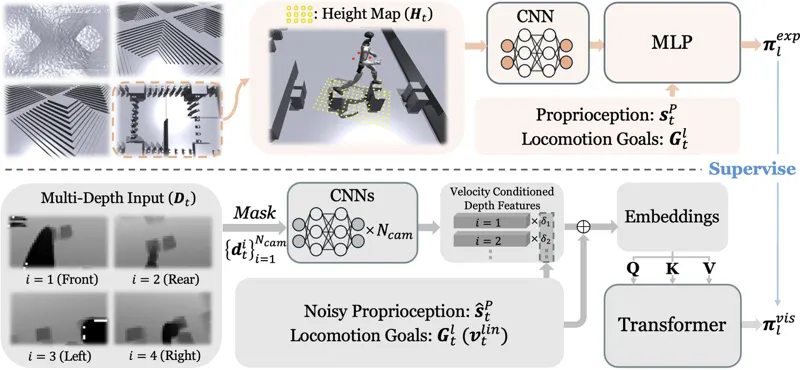
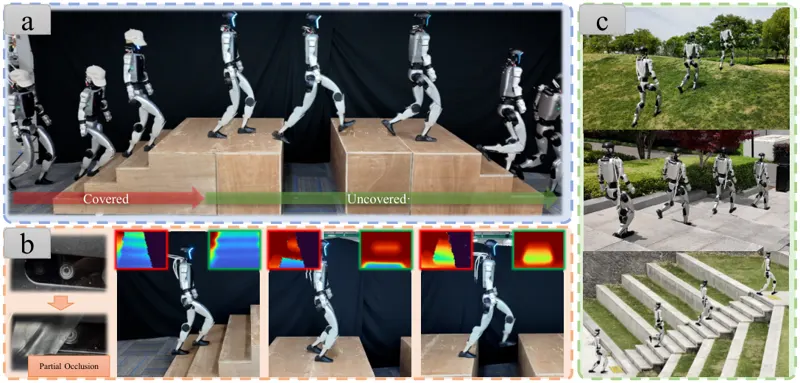
Humanoid locomotion across complex terrain demands forward-looking exteroception to anticipate obstacles, yet this signal is unreliable in real-world deployment, failing partially and intermittently. Existing perceptive policies often assume that depth observations remain clean and in-distribution, while recent attempts to unify perceptive and blind control typically route or switch between separate sub-policies, leaving recoverable information in partially corrupted depth unexploited. We instead propose CAP, a single-stage humanoid locomotion policy that recovers this signal with a perceptive world-model encoder trained as a learned denoiser to reconstruct clean depth from a corrupted input, together with a co-active proprioceptive variational encoder that supplies depth-free body-state information. A coupled training recipe pairs a depth-noise curriculum on the world-model input with world-model feature dropout on the policy-facing latent, exposing the policy to failures across the entire perception-quality spectrum. In simulation, CAP matches or improves upon perceptive baselines when depth remains informative, and degrades more smoothly than a binary-switching baseline as perception worsens. On the Unitree G1, controlled trials and indoor-outdoor deployments demonstrate perception-robust locomotion under intermittent occlusion, real-sensor corruption, and outdoor depth artifacts.
Chen, Hongjin, Xu, Zijun, Ma, ShihaoSep 10, 2026
Humanoid LocomotionWorld ModelsDepth DenoisingSep 10, 2026
TANGO: Humanoid Navigation in Cluttered Environments with a Whole-Body Vision-Language-Action Model

TANGO: Humanoid Navigation in Cluttered Environments with a Whole-Body Vision-Language-Action Model

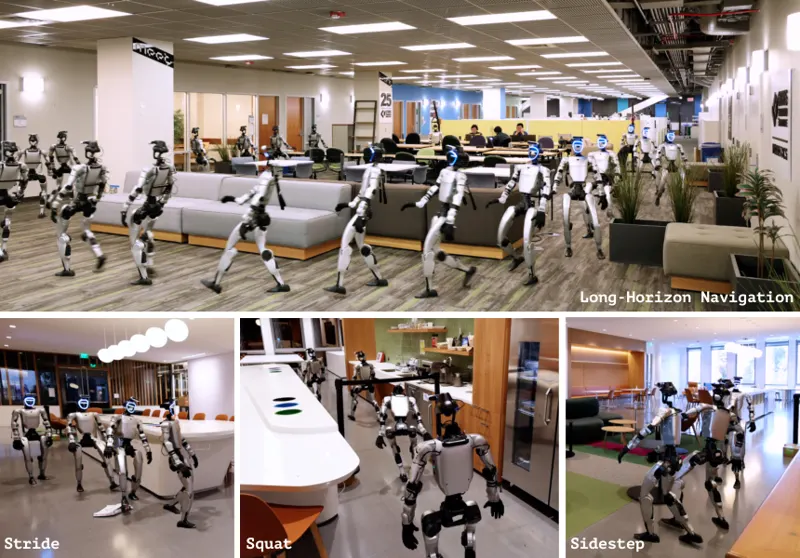
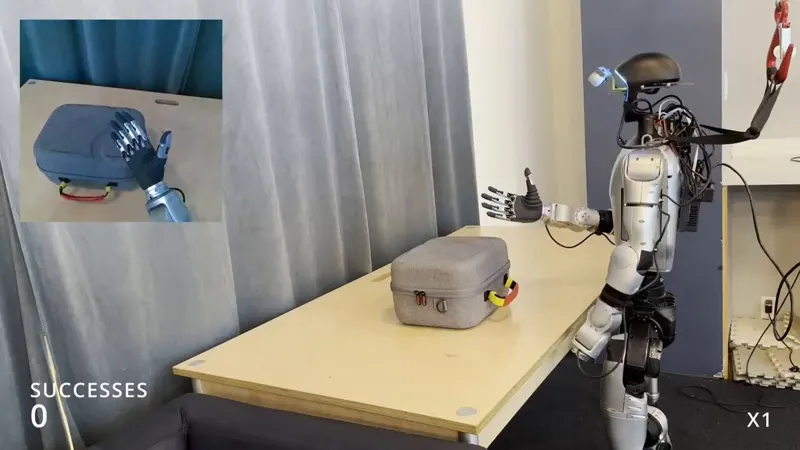
We study the problem of navigating cluttered indoor environments with a humanoid robot. Unlike conventional methods that model navigation as a 2D path planning problem, humanoid traversal in cluttered environments requires continuous geometry-aware whole-body adaptation, including coordinated arm placement, torso adjustment, and gait modulation for collision-free movement through complex 3D spaces. We introduce TANGO, the first whole-body vision-language navigation framework for language-conditioned humanoid traversal in cluttered environments. Given a natural-language instruction and egocentric RGB observations, TANGO directly predicts 29-DoF joint-space actions for downstream whole-body control. We train TANGO entirely in simulation by synthesizing diverse collision-free traversal behaviors via global path planning, kinematic whole-body motion generation, obstacle-aware motion editing, and RL-based tracking. This pipeline provides dynamically feasible action supervision for learning language-conditioned whole-body policies. In extensive simulation experiments, TANGO demonstrates state-of-the-art performance in vision-language navigation, while outperforming strong modular baselines in navigating challenging scenes requiring obstacle negotiation. Lastly, we deploy TANGO zero-shot on a Unitree G1 humanoid robot, and observe robust language-guided traversal in cluttered real-world scenes without training on any real-world navigation data.

Anqi Li, Yuxin Chen, Zhaobo LiSep 8, 2026
HumanoidVLANavigationSep 8, 2026
Towards Adaptable Humanoid Control via Adaptive Motion Tracking

Towards Adaptable Humanoid Control via Adaptive Motion Tracking

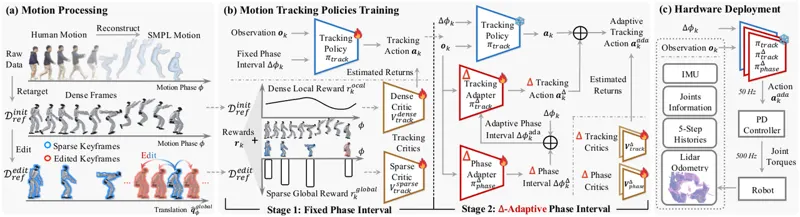
Humanoid robots are envisioned to adapt demonstrated motions to diverse real-world conditions while accurately preserving motion patterns. Existing motion prior approaches enable well adaptability with a few motions but often sacrifice imitation accuracy, whereas motion-tracking methods achieve accurate imitation yet require many training motions and a test-time target motion to adapt. To combine their strengths, we introduce AdaMimic, a novel motion tracking algorithm that enables adaptable humanoid control from a single reference motion. To reduce data dependence while ensuring adaptability, our method first creates an augmented dataset by sparsifying the single reference motion into keyframes and applying light editing with minimal physical assumptions. A policy is then initialized by tracking these sparse keyframes to generate dense intermediate motions, and adapters are subsequently trained to adjust tracking speed and refine low-level actions based on the adjustment, enabling flexible time warping that further improves imitation accuracy and adaptability. We validate these significant improvements in our approach in both simulation and the real-world Unitree G1 humanoid robot in multiple tasks across a wide range of adaptation conditions. Videos and code are available at https://taohuang13.github.io/adamimic.github.io/.

Huang, Tao, Wang, Huayi, Ren, JunliOct 16, 2025
HumanoidMotion TrackingReinforcement LearningOct 16, 2025
RoboGesture: Real-Time Semantic-aligned Co-Speech Gestures Generation for Humanoid Interaction

RoboGesture: Real-Time Semantic-aligned Co-Speech Gestures Generation for Humanoid Interaction

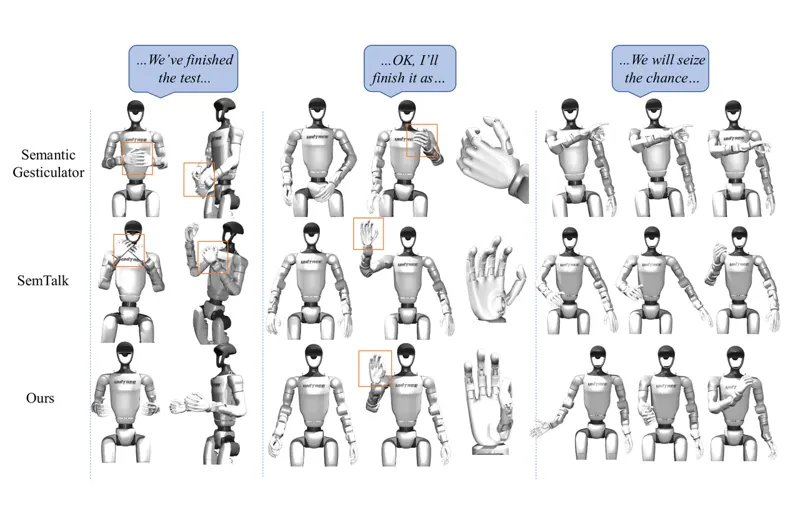
Enabling humanoid robots to respond to human speech with synchronized and semantically meaningful gestures is fundamental to natural human-robot interaction. However, this task faces three critical barriers: the scarcity of semantically rich datasets, the "modality eclipse" where models ignore audio cues in favor of kinematic inertia, and the sim-to-real gap regarding physical safety. We propose RoboGesture, a robot-centric framework that co-designs data, modeling, and control to power a complete interactive human-humanoid system in which the robot listens, responds, and gestures in real time. We first establish the RoboGesture dataset featuring over 300 gesture categories and develop an automated pipeline to synthesize large-scale collision-free, robot-specific audio-motion pairs. Our architecture features a Hierarchical Semantic-Acoustic Aligner that extracts multi-granular prosodic and semantic cues directly from raw audio tokens. These cues drive a Streaming Conditional Motion Generator based on a diffusion transformer with conditional flow matching. To ensure high responsiveness, we introduce Anti-Inertia CFG Masking, which prevents the model from collapsing into repetitive historical patterns by compelling it to proactively mine control signals from the audio modality. Finally, an MPC-based safety filter ensures real-time, collision-free execution on physical hardware. Experiments on a Unitree G1 humanoid demonstrate that RoboGesture generates safer, more rhythmic, and more semantically appropriate responses compared to state-of-the-art baselines.

Wang, Zifan, Ren, Ziang, Shi, PengyangAug 27, 2026
MPCSim-to-RealUnitreeAug 27, 2026
ZEST: Zero-shot Embodied Skill Transfer for Athletic Robot Control

ZEST: Zero-shot Embodied Skill Transfer for Athletic Robot Control

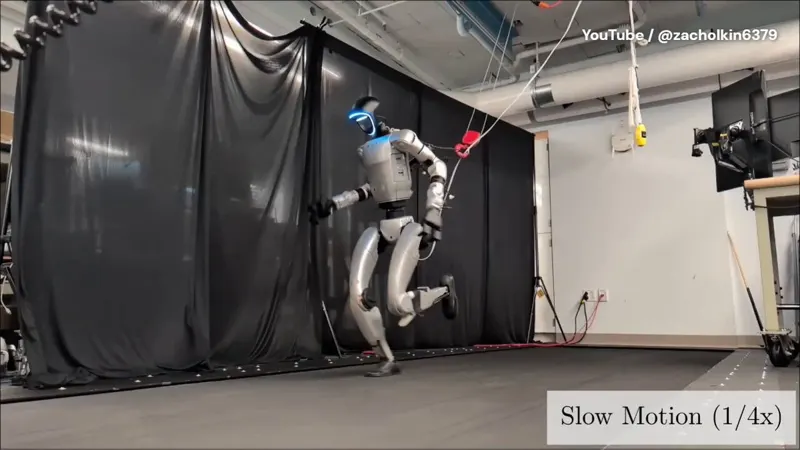
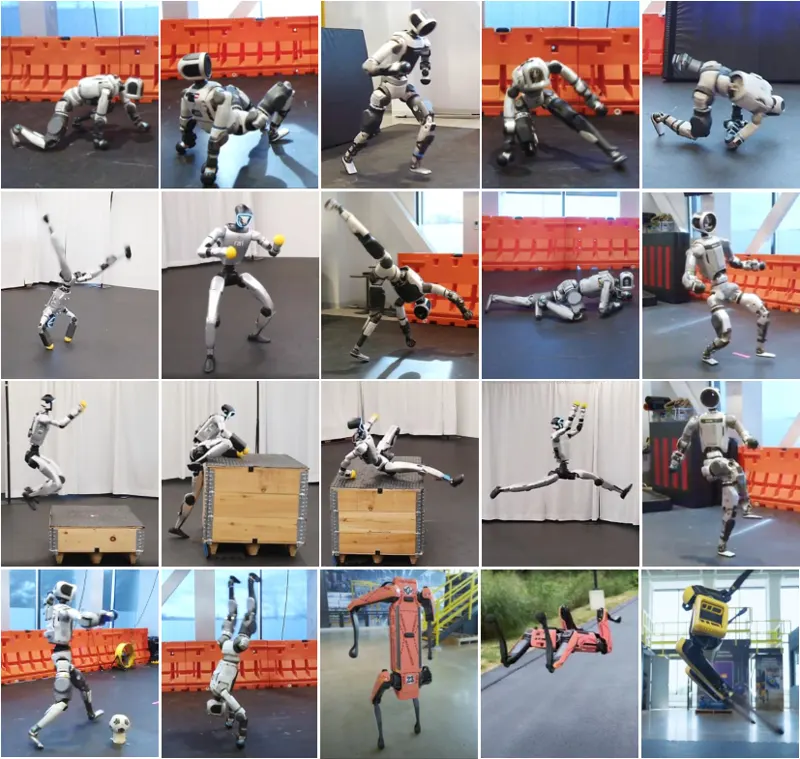
Achieving robust, human-like whole-body control on humanoid robots for agile, contact-rich behaviors remains a central challenge, demanding heavy per-skill engineering and a brittle process of tuning controllers. We introduce ZEST (Zero-shot Embodied Skill Transfer), a streamlined motion-imitation framework that trains policies via reinforcement learning from diverse sources – high-fidelity motion capture, noisy monocular video, and non-physics-constrained animation – and deploys them to hardware zero-shot. ZEST generalizes across behaviors and platforms while avoiding contact labels, reference or observation windows, state estimators, and extensive reward shaping. Its training pipeline combines adaptive sampling, which focuses training on difficult motion segments, and an automatic curriculum using a model-based assistive wrench, together enabling dynamic, long-horizon maneuvers. We further provide a procedure for selecting joint-level gains from approximate analytical armature values for closed-chain actuators, along with a refined model of actuators. Trained entirely in simulation with moderate domain randomization, ZEST demonstrates remarkable generality. On Boston Dynamics' Atlas humanoid, ZEST learns dynamic, multi-contact skills (e.g., army crawl, breakdancing) from motion capture. It transfers expressive dance and scene-interaction skills, such as box-climbing, directly from videos to Atlas and the Unitree G1. Furthermore, it extends across morphologies to the Spot quadruped, enabling acrobatics, such as a continuous backflip, through animation. Together, these results demonstrate robust zero-shot deployment across heterogeneous data sources and embodiments, establishing ZEST as a scalable interface between biological movements and their robotic counterparts.

Jean Pierre Sleiman, He Li, Alphonsus Adu-BreduJan 30, 2026
ZESTSim-to-RealAtlasJan 30, 2026
Learning Athletic Humanoid Tennis Skills from Imperfect Human Motion Data

Learning Athletic Humanoid Tennis Skills from Imperfect Human Motion Data

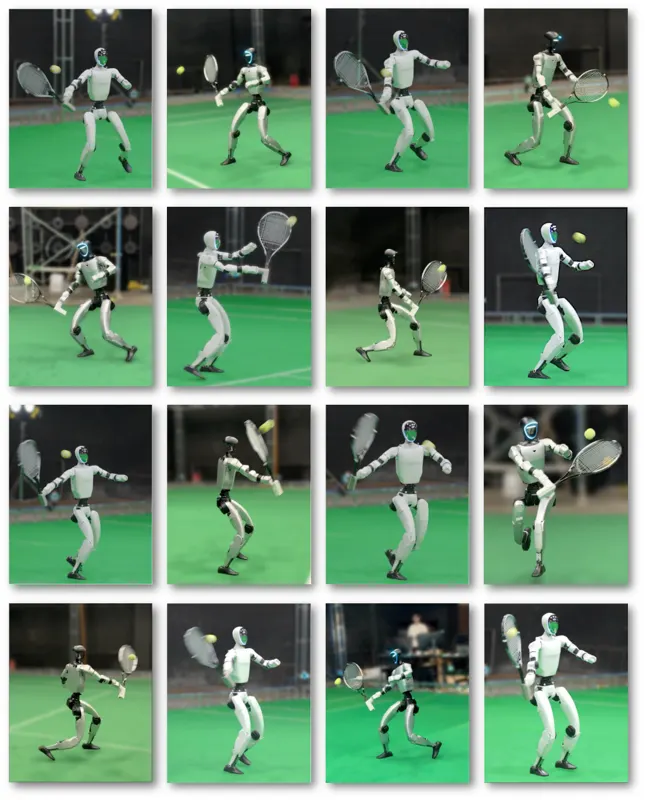
Human athletes demonstrate versatile and highly-dynamic tennis skills to successfully conduct competitive rallies with a high-speed tennis ball. However, reproducing such behaviors on humanoid robots is difficult, partially due to the lack of perfect humanoid action data or human kinematic motion data in tennis scenarios as reference. In this work, we propose LATENT, a system that Learns Athletic humanoid TEnnis skills from imperfect human motioN daTa. The imperfect human motion data consist only of motion fragments that capture the primitive skills used when playing tennis rather than precise and complete human-tennis motion sequences from real-world tennis matches, thereby significantly reducing the difficulty of data collection. Our key insight is that, despite being imperfect, such quasi-realistic data still provide priors about human primitive skills in tennis scenarios. With further correction and composition, we learn a humanoid policy that can consistently strike incoming balls under a wide range of conditions and return them to target locations, while preserving natural motion styles. We also propose a series of designs for robust sim-to-real transfer and deploy our policy on the Unitree G1 humanoid robot. Our method achieves surprising results in the real world and can stably sustain multi-shot rallies with human players. Project page: https://zzk273.github.io/LATENT/

Zhikai Zhang, Haofei Lu, Yunrui LianMar 13, 2026
LATENTSim-to-RealUnitreeMar 13, 2026