Skip to content
← Tags
Real2Sem2Real: 3D Semantic Augmentations for Robot Learning from a Single Human RGB Demonstration

Real2Sem2Real: 3D Semantic Augmentations for Robot Learning from a Single Human RGB Demonstration

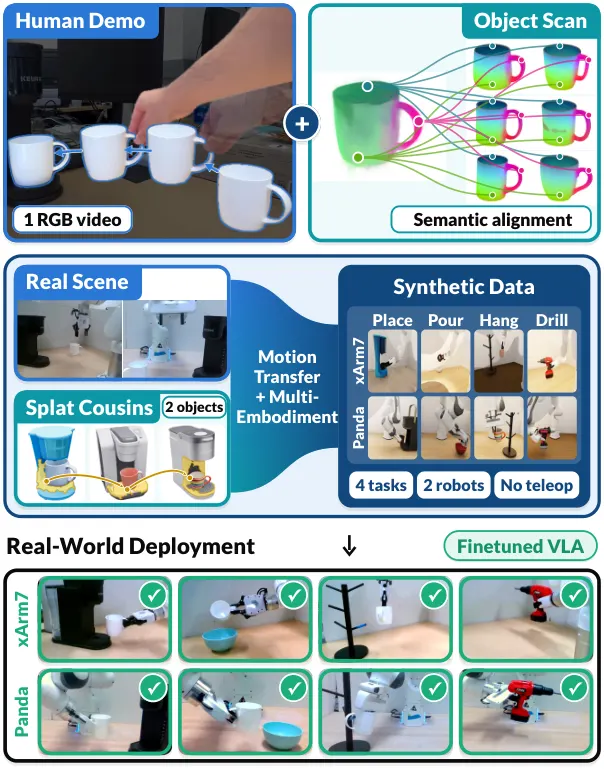
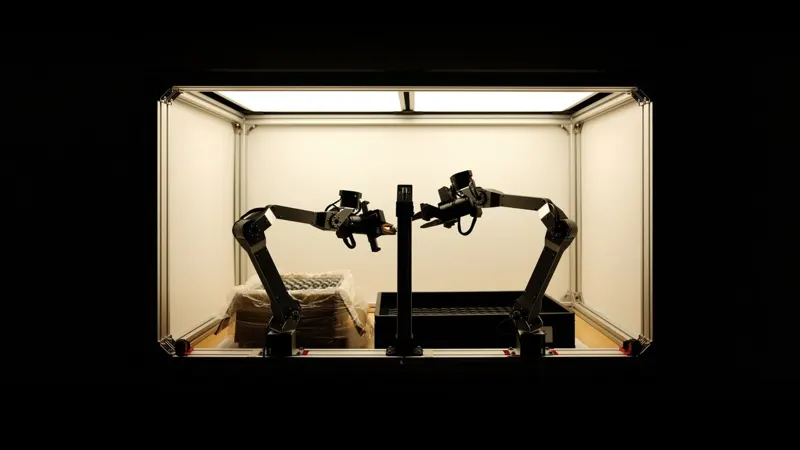
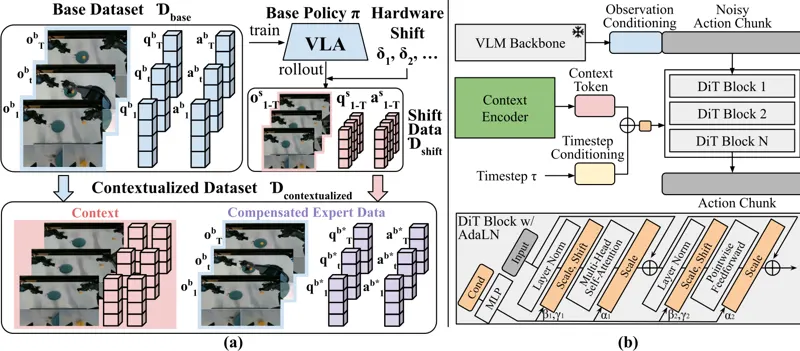
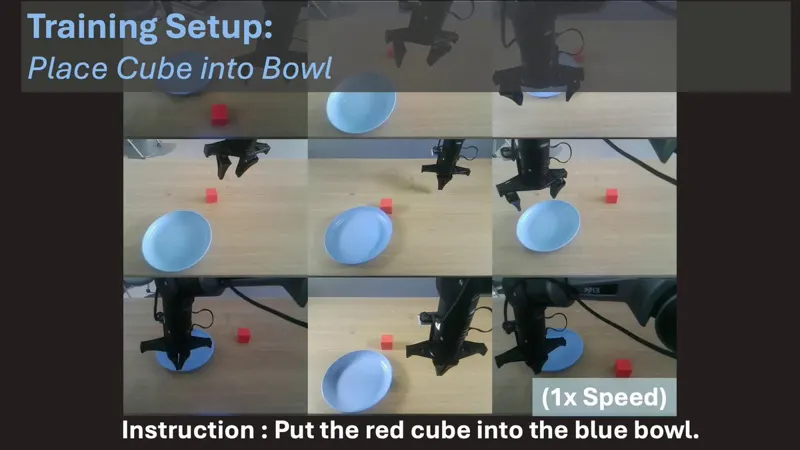
Human video scales easily and does not need robot hardware, but existing methods require depth sensing, overlay the robot onto 2D video, or generate data only for the demonstrated objects. We present Real2Sem2Real (R2Sem2R), a real-to-semantic-to-real pipeline that turns one monocular RGB video of a human demonstration into thousands of robot demonstrations across the semantic object instances of a category. R2Sem2R tracks the SE(3) pose of each object with DINOv3-distilled Gaussian splats, outperforming existing methods and FoundationPose with estimated metric depth. R2Sem2R then aligns digital cousins, each generated from one or a few photographs, to the demonstrated objects with a semantic alignment. This alignment matches whole objects and the functional regions of target objects, such as a coffee machine's tray. R2Sem2R maps the human hand to a feasible robot grasp that extends to the cousins. Robot demonstrations are generated either in IsaacSim, for photorealistic rendering, or MuJoCo, for contact physics, and R2Sem2R can generate over 2,000 episodes in about two hours. On two real robots and four tasks, we train a vision-language-action policy on data from one human video per task, and policies trained on our data match or exceed policies trained on teleoperation across diverse object instances. The project page is available at https://real2sem2real.github.io/.

Matthew Strong, Ankush K. Dhawan, Julien Poffet · 46 views · Oct 20, 2026
Robot LearningHuman demonstrations
Oct 20, 2026
PACE: Temporal-Role Tactile Conditioning for Chunk-Based Insertion Policies

PACE: Temporal-Role Tactile Conditioning for Chunk-Based Insertion Policies

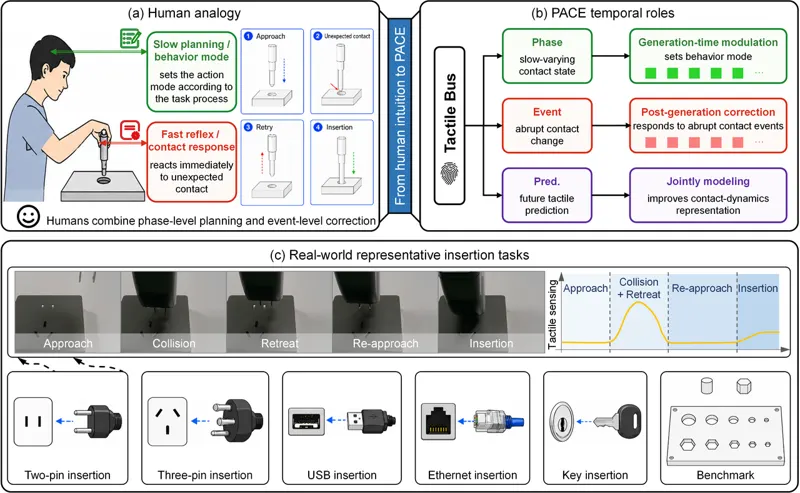
Contact-rich insertion requires a robot to combine visual alignment with tactile adjustment. Existing visuotactile chunk-based policies often collapse tactile feedback into one generation-time pathway, so persistent contact state, abrupt contact events, and the future contact consequences of an action are modeled implicitly in a single representation. PACE assigns one tactile stream three temporal roles. An exponential-smoothed contact state modulates action-chunk generation through layer-wise feature conditioning. A short-window tactile difference forms an event cue and drives a gated residual correction over only the first steps of the chunk. A training-only head predicts future tactile increments from decoder states as an auxiliary representation-learning objective. This preserves chunk-level action continuity while giving slowly varying contact phases and fast collision or jamming events separate pathways. Across five real insertion tasks, PACE reaches 90.7 percent average success, more than 44 percentage points above vision-only and single-path tactile-fusion baselines. It also averages 88.7 percent on six ManipulationNet geometry and clearance settings, including 0.1 mm clearance. Ablations show complementary contributions from Phase, Event, and Pred., while cross-signal and cross-architecture tests extend the principle to force/torque, joint current, and diffusion-policy backbones.

Zhiyuan Chen, Shixiong Xu, Shuai Chen · 242 views · Oct 12, 2026
Tactile SensingRobot Manipulation
Oct 12, 2026
Thinker-WM: A Unified World Model with Shared Multimodal Representations for Embodied Intelligence

Thinker-WM: A Unified World Model with Shared Multimodal Representations for Embodied Intelligence

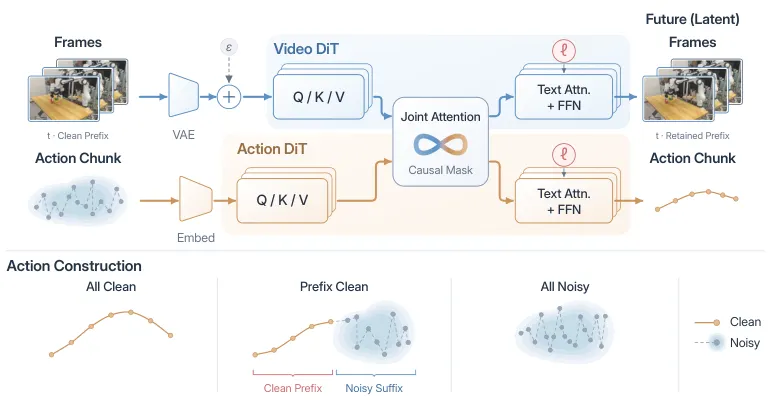
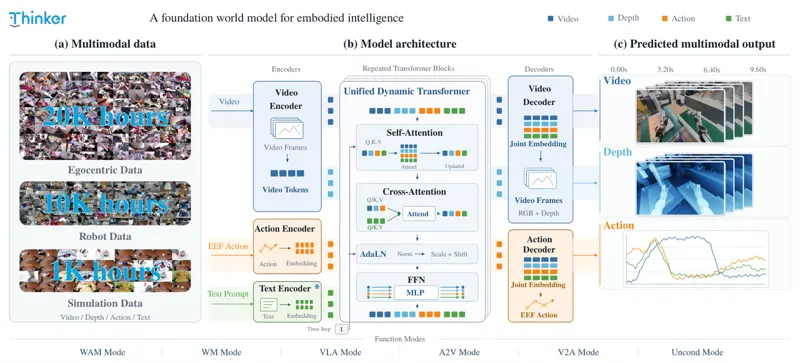
World models have emerged as a promising paradigm for embodied AI, yet existing systems often remain fragmented in the modalities they model and the functions they support. In particular, visual dynamics, geometric structure, and executable action are commonly coupled through separate interfaces or downstream modules rather than being jointly represented and evolved within a shared dynamics model. In this work, we present Thinker-WM, a unified multimodal world model that jointly models and generates RGB, metric depth, and robot action through a shared intermediate Unified Dynamics Transformer with modality-specific encoders and decoders. The model performs multimodal unification at the representation level: appearance, geometry, and action are transformed into a common dynamic representation and jointly evolved by shared parameters, while their distinct output structures are preserved. The same parameterization supports multiple functions, including joint video-action generation, world prediction, policy inference, action-conditioned generation, video-to-action generation, and inverse dynamics. To examine whether the shared representation captures action-related information, we introduce a lightweight motion probe that shows the frozen visual representation contains recoverable motion information. Thinker-WM is trained on a heterogeneous corpus comprising approximately 20K hours of egocentric video, 10K hours of real-robot data, and 1K hours of simulation data, including approximately 4K hours of real-robot data with aligned depth supervision. Extensive experiments demonstrate strong performance across embodied world-model evaluations. Thinker-WM ranks first on EWMBench, WorldOlympiad and WorldArena, while controlled studies further demonstrate the benefits of action conditioning, geometric interaction, and multi-function training within the shared representation.

Thinker Team, Peng Gao, Jichao Jiao · 264 views · Oct 13, 2026
World ModelsEmbodied AI
Oct 13, 2026

EWAM: Emergent Depth-Wise Specialization in a Unified Embodied Model – From Semantic Understanding through Visual Foresight to Action

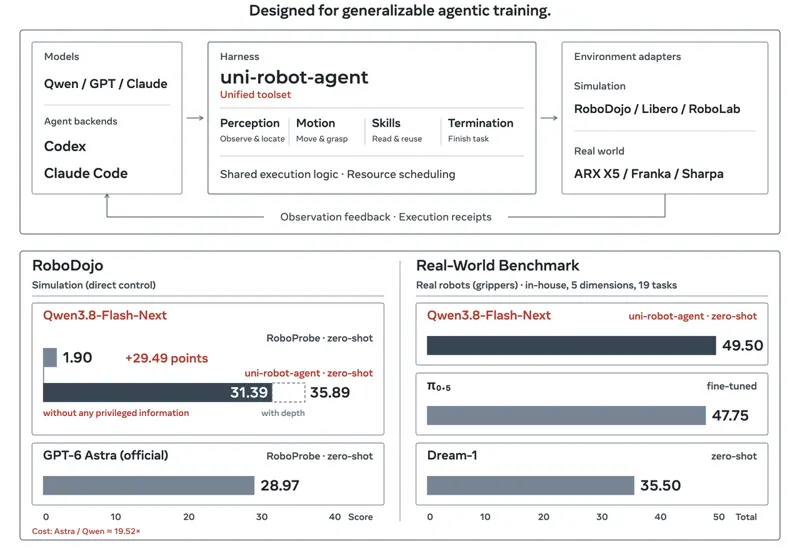
EWAM: Emergent Depth-Wise Specialization in a Unified Embodied Model – From Semantic Understanding through Visual Foresight to Action

Vision-language-action (VLA) policies emphasize semantic understanding, whereas world-action models (WAMs) learn predictive representations of environment dynamics. Systems that expose a policy to both sources often still concentrate action computation on a single expert. We present EWAM, an action-centric unified embodied model whose asymmetric joint attention lets action tokens read semantic, current-visual, predicted-future, and action information at every layer while the perceptual experts retain their distinct roles. Without layer-wise supervision, EWAM develops an emergent depth-wise specialization: action queries attend mainly to vision-language features in shallow layers, to predicted future frames in intermediate layers, and to action tokens themselves in deep layers. This handoff replicates across tasks and is stable across denoising steps. Checkpoint tracking and causal interventions show that it is learned and that action generation depends on it. EWAM is pretrained in two separate regimes, one on cross-embodiment robot trajectories and one on human egocentric video. In simulation and real-robot experiments, it surpasses existing VLA, WAM, and hybrid baselines. Human egocentric data improve both cross-embodiment transfer and real-robot robustness, and subtask-phase supervision improves long-horizon completion. Together, these results suggest that unified embodied learning can induce an ordered internal progression from semantic understanding, through visual foresight, to action formation.

Hao Wang, Jiajun Wen, Jingzhi Liu · 192 views · Sep 30, 2026
VLAWorld-action models
Sep 30, 2026

As an Amazon Associate, we earn from qualifying purchases.