Skip to content
Tags

#Imitation Learning (23)

HIL-UMI: Bringing Human-in-the-Loop Post-Training of Vision-Language-Action Models to Universal Manipulation Interface

HIL-UMI: Bringing Human-in-the-Loop Post-Training of Vision-Language-Action Models to Universal Manipulation Interface

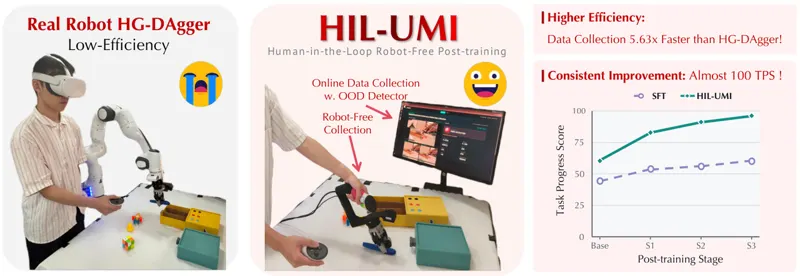
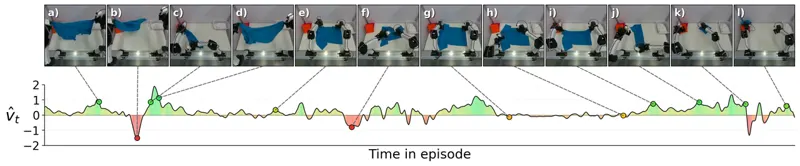
Large-scale vision-language-action (VLA) models provide powerful priors for robot manipulation, yet adapting them to a specific deployment remains challenging. Supervised fine-tuning (SFT) on task-specific demonstrations provides a step toward deployment, but faces two persistent limitations: static data provide limited coverage of out-of-distribution states, and standard imitation objectives do not distinguish progressing behavior from less useful data. Interactive post-training can address these limitations, but typically requires repeated policy execution and human intervention on a physical robot. We introduce HIL-UMI, a policy-guided Universal Manipulation Interface (UMI) framework for robot-free human-in-the-loop VLA post-training. During handheld UMI demonstrations, HIL-UMI queries the current policy on the same observation stream without executing its predictions. The Energy Score compares the human action trajectory with policy inference and triggers collection when their discrepancy indicates an out-of-distribution region. In a separate feedback loop, low online advantage predictions identify essential segments for refining a progress-based advantage estimator. The updated estimator then guides advantage-conditioned behavioral cloning using a balanced mixture of base demonstrations and new policy data. This design preserves the iterative and policy-aware nature of human-in-the-loop learning while decoupling data collection from robot deployment. Experiments on four real-world tasks spanning long-horizon and precise manipulation show that HIL-UMI achieves consistent improvement over SFT and benefits from both targeted collection and advantage refinement. Moreover, HIL-UMI outperforms HG-DAgger on Clean Up Table with lower per-frame collection time, suggesting a scalable path for VLA post-training across operators and locations.
Han, Zimu, Zeng, Yiming, Zhang, JiyaoSep 17, 2026
VLAHuman-in-the-LoopPost-trainingSep 17, 2026
EgoWAM: World Action Models Beyond Pixels with In-the-Wild Egocentric Human Data

EgoWAM: World Action Models Beyond Pixels with In-the-Wild Egocentric Human Data

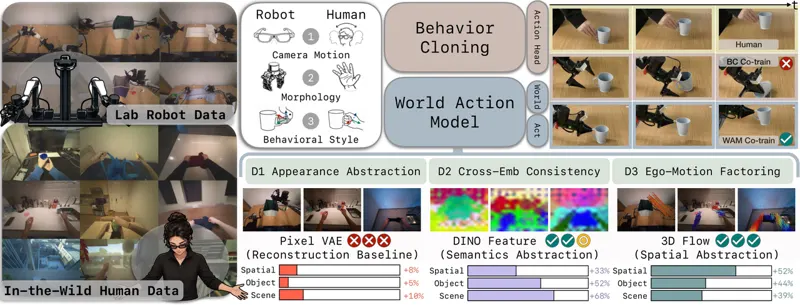
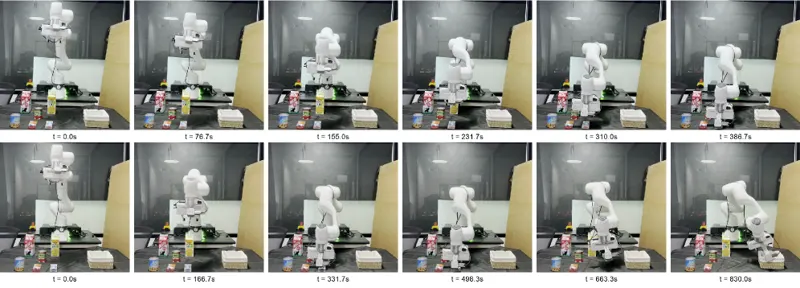
Egocentric human data offers scalable supervision for robot manipulation. However, behavior cloning entangles transferable content like objects, scenes, and task semantics, with non-transferable factors like human morphology, head motion, and behavioral style. We study whether World Action Models (WAMs) provide a better training signal by requiring policies to predict not only actions, but also how the scene evolves. The central question is what world representation best enables human-to-robot transfer. We hypothesize that an effective world target should abstract appearance, capture agent-invariant physical effects, and separate camera motion from environment change. We introduce EgoWAM, a controlled human-robot co-training framework that fixes the policy backbone, action head, and data mixture while varying only the world prediction target, comparing Pixel, DINO, and 3D motion flow. Across three real-world bimanual tasks, WAM co-training scales more effectively with in-the-wild egocentric human data than behavior cloning. Pixel-based prediction transfers weakly, while DINO and 3D flow yield substantial gains: DINO improves out-of-distribution object and scene generalization by up to 4x, and 3D flow improves in-domain performance by 20-30%. More details: https://gatech-rl2.github.io/egowam.github.io

Baoyu Li, Xinchen Yin, Mengying LinJul 8, 2026
World ModelsRobot ManipulationImitation LearningJul 8, 2026
HiFi-UMI: Learning Deployable Manipulation Policies from High-Fidelity UMI Data Alone

HiFi-UMI: Learning Deployable Manipulation Policies from High-Fidelity UMI Data Alone

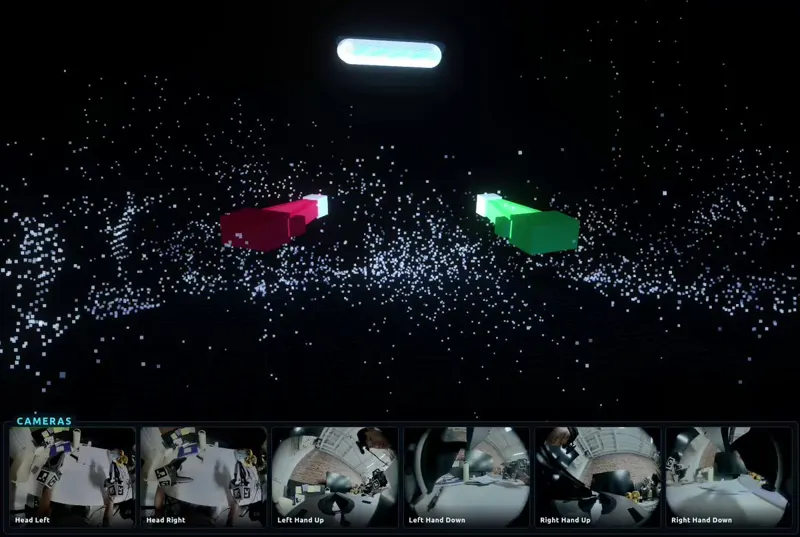
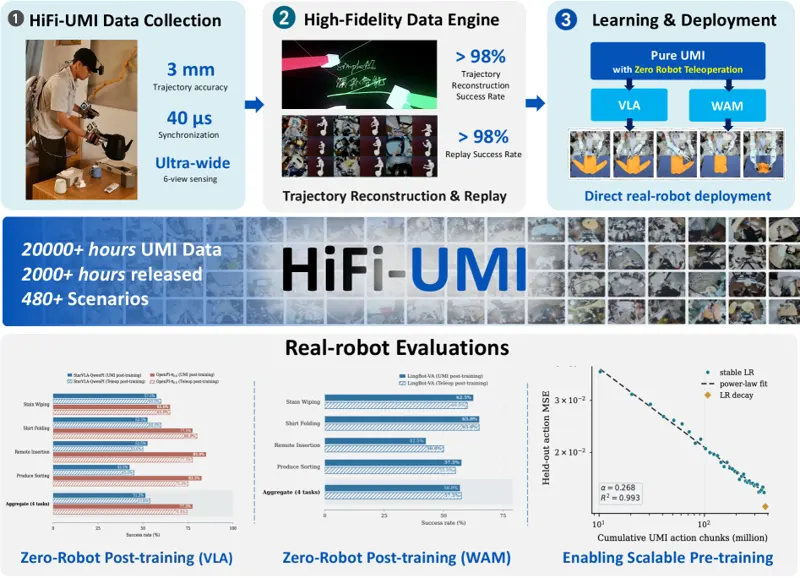
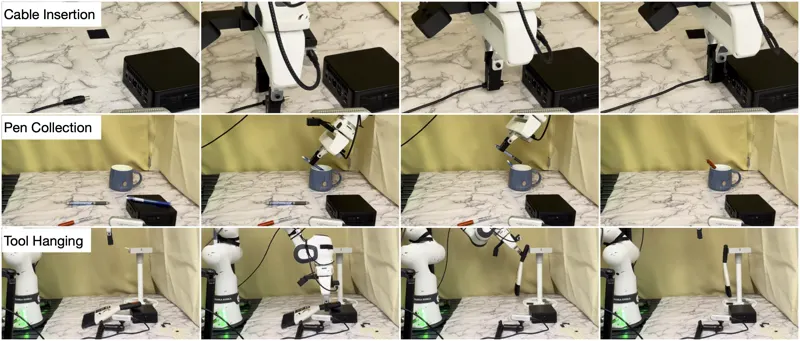
Learning deployable manipulation policies is bottlenecked by the scarcity of data that is both high-fidelity and scalable. Real-robot teleoperation is accurate but costly to scale; robot-free UMI capture scales readily, and current practice uses the resulting data mainly for pre-training, adding a small real-robot "anchor" at post-training. We ask whether raising the fidelity of robot-free UMI data, rather than shrinking the real-robot fraction, can remove that anchor. We present HiFi-UMI, a portable UMI data-production system co-designed for trajectory accuracy, inter-gripper relative pose, synchronization, and field of view: head-mounted offline stereo-inertial SLAM, native rather than reconstructed relative pose, a shared microsecond GPIO trigger, and two wide-angle cameras per hand covering ~200 degrees. It reaches 3 mm workspace-local end-effector accuracy without external tracking infrastructure. Using this corpus, we demonstrate zero-robot post-training: a policy post-trained solely on HiFi-UMI demonstrations deploys directly on a real robot and matches in-domain teleoperation across three backbones spanning the vision-language-action and world-action-model families, with success-rate differences of -2.5, +3.1, and -0.6 percentage points on StarVLA-QwenPI, OpenPI-pi_0.5, and LingBot-VA; the strongest policy reaches 85% on a precision insertion task, even though the teleoperation baseline is collected in the evaluation scene and no HiFi-UMI trajectory is. Pre-training on 4,000 hours from the same corpus lowers action error on ten unseen tasks by 41% and, on StarVLA-QwenPI, raises real-robot success by a further 18.1 percentage points. We open-source HiFi-UMI-2K, 2,000 hours of microsecond-synchronized, ultra-wide-FoV demonstrations, each automatically reconstructed and validated through simulation replay, as a large-scale, high-fidelity resource for the robot-learning community.

Simple AI, :, Yuteng WeiJul 28, 2026
UMIVLAHiFi-UMIJul 28, 2026
Patch Policy: Efficient Embodied Control via Dense Visual Representations

Patch Policy: Efficient Embodied Control via Dense Visual Representations

Pretrained dense visual features from Vision Transformers (ViTs) are powerful yet have been underutilized in robot learning. Modern robot policies either compress each observation into a single global token, or rely on visual backbones trained from scratch, sacrificing both fine-grained spatial detail and the benefits of large-scale visual pre-training. While there exist policies that do operate on dense patch features like large vision-language-action models (VLAs), they tend to be heavy and slow, inheriting the full cost of a billion-parameter vision-language model (VLM) backbone. We close this gap with Patch Policy, a minimal architectural extension that enables transformer-based policies to consume dense pre-trained patch tokens directly without the computational overhead of a full VLM. At its core is a block-causal attention mask that preserves the temporal causality of standard policies while letting the model attend over many patch tokens per observation, alongside other state information. Patch Policy is lightweight, fast, and highly effective. Across four simulated and three real-world environment suites, our method achieves a 40% relative improvement over policies using state-of-the-art global-pooled representations. Furthermore, it surpasses fine-tuned OpenVLA-OFT by 18% while using roughly 0.7% of the parameters. We believe Patch Policy provides a pipeline for the robotics community to readily leverage continuing progress in visual representation learning, without sacrificing the training efficiency or inference speed required for high-frequency, reactive control. Videos can be viewed at https://patch-policy.github.io

Gaoyue Zhou, Zichen Jeff Cui, Ada LangfordJul 20, 2026
Patch PolicyDense Visual RepresentationDINOv2Jul 20, 2026
PRISM: Polynomial Representations for Interaction-Structured Motor Control

PRISM: Polynomial Representations for Interaction-Structured Motor Control

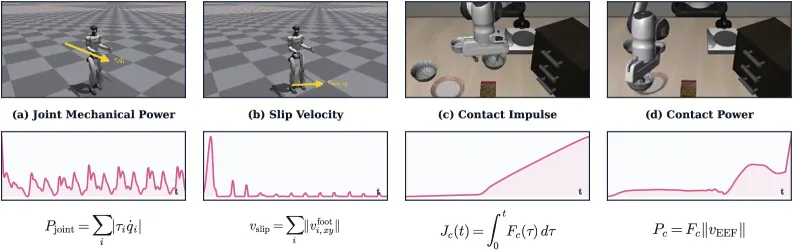
Robot policies are typically MLPs mapping observations to actions. Yet robot observations are physical variables, and many action-relevant cues arise not from individual variables but from their interactions; power, inertial effects, contact, slip, and compliance depend on products among observable signals. We introduce PRISM, a policy representation that makes polynomial interactions among observable physical variables explicit, learnable, and compact. Rather than listing all polynomial terms, PRISM uses a factorized polynomial module to expose higher-order interaction features efficiently. In reinforcement learning, it keeps the standard MLP backbone but applies a gradually activated element-wise polynomial function after it. In imitation learning, it replaces linear proprioceptive conditioning in Diffusion Policy with a polynomial layer trained end-to-end. Across humanoid locomotion and contact-rich manipulation, PRISM improves performance over standard MLP policies and larger MLPs with matched capacity, showing that interaction structure cannot be replaced by capacity alone. It also yields sensorless compliant behavior without force, wrench, tactile input, contact labels, or admittance control. These results suggest that polynomial representations should become a standard architectural choice for embodied motor control. The project page is available at https://lsh3163.github.io/prism/

Seung Hyun Lee, Stella X. YuJul 26, 2026
PRISMMotion ControlPolynomial NetworkJul 26, 2026
Dynamics-Aware Meta-Imitation for Generalization to Unseen Robotic Manipulation

Dynamics-Aware Meta-Imitation for Generalization to Unseen Robotic Manipulation

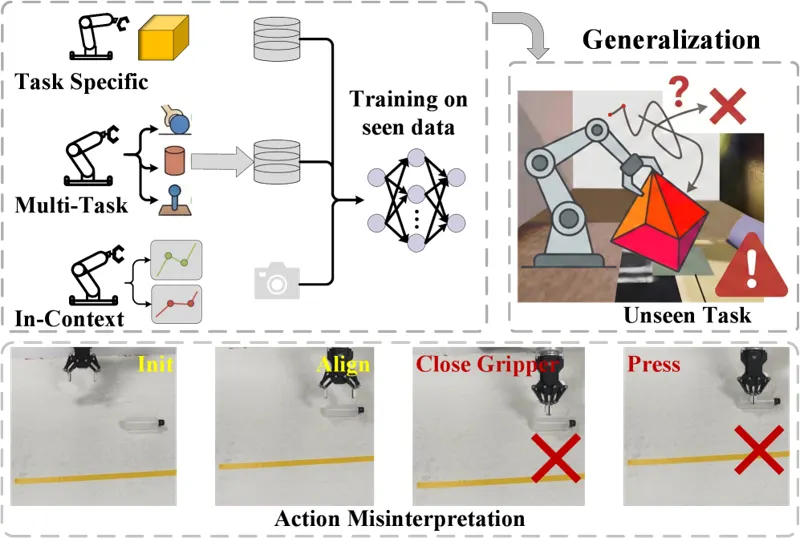
Imitation Learning aims to learn skills from extensive observations and demonstrations for robots, so it suffers from data scarcity and environment generalization. The existing methods predominantly focus on imitation from in-domain tasks and consequently struggle with generalization to unseen tasks. To bridge this generalization gap, we propose the Dynamics-Aware Meta-Imitation (DAMI) framework. By integrating meta-learning to construct a shared skill space, DAMI equips agents for rapid adaptation to novel tasks. We introduce the Visual-Motor Trajectory (VMT) module to capture complex spatio-temporal dynamics within the task latent space. Furthermore, we propose the Unpaired Unified Task (U2T) block to fuse unstructured multimodal observations. To coordinate these representations, we integrate a Task-Conditioned Feature Modulation (TCFM) mechanism customized for modulating low-level 3D features. By capturing intrinsic dynamics from a random complete reference demonstration, our framework learns the underlying task logic rather than memorizing static cues, ensuring effective generalization. Extensive experiments in both simulation and real-world settings demonstrate that our approach outperforms state-of-the-art baselines regarding direct inference on seen tasks and adaptation to unseen tasks via few-shot fine-tuning.

Zhenduo Shang, Xiyao Liu, Bohan LiJul 17, 2026
Imitation LearningMeta-learningGeneralizationJul 17, 2026
Scalable Causal Imitation Learning

Scalable Causal Imitation Learning

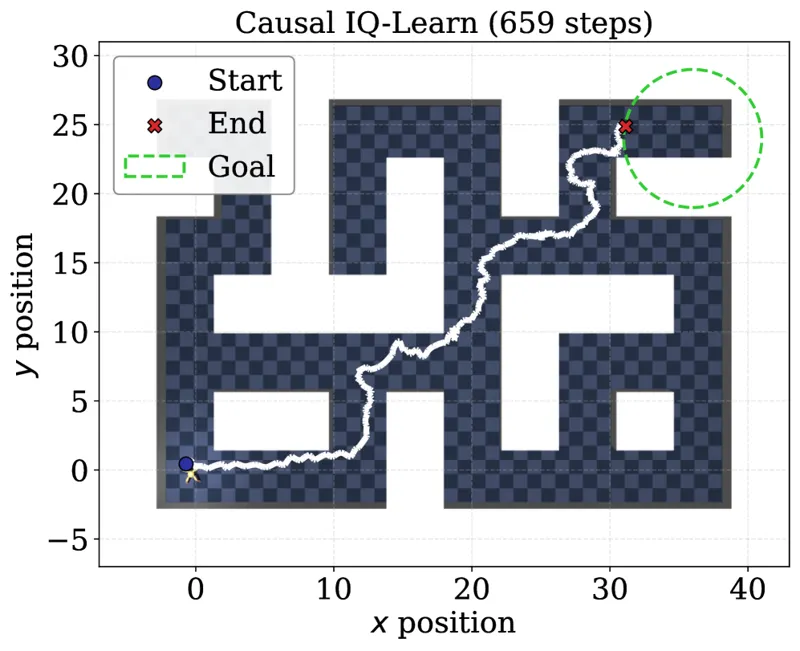
Imitation learning enables learning a policy in an unknown environment with a latent reward signal using expert demonstrations, but it struggles when the imitator's and expert's observations are mismatched and unobserved confounders are present in expert demonstrations. By identifying appropriate adjustment sets via the sequential π-backdoor criterion, causal imitation learning (CIL) provides a framework for approximating the expert's policy from confounded data. However, existing CIL methods, Causal Behavioral Cloning (Causal BC) and Causal Generative Adversarial Imitation Learning (Causal GAIL), are designed for short-horizon, low-dimensional settings. When applied to continuous control tasks with long horizons and high-dimensional state-action spaces, these methods exhibit poor performance: Causal BC suffers from compounding errors, Causal GAIL is unstable and sample-inefficient, and sequential π-backdoor adjustment becomes impractical. We introduce Causal Soft Q Imitation Learning (SQIL) and Causal Inverse soft-Q Learning (IQ-Learn), two off-policy causal imitation learning algorithms that combine the causal adjustment framework with state-of-the-art inverse reinforcement learning objectives. Both algorithms operate on causally-adjusted state representations produced by an efficient approximation of the sequential π-backdoor criterion, exploiting the causal structure of continuous control environments to reduce the full-horizon adjustment to a fixed-size sliding window. We evaluate all methods in a suite of confounded environments and find that Causal SQIL and Causal IQ-Learn substantially outperform prior CIL algorithms on long-horizon tasks, sometimes surpassing the expert, whereas all causally unaware imitation methods fail to learn meaningful behavior.

Eylam Tagor, Mingxuan Li, Elias BareinboimJul 18, 2026
Imitation LearningCausal InferenceDistribution ShiftJul 18, 2026
MEVION: Low-Cost Open-Source Data Collection System for Powerful and High-Speed Dual-Arm Manipulation

MEVION: Low-Cost Open-Source Data Collection System for Powerful and High-Speed Dual-Arm Manipulation

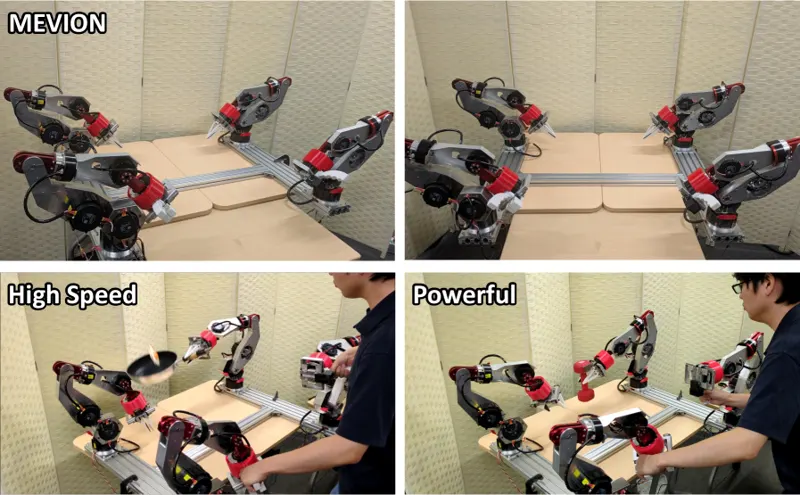
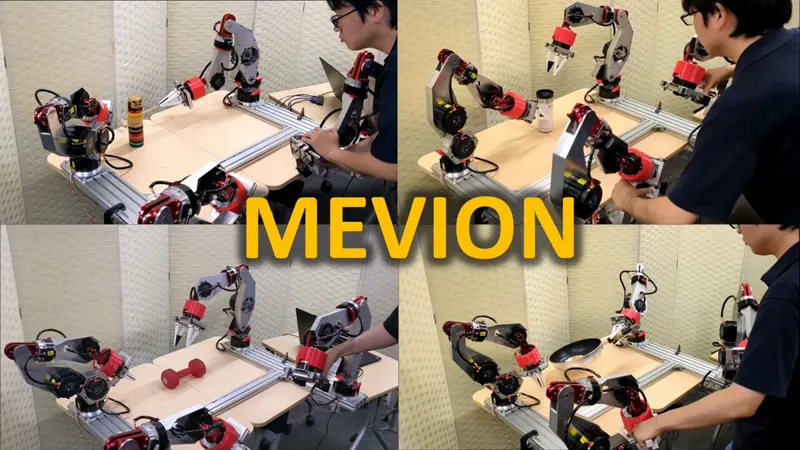
The global competition for developing robotic foundation models is intensifying. Among the data collection systems used for dual-arm robots, ALOHA is representative of being low-cost and open-source, and is widely adopted by researchers as a de facto standard. However, due to its limited ability to generate high forces and speeds, it is difficult to handle heavy objects or perform fast manipulations. To address this, we developed MEVION, a low-cost and open-source dual-arm robot data collection system capable of generating greater force and speed. All parts of this robot can be sourced through e-commerce, and by extensively utilizing sheet metal welding, its large body structure is constructed with a small number of components at low cost, while also simplifying assembly. MEVION is equipped with four 6-DoF arms with parallel grippers. Each arm weighs 7.0 kg and has a maximum torque of 60 Nm, and the entire system can be constructed for about USD 14,000. The elbow joint adopts a closed-link mechanism similar to those used in quadruped robots, which reduces the distal mass and enables higher force and speed output at the end-effector. We demonstrate that MEVION enables data collection for object manipulation tasks not previously possible and supports imitation learning-based motion generation. All hardware and software of this work are included in the Supplementary Materials or https://github.com/haraduka/mevion.

Kento Kawaharazuka, Yoshiki Obinata, Hirokazu IshidaJul 20, 2026
Data CollectionDual-ArmOpen SourceJul 20, 2026
AXIS: A Growable Community-Driven Data Engine for Scalable Robot Manipulation

AXIS: A Growable Community-Driven Data Engine for Scalable Robot Manipulation

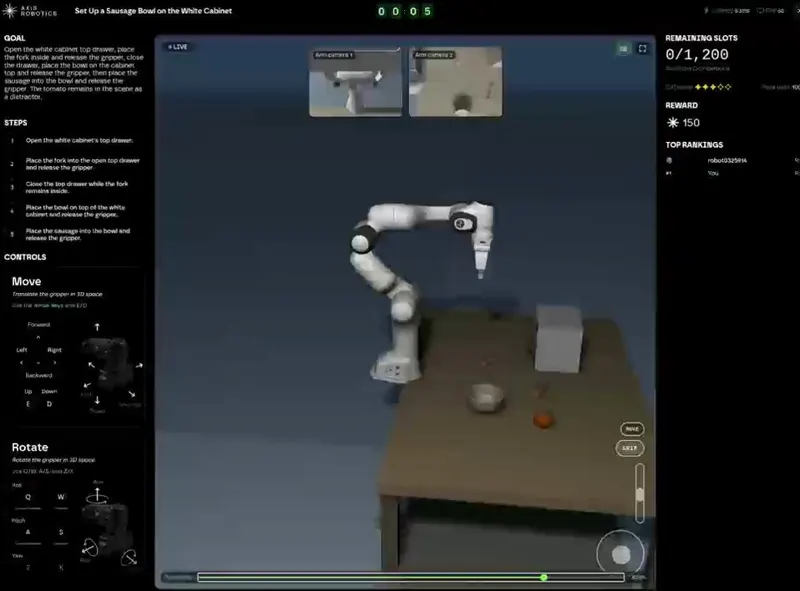
Learning effective robot manipulation policies requires diverse, high-quality demonstrations, yet existing data pipelines are often difficult to scale because they rely on specialized hardware, centralized operators, or fixed task suites. We present AXIS, a growable community-driven data engine and benchmark for scalable robot learning, which enables browser-based teleoperation for large-scale demonstration collection, automatically generates and validates new manipulation tasks, and transforms community-collected demonstrations into training-ready data through automated success checking, quality filtering, trajectory smoothing, and visual and physics-based augmentation. The AXIS dataset currently contains 207 diverse tasks and 50K+ trajectories. Meanwhile, AXIS organizes data into task snapshots and evaluates policies with a systematic held-out protocol. We compare vision-language-action (VLA) policies under a unified AXIS evaluation suite and analyze scaling behavior across different data volumes. Continual pretraining on AXIS substantially improves the overall success rate of π_0.5 by 5.8%, outperforms the model pretrained on RoboCasa365 by 37.3%, and exhibits consistent scaling with increasing data volume, with the largest gains observed under layout, sensor-noise, and camera perturbations.

Mengfei Zhao, Dihong Huang, Yikai TangJul 23, 2026
Robot ManipulationData engineCommunity-DrivenJul 23, 2026