Skip to content
N₀-VTLA: Scaling Vision-Tactile-Language-Action Model with Latent Tactile Tokens

N₀-VTLA: Scaling Vision-Tactile-Language-Action Model with Latent Tactile Tokens

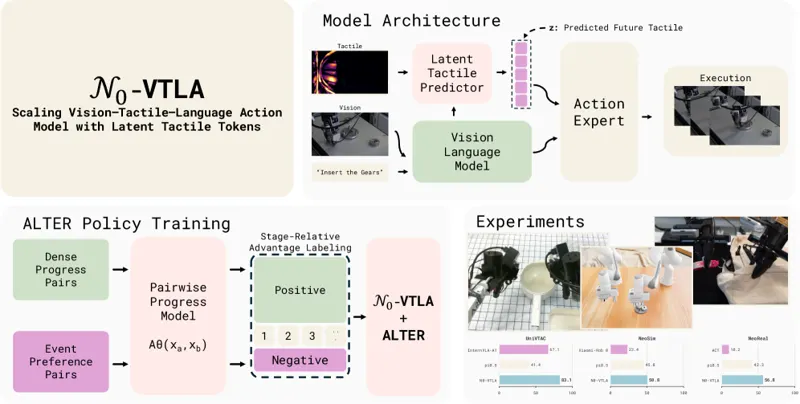
We present N₀-VTLA, a vision-tactile-language-action (VTLA) foundation model capable of (1) fine-grained contact-rich manipulation with tactile perception and tactile-feedback control, and (2) offline policy improvement from stored deployment data. Building on current vision-based backbones, we propose a training recipe for tactile integration consisting of visuo-tactile pre-training, staged tactile-pathway integration, and advantage-conditioned offline policy improvement. During pre-training, the policy learns broad contact priors from NeoData, our large-scale visuo-tactile robot dataset; to our knowledge, N₀-VTLA is the first VTLA model pretrained on tactile data at scale. During post-training, we augment the policy with a predictive tactile pathway that distills the contact patterns learned at scale into the fine motion adjustments required by downstream tactile-centric manipulation. For offline policy improvement, we introduce ALTER, an advantage-conditioned offline reinforcement learning method that converts relative progress and trajectory-event comparisons into binary advantage labels for policy training on a fixed deployment corpus, further improving task-specific learning on contact-rich skills such as deformable object manipulation. Across contact-rich benchmarks, N₀-VTLA outperforms strong baselines by wide margins: it wins all nine real-robot NeoReal tasks and reaches 63.8% mean success on a twenty-task simulation suite, against 44.0% for the strongest baseline. N₀-VTLA policies trained with ALTER reach 75-95% success on three long-horizon real-robot tasks. These results lay a foundation for versatile tactile-driven manipulation policies.

Simulation NeoteAI Team, Fudan TEAI Team·Jul 26, 2026
Self-Supervised Consistency Enhanced Disentangled Learning for Neural Decoding Generalization in Brain-Machine Interface

Self-Supervised Consistency Enhanced Disentangled Learning for Neural Decoding Generalization in Brain-Machine Interface

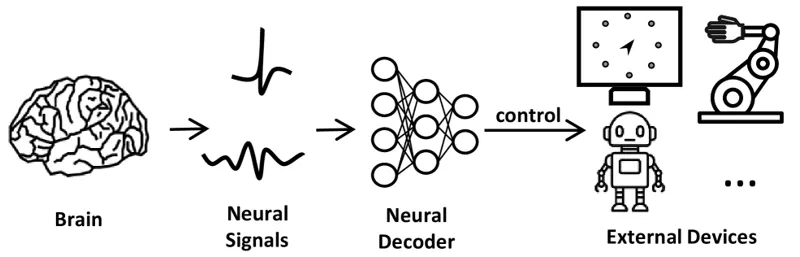
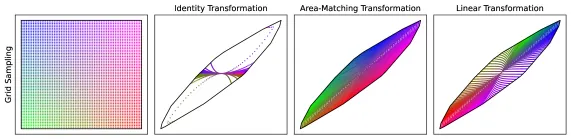
Brain-Machine Interfaces (BMIs) provide a direct communication pathway between the brain and external devices, enabling humans to control assistive and robotic technologies, with potential applications in rehabilitation, human motor augmentation, and human-centered robotics. However, due to neural drift, the performance of BMIs decreases over time, posing challenges for long-term viability, particularly for invasive BMIs (iBMIs). Existing solutions suffer from two main drawbacks: (i) difficulty in learning robust neural representations, and (ii) neglecting that neural drift varies across motor parameters (e.g., velocity, direction, and speed). To overcome these limitations, we propose Self-Supervised Consistency enhanced Disentangled Learning (SSCDL), a neural decoding generalization framework built on two key innovations. We first design a backbone model named Consistency enhanced Neural Decoder (CND), using a novel teacher-student consistency constraint with simulated neural signal perturbations to learn robust representations invariant to neural drift. Then, we employ three dedicated CNDs under the Complementary-Disentangled Generalization (CDG) mechanism, which disentangles motor signals into velocity, direction, and speed with inspiration from neural preference theory. This disentangled learning enables SSCDL to capture invariant neural representations from diverse neural preference perspectives, significantly enhancing cross-day generalization. Extensive experimental results show that SSCDL delivers state-of-the-art decoding performance, exhibiting high robustness and cross-day stability. These capabilities underscore its strong potential for long-term interaction in human-centric robotic and fine-grained assistive applications.
SimulationJiyu Wei, Di Hong, Zhanjie Zhang·Jul 27, 2026
Moving-Horizon Estimation and Nonlinear Model Predictive Control of Cable-Driven Soft Manipulators

Moving-Horizon Estimation and Nonlinear Model Predictive Control of Cable-Driven Soft Manipulators

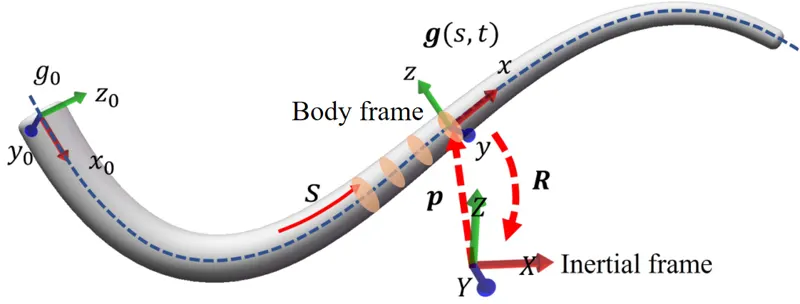
Precise control of soft manipulators remains challenging due to the difficulty of developing accurate yet computationally tractable models for model-based estimation and control. Reduced Cosserat-rod models provide a physics-based and control-oriented description of soft-robot dynamics, offering an explicit alternative to purely data-driven input-output representations. In this paper, we propose a moving-horizon estimation (MHE) and nonlinear model predictive control (NMPC) framework for cable-driven soft manipulators based on reduced Cosserat dynamics. A smooth cable-length-driven modeling formulation is developed by approximating the complementarity relationship between cable tension and cable slackness, enabling cable-length control without direct tension sensing. Based on this formulation, an MHE method is introduced to estimate the reduced state and reconstruct the manipulator configuration from end-effector pose measurements and cable-length information. An NMPC controller is then formulated to achieve task-space control under cable-length and cable-rate constraints. The proposed framework is validated through numerical simulations and experiments. Simulation results demonstrate the effectiveness of the estimator and controller for pose and strain-related regulation on a multi-cable soft manipulator. Experimental results on a four-cable prototype further show that the proposed MHE-NMPC scheme can be implemented in real time and enables accurate end-effector position tracking through cable-length control.

SimulationLingxiao Xun, Haihong Li, Gang Zheng·Jul 27, 2026
Think at 5 Hz, Act at 20 Hz: Asynchronous Fast-Slow Vision-Language-Action Inference for Closed-Loop Driving

Think at 5 Hz, Act at 20 Hz: Asynchronous Fast-Slow Vision-Language-Action Inference for Closed-Loop Driving

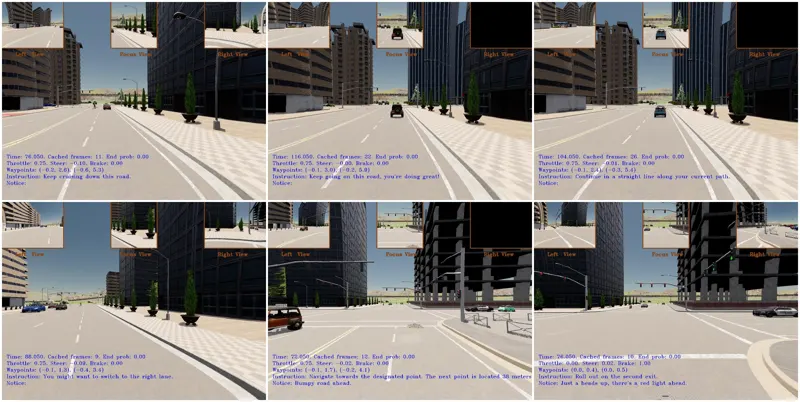
Large language models bring instruction following and scene reasoning to end-to-end driving, but their inference latency collides with the control rate a vehicle requires. Existing closed-loop agents hide this gap by invoking the model on alternate simulation ticks and replaying the previous command in between, so half of all control outputs ignore the newest observations. We present a fast-slow architecture that removes this compromise. A frozen 7B vision-language backbone acts as the slow system, digesting navigation instructions and visual history at low frequency while exposing its per-layer key-value cache as a standing representation of the scene. A lightweight action expert acts as the fast system, attending to this cache and to the current camera frame at every simulation tick to regress waypoints in a single forward pass. Since the cache lags behind the world at deployment, we train the expert under randomized staleness, aligning training with asynchronous execution. On LangAuto-Short routes in CARLA, our system produces fresh control at every 50 ms simulation tick and lifts route completion from 37.0 to 94.0 over the frame-skipping baseline. A frame-skip ablation with the same expert separates the two factors at work: the expert raises the driving score on its own, while per-tick freshness raises completion from 82.1 to 94.0 and cuts red-light violations by a third. Trained on a single town, the expert transfers zero-shot to two unseen towns, holding 84-94% route completion where the baseline reaches 31-41%. It reduces open-loop waypoint error by nearly a factor of four compared to the backbone's own action head, at a per-tick model cost of 32 ms that is independent of history length on a single consumer GPU.

Autonomous DrivingSimulationtestingYun Li, Jiachen Gong, Simon Thompson·Jul 17, 2026
AC-VLA: Robust Out-of-Distribution Action Execution via Compositional Learning

AC-VLA: Robust Out-of-Distribution Action Execution via Compositional Learning

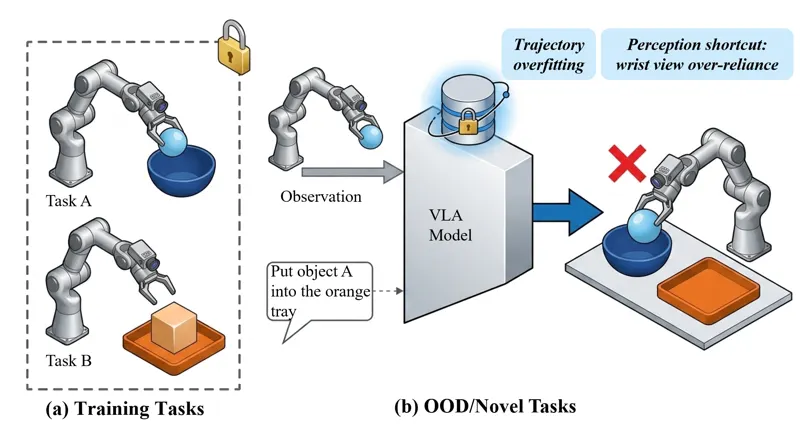
Vision-Language-Action (VLA) models excel at end-to-end robotic manipulation but struggle with out-of-distribution (OOD) generalization when familiar sub-tasks are recombined in unseen configurations. We identify two mutually reinforcing failure modes: trajectory overfitting, where models overfit to holistic trajectory patterns rather than compositional sub-skill semantics; and perceptual shortcut, where action tokens over-rely on wrist-view textures at the expense of global spatial grounding. To address both, we introduce AC-VLA, a plug-and-play Action Compositional learning framework comprising two architecture-agnostic components: (i) a compositional learning module that uses an LLM-driven instruction decomposer and a proprioceptive trajectory aligner to generate dense sub-task supervision, followed by mixed training on complete demonstrations and decomposed data to endow the model with compositional generalization; and (ii) a state-conditioned asymmetric masking strategy that suppresses wrist-view inputs during closed-gripper phases, enforcing global semantic grounding. All components are architectural modification-free and directly integrable into any VLA backbone. Instantiated on π_0.5 and evaluated on LIBERO and LIBERO-OOD benchmarks, AC-VLA achieves a ~28% absolute improvement on compositional OOD tasks while maintaining near-perfect in-distribution performance.

TactileSimulationManipulationXiaojiang Peng, Kai Peng, Jie Lu·Jul 17, 2026