Skip to content
METATRON: A Promptable Whole-Body Execution Layer for Humanoids

METATRON: A Promptable Whole-Body Execution Layer for Humanoids

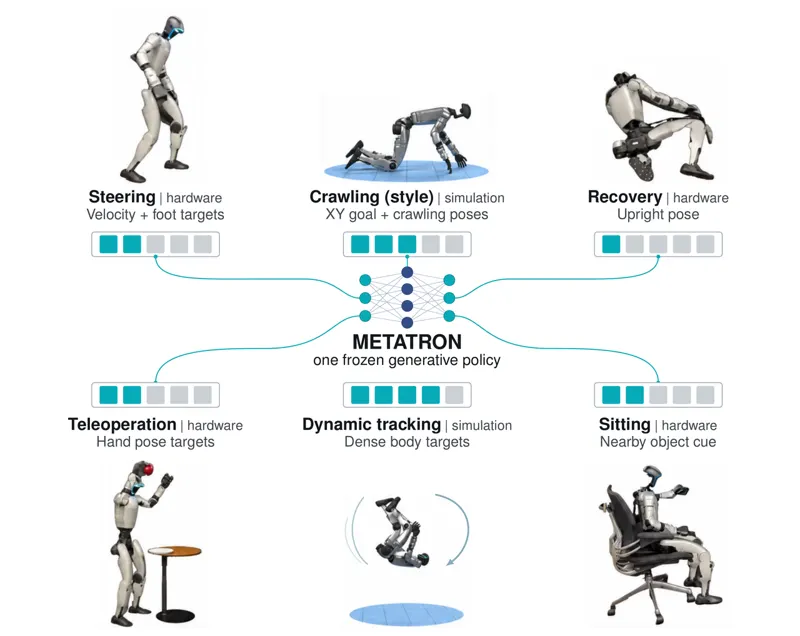
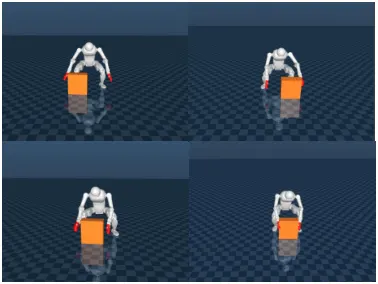
Humanoid controllers often require task-specific training despite sharing the need for balance and whole-body coordination. We present Metatron, a promptable whole-body execution layer combining a generative base policy with a programmable skill layer. The base policy receives partial goals, collectively called a prompt, that can combine timed body-part targets, velocity commands, and style cues. It produces diverse whole-body motions consistent with these goals. Training combines motion capture, synthetic recovery trajectories, and retargeted scene-interaction motions. After training, the policy is frozen. Stateful programs called skills express task intent as prompts at each control step, drawing rough geometric sketches that the policy turns into coordinated movement. Skills are ordinary code, refined by coding agents that analyze motion data and fit compact rules without task-specific policy training. On the physical Unitree G1, one frozen checkpoint supports walking, recovery, teleoperated object pickup, and sitting on furniture. Comparative evaluations show higher reaching success and push robustness than the tested reference-tracking pipelines. The same recipe produces climbing and acrobatics on a simulated character. Metatron enables coding agents to turn learned motor capabilities into new skills through code, without further policy training.

HumanoidWhole-Body Control
Chen Tessler, Yifeng Jiang, Alec Otto · 451 views · Oct 27, 2026
PACE: Temporal-Role Tactile Conditioning for Chunk-Based Insertion Policies

PACE: Temporal-Role Tactile Conditioning for Chunk-Based Insertion Policies

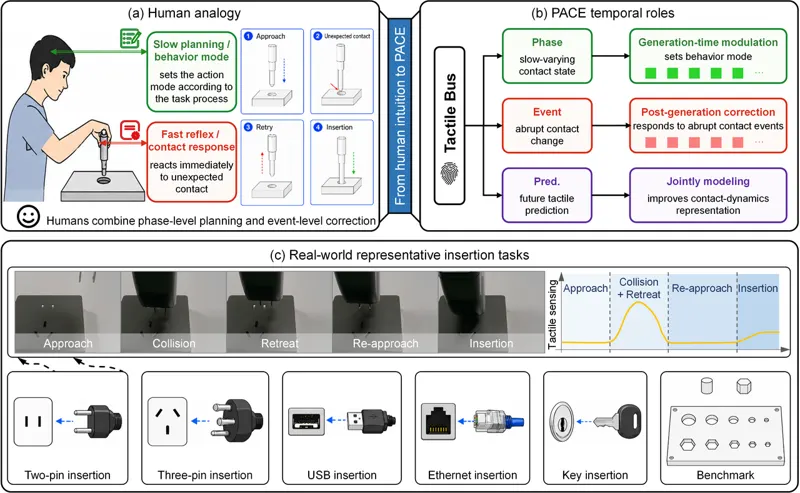
Contact-rich insertion requires a robot to combine visual alignment with tactile adjustment. Existing visuotactile chunk-based policies often collapse tactile feedback into one generation-time pathway, so persistent contact state, abrupt contact events, and the future contact consequences of an action are modeled implicitly in a single representation. PACE assigns one tactile stream three temporal roles. An exponential-smoothed contact state modulates action-chunk generation through layer-wise feature conditioning. A short-window tactile difference forms an event cue and drives a gated residual correction over only the first steps of the chunk. A training-only head predicts future tactile increments from decoder states as an auxiliary representation-learning objective. This preserves chunk-level action continuity while giving slowly varying contact phases and fast collision or jamming events separate pathways. Across five real insertion tasks, PACE reaches 90.7 percent average success, more than 44 percentage points above vision-only and single-path tactile-fusion baselines. It also averages 88.7 percent on six ManipulationNet geometry and clearance settings, including 0.1 mm clearance. Ablations show complementary contributions from Phase, Event, and Pred., while cross-signal and cross-architecture tests extend the principle to force/torque, joint current, and diffusion-policy backbones.

Tactile SensingRobot Manipulation
Zhiyuan Chen, Shixiong Xu, Shuai Chen · 286 views · Oct 12, 2026
DONIC: Generalist Dexterous Bimanual Tracking Control from Human Demonstrations

DONIC: Generalist Dexterous Bimanual Tracking Control from Human Demonstrations

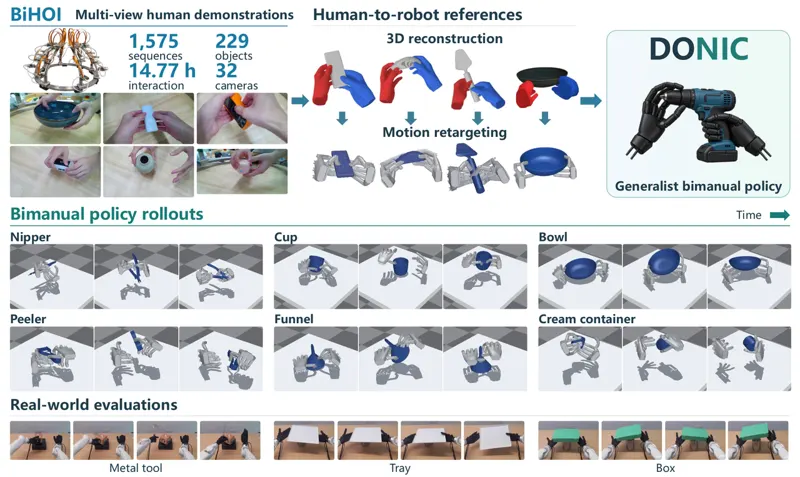
Despite recent progress in dexterous reference tracking, existing models focus primarily on single-hand manipulation and a limited range of interactions, leaving the bimanual dexterous behaviors common in real life unaddressed. The scarcity of contact-rich bimanual manipulation data and the increased complexity of coordinating contacts make developing a generalist bimanual tracker particularly challenging. Therefore, we present 1) DONIC, the first generalist bimanual tracker jointly trained across operation categories and human-motion sources, together with 2) BiHOI, a multi-view dataset of 1,575 sequences spanning 229 objects and emphasizing sustained bimanual interaction, where reconstructed interactions are retargeted into robot references. DONIC combines proximal policy optimization with behavioral cloning in a feedback loop that recycles verified successful executions into training demonstrations. An object-centered per-hand reward maintains object-motion feedback while supervising each hand according to its reference contact role. Clip-Centered Advantages remove reference-dependent advantage offsets while preserving within-trajectory differences. Together, these designs enable one single policy to learn coordinated manipulation across heterogeneous references. Without finetuning, a single checkpoint achieves 86.79% success on unseen trajectories of training objects and 57.32% on held-out objects, surpassing the state-of-the-art bimanual tracking baselines by 77.36 and 45.73 percentage points.

Dexterous ManipulationBimanual Manipulation
Mingze Sun, Ziang Cao, Yuan Fei · 241 views · Oct 21, 2026
SimpleVLN: Towards Simple and Frontier Vision-Language Navigation

SimpleVLN: Towards Simple and Frontier Vision-Language Navigation

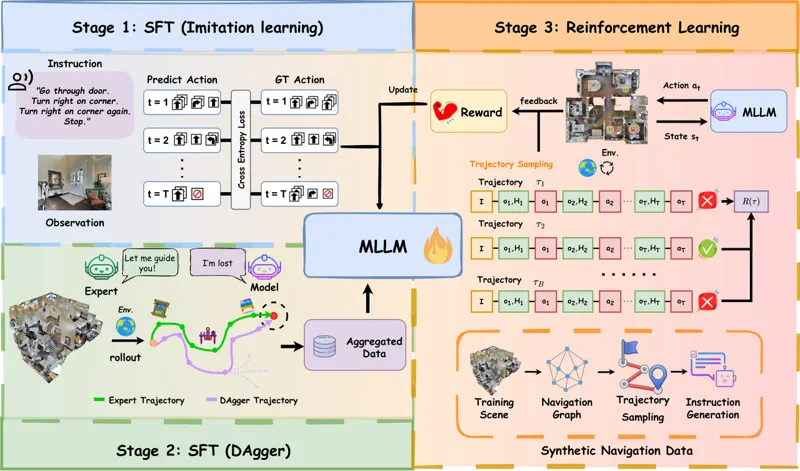
Vision-and-Language Navigation (VLN) requires embodied agents to ground language in visual observations and make long-horizon decisions. Existing methods often address these demands through task-specific architectures. As multimodal large language models (MLLMs) become increasingly capable, an important question remains: Have we truly unlocked the potential of native MLLMs for VLN before introducing task-specific architecture? We present SimpleVLN, an architecture-preserving framework developed through studies of navigation formulation, data construction, and optimization. At the formulation level, SimpleVLN combines single-turn decision inputs with fixed-budget global-local memory to efficiently use navigation history without unbounded context growth, while action chunks enable efficient output of multiple primitive actions per model invocation. For data construction, we combine expert demonstrations with policy-dependent DAgger experience and develop a scalable synthesis pipeline that generates large-scale tasks for reinforcement learning. At the optimization level, a progressive IL-DAgger-RL pipeline advances from action imitation to task-level outcome optimization. Comprehensive experiments validate the effectiveness of these three aspects. We instantiate SimpleVLN across multiple MLLM backbones and model sizes, demonstrating its generality. SimpleVLN achieves 76.7% and 80.1% success rates on the R2R-CE and RxR-CE splits, respectively, substantially outperforming existing methods. These results show that the navigation capabilities of native MLLMs can be effectively unlocked without task-specific architectural designs.

Vision-language navigationEmbodied AI
Lingyi Hong, Weiren Cai, Jiayu Chen · 315 views · Oct 16, 2026
Perceptive Humanoid Parkour: Chaining Dynamic Human Skills via Motion Matching

Perceptive Humanoid Parkour: Chaining Dynamic Human Skills via Motion Matching

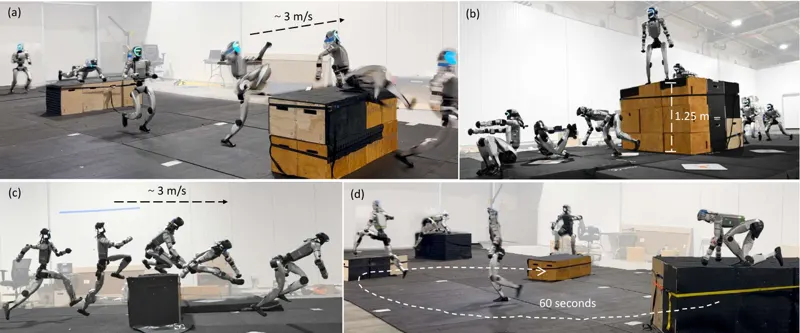
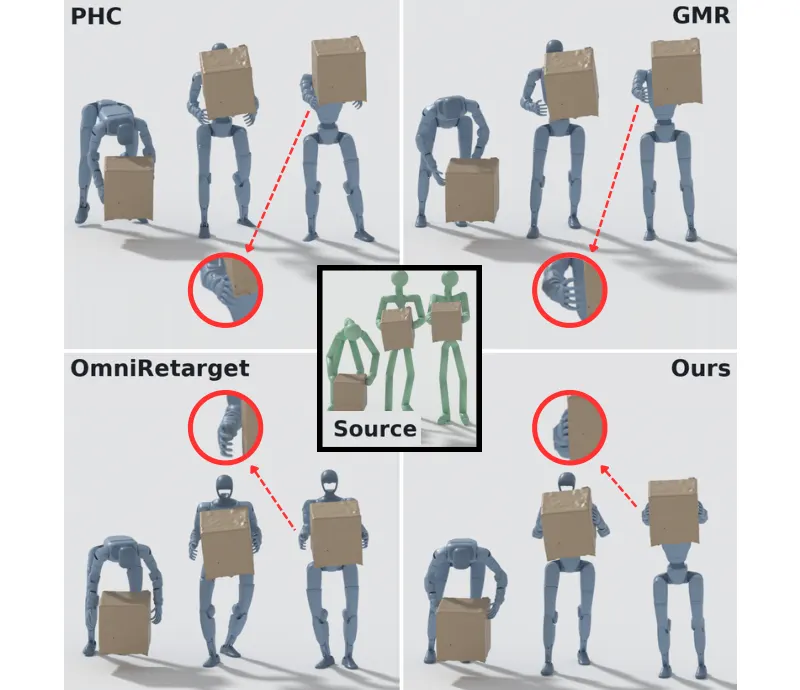
While recent advances in humanoid locomotion have achieved stable walking on varied terrains, capturing the agility and adaptivity of highly dynamic human motions remains an open challenge. In particular, agile parkour in complex environments demands not only low-level robustness, but also human-like motion expressiveness, long-horizon skill composition, and perception-driven decision-making. In this paper, we present Perceptive Humanoid Parkour (PHP), a modular framework that enables humanoid robots to autonomously perform long-horizon, vision-based parkour across challenging obstacle courses. Our approach first leverages motion matching, formulated as nearest-neighbor search in a feature space, to compose retargeted atomic human skills into long-horizon kinematic trajectories. This framework enables the flexible composition and smooth transition of complex skill chains while preserving the elegance and fluidity of dynamic human motions. Next, we train motion-tracking reinforcement learning (RL) expert policies for these composed motions, and distill them into a single depth-based, multi-skill student policy, using a combination of DAgger and RL. Crucially, the combination of perception and skill composition enables autonomous, context-aware decision-making: using only onboard depth sensing and a discrete 2D velocity command, the robot selects and executes whether to step over, climb onto, vault or roll off obstacles of varying geometries and heights. We validate our framework with extensive real-world experiments on a Unitree G1 humanoid robot, demonstrating highly dynamic parkour skills such as climbing tall obstacles up to 1.25m (96% robot height), as well as long-horizon multi-obstacle traversal with closed-loop adaptation to real-time obstacle perturbations.

HumanoidParkour
Zhen Wu, Xiaoyu Huang, Lujie Yang · 256 views · Feb 17, 2026
Juno: Taming Predictive Latents for Vision-Language-Action Models

Juno: Taming Predictive Latents for Vision-Language-Action Models

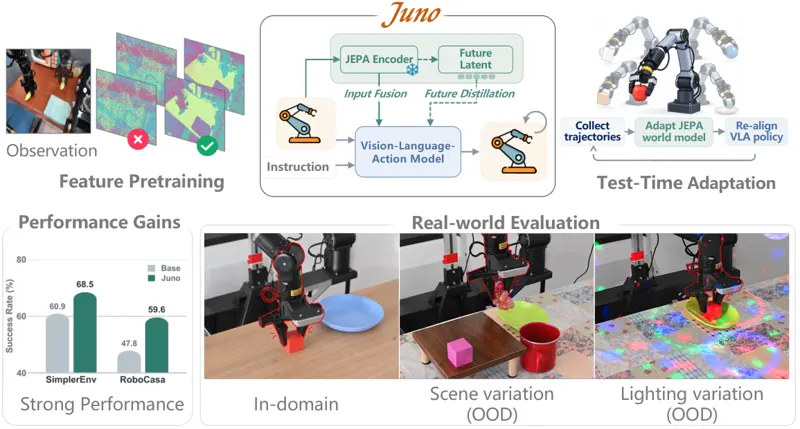
Joint-embedding predictive architectures (JEPAs) predict masked or future observations in representation space, offering a natural source of predictive latents for vision-language-action (VLA) models. Yet making these latents useful across pretraining, policy learning, and deployment requires addressing three failures: mismatch with embodiment-specific control, interference with action learning, and teacher miscalibration under distribution shifts. We introduce Juno, a unified framework built around one action-conditioned JEPA that serves as a control-aligned representation backbone, a predictive teacher, and an adaptable dynamics model. During pretraining, we train it on embodiment-matched trajectories and use a dynamic CLS loss to transfer motion-weighted patch dynamics to a compact global state. During policy learning, we fuse current-frame JEPA patches into VLA perception and use a decoupled reasoning branch with separate transformation parameters to distill future latent states for action generation. During deployment, we adapt the world model on all observed transitions, including failed rollouts, freeze the adapted teacher, and re-align the policy on verified executions using LoRA adapters and a trainable action head, without expert corrections or task rewards. On SimplerEnv, Juno raises average success from 60.9% to 68.5% over Qwen3GR00T, the strongest baseline, and test-time adaptation further reaches 72.7%; on a real robot, it retains 70%–75% success under background, height, and object shifts where the base policy collapses to 0%.

Vision-language-action (VLA)World Models
Yuchen Zhu, Chenyi Xu, Yulin Zhang · 248 views · Oct 7, 2026
LoopWAM: Closed-Loop Generalist Policy Improvement from Deployment Rollouts

LoopWAM: Closed-Loop Generalist Policy Improvement from Deployment Rollouts

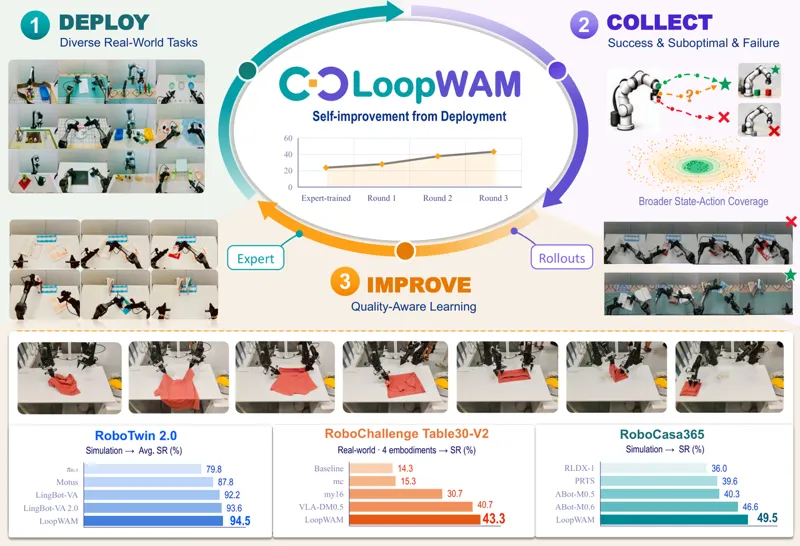
Scaling expert demonstrations alone does not enable generalist robot policies to improve from deployment. Real-world rollouts contain successes, suboptimal behavior, and failures: imitating every recorded action can reinforce poor behavior, while filtering out failures discards evidence of physical interactions and their consequences. We introduce LoopWAM, a closed-loop world-action model that learns directly from this full quality spectrum, using rollouts from both itself and other deployed policies. Source-dependent noise sampling unifies behavior learning and action-conditioned world modeling, while quality steering and quality-weighted supervision retain full video supervision across qualities and regulate action imitation. Video and action tokens interact throughout parallel denoising, allowing learned consequences to inform action generation directly. On RoboChallenge Table30-V2, three deployment-and-training rounds raise success from 23.67% to 43.33%, a 19.7-percentage-point gain, with a final score of 56.80. LoopWAM also achieves 94.5% average success on RoboTwin 2.0 and 49.5% overall success on RoboCasa365 without additional embodied pretraining, obtaining the best overall results among the compared methods across all three benchmarks. On challenging shirt folding task, two rounds of deployment-driven improvement after single-task post-training raise success from 13.20% to 55.56%. These results demonstrate closed-loop improvement from mixed-quality experience under both multi-task learning and single-task post-training. Project page: https://loop-wam.github.io/

World-action modelsSelf-Improvement
Wenxuan Guo, Yingping Liang, Zhaoguo Wang · 394 views · Oct 13, 2026

As an Amazon Associate, we earn from qualifying purchases.