Skip to content
←Back to the radar

SOTA · agents

Games & Simulation

Long-horizon policy in resettable environments, open-world game agents

Games and simulation are the resettable proving ground for agent capability: the same environment can be restarted without limit and failure carries no real cost, which is what made strategy learning measurable at scale for the first time. Its relation to AGI is not that AI can play games, but that games are the only standardised environment offering long-horizon decision making, partial observability, sparse reward and interactive physics at once - the four properties of the real world that can each be isolated and studied here. `games` sits in the Agents & Harness family rather than the Embodied family precisely because of that distinction: game environments reset, physical robots do not, and the cost of failure and the way data is acquired differ completely, so folding them into one domain would drain the word "progress" of meaning. Judgement in this domain is based on policy transfer and long-horizon consistency, not on visuals: a demo that looks clever may be nothing more than a scripted trigger. Coverage status: the top of this ladder currently carries a single bridged asset (Genesis-Embodied-AI's genesis-world at 30k stars, also linked to embodied / world3d / games / safety); standalone general game-playing systems measured on Atari, Procgen, MineDojo or BALROG protocols are not yet in the library, and on the world-model side zing-world-model (123 stars) is visible in the evidence stream but stays out of the ladder because it falls below the evidence floor.

RULERAtari 100k, Procgen, MineDojo, BALROG

The ladder

1
Embodied AI

Genesis World: The Unified Multi-Physics Simulation Platform for Physical AI

Genesis AI's open simulation platform for physical AI: one Pythonic API over a multi-physics engine (rigid, FEM, MPM, PBD, SPH, Stable Fluid, IPC), the Nyx path tracer, and Quadrants, a cross-platform Python-to-GPU compiler. It is built to be the evaluation engine for robot foundation models rather than a data factory: 30,000 parallel environments at 43M FPS, and under a zero-shot real-to-sim protocol, sim-vs-real evaluation agreement of Pearson 0.8996 with mean maximum rank violation 0.0166. Apache 2.0, 29.9k stars.

30kGitHub stars
Genesis World: The Unified Multi-Physics Simulation Platform for Physical AI

Latest demos

8

Papers & deep reads

2
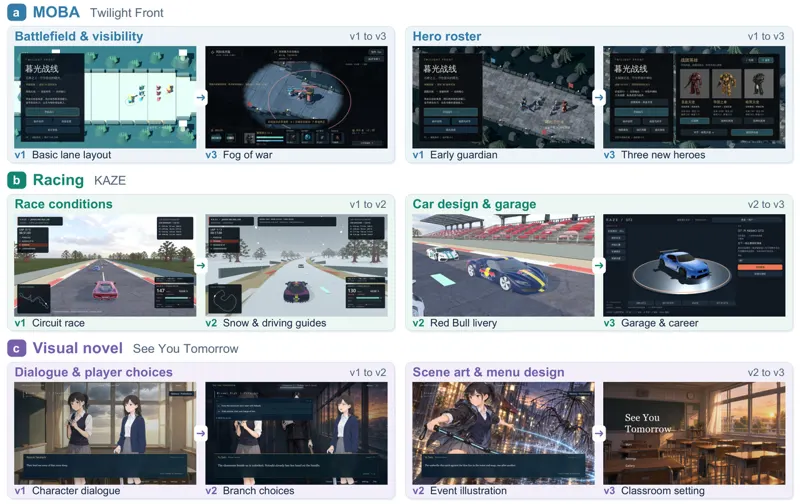
Recursive Game Creator: An Agentic Product-Level Experience-Oriented Game Harness2026-10-06Recursive Game Creator: An Agentic Product-Level Experience-Oriented Game HarnessRecent game design agents have made substantial progress in generating playable games. However, program correctness does not ensure an enjoyable experience for players. We present Recursive Game Creator, an experience-oriented harness to advance agentic game development from rough game prototypes into entertaining games. Recursive Game Creator organizes recursive development around four components: Designer, Builder, Player, and Reviewer. The Designer translates user instructions and Reviewer's feedback into detailed plans. The Builder turns these plans into candidate games. The coding-native Player creates and executes reusable policies through programmatic interfaces to efficiently collect diverse gameplay trajectories, mitigating evaluation bias caused by slow GUI-based collection. The Reviewer uses carefully designed trajectory-based metrics to induce player preferences, integrating with visual evidence and explicit textual preferences to evaluate games against game-specific criteria. Finally, the Reviewer accepts the better version and provides improvement reviews for the next round, closing the recursive loop. Our method achieves state-of-the-art overall performance of 77.89 on GameCraft-Bench. On GameASG-Bench, it achieves a strict task success rate of 53.2%, a 34.1% improvement over the same-model baseline, and the highest mean runtime-check pass rate at 93.4% among compared methods. A user study shows longer playtime and higher ratings. Code is coming soon.

Open source

3

Assets you can use now

No installable skill wired to this domain yet.

Verticals using it

Boundaries & failure modes

The classic trap in this domain is "passes the benchmark, unusable in the game". One, policies do not transfer: a policy learned under a fixed protocol like Atari 100k collapses when resolution changes, when a key mapping changes, or after one version update, because it learned pixel statistics rather than the rules of the game - and commercial patches change both. Two, evaluation protocols are detached from real play: Procgen, MineDojo and BALROG each measure one facet (generalisation, open world, language understanding) and none represents "can an agent complete a real stretch of gameplay for a player", so benchmark readings in this domain are defaulted to needs-reproduction. Three, memory and state management are the true bottleneck: a long playthrough requires the agent to remember what happened tens of minutes ago, where an item was left and what an NPC said, and current context windows plus retrieval mechanisms cannot hold persistent state at that scale, with the failure showing up as walking the same path repeatedly or forgetting a puzzle already solved. Four, cost spills over even in resettable environments: one full playthrough costs far more inference than one conversation, an overnight automated run can burn a substantial token budget, which means large-scale self-play at current prices is only viable for a handful of labs. Five, the sim-to-real gap: control policies learned in a game expose the physics engine's approximation error the moment they reach a robot, and that is the fundamental reason games and embodied stay in separate domains.

As an Amazon Associate, we earn from qualifying purchases.