Skip to content
←Back to all verticals

APPLICATIONS · Knowledge & Research

Research

Literature search, paper writing, lab notes, academic typesetting

Research is the field where AI help is most asymmetric: retrieval, review, writing, typesetting and figures - the expression layer - have been substantially accelerated, while posing a good question, designing a falsifiable experiment and judging whether a result is credible - the judgement layer - have barely been touched. That asymmetry matters because it fixes where the tools belong: use AI to read more and write faster, not to decide what is worth studying. The link to AGI is that research is one of the few domains with expensive but well-defined verification, so a system that can close the hypothesis-experiment-check loop autonomously means far more than a model that can produce a paper. That is why agent-based research workbenches, rather than paper generators, are what to watch. The ladder here is ranked by whether a tool advances that loop, not by how much its output resembles a paper.

Tracked assets
3
Installable skills
3
Capability domains
13

SOTA applications

3
MathResearchTopB

AlphaEvolve: pointing a model at problems that come with an objective scoring function

Google DeepMind's coding-agent-driven evolutionary search: Gemini Flash proposes candidates in volume and Gemini Pro in quality, automatic evaluators score them, and high scorers stay in the population as next-round context, i.e. evolutionary search with an LLM as the mutation operator; it applies only where an automatic evaluator exists, hence the math and agents filing. An evolved scheduling heuristic has run in production in Google data centres (Borg) for over a year, recovering 0.7% of Google's global compute (Google's compute, not all compute on earth), the card reading and the only result validated by long-running production. An evolved matmul kernel is 23% faster at specific sizes, and about 20% of 50+ open maths problems improved, including 4x4 complex matrix multiplication in 48 multiplications against Strassen's 1969 record of 49. Verification differs from the prover line: a Lean check is mathematical correctness, "23% faster" is an empirical reading on specific hardware. No public weights, Early Access is a waitlist, and the precondition is an evaluator you write yourself. Graded B (contested): a year of production behind the Borg result, nothing reproduced.

0.7%Google global compute recovered (production-verified)Contested · 2025-05
ProductionGoogle DeepMindSite
AlphaEvolve: pointing a model at problems that come with an objective scoring function
MathResearchTopC

DeepSeek-Prover-V2: making the Lean kernel, not the model, the judge of correctness

DeepSeek's formal theorem proving model: a 671B MoE base shared with DeepSeek-V3 and Lean 4 as target language, so formal alignment on a flagship base. The core move is recursive subgoal decomposition at cold start: one-shot proofs of competition statements succeed so rarely that RL has almost no positive samples, so DeepSeek-V3 splits a statement into subgoals, a 7B model proves each, and the composed proofs become training data, trading decomposability for data density; the RL reward is binary and comes from the Lean kernel. Vendor-reported: MiniF2F-test 88.9% at pass@8192, PutnamBench 49/658 (about 7.4%), own ProverBench 325 problems. Read them together: MiniF2F is near saturation at that budget while hard Putnam problems drop an order of magnitude, and ProverBench is self-built and self-run. The public repo (about 1304 stars) ships a ZIP of proofs you can run through Lean, putting verifiability a tier above closed models. Limits: pass@8192 means eight thousand-plus candidates per problem, not comparable with pass@1. Not commensurable with Kimina-Prover's 92.2%, so list both without ranking. Graded C (vendor-stated): nothing recomputed in a standard Lean 4 + mathlib environment.

88.9%MiniF2F-testVendor Claim · 2025-07
ResearchDeepSeekSiteRepo
DeepSeek-Prover-V2: making the Lean kernel, not the model, the judge of correctness
MathResearchTopC

Kimina-Prover: reaching 92.2% on miniF2F with whole-proof RL and no search tree

The Lean 4 theorem proving line from Moonshot AI with Numina, deliberately contrarian: no prover feedback in training or inference, no Monte Carlo tree search, value function or process reward model (arXiv:2504.11354), so search is internalised into a single whole-proof generation, and a custom Formal Reasoning Pattern writes a natural-language draft before Lean code, recasting a sparse binary reward as a language problem. The base is Qwen2.5-72B with up to 32K context. Keep two generations apart: Preview (2025-04) reached 80.7% on miniF2F-test at pass@8192, the first public result above 80%; the 72B model (2025-07-10) reached 92.2% after adding TTRL search and error repair, the highest public reading then and the number on the card, while pass@1 under the same protocol is only 63.9%. Equal-budget pass@1/32/1024 of 63.9/84.0/87.7 leads the 671B DeepSeek-Prover-V2 (61.9/82.4/86.6) at all three budgets. Discounts: that table is Kimina's own and its DeepSeek rows are their reruns, the repo declares no licence, and miniF2F holds 244 problems now past 92%, so its power to separate frontier models is decaying. No third-party board exists here, so read the numbers as direction. Graded C (vendor-stated): nothing recomputed on a pinned commit.

92.2%miniF2F (after TTRL search)Vendor Claim · 2025-07
ResearchMoonshot AI (Numina & Kimi)SiteRepo
Kimina-Prover: reaching 92.2% on miniF2F with whole-proof RL and no search tree

Skills you can install

3
ResearchImbad0202/academic-research-skills

Academic Research Skills: A five-skill research pipeline

Editor's takeIts strongest idea is not that it can draft a paper, but that it makes research state, evidence, and stopping conditions explicit: every stage needs scholar confirmation, integrity gates inspect citations and declared provenance, and simulated review is constrained to author feedback rather than a publication decision.

v3.23.0, 50,461 stars, CC BY-NC 4.0. Five Claude Code skills connect deep research, paper writing, simulated peer review, a 10-stage orchestrator, and systematic-review screening, using a Material Passport, mandatory checkpoints, and integrity gates to keep the scholar in control.

Claude Code
/plugin marketplace add Imbad0202/academic-research-skills && /plugin install academic-research-skills
PythonImbad020250.5k
Academic Research Skills: A five-skill research pipeline
ResearchzLanqing/codex-claude-academic-skills

Three Chinese-first research skills that run on both Claude Code and Codex

Editor's takeThe part worth copying is that academic integrity is written as instructions: no fabricated data, DOIs or journals, and every piece of content is classified as quotation, confirmed fact, reasonable inference or writing suggestion, so the author can see at a glance which sentences have a source. The real danger in academic writing is not weak prose but a model writing inference as though it were established fact, and that four-way split blocks exactly that. The three skills also compose: figures, then body text, then defence slides.

4,117 stars, MIT. research-writing handles drafting, revising and polishing paper sections plus rebuttals; office-academic generates and edits academic Word and PPT at the OOXML layer (literature reports, group meetings, proposals, defences); scientific-toolkit covers MATLAB/Python simulation, signal processing, statistics, machine learning and paper figures, with literature search across arXiv, PubMed, CrossRef, Semantic Scholar and OpenAlex.

Claude CodeCodex
git clone https://github.com/zLanqing/codex-claude-academic-skills && cp -r codex-claude-academic-skills/research-writing-skill ~/.claude/skills/
PythonzLanqing4.1k
Three Chinese-first research skills that run on both Claude Code and Codex
Research199-biotechnologies/claude-deep-research-skill

An eight-phase deep research pipeline with an evidence ledger

Editor's takeThe soul is four append-only JSONL ledgers: sources, evidence, claims and run_manifest. Every factual claim must carry an inline [N] backed by evidence.jsonl, unsupported claims may not ship, and validate_report.py plus verify_citations.py check the result. The repo has no LICENSE file, which under default copyright means all rights reserved: you can read and run it locally, but get the author's permission before redistributing or using it commercially.

1,051 stars. Four intensity modes — Quick at 3 phases and 2-5 minutes, Standard at 6, Deep at 8, UltraDeep at 8+ and 20-45 minutes — running SCOPE, PLAN, RETRIEVE, TRIANGULATE, outline refinement, SYNTHESIZE, CRITIQUE, REFINE and PACKAGE, and emitting Markdown, a McKinsey-style HTML report and a PDF.

Claude Code
git clone https://github.com/199-biotechnologies/claude-deep-research-skill ~/.claude/skills/deep-research
Python199-biotechnologies1.1k
An eight-phase deep research pipeline with an evidence ledger

Open source

6

Demo videos

1013

Papers & deep reads

540
D&A: Decoupling Description and Assessment Enables VLMs as Zero-Shot Robotic Reward Models2026-11-02D&A: Decoupling Description and Assessment Enables VLMs as Zero-Shot Robotic Reward ModelsVision-Language Models (VLMs) hold promise for zero-shot video task-progress estimation in robot learning, yet existing frameworks frequently suffer from confirmation bias, hallucinating progress in failed executions due to implicit success assumptions or relative temporal ranking designs. Naive prompting of frontier models collapses into a binary success detector that fails to capture nuanced, non-linear progress and failures. While post-training approaches can mitigate this through explicit training, they demand expensive real-world robotics data and require computationally intensive post-training for every individual base model. To resolve these limitations, we introduce D&A (Describe & Assess): our approach decouples progress estimation into an objective, task-grounded textual description of scene dynamics followed by an assessment phase using explicit rubrics. By compelling the VLM to synthesize an explicit, text-based definition of absolute success before scoring, the framework anchors evaluations to an external, global criterion rather than the video's internal timeline. Empirical results demonstrate that our method calibrates zero-shot estimates and mitigates confirmation bias, providing fine-grained, partial progress metrics that accurately penalize failed executions while correctly interpolating successful runs. Being purely prompt-based, D&A generalizes across tasks, embodiments, and benchmarks---matching or surpassing post-trained reward models---and its reward estimates enable efficient downstream reinforcement learning.
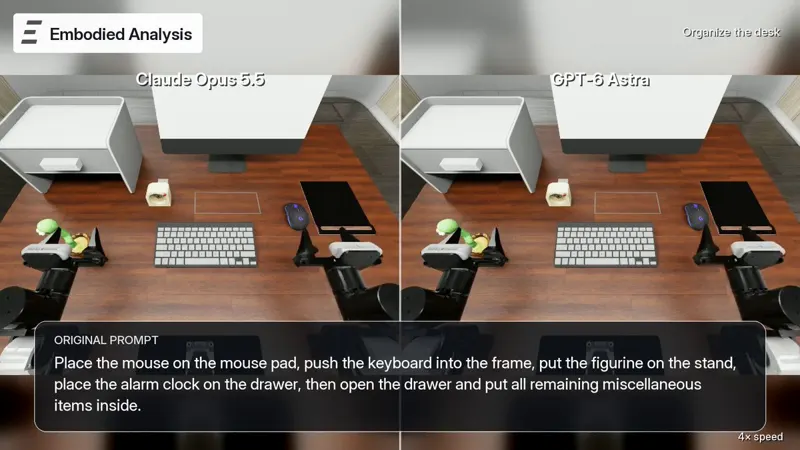
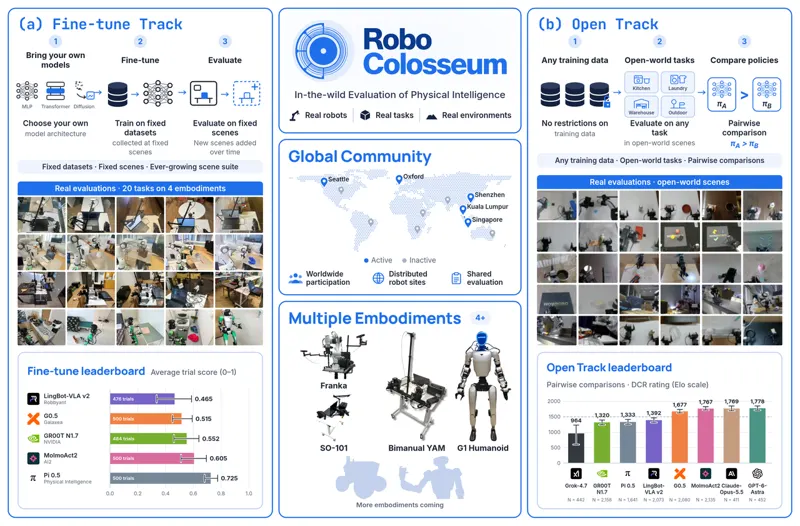
RoboColosseum: Evaluating Physical Intelligence at Scale In-The-Wild2026-11-02RoboColosseum: Evaluating Physical Intelligence at Scale In-The-WildGeneral-purpose robot policies must work across robots, tasks, and environments, yet the variation that makes physical trials informative also makes them difficult to reproduce. We introduce RoboColosseum, a distributed evaluation framework that combines unified policy serving and standardized protocols across a network of locally operated robots in diverse environments. Our initial study evaluates five vision-language-action (VLA) policies and three frontier AI agents across four embodiments (SO-101, Franka, Bimanual-YAM, and G1 Humanoid). The Open Track compares models without task-specific adaptation in blinded, pairwise trials under matched local conditions. The Fine-tune Track measures how well VLA policies adapt to 20 tasks across all four embodiments when each policy receives the same 100 demonstrations per task. Across 5,699 pairwise Open Track comparisons at 124 sites, frontier agents rival specialized VLA policies, while all systems struggle to complete open-world tasks reliably. After fine-tuning, GR00T N1.7 leads on SO-101 and pi0.5 leads on Franka and Bimanual-YAM. Policy rankings show weak agreement across embodiment-specific task suites (Kendall W = 0.24). Open Track rankings poorly predict relative performance after fine-tuning, with substantial rank reversals on all three embodiments shared between tracks. Measuring partial progress reveals differences that task success alone misses. On the G1 Humanoid, no policy completes any of the five tasks, yet average progress ranges from 13.3% to 23.2% across policies. Open Track rankings stabilize as trials accumulate, and active matchmaking achieves comparable ranking agreement with substantially fewer physical trials than uniform sampling. These results show how distributed physical evaluation can reveal where robot policies generalize, how well they adapt to new tasks, and how far they progress on tasks they fail to complete.
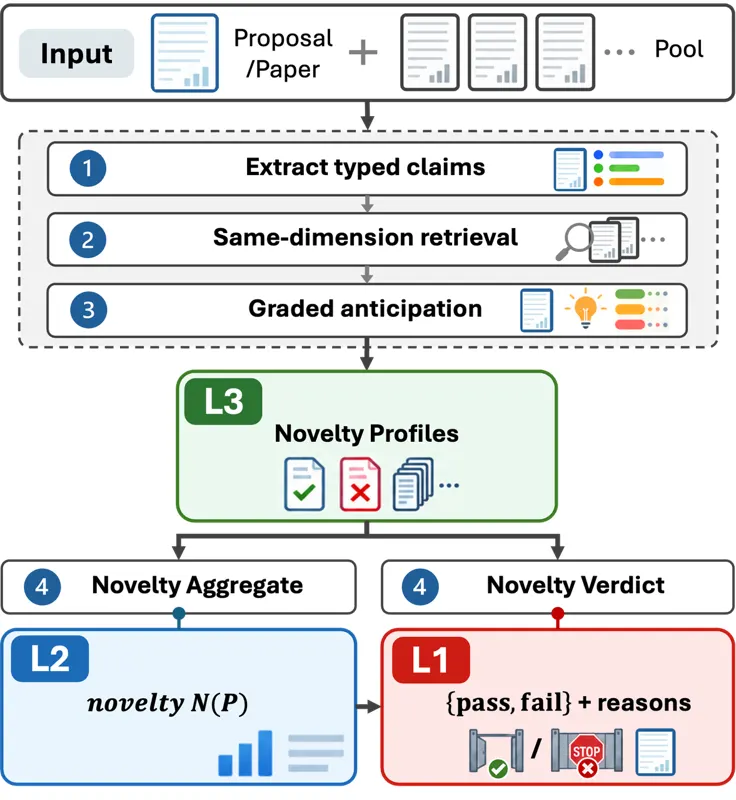
Do AI Scientists Know What's New?2026-10-27Do AI Scientists Know What's New?A major challenge facing AI scientific discovery pipelines is how to determine when a generated idea is meaningfully novel. Ideally, novelty checks in these pipelines must be able to reject non-novel ideas while not rejecting too many novel ideas, and they should also be able to distinguish which parts of a proposal are non-novel, as opposed to opaquely discarding entire proposals. We design an analytical framework for evaluation of novelty checks with temporal ground truth at both the proposal- and claim-level, using four datasets of 1,060 proposals built from published papers, reviewer disputes, and generated ideas matching ones the field went on to publish. Auditing existing novelty checks with this framework, we find that checks with high rejection rates on non-novel work also tend to have high false alarms on ideas that are later realized by human researchers, and observe that checks built to evaluate proposals as a whole can point to claim-level prior art only by rejecting the whole proposal. We therefore introduce ClaimNov, a fine-grained, interpretable claim-level novelty module. ClaimNov catches 97% of disguised papers at a 1.5% false-alarm rate, and its claim-level novelty profile cuts the LLM judge's false alarms from 11.8% to 1.5%. Because its verdict rests on claim-level evidence, ClaimNov also keeps proposals that build on established contributions, rejecting only 3% of ICLR-accepted proposals with a reviewer-disputed contribution and keeping 91 of 100 novel proposals with one spliced prior contribution, against 76 for the strongest existing check. Code and data are available at https://github.com/emmatliu/claimnov.
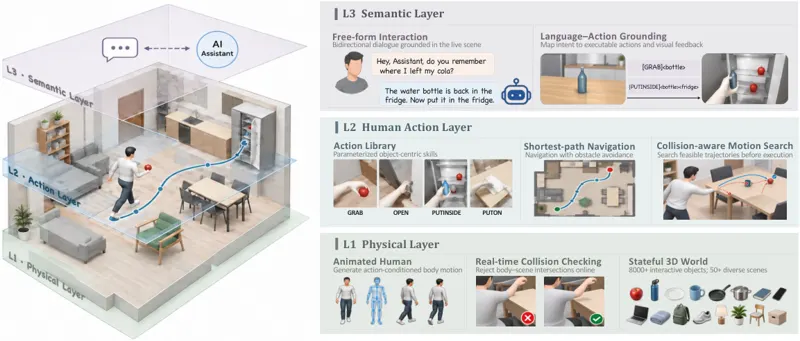
InteractiveWorld: A Verifiable Human-Centric Environment for Building Better Interactive MLLM Assistants2026-10-25InteractiveWorld: A Verifiable Human-Centric Environment for Building Better Interactive MLLM AssistantsPeople have long dreamed of an assistant that is always there to guide them and remind what they forget, from new dishes to lost keys. Powered by multimodal large language models (MLLMs), egocentric AI assistants on wearable devices are bringing this dream within reach: they see what the user sees and give instructions for user's physical work when necessary. However, testing such assistance is challenging and usually requires real people. The expensive and rare real interaction data leaves a key question unanswered: Can today's MLLMs truly help people in physical world? To answer this question, we propose InteractiveWorld, the first verifiable environment for closed-loop interaction between human and AI assistant. Unlike existing robot-centric simulators, InteractiveWorld lets the assistant guide a human agent who observes the scene, understands instructions, and acts independently. It thus realistically simulates how AI assistant collaborates with human: the assistant instructs, the human acts, and the environment executes actions and updates what they see next. Building on it, we introduce InteractiveBench, the first dynamic benchmark for egocentric AI assistants, with 120 multi-turn tasks across six categories. In each task, the assistant guides the human in real time, and every instruction shapes the outcome, which is scored by verifiable, state-based rewards. Experiments with 12 frontier MLLMs show they are still far from reliable assistants. Even the strongest model, Claude Fable 5.1, achieves at most 20% and 25% on long-horizon Guidance and Planning tasks, respectively. Overall, our work offers a verifiable platform and a rigorous evaluation set, laying a solid foundation for research on interactive MLLM assistants that truly help people in the physical world.

Capabilities it draws on

13

As an Amazon Associate, we earn from qualifying purchases.