PAPER DEEP DIVE
MorphMimic: Morphology-Conditioned World Model and Policy Sharing Across Humanoids
MorphMimic conditions a shared differentiable world model and tracking policy on a 125-value morphology descriptor, enabling three humanoids to learn from 128,786 common motion clips and share one controller.
One-sentence summary
MorphMimic trains one morphology-conditioned world model and one whole-body tracking policy for the Unitree G1, AgiBot X2 Ultra, and Booster T2, preserving specialist-level simulation return across 128,786 shared clips and deploying the same policy on a physical G1.
1. Why a Common Joint List Is Not Yet a Common Controller
Whole-body motion tracking is the low-level layer behind expressive movement, humanoid teleoperation, and reference-motion playback. At each 50 Hz control step, the controller maps a short future window of retargeted human motion and its own proprioception into joint position targets. Learned trackers can produce natural movement, but most are trained around one robot. A new platform then requires another dynamics model, another training run, and often another integration effort.
This repetition is costly because modern humanoids look deceptively similar in kinematic diagrams. The three robots in MorphMimic each expose 29 policy joints, yet their native ordering, positive axes, neutral poses, link dimensions, masses, proportional and derivative gains, and maximum efforts differ. The same normalized action can therefore generate visibly different acceleration and contact behavior. A shared tensor shape is not sufficient evidence that two robots share a control representation.
The paper's central claim is that a single differentiable world model and a single tracking policy can take the body as an explicit input. The shared network does not merely classify commands. It predicts dynamics, receives policy gradients through short imagined rollouts, and outputs continuous low-level actions for every robot. This makes cross-embodiment sharing harder than training three task planners above three unchanged controllers: a prediction error on one body propagates into both the imagined trajectory and the shared actor update.
MorphMimic addresses that coupling at three levels. A canonical layout makes joint and body slots semantically comparable. A physical descriptor tells the world model, decoder, and critics which actuators and geometry produced the current data. A latent-alignment loss encourages corresponding reference frames to occupy nearby command coordinates. A second sparse-keypoint encoder is then trained to reuse the same decoder by matching its robot's full-motion latent.
The experiments test both the favorable and unfavorable sides of this design. When all three bodies are trained together, the unified model comes very close to per-robot specialists. When a G1-only tracker is transferred unchanged, performance can collapse on X2 or T2. That contrast is central to reading the paper accurately: the work demonstrates joint training across a defined humanoid family; it does not establish unrestricted zero-shot transfer to any unseen body.
2. Objective and Evaluation Protocol
Let b index the G1, X2, and T2. State stb evolves under robot-specific simulator dynamics Pb after canonical action at, which contains 29 target displacements. A reference supplies a goal gtb built from K=10 future frames, and the policy observes a history ot-K+1:tb. Rather than pooling every transition from every robot into one undifferentiated average, the objective first forms a discounted return per body and then averages bodies equally:
$$J(\theta)=\frac{1}{|\mathcal B|}\sum_{b\in\mathcal B}\mathbb{E}\left[\sum_{t=0}^{T_b-1}\gamma^t r_{t+1}^b\right]$$
This body-balanced objective matters conceptually even though the reported runs use equal environment budgets. It states that each morphology should have the same influence on the shared parameters. Replay buffers, motion libraries, reset samplers, normalizers, default poses, and action maps remain robot-specific. Sharing therefore occurs in selected learnable blocks rather than through a fictitious claim that the three simulation environments are the same Markov decision process.
The full-motion goal is position-free with respect to the robot. Each of the ten frames carries joint positions, joint velocities, and a torso-anchor position and six-dimensional orientation, producing a 670-dimensional input. Anchor positions are expressed in a reference pelvis-heading frame and retain absolute height. Anchor orientations are relative to the robot's current torso, supplying yaw as well as roll and pitch feedback. The deployed policy does not need its world-frame location.
Evaluation uses survival and normalized return. Survival is the fraction of clips that reach their final frame without termination from excessive anchor-height or tilt error. For a clip of Li steps and ni executed transitions, normalized return is:
$$R_i^{\mathrm{norm}}=\frac{\sum_{t=0}^{n_i-1}r_{i,t+1}}{r_{\max}(L_i-1)}$$
Because the denominator always spans the entire clip, early termination sharply lowers the score even if the first few frames track well. The common evaluation set contains 128,786 clip versions present in all three retargeted libraries. Runs are deterministic and use nominal simulator parameters, clean observations, clean targets, and clean resets. These conditions are suitable for controlled architecture comparison but are not a substitute for hardware reliability data.
3. Canonical Representation: Where Semantics End and Physics Begins
The canonical map assigns joints to common functional slots. For robot b and canonical slot j, let pb(j) identify the native joint, εb,j encode its sign, and δb,j its neutral-pose offset. A native joint position is converted to the canonical value by:
$$q_j^c=\epsilon_{b,j}q_{p_b(j)}^b-\delta_{b,j}$$
Velocities and other differences use only the permutation and sign, not the constant offset. This step removes naming and sign ambiguity. It does not pretend that a G1 hip and a T2 hip have the same inertia, friction, or torque response. Those distinctions are retained through robot-local statistics and the morphology descriptor.
Actions are scaled displacements from each robot's native default pose. With action scale κa, effort limit τmax, and proportional gain kp, the paper defines αb,j=κaτb,jmax/kp,b,j and sends the target
$$q_{p_b(j),t}^{\mathrm{target}}=q_{p_b(j)}^{b,\mathrm{default}}+\epsilon_{b,j}\alpha_{b,j}a_{t,j}$$
A unit action therefore changes the proportional torque, at the measured joint state, by a fixed fraction of each actuator's effort limit. This improves comparability across motors without erasing saturation, delay, backlash, or thermal effects. It also exposes an important transfer condition observed later: the same action semantics depend on whether the decoder learned around the source robot's action scale or the target robot's scale.
The observation and state representation tracks 14 body slots: a pelvis equivalent, three bodies per leg, a torso equivalent, and three bodies per arm. A local transform removes global pelvis position while retaining heading. A 33-value context records foot friction, joint-encoder bias, and center-of-mass offset. These values condition training but are not collapsed into shared weights because they belong to each simulator instance.
The static morphology vector concatenates four 29-dimensional log actuator blocks and nine geometry or mass features:
$$m_b=\mathcal S\left([\log\alpha_b,\log k_{p,b},\log k_{d,b},\log\tau_b^{\max},\eta_b]\right)$$
The actuator blocks contain 116 values and ηb contributes nine more, yielding a 125-dimensional descriptor. The nine features are thigh, shank, upper-arm, and forearm lengths; hip width; torso height; total mass; leg-subtree mass; and arm-subtree mass. Scaling maps the observed range to roughly [−1,1] and maps constant features to zero. This vector is supplied to dynamics prediction, actor decoding, critic inputs, and the five-point action path.
4. Shared Dynamics in a Robot-Local Residual Frame
The world model uses SuperMimic's short-horizon autoregressive fitting procedure but shares one dynamics network across the three robot streams. It predicts a residual in the current pelvis-local frame Ft, not an absolute position in a common world frame. Its root-frame feature vector is
$$x_t^b=[N_s^b(u_t),e_t^b,a_t,\mathcal S_\xi\xi^b,m_b]$$
where ut=ΦFt(st) is the normalized local state, etb contains local gravity and tracked-body heights, and Sξξb is the scaled context. The appendix gives 472 values in total: 268 local state features, 17 gravity and height values, 29 actions, 33 context values, and 125 morphology values.
The one-step predicted state is reconstructed as
$$\hat s_{t+1}^b=\Phi_{F_t}^{-1}\left(u_t+\sigma_{\Delta,b}\odot f_\omega(x_t^b)\right)$$
The fixed σΔ,b is the RMS one-step residual measured during warm-up. It normalizes learning and evaluation across bodies. The residual output is initialized to zero, so the first prediction is the unchanged local state. That initialization reduces the chance that a newly shared model sends an unnamed robot through a violently incorrect imagined trajectory before its residual scale has become meaningful.
Termination is predicted as a hazard. Height and tilt errors ez and eu produce learned sigmoid probabilities, which are combined under the assumption that either failure can end the episode:
$$p_z=\sigma(k_z(e_z-\bar e_z)+b_z),\qquad p_u=\sigma(k_u(e_u-\bar e_u)+b_u),\qquad \hat d=1-(1-p_z)(1-p_u)$$
The height and tilt branches are not independent physical mechanisms, but the probabilistic combination provides a differentiable summary that lets a positive error on either branch raise termination risk. The thresholds remain those of each simulator. This is more structured than a body-agnostic binary classifier, while still allowing learned gain and bias to account for different robot sensitivities.
5. Shared Actor, Morphology Conditioning, and Command Alignment
The full-motion encoder maps the normalized ten-frame goal to a 32-dimensional latent inside a tanh range. A shared decoder receives that latent, the last ten proprioceptive observations, and the morphology descriptor:
$$z_t^b=E(N_g^b(g_t^b)),\qquad a_t=D(z_t^b,N_o^b(o_{t-K+1:t}^b),m_b)$$
This separation gives the latent an explicit role as the requested motion. Execution conditions remain in the decoder. The encoder sees only the reference, while the decoder also sees state feedback and hardware. The critics likewise receive morphology and training-only reference-anchor positions. This limits the temptation for the command representation to absorb body-specific corrective actions.
Feature-wise linear modulation complements direct concatenation. For hidden activation hl, learned Γl, Bl, μl, and νl, the modulated activation is
$$\tilde h_l=h_l\odot(1+\Gamma_lm_b+\mu_l)+B_lm_b+\nu_l$$
The modulation parameters begin at zero, making early training equivalent to a concatenation-only decoder. As training proceeds, multiplicative terms can alter channel sensitivity while additive terms introduce body-dependent bias. This supports interactions such as the same motion latent needing different joint excursions for different limb lengths.
Policy optimization uses frozen model and critic rollouts of 32 steps. The gradient is averaged across active robot processes before clipping and Adam update. Equal averaging prevents a robot with a larger gradient norm from dominating the shared actor solely because its local loss surface is steeper.
Latent alignment supplies a cross-body correspondence objective. At each policy update, robots sample the same 1,024 clip-frame pairs from the intersection of their motion sets. The shared encoders process each robot's version, and the loss moves each latent toward the stop-gradient mean of the three:
$$\mathcal L_{\mathrm{align}}=\frac1{N_a}\sum_{i=1}^{N_a}\frac{\lVert z_i^b-\operatorname{sg}(\bar z_i)\rVert_2^2}{2}$$
The motion-policy objective is the negative imagined return plus a 0.05-weighted alignment term. Stop-gradient is important because it makes robots approach a moving common target rather than allowing all three to move the target while reducing their own loss. Alignment does not force complete states or actions to match. It creates a semantic coordinate around corresponding reference frames.
6. Reusing the Same Decoder for Five-Point Control
Many teleoperation interfaces do not supply a full 29-joint reference. MorphMimic therefore defines five tracked points at the pelvis, both ankles, and both wrists, corresponding to canonical body slots 0, 3, 6, 10, and 13. Each point has a 3D position and a six-dimensional orientation over ten frames. Ten frames times five points times nine values gives 450 scalar values; five point-mask bits and ten frame-mask bits bring the input to 465.
Target positions use the robot's physical scale and the reference heading frame. Heights are absolute, horizontal positions do not depend on the robot's current location, and orientations are relative to the current pelvis. Masked target blocks are zeroed and mask bits are retained. A running normalizer processes the features before masking.
The five-point encoder outputs a 32-dimensional tanh latent. It then calls the exact morphology-conditioned decoder used by the full-motion interface:
$$z_t^{b,kp}=E_{\mathrm{kp}}(\tilde g_t^{b,kp}),\qquad a_t=D(z_t^{b,kp},N_o^b(o_{t-K+1:t}^b),m_b)$$
Training does not ask the sparse targets to directly predict joint targets. Instead, it matches the sparse latent to the full-motion latent that the shared encoder produces from the clean full goal at the corresponding imagined state. The loss is:
$$\mathcal L_{\mathrm{kp}}^b=-\hat J_{\mathrm{kp}}^b+\beta_{\mathrm{kp}}\frac1{|\mathcal I_b|}\sum_{(i,t)\in\mathcal I_b}\frac{\lVert z_{i,t}^{b,\mathrm{kp}}-\operatorname{sg}(z_{i,t}^{b,\mathrm{motion}})\rVert_2^2}{2}$$
The keypoint weight is 0.1. Only the five-point encoder is updated in this extra step; its gradients pass through a frozen decoder, world model, and critic. This design keeps command learning in a shared latent and avoids cloning a second body-specific execution network.
To avoid training on unrealistically exact targets, the actor receives bounded perturbations during imagination. Horizontal jitter is ±0.05 m, vertical jitter is ±0.01 m, roll-pitch jitter is ±0.1 rad, and yaw jitter is ±0.2 rad. Rewards, termination, critic targets, data collection checks, and final evaluation use clean references. Half of the collection environments use the five-point encoder and half use the full encoder, so sparse-interface behavior also contributes to future dynamics fitting.
| Component | Input and output | Shared learning | Robot-local configuration |
|---|---|---|---|
| Full-motion encoder | 670-dimensional goal to 32-dimensional latent | Yes | Goal normalizer |
| Five-point encoder | 465-dimensional targets and masks to 32-dimensional latent | Yes | Running normalizer |
| Decoder | Latent, ten observations, 125 morphology values to 29 actions | Yes, with FiLM | Observation normalizer, default pose, action map |
| World model | 472 root-frame features to next local residual and termination risk | Yes | Replay buffer, residual scale, state statistics |
| Critics | Predicted state, rubric, anchor reference, context, morphology | Unified configuration shares them | Interface and robot-specific targets |
The word “shared” therefore needs a careful operational definition. A checkpoint still requires the selected robot's normalization statistics, joint limits, default pose, and native action map. Adding a new humanoid requires a kinematic map, morphology descriptor, and retargeted motions. MorphMimic reduces the number of learned controller variants; it does not eliminate robot onboarding.
7. The Joint-Training Loop
flowchart LR
    A[G1 simulator and retargeted corpus] --> D[Robot-local replay]
    B[X2 Ultra simulator and corpus] --> E[Robot-local replay]
    C[T2 simulator and corpus] --> F[Robot-local replay]
    D --> G[Fit shared world model]
    E --> G
    F --> G
    G --> H[32-step imagined rollouts]
    H --> I[Shared motion encoder and decoder]
    I --> J[Align corresponding-frame latents to their mean]
    H --> K[Train five-point encoder to match own motion latent]
    J --> L[Average shared gradients equally]
    K --> L
    L --> M[Clip and apply Adam update]
    M --> N[Collect and evaluate per robot]
Each robot runs its own simulator process, motion library, replay buffer, and reset sampler. A training iteration collects transitions, fits an eight-step shared world model, updates the motion encoder and decoder through 32-step imagined rollouts, fits the motion critic, then updates the five-point encoder and its critic from fresh imagined starts. Each robot uses 4,096 environments, and the unified run lasts 40,000 iterations. Actuator delay is randomized between 0 and 40 ms.
The source motion corpus is BONES-SEED. G1 uses the dataset's retargeted motions; X2 and T2 are generated by Nvidia's SOMA Retargeter from the same human source. References are converted to the 50 Hz control rate and filtered against soft joint limits. The evaluation intersection is truncated to 128,786 clips, ensuring that clip index i describes the same source action on all three bodies. Without this construction, latent alignment and performance comparison would be much less interpretable.
The compute result deserves a literal reading. The unified run takes 5 h 26 min and 16.3 H100-NVL GPU-hours on three GPUs. The three specialists together use 13.9 GPU-hours. Joint training is therefore about 17% more expensive in raw accelerator time. Its advantage is model and interface reuse, not a measured compute reduction. The paper does not report engineering hours, scheduler complexity, or the cost of maintaining three live simulator streams.
8. Reported Performance Across Interfaces and Bodies
The main comparison covers four sharing configurations: independent specialists, shared world model, shared actor, and a unified model that also shares critics. All use the same architectures, environment count, iteration count, and optimizer settings. Table 2 isolates the specialist and unified endpoints, which are sufficient to assess whether joint training preserves performance on the evaluated bodies.
| Interface | Configuration | G1 survival / return | X2 Ultra survival / return | T2 survival / return |
|---|---|---|---|---|
| Full motion | Specialist | 99.797% / 0.9306 | 99.818% / 0.9253 | 99.860% / 0.9448 |
| Full motion | Unified | 99.747% / 0.9358 | 99.891% / 0.9304 | 99.886% / 0.9398 |
| Five point | Specialist | 99.849% / 0.8807 | 99.841% / 0.8689 | 99.857% / 0.9014 |
| Five point | Unified | 99.729% / 0.8626 | 99.880% / 0.8774 | 99.852% / 0.8890 |
Every unified return lies within 0.02 of the corresponding specialist. The largest gap is 0.018 on G1 with five-point commands. Unified survival is lower by 0.050 percentage points on G1 full motion, 0.120 points on G1 five-point, and 0.026 points on T2 full motion; it is slightly higher on both X2 interfaces and T2 five-point. No body has to absorb a hidden dramatic regression for the average result to look good.
The sparse interface reduces return by roughly 0.04 to 0.07 relative to full motion. In the unified configuration it introduces 23, 13, and 44 additional early terminations on G1, X2, and T2, respectively. Five bodies constrain gross limb placement but not every intermediate joint angle, so some precision loss is expected. The interface remains useful because pelvis, ankle, and wrist tracks are easier to obtain from human motion or teleoperation than a full 29-joint reference.
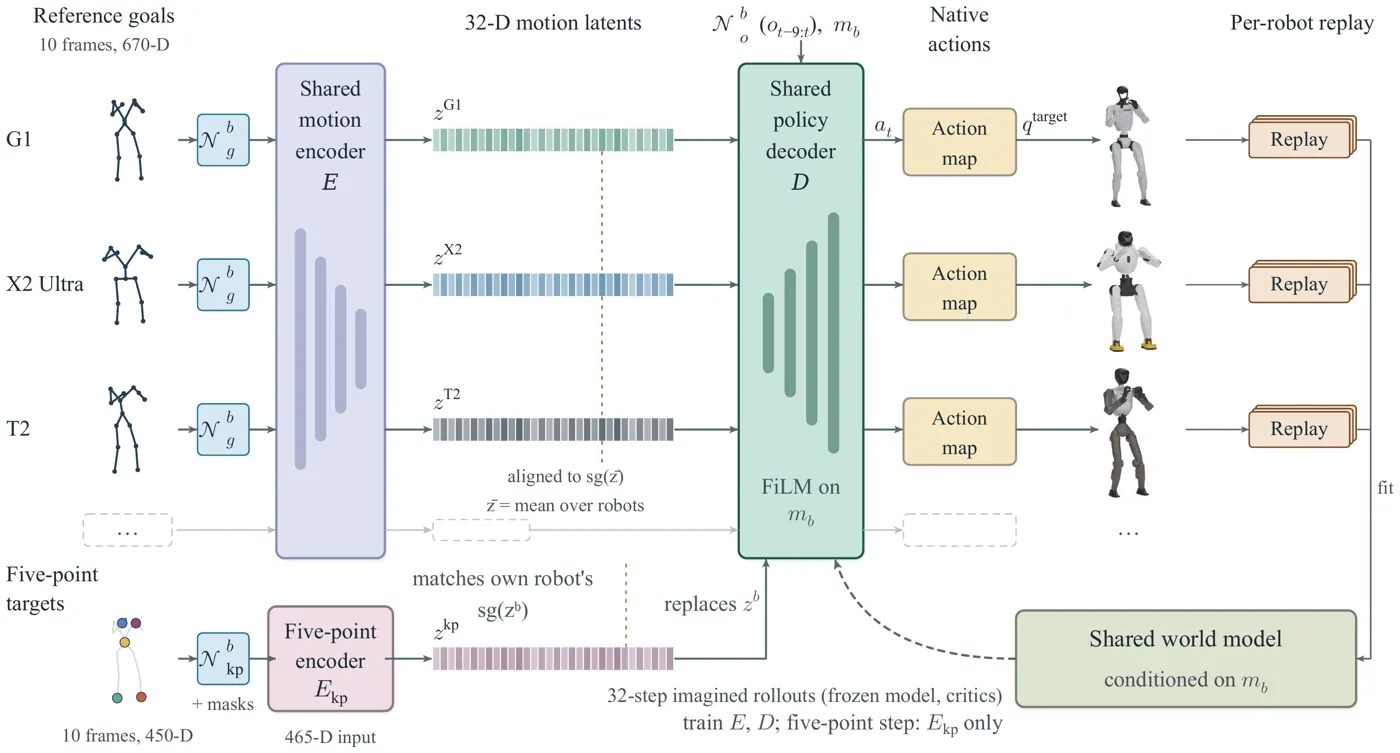
Figure 2: Full-motion and five-point goals enter a shared 32-dimensional latent space. Morphology is concatenated into the decoder and world model and also modulates decoder features through FiLM.
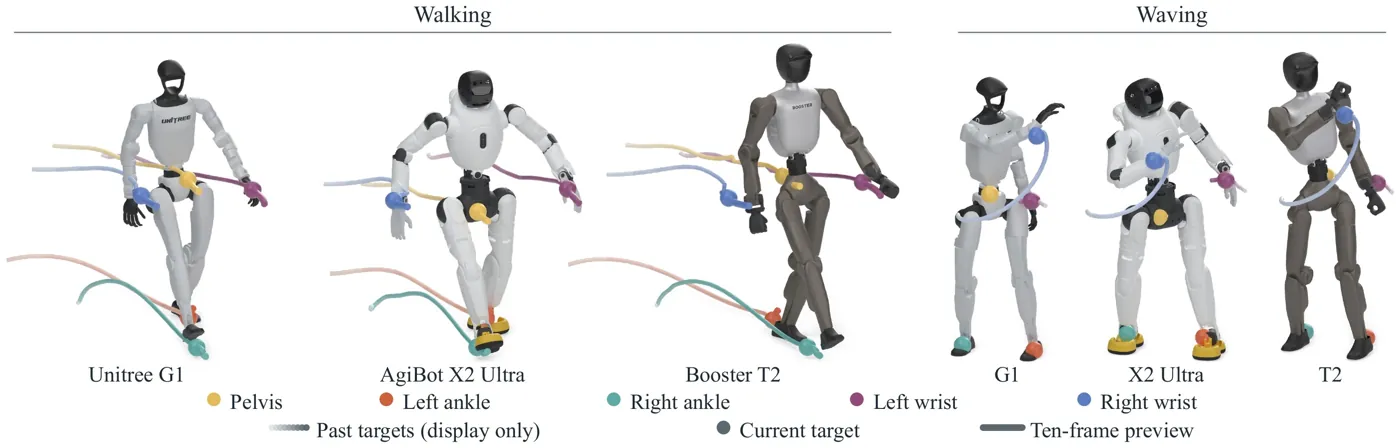
Figure 3: One walking-and-waving reference executed through five-point commands on G1, X2 Ultra, and T2. Spheres mark current targets and solid curves show the ten-frame preview.
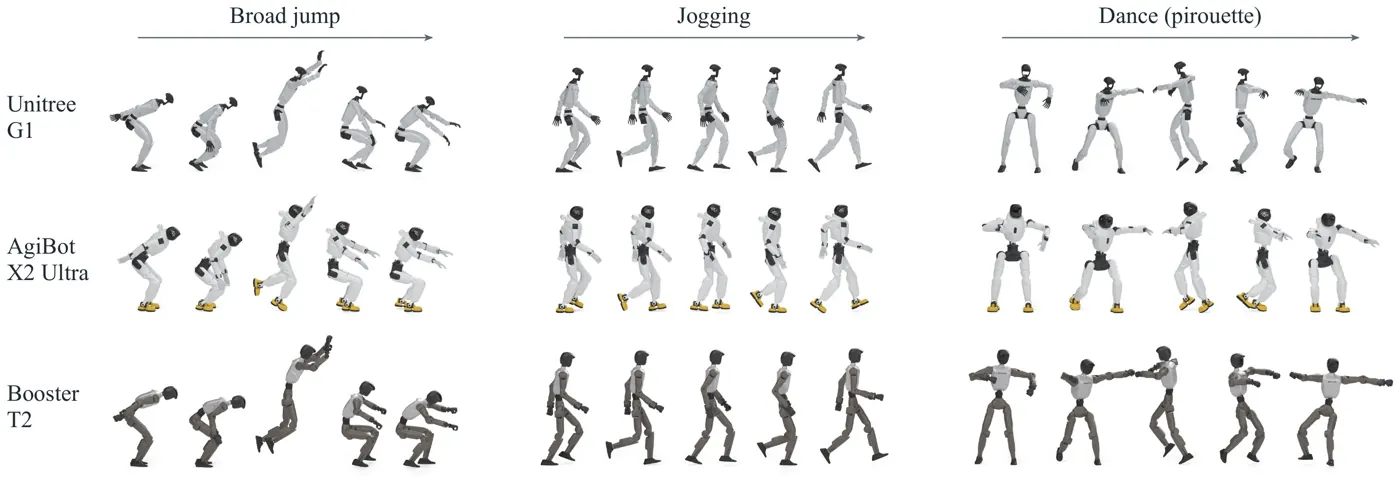
Figure 4: The unified full-motion policy produces broad jump, jogging, and a pirouette on all three robots. Each strip contains five simulator frames ordered left to right.
9. Single-Robot Transfer Reveals the Real Boundary
The most informative experiment is not the near-equal unified table. It is the diagnostic transfer of a G1-only policy to X2 and T2 without retraining. The authors test a G1 specialist and a shared-world-model actor on the common set. They compare two interpretations of the target action interface: use the target robot's action scale and default pose, or retain the G1 parameters while mapping to target joints.
| Transfer condition | X2 full motion | X2 five point | T2 full motion | T2 five point |
|---|---|---|---|---|
| G1 specialist, target parameters | 7.7% / 0.213 | 17.2% / 0.264 | 1.9% / 0.048 | 2.6% / 0.047 |
| G1 specialist, G1 parameters | 87.7% / 0.724 | 76.8% / 0.401 | 1.6% / 0.042 | 2.1% / 0.027 |
| Shared-world-model G1 actor, target parameters | 8.1% / 0.223 | 24.6% / 0.278 | 1.5% / 0.040 | 2.2% / 0.035 |
| Shared-world-model G1 actor, G1 parameters | 82.8% / 0.692 | 82.2% / 0.407 | 1.6% / 0.036 | 1.7% / 0.025 |
On X2, substituting the target robot's action scale and default pose is worse than retaining the source parameters. The G1 specialist falls from 87.7% to 7.7% survival on full motion and from 76.8% to 17.2% on five-point tracking. The network learned its corrections around a particular relationship between action values and actuator response. Changing that relationship at deployment pushes the output outside its training distribution, even though the replacement is physically more “correct” for X2.
T2 fails under nearly every transfer condition, with survival below 3%. Part of the explanation is a different sensing definition: T2 uses a trunk-mounted IMU, while the G1 actor was trained with a pelvis IMU. Moving the simulated T2 IMU to the waist-yaw link raises transferred G1-parameter survival to 83.4% for the specialist and 81.5% for the shared-world-model actor on full motion, and to 75.4% and 74.2% on five point. The target-parameter versions also recover substantially but remain lower and less consistent.
This is direct evidence that canonical joints are necessary but not sufficient. Morphology, action scaling, default pose, and observation frame are all part of the controller's effective embodiment. With all three bodies present during training, the unified actor learns to separate these factors through morphology conditioning and shared latent commands, reaching roughly 99.9% survival on X2 and T2. That result validates supervised multi-body training. It does not show that a fourth, unseen body can be controlled without new behavioral data.
10. Physical G1 Validation and Deployment Requirements
The 40,000-iteration unified policy is exported to ONNX and deployed on one physical Unitree G1. At every control step, the policy reads pelvis IMU orientation and angular velocity plus 29 joint encoders. Its canonical output is translated through the G1 action map into position targets for PD controllers using the training gains. The shared network weights are the same ones reported for all three simulated robots, but deployment still loads G1-specific normalization and physical constants.
Dance and walking use the full-motion interface. Each source clip is rotated to the robot's initial heading so that the pelvis IMU orientation establishes a common direction. Five-point teleoperation uses a PICO headset, two hand controllers, and two ankle trackers. Operator motion is resampled and retargeted to G1 reference states at the control rate. Because live human input does not provide future joint goals, a nominal K−1=9-frame buffer supplies the short preview. The robot follows standing, squatting, and arm motion during the demonstration.
The hardware result establishes feasibility of three links: a policy trained in imagined rollouts can cross from simulation to G1; one morphology-conditioned decoder can serve both dense and sparse interfaces on physical hardware; and all policy inputs can come from the reference plus onboard sensing rather than a mocap system tracking the robot's global pose. It does not establish that X2 or T2 has crossed sim-to-real, and it does not report per-motion success rates, tracking error, run duration, or recovery behavior.
For reproduction, the critical artifacts are not merely shared network weights. A deployment needs a verified native-to-canonical joint table, a default pose, actuator-specific action scaling, a 125-value morphology descriptor, robot-local observation statistics, and an interface switch between full and five-point goals. An error in any of these can invalidate the assumption that the same policy is operating in its training representation. The T2 IMU experiment is an unusually clear example of how one sensing-frame mismatch can dominate apparent morphology transfer.
11. What Is New, and What the Evidence Does Not Show
MorphMimic is not the first cross-embodiment controller. Prior systems have conditioned policies on hardware, reused actuator-level modules, aligned semantic joints, randomized morphology, and conditioned world models on physical structure. The paper's contribution is the integration of shared differentiable dynamics and whole-body tracking with canonical action semantics, explicit morphology conditioning, corresponding-frame latent alignment, and a second sparse encoder that reuses the full-motion decoder.
The three-part design is coherent. Canonicalization creates a common tensor meaning. Morphology descaling and conditioning represent how each body realizes that meaning. Latent alignment turns common reference content into a common command coordinate. The five-point path then produces a useful sparse interface without duplicating the execution network. Each component addresses a distinct source of mismatch rather than piling unrelated architectural features onto one model.
The strongest empirical conclusion should remain bounded. The robots share sensor modality and roughly humanoid scale, and the paper defines a common 29-joint, 14-body interface before training. A wheeled humanoid, a robot with substantially different hands and feet, or a platform without corresponding pelvis-ankle-wrist structure would violate the interface rather than test the model's generality. The phrase “new humanoids” in the paper means bodies that fit the proposed layout and have retargeted data.
The morphology vector also has practical prerequisites. It requires actuator scales, gains, limits, limb lengths, masses, and subtree masses. Such quantities may come from manufacturer data, CAD, system identification, or a simulation model, and their accuracy will vary. The paper does not perturb these values or test descriptor coverage at deployment. A future operator may find descriptor acquisition and validation more difficult than running the learning algorithm itself.
12. Limitations
The authors explicitly limit hardware validation to the Unitree G1. This is not a minor omission. Foot contact, actuator heating, communication delay, encoder bias, and IMU noise differ across platforms, and each can become the dominant source of policy error. Successful G1 deployment does not demonstrate three-platform sim-to-real transfer, even if the simulation returns are nearly identical.
All reported simulation comparisons use nominal parameters and clean observations, resets, and targets. Training randomizes actuator delay, but the paper does not characterize sensitivity to friction, mass, gain, latency beyond that range, or sensing noise. The hardware evidence is qualitative. The current study therefore supports controlled feasibility rather than long-run reliability or safety.
No morphology is held out. X2 and T2 are inside the shared training set, so their high survival rates are in-distribution results. The G1-only transfer test is a useful negative control, but it does not form a sample-efficient adaptation study. Future work should separate new motions on a known body, new parameters on a known body, and few-shot adaptation to an unseen body; the present paper primarily covers the first case and a controlled version of the second.
The motion pipeline is also single-source. X2 and T2 references are both produced by SOMA Retargeter from BONES-SEED, so retargeting bias enters training and evaluation together. A policy evaluated on the same retargeting family may appear more robust than it would under human raw motion, another retargeter, or live teleoperation with imperfect body tracking. The paper's limited teleoperation demonstration does not quantify this gap.
Finally, the policy uses a ten-frame, roughly 0.2-second future window. This is enough to track an immediate reference but not to reason explicitly about long contact schedules, future footholds, or energy. The five-point actor also sees a terminal target stream that does not contribute a complete future pose. The paper does not report long-duration drift, repeated clip switching, blocked-motion recovery, or accumulation of shared world-model error over extended operation.
13. Conclusion
MorphMimic provides a concrete recipe for joint humanoid whole-body control: canonicalize joint and body semantics, normalize action scale by actuator authority, condition the world model and actor on a physical morphology vector, align corresponding motion latents, and train a sparse command encoder to reuse the same decoder. A unified run remains within 0.02 mean return of specialists across six robot-interface pairs and transfers its shared weights to a physical G1.
The transfer study draws the useful boundary. A controller trained only on G1 can degrade abruptly when actuator semantics or IMU frames change, while joint training across known bodies recovers near-specialist behavior. MorphMimic is therefore strongest as evidence for multi-morphology co-training with a shared control interface, not as proof of unrestricted zero-shot generalization. The next decisive experiment is a genuinely held-out humanoid trained with limited data, followed by parameter perturbations, retargeter variation, and repeated physical trials on X2 and T2.
MorphMimic shows that one brain can learn three similar bodies, while also showing why a common joint list is only the entry point: actuator authority, sensing frames, and training distribution still decide whether the policy stands.
Sources and Verification Notes
This analysis is based on the nine-page PDF linked by the project page, including its equations and Tables I–III, plus the project page's simulation and hardware materials. No arXiv identifier has been invented. Figures 2, 3, and 4 were extracted from the paper source and stored as site media. The linked GitHub repository was checked for code status but is not treated as the authors' original experimental implementation.
Related-work anchors used only for context: SuperMimic, Any2Any, morphology-conditioned quadruped world models, and Nvidia SOMA Retargeter.