PAPER DEEP DIVE
Compliant GMT: Making General Motion Tracking Compliant via Residual Reference Adaptation
We propose Compliant GMT (C-GMT), a modular framework for full-body compliant responses in general motion tracking. As humanoid robots move into real world deployment, they not only need to perform any motion but also respond safely and robustly to interaction forces. Existing general motion tracking policies can imitate diverse motions but are trained to be stiff, leading to unexpected and unsafe behaviors under disturbance. Prior work in compliant humanoid control trades off compliance and generality. There exist examples of full-body compliant responses, but these are heavily curated to single-reference policies. On the other hand, general motion trackers (GMT) are trained to rigidly imitate massive motion capture datasets. Our key insight is to leverage the generality of pretrained GMTs for motion tracking while introducing compliance from a residual adapter that conditions on a history of proprioception. This enables our approach, C-GMT, to achieve both general motion tracking and whole-body compliant responses. Compared to state-of-the-art general motion trackers and single-motion compliant policies, C-GMT demonstrates competitive performance in both motion tracking accuracy and compliance adherence. We further demonstrate improved safety, robustness, and error tolerance in simulation and real-world G1 experiments.
One-sentence summary
C-GMT keeps a pretrained general motion tracker and adds a proprioceptive residual adapter that rewrites its discrete motion reference using an external-force teacher, allowing one policy to remain versatile while producing adjustable full-body compliant responses.
1. Why a capable motion tracker is not automatically a safe physical collaborator
Humanoid robots are moving from open laboratory floors into kitchens, factories, exhibition halls, and homes. General motion tracking, or GMT, has become a central whole-body control interface for this transition. A single learned policy receives a motion clip, a teleoperated pose, or an action target from a vision-language-action model and converts it into joint commands. The policy is expected to walk, turn, dance, reach, and recover balance across motions that differ substantially in speed and contact pattern.
Most GMT systems are optimized to stay close to the commanded trajectory. Position error produces corrective action, which is useful when the robot moves through free space but problematic when it touches the world. Consider wiping a whiteboard. The human operator, planner, or object model may place the hand a centimeter too far into the board. A stiff tracker interprets that physical mismatch as tracking error and keeps pushing toward the nominal point. The board, the tool, the robot's arm, or all three then carry an unnecessary force.
The same issue appears when the reference itself is imperfect. A teleoperation system has latency, a headset has pose noise, and a VLA may produce a locally inaccurate action. Physical contact can also change the robot's state faster than the upper layer can update. A low-level controller that treats every commanded point as inviolable leaves no mechanical room for these errors. It may display excellent playback in free space and still be unsuitable for contact-rich deployment.
Existing compliant humanoid controllers face a tradeoff. Some produce convincing whole-body yielding, but the policy is specialized to one motion and cannot cover a large motion library. Others support general tracking but confine compliance to the arms while the pelvis and legs remain rigid. Systems trained end to end for both generality and compliance must simultaneously learn motion imitation, balance, force inference, and the desired mechanical response. That joint objective increases training time and makes reward tuning fragile, especially because many force-motion combinations are physically infeasible.
C-GMT starts from a different decomposition. Instead of asking one large policy to become soft, it first builds a general tracker that can execute references under load, then learns a small adapter that changes the reference when interaction is detected. The compliant behavior is therefore specified and checked before it reaches the tracker. This turns compliance into a reference-generation problem with explicit geometry and stiffness, while leaving the difficult locomotion and balance prior in the pretrained tracker.
2. Background: SONIC, motion tokens, and why the reference layer matters
C-GMT builds on SONIC, a general motion tracker that encodes motions into a learned latent representation and uses finite scalar quantization, or FSQ, to produce universal motion tokens. A residual could be added directly to root velocity or joint positions, but the authors argue that this space is too sensitive. A small root-velocity correction can create a large change in foot placement; in their early experiments it caused unintended walking. A compact token space offers a more controlled interface for adaptation.
The new module is not a replacement for the low-level controller. At deployment time, the adapter changes the motion token, and the frozen force-robust decoder remains responsible for producing physically executable joint actions. The tracker still knows how to coordinate limbs and maintain balance. The adapter answers a narrower question: how should this intended motion deform while the robot is being pushed or pulled?
Compliance is parameterized by a commanded stiffness. A low stiffness should generate a larger displacement for the same force, while a high stiffness should stay closer to the original motion. This is more useful than training only one fixed soft policy because different tasks need different interaction behavior. A robot wiping a fragile surface may need low stiffness, whereas a robot holding a heavy tool may need a firmer arm. The paper therefore evaluates not only whether the robot becomes soft, but whether it follows the requested stiffness over a range.
3. Method: a force-robust base plus a distilled compliant adapter
Figure 2 of the paper shows the full training and deployment architecture. The first stage fine-tunes the SONIC decoder and critic with PPO under payload and pulling-force perturbations while freezing the motion encoder and FSQ quantizer. The second stage creates a privileged teacher that can see the applied force and uses a spring law plus inverse kinematics to generate a compliant reference. The third stage distills that teacher into a proprioceptive residual adapter. At deployment, only the adapter and force-robust tracker remain, and the adapter sees no direct force measurement.
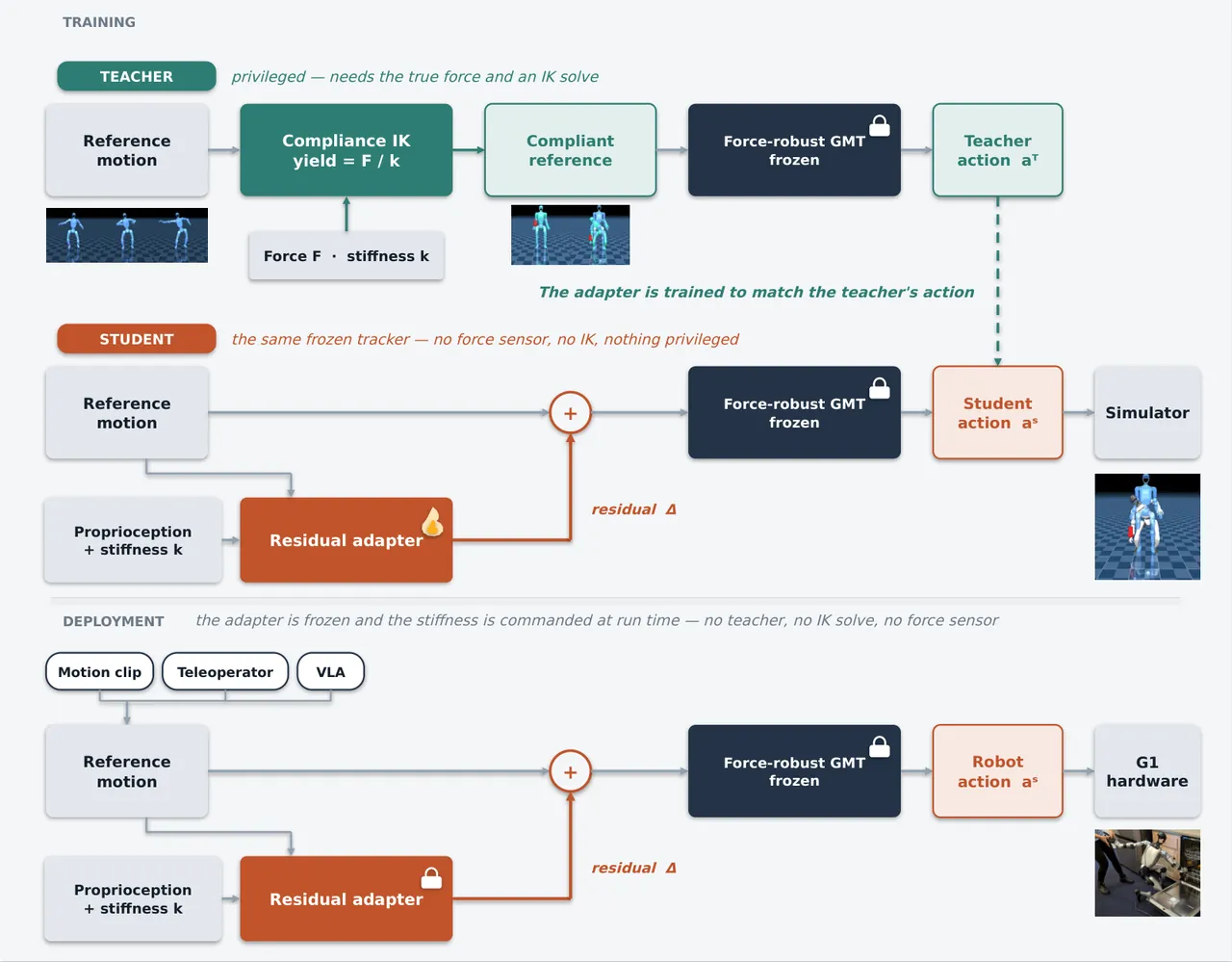
Figure 1: Paper Figure 2. The force-robust tracker is trained first; a force-privileged spring and IK teacher then supervises a lightweight adapter that runs from proprioception at deployment.
flowchart LR
    A["Motion clip or teleop"] --> B["Frozen encoder and FSQ"]
    B --> C["Motion token z"]
    C --> D["Residual adapter"]
    P["Proprioceptive history"] --> D
    K["Commanded stiffness"] --> D
    D --> E["Adapted token z tilde"]
    E --> F["Force-robust decoder"]
    F --> G["G1 joint targets"]
    T["Force-privileged spring and IK teacher"] -. "distillation" .-> D
This order matters. If one first trains an extremely soft base policy, later trying to recover accurate motion tracking can recreate the same conflict. C-GMT instead ensures that the base can faithfully follow references under load, and only then lets the adapter decide where the reference should yield. The tracker also remains a complete fallback system if the adapter contributes zero residual.
3.1 Force-robust tracking: preserving the reference under load
Original SONIC was not trained for sustained arm loads. A heavy hand payload can pull the arm away from the reference, and a sufficiently large external force can destabilize the robot. The authors fine-tune the decoder and critic while retaining the original encoder, quantization scheme, rewards, domain randomization, and adaptive motion sampling. During training, each hand can receive an independently sampled payload of up to 2 kg, together with an external force whose direction and magnitude are held for 2 to 4 seconds before resampling.
Different motion clips tolerate different loads. A standing pose has more room to shift its center of mass than a dynamic dance or a landing. C-GMT therefore assigns each clip a load scale that changes with its cumulative failure rate. The clip-specific force budget is:
$$B_c=\mu_c B$$
Here, B is the current global budget and the multiplier for clip c adjusts the disturbances applied to that clip. Clips with frequent failures receive weaker perturbations; as the policy improves, their budget can rise again. This mechanism avoids spending most training steps on force-motion combinations that cannot be executed, while still exposing feasible motions to meaningful loads. The global budget gradually increases from 10 N to 30 N.
| Load condition | Tracker | Success | Global MPJPE (mm) | Local MPJPE (mm) | PA-MPJPE (mm) |
|---|---|---|---|---|---|
| No load | SONIC | 0.953 | 135 | 28.8 | 20.9 |
| No load | Force-robust | 0.977 | 183 | 26.5 | 18.8 |
| 4 kg, right hand | SONIC | 0.914 | 208 | 33.0 | 25.6 |
| 4 kg, right hand | Force-robust | 0.977 | 212 | 27.6 | 20.6 |
| Pull up to 40 N, both hands | SONIC | 0.906 | 419 | 39.6 | 26.4 |
| Pull up to 40 N, both hands | Force-robust | 0.945 | 289 | 29.8 | 20.7 |
| Pull up to 60 N, both hands | SONIC | 0.820 | 708 | 42.8 | 28.8 |
| Pull up to 60 N, both hands | Force-robust | 0.867 | 349 | 32.6 | 22.3 |
Table I contains a useful tradeoff rather than a uniform win. Without load, global MPJPE rises from 135 mm to 183 mm, a 4.8 cm increase, while local MPJPE and PA-MPJPE improve. The authors note that the global increase is only 2.6% of the 1.82 m average displacement of the 128 held-out clips. Under 4 kg or 60 N, the robust tracker has substantially better success and local accuracy. This is important because the adapter needs the base to execute the modified reference accurately during contact; a tracker that abandons the arm whenever a load appears cannot support the proposed two-stage design.
3.2 A privileged teacher turns force into a reference
The teacher receives the true force applied to a link and a commanded stiffness. It first computes a desired position for that link with a spring law:
$$\mathbf{p}_{i,\mathrm{des}}=\mathbf{p}_{i,\mathrm{ref}}+\frac{\mathbf{F}_i}{K_t^{\mathrm{cmd}}}$$
In this expression, the desired position is the original reference plus a force-dependent displacement. A larger force creates more displacement; a larger stiffness reduces it. The teacher then sends the displaced link target, foot targets, center-of-mass target, and posture regularization to a whole-body inverse-kinematics solver. The solver uses weighted, box-constrained objectives with joint position and velocity limits and collision constraints.
The IK weights show the intended hierarchy. The pushed wrist position has weight 5.0. Foot position and orientation use 2.5 and 0.5, while pelvis orientation uses 0.03. Center-of-mass horizontal objectives use 0.1 and the vertical objective is nearly unconstrained at $10^{-6}$. Smaller posture and joint regularization terms keep the solution near the original pose. The robot therefore yields primarily at the hand but can move the whole body to preserve support.
The teacher provides a valuable safety gate before any neural adapter is trained. The authors run the IK references through the force-robust GMT in simulation and inspect whether the robot falls and whether the resulting behavior looks plausible. They scan 4,096 representative BONES-SEED motions, eight force directions, and several stiffness values. Force ranges that cause instability are removed from adapter training. The learning target is therefore grounded in a base controller that has already executed it, not merely in an analytically desired hand position.
3.3 Applying the residual after FSQ
The deployed adapter receives a 10-step history of proprioceptive observations and previous actions, a 64-dimensional motion token, and the logarithm of the commanded stiffness. The scalar log transformation represents the 40 to 600 N/m range more evenly. The network is a two-layer MLP with hidden sizes 512 and 256 and ELU activations. It has a residual head, a gating head, and an auxiliary force-prediction head.
The residual head predicts a 64-dimensional correction. The gating head predicts one sigmoid value for each of SONIC's two motion tokens. The adapted token is:
$$\tilde{\mathbf{z}}=\mathbf{z}+\mathbf{g}\odot\Delta\mathbf{z}$$
The correction is applied after FSQ rather than before it. Quantization creates discrete boundaries, so a small change in a continuous latent can cross a boundary and produce an abrupt token change. Applying the residual after FSQ avoids that discontinuity. A learned gate can suppress a residual dimension when it is not useful, and entries with magnitude below 0.005 are set to zero. The residual head is zero-initialized, so the system starts from the exact base tracker and learns to deviate only when interaction evidence accumulates.
The auxiliary force head predicts forces on the two wrists during training. It is not required as a measurement at deployment, but it pushes the shared history encoder to retain information related to contact. This is a standard form of representation shaping: even if the explicit force estimate is imperfect, the hidden features may separate loaded from unloaded states. The paper does not report a force-estimation benchmark, so the quantitative usefulness of this auxiliary signal remains an open implementation detail.
3.4 Distillation from teacher-driven to student-driven rollouts
The adapter is trained by matching the teacher's decoded action and the teacher-modified motion token. Samples with an external force receive stronger action-imitation weight. Additional losses supervise force prediction, penalize large residuals, and require the adapter to return to the base behavior when no force is present. Action-rate and jerk terms discourage abrupt changes, but the authors found that these generic smoothness penalties were insufficient for the observed oscillations.
Training starts with 500 teacher-driven updates. Over the next 1,000 updates, the rollout driver shifts linearly from the teacher to the student, after which the student drives the trajectory until convergence. This curriculum exposes the adapter to states induced by its own errors. If training stayed teacher-driven, the student could learn a mapping on a narrow, unrealistically successful state distribution. Switching to student-driven data should improve recovery when its force estimate or residual prediction is wrong.
The loss weights in Table VI reflect the priority of stability. Action imitation is 1.0 normally and 2.0 under force; motion-token imitation is 0.25 and force prediction is 0.1. The standard anti-oscillation loss has weight 60, while its normalized counterpart has weight 10. The adapter is therefore not simply fitted to a desired displacement. A large portion of the objective is devoted to preventing the correction from resonating with the robot's existing motion.
3.5 Two anti-oscillation losses
Early adapters produced periodic arm motion during compliant responses and lower-amplitude jitter near rest or under sustained force. Increasing ordinary rate and jerk penalties either failed to remove the behavior or suppressed the intended yielding. The authors instead penalize a specific dynamic relation: whether the change in the residual action reinforces the current change in joint velocity.
For arm joint j, the residual action is the difference between the student's joint target and the unmodified base tracker target:
$$r_j(t)=a_j^S(t)-a_j^B(t)$$
The quantities $a_j^S$ and $a_j^B$ are the student and base actions. The paper then computes the one-step change in residual action and the one-step change in joint velocity:
$$\Delta r_j(t)=r_j(t)-r_j(t-1),\qquad \Delta v_j(t)=v_j(t)-v_j(t-1)$$
The first anti-oscillation loss averages the products across the 14 arm joints and keeps only positive alignment:
$$\mathcal{L}_{\mathrm{osc}}=\operatorname{ReLU}\left(\frac{1}{14}\sum_{j=1}^{14}\Delta r_j(t)\Delta v_j(t)\right)$$
When a positive residual change coincides with positive velocity change, the adapter is adding energy in the direction the joint already moves. The ReLU ignores negative products, which represent damping-like corrections. The loss is useful for large motions but becomes weak near rest because both changes are small.
The normalized version compares changes over five steps and divides by the squared velocity change across the sampled window:
$$\mathcal{L}_{\mathrm{osc}}^{\mathrm{norm}}=\frac{1}{14}\sum_{j=1}^{14}\operatorname{ReLU}\left(\frac{\sum_t \Delta_5 r_j(t)\Delta_5 v_j(t)}{\sum_t(\Delta_5 v_j(t))^2+\epsilon}\right)$$
Here, the five-step differences are denoted by the subscript 5, and epsilon is $2\times10^{-3}$ for numerical stability. Normalization makes the loss sensitive to persistent low-amplitude oscillations, while the longer interval reduces the influence of fast step-to-step noise. The two terms are complementary: one handles larger dynamic amplification, the other handles subtle jitter under sustained contact or rest. Neither is a blanket ban on acceleration, which is important because compliant yielding itself requires motion.
4. Experimental setup
The force-robust tracker is trained in Isaac Lab on BONES-SEED with three H200 GPUs for about five days. It uses a 5 ms physics timestep and a 50 Hz policy. The residual adapter is then trained in mjlab, the MuJoCo-Warp simulator, with four H100 GPUs for about two days, a 2 ms physics timestep, and a 50 Hz control rate. The real robot is a Unitree G1 driven by a laptop with an RTX 3080. The same trained adapter and base tracker are used across evaluation interfaces.
Three kinds of reference are supported. Direct playback uses SONIC's G1 motion encoder. Whole-body teleoperation uses a PICO 4 Ultra to capture human poses and convert them to the SMPL format expected by SONIC's human encoder. VLA experiments use references generated by fine-tuned GR00T N1.7-3B policies. In all cases, the adapter and force-robust tracker operate on the same reference path, so the experiments test a shared control design rather than separate task-specific controllers.
Deployment includes an interaction guard. The predicted force magnitude is filtered with an exponential moving average. If it exceeds a stiffness-dependent threshold, the reference motion playback is paused; when the average falls, playback resumes. This prevents the robot from advancing through a motion clip while a large disturbance has moved it far from the reference. The guard is a state-management policy, not a replacement for compliant control, and the paper does not expose the exact threshold table.
5. Results: what the compliance buys and what it costs
5.1 Commanded stiffness is measurable
The first evaluation applies forces to the hands of a standing robot and measures the resulting displacement. Effective stiffness is the ratio of force magnitude to displacement:
$$K_{\mathrm{eff}}=\frac{\lVert\mathbf{F}\rVert}{\lVert\Delta\mathbf{p}\rVert}$$
Figure 3 plots this relation on log-log axes and compares C-GMT with SoftMimic, a controller trained specifically for the standing motion. C-GMT produces smaller displacements as the commanded stiffness rises across the training range. Its curve is close to SoftMimic despite being trained for diverse motions. The result supports the claim that the adapter realizes the stiffness command rather than merely switching between a few qualitative behavior modes.
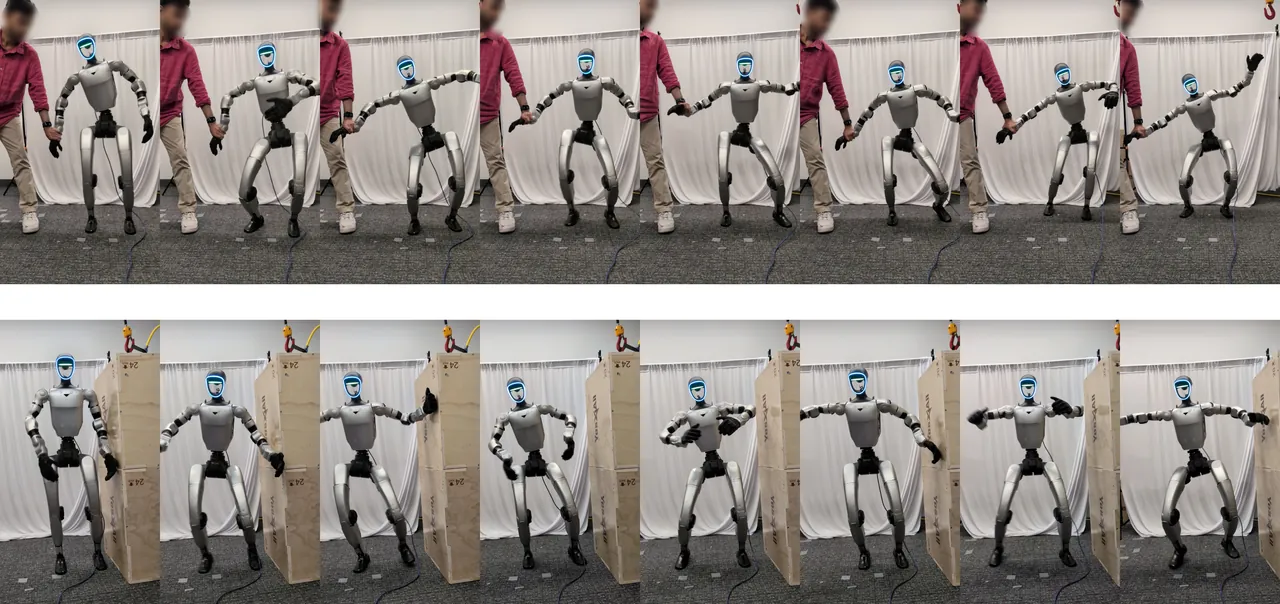
Figure 2: Paper Figure 3. Effective displacement as a function of commanded stiffness. The versatile controller tracks the behavior of a motion-specific compliant policy.
This experiment measures reference-level compliance, not industrial impedance control. The adapter infers force from proprioception, so contact geometry, friction, payload, and model error can all change the actual response. The important contribution is that stiffness becomes an explicit, predeclared variable that a higher-level system can request. Whether that variable corresponds to a calibrated physical impedance outside the evaluated simulation remains to be established.
5.2 Nominal tracking remains competitive
The tracking experiment uses 12 LAFAN1 walking clips and 17 dynamic clips, totaling 48 and 63 minutes. It compares SONIC, the force-robust tracker without the adapter, C-GMT at k=100 and k=300, TWIST2, and GentleHumanoid. Success means that the robot remains upright during an evaluation window. Global and local position and orientation errors are averaged over robot links.
| Motion group | Method | Success | Global position (m) | Local position (m) | Local orientation (rad) |
|---|---|---|---|---|---|
| Walking | C-GMT, k=100 | 97.1% | 0.44 (0.36) | 0.038 (0.014) | 0.20 (0.07) |
| Walking | C-GMT, k=300 | 97.9% | 0.43 (0.36) | 0.037 (0.014) | 0.20 (0.07) |
| Walking | SONIC | 98.9% | 0.24 (0.22) | 0.040 (0.010) | 0.21 (0.05) |
| Walking | Force-robust decoder | 97.5% | 0.37 (0.34) | 0.032 (0.013) | 0.18 (0.06) |
| Walking | TWIST2 | 86.8% | 1.00 (1.08) | 0.030 (0.021) | 0.19 (0.12) |
| Walking | GentleHumanoid | 68.6% | 0.97 (0.74) | 0.031 (0.022) | 0.20 (0.12) |
| Dynamic | C-GMT, k=100 | 88.0% | 0.61 (0.70) | 0.049 (0.021) | 0.28 (0.13) |
| Dynamic | C-GMT, k=300 | 88.3% | 0.60 (0.70) | 0.047 (0.019) | 0.28 (0.12) |
| Dynamic | SONIC | 90.4% | 0.48 (0.63) | 0.048 (0.015) | 0.26 (0.09) |
| Dynamic | Force-robust decoder | 87.2% | 0.58 (0.75) | 0.040 (0.016) | 0.24 (0.10) |
| Dynamic | TWIST2 | 65.8% | 1.27 (1.23) | 0.040 (0.026) | 0.24 (0.14) |
| Dynamic | GentleHumanoid | 46.2% | 0.79 (0.82) | 0.049 (0.030) | 0.30 (0.17) |
C-GMT's dynamic success is 88.0% to 88.3%, around two percentage points below SONIC but far above TWIST2 and GentleHumanoid. Global position error increases by roughly 0.12 to 0.13 m, while local position error changes by only about 1 mm. The pattern suggests that most of the nominal tracking cost comes from making the base tracker force-robust, not from the adapter randomly deforming motions. The adapter is close to transparent when no external force is present.
The nearly identical no-force results at k=100 and k=300 provide a useful check. If the adapter confused its own arm motion with external force, changing the requested stiffness could alter the residual and create a stiffness-dependent tracking bias. The small difference indicates that the history encoder and no-force regularization help separate self-motion from contact. This is evidence from simulation only; it does not establish the false-positive rate under unexpected real-world loads.
5.3 A dynamic dance against a wall
The compliance test moves beyond slow standing poses. The G1 executes the same dynamic dance next to a rigid wall under C-GMT, SONIC, and TWIST2. C-GMT uses k=60 N/m, and the authors measure hand-wall contact force over time. Figure 4 shows the lowest interaction force for C-GMT, larger forces for SONIC, and the largest impact for TWIST2. The post-impact snapshots show a related behavioral difference: SONIC pushes itself away from the wall, while TWIST2 is launched farther by the impact. C-GMT yields, stays near the contact region, and continues the motion.
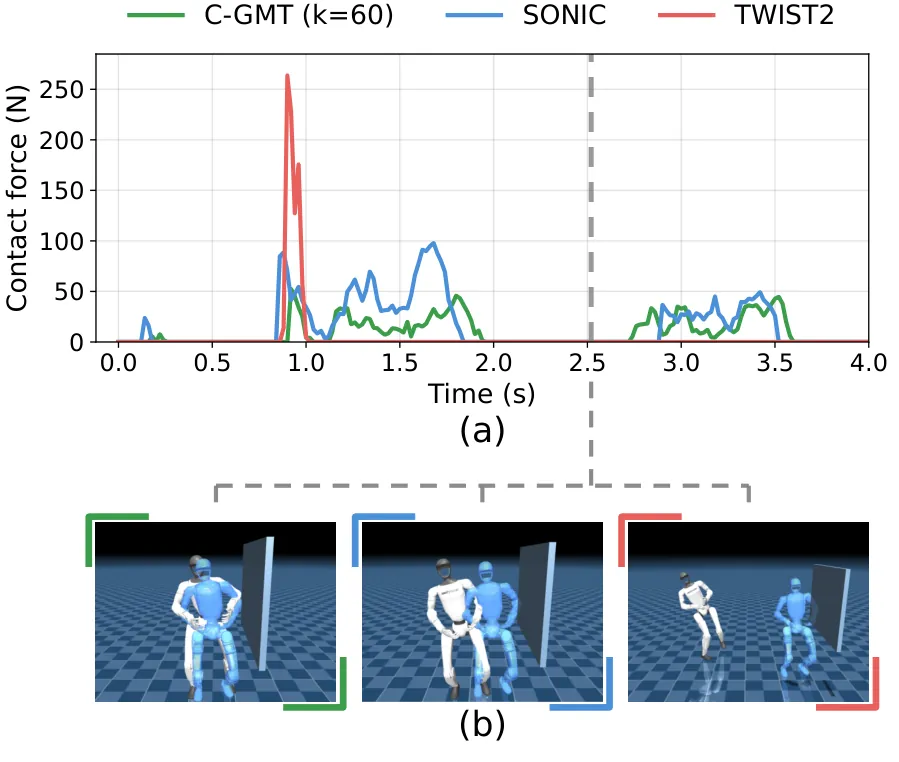
Figure 3: Paper Figure 4. Hand contact force and post-impact behavior during a dynamic dance. The compliant policy lowers the force peak and avoids using the wall as a launch surface.
Dynamic contact is a stronger safety test than static hand displacement. The robot's momentum can produce a short force peak even when the commanded path is only slightly wrong. A stiff controller may recover its own state after the impact but still displace the robot or the object enough to ruin the task. A lower force peak is valuable, but the preservation of the surrounding trajectory is equally important. C-GMT demonstrates both in this simulation, and the paper reports similar attenuation when the same dance is run on hardware near a wall or while a person pulls the robot.
5.4 Whole-body compliance versus upper-body compliance
Figure 6 applies an increasing downward force to a standing robot's hand. C-GMT and SoftMimic bend the knees and lower the body, distributing the load through arms, torso, pelvis, and legs. GentleHumanoid, whose compliant response is restricted to the upper body, remains largely upright and eventually falls. This experiment makes the generality-versus-compliance argument concrete: a soft wrist is not enough when the support chain remains rigid.
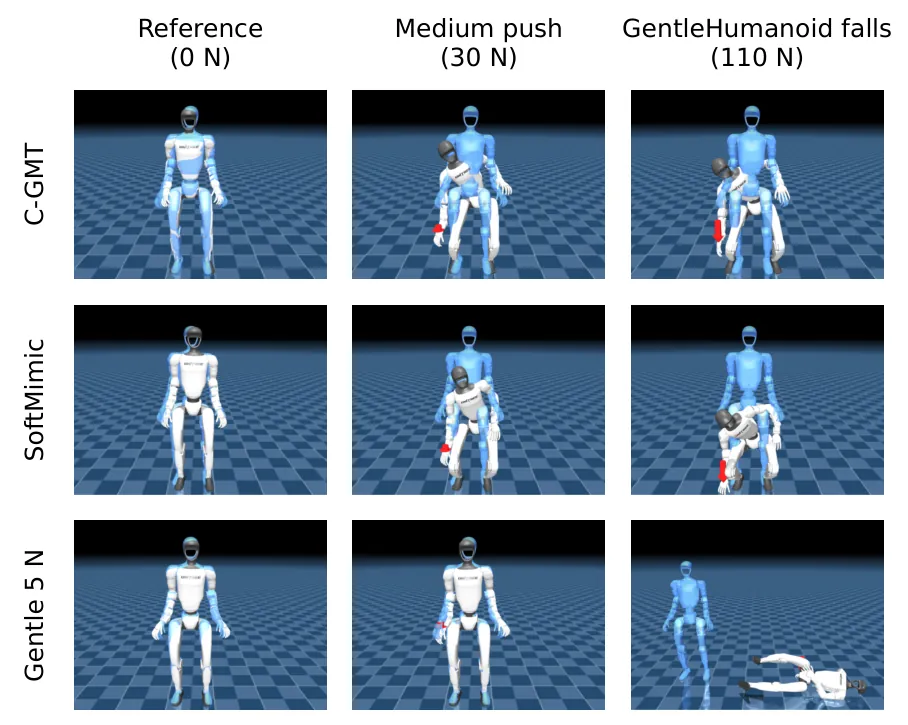
Figure 4: Paper Figure 6. Under a growing downward force, C-GMT and SoftMimic squat while the upper-body-only controller eventually loses balance.
The result also exposes the cost of whole-body compliance. A large downward force can move the robot far from its original pose. The stiffness command is therefore a working-point choice between preserving the motion and accepting a posture that is mechanically safer. The teacher's IK hierarchy keeps the feet planted and regularizes posture, but it cannot make both goals exact when the force is large. C-GMT's advantage is that it makes this compromise explicit and trainable rather than leaving it to an implicit reward.
5.5 Contact-rich teleoperation and VLA execution
The authors demonstrate opening a door, wiping a whiteboard, dragging a chair while walking, and holding a rubber ball with teleoperation. These tasks contain interaction dynamics that an operator cannot see precisely and a reference generator cannot model perfectly. C-GMT lets the robot absorb the mismatch instead of turning every reference error into a force against the environment. The qualitative value is clear, although the paper does not report a large randomized success table for each teleoperation task.
The VLA experiment is more quantitative. Two GR00T N1.7-3B policies are fine-tuned for a walk-to-table-and-lift-box task from procedurally generated demonstrations. One uses SONIC as its low-level controller, the other uses C-GMT. Both high-level policies are trained in the same way without force disturbances. Each condition is evaluated for 50 trials from the same initial states.
| Disturbance | SONIC low level | C-GMT low level (k=300) |
|---|---|---|
| No disturbance | 48/50 | 49/50 |
| 20 N pull close to table | 34/50 | 44/50 |
| 40 N pull close to table | 30/50 | 41/50 |
| 60 N pull early in walk | 28/50 | 46/50 |
Without disturbance, the systems are nearly tied at 96% and 98% success. At 60 N, SONIC falls to 56% while C-GMT remains at 92%. Figure 8 shows a representative failure and success. A 1.5 s pull on the right hand pushes the SONIC-based robot toward the table, causing it to stumble into and move the box. The high-level policy cannot recover from the changed object state. The C-GMT robot yields through a coordinated whole-body response, stays closer to its commanded route, recovers after the force disappears, and completes the grasp.
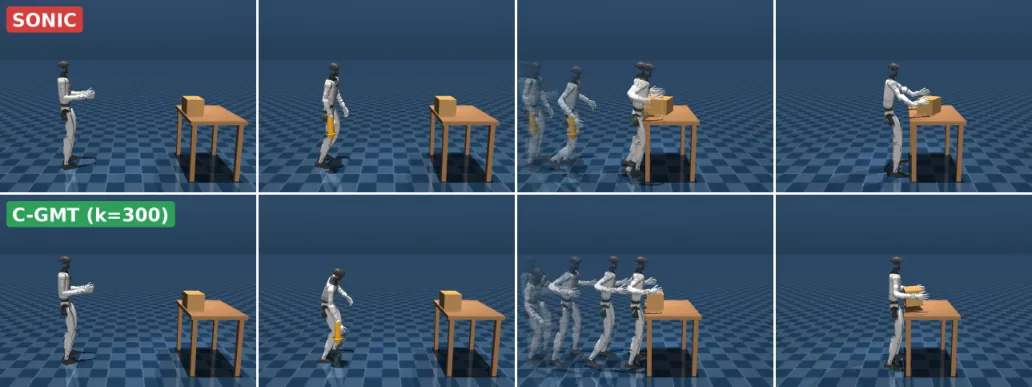
Figure 5: Paper Figure 8. A VLA rollout under an unexpected pull. The compliant low level preserves the task-relevant state long enough for the upper policy to recover.
The table should be read carefully. The 20 N and 40 N pulls occur close to the table, while the 60 N pull occurs early in the walk. These are different situations, not a controlled dose-response experiment. The result demonstrates robustness across several disturbance scenarios, but it does not define a complete safety envelope. A larger study would vary force, direction, timing, contact point, and object mass independently.
6. Feasibility sampling and training efficiency
The teacher sweep is not only a design-time sanity check. The authors compare feasibility-based force sampling with uniform sampling on a standing motion. Uniform sampling causes falls in 5.4% of training steps; feasibility-based sampling reduces that to 0.4%, roughly a 13-fold decrease. It also learns faster: C-GMT reaches over 95% give-way adherence within 6,000 updates, while uniform sampling remains around 74% in the reported comparison.
This ablation explains why the decomposition can be practical despite its large models. By filtering impossible force-motion pairs before adapter training, most gradient updates are spent on behaviors that the base tracker can actually execute. The method does not eliminate the need for simulation or compute. The force-robust tracker took about five days on three H200 GPUs, and the adapter about two days on four H100 GPUs. The adapter is lightweight at inference, but the full development pipeline is still resource intensive.
7. Limitations and open questions
The authors explicitly limit the current compliant response to forces at the hands or end effectors. They identify extending the method to any link as future work. This matters because real contact can occur at the elbow, shoulder, hip, or torso. A teacher defined around pushed wrist positions does not automatically generate sensible references for those contacts, even if the same underlying motion tracker could execute them.
The second self-stated limitation is that stiffness is supplied by a human. The authors propose that a higher-level policy should choose and adapt stiffness from context. This would require a model of object compliance, task risk, and the robot's current support state. The current system shows that a human or external controller can request a range of behaviors, not that the robot can decide the right mechanical impedance autonomously.
A further limitation is observability. The deployed adapter has proprioception but no direct force sensor or tactile measurement. The auxiliary force head may encode useful contact information, but different forces can produce similar joint histories, especially when an object constrains motion or friction changes. The paper does not provide a force-estimation error curve or show how errors propagate into stiffness adherence. This is important for safety-critical deployment and for deciding when an extra force sensor is justified.
The evaluation range is also bounded. The base is trained on BONES-SEED, tracking is evaluated on LAFAN1 walking and dynamic motions, and simulated forces are sampled within teacher-derived limits and capped at 140 N. The hardware study uses one Unitree G1 and a modest set of scenarios. Cross-embodiment transfer, different shoes and floors, long-duration wear, extreme payloads, and multi-contact manipulation are not established. The no-load global tracking error is higher than SONIC, so the design is not cost-free even when compliance is not active.
8. Why the decomposition matters
C-GMT's central idea is that a comfortable robot should not necessarily be a globally soft policy. Compliance can be introduced as a controlled deformation of the reference. The force-privileged teacher uses a physical law and IK to create target behavior. The force-robust tracker learns to execute references under load. The adapter distills the teacher into a compact module that runs from proprioception. Each component has a separate contract, which makes failure diagnosis more tractable than in a single black-box policy.
The design also broadens the meaning of whole-body motion tracking. A robot can track a motion while temporarily changing its hand, pelvis, and support pose to absorb a disturbance. This is not a violation of tracking in the contact phase; it is a deliberate change in priority. The stiffness parameter gives that priority a measurable scale. For teleoperation, it lets the operator push through a contact without fighting a rigid controller. For a VLA, it gives the upper policy a mechanical error budget when its command or world model is inaccurate.
The limitations point toward a larger research agenda. A future system would need contact estimation over the entire body, online stiffness selection, and runtime verification that the adapted reference remains dynamically feasible. It might combine the current proprioceptive adapter with tactile skin, object-state estimation, and a safety monitor. The teacher could become a library of contact behaviors rather than a single spring law. These extensions would preserve the useful modularity while addressing cases where yielding at the hand is not enough.
9. Conclusion
Compliant GMT combines a force-robust pretrained motion tracker with a distilled residual adapter that modifies motion tokens according to external force and commanded stiffness. The teacher uses a spring law and whole-body IK; the adapter operates after FSQ, receives proprioceptive history and log stiffness, and is trained with gated residual imitation and two anti-oscillation losses. Experiments show adjustable stiffness, competitive nominal tracking, lower contact forces in a dynamic dance, whole-body yielding under sustained load, contact-rich teleoperation, and substantially better VLA success under pulls.
The work supports the claim that general motion tracking and full-body compliance can be combined without training a new monolithic policy. Its practical message is equally important: the compliant layer must be validated before learning, the base tracker must be strong enough to execute the adapted reference, and the adapter must remain nearly transparent in the absence of force. Those conditions define a useful blueprint for future humanoid systems that are expected to work beside people, not merely perform motion on an empty stage.