Skip to content
←Back to the radar

SOTA · language

Multimodal

Image-text understanding, chart/doc QA, visual reasoning

Multimodal understanding is the threshold capability for whether an agent can enter the real world: what text cannot describe - a screenshot, a chart, a video frame, the state of a UI - can only come in through the visual channel. Two things connect it to AGI. First, it shares representations with generation: only a model that understands spatial relations and semantics can rebuild them on instruction, which is why understanding-side `multimodal` is split from generation-side `image` yet both are judged with the same logic - the ruler for understanding is MMMU, MathVista, ChartQA and DocVQA, the ruler for generation is arena preference. Second, it determines the surface an agent can act on: computer use, robot vision, document processing and video understanding all require seeing correctly first, and only then does downstream planning mean anything. The top of this ladder is ordered by third-party readings plus real use: the Arena Agent board (2026-09-22) measures how far a model pushes a real task forward, with Claude Fable 5.1 leading at 13.71 net improvement and GPT-6 Astra at 11.54, and those two readings are much closer to "does multimodal understanding work in production" than any single-point vision score. On the asset side the collection covers cross-modal products and the visual path of generation models: GPT-Image 2.5 and Qwen-Image 2.1 carry the image-side readings, Gamma is the document-side delivery form, and Gemini Omni is the only row in this domain that is both third-party arena measured (text-to-video Elo 1516 over 1784 votes) and graded confirmed, folding video understanding and video editing into one conversational turn, which is the signal that multimodal understanding is moving from still frames to temporal content.

RULERMMMU, MathVista, ChartQA, DocVQA

The ladder

6
MultimodalDocs & SlidesTopC

Gamma: the orchestration tool that turns a body of source material into a presentable deck

What Gamma does is not "prompt for one slide" but reorganise existing material into something presentable: it ingests long documents, PDFs, pasted text or a URL, and returns a full deck with outline, pagination, imagery and layout, in a card-based structure where each page can be reordered, rewritten or re-illustrated on its own. It represents the kind of AI that is genuinely useful in the documents vertical - the value is in orchestration and editorial selection, not in generation quality. Its ceiling is equally clear: the output lives in Gamma's own layout system, and exporting to pptx loses a layer of fidelity - which happens to be a hard requirement for most organisations.

Web / pptx / pdfOutput formatsVendor Claim · 2025-01
ProductGamma TechSite
Gamma: the orchestration tool that turns a body of source material into a presentable deck
Video GenerationMediaTopA

Gemini Omni: moving the unit of video delivery from one attempt to a conversational editing process

Google DeepMind's video and multimodal generation model, officially create anything from any input, starting with video: it edits video through step-by-step conversation, each edit building on the last and keeping the scene coherent, raising the unit of delivery from one shot to footage you can keep revising; the other two surfaces are real-world knowledge and arbitrary reference composition. Read the level with its votes: on the Artificial Analysis arena (2026-09-22) gemini-omni-1.1-flash is #1 for text-to-video at Elo 1516 with only 1,784 votes and a ±15 CI, while #2 is the sibling at 1513 with 26,576 votes and ±9, a 3-point gap far smaller than either CI, so statistically indistinguishable: the honest statement is that the Omni family ties for the top. For image-to-video minimax-h3 leads (1495, 57,112 votes) with Omni #2 at 1488 on 3,734 votes. Pricing: $1.50 per million input tokens, $9.00 text and $17.50 video output, 720p about $0.10 per second and a 30-second clip roughly $3. GA to paid-tier developers, none on the free tier. Closed, not self-hostable, not fine-tunable. Graded A (confirmed), the first A-grade video asset; A means the reading is credible and checkable, not undisputed first place.
1516Arena T2V Elo (1,784 votes)Confirmed · 2026-09
ProductGoogle DeepMindSite
Gemini Omni: moving the unit of video delivery from one attempt to a conversational editing process
Image GenerationDesign & FrontendTopC

GPT Image 2.5: the image flagship that writes multi-round editing consistency into the API contract

OpenAI's image generation and editing model released 2026-09-08, in two variants: Flare (the default, higher quality than GPT Image 2 at 50% lower latency) and Sunburst (the precision tier, trading longer generation time for fidelity on intricate detail). Four endpoints in total, each variant with text-to-image and edit, identical API surface and identical pricing. Capability surface: 3840px long edge, six quality levels (auto/low/medium/high/xhigh/max, two above the previous ceiling), editing with up to 16 reference images per request, optional mask, and real alpha transparency on PNG/WebP. The launch weight sits on consistent details across multiple edits and comment-based edits that change only what you ask, i.e. multi-round editing that does not drift. Third-party reading: on the Artificial Analysis arena (2026-09-22), sunburst is #1 on both text-to-image (Elo 1423) and image editing (1526), with flare #2 on both (1401/1482), the only family holding two crowns at once; both rows are still preliminary, however, with vote counts (8,791/8,014) far below the gpt-image-2 row they overtake (82,862). Closed, reachable only through ChatGPT and the API, no self-hosting or fine-tuning. Not independently benchmarked; graded C (vendor-stated).

1423/1526Arena text-to-image / image-editing Elo, #1 on both boardsVendor Claim · 2026-09
ProductOpenAISite
GPT Image 2.5: the image flagship that writes multi-round editing consistency into the API contract
Image GenerationDesign & FrontendTopC

Qwen-Image-2.1: one set of open weights for generation, local editing and transparency

Alibaba Qwen tier for image generation and editing: text-to-image, local edits (circle, brush, standalone mask), fusion of up to 10 reference images and native RGBA transparency all live in one 7B visual component (32 Single-Stream DiT layers), with mixed-granularity attention and prefix KV-cache reuse cutting the marginal cost of batch generation; native 2048px across 7 aspect ratios. Among weights you can actually download it is one of the highest-ranked entries on the image arena (#17 text-to-image, Elo 1228; #16 editing, 1367). The licence is the Qwen Research License rather than Apache-2.0, so commercial use needs the terms read first, and diffusers must be installed from git main. Not independently benchmarked; graded C (vendor-stated).
7BVisual generation component parametersVendor Claim · 2026-09
ProductAlibaba QwenSiteRepo
Qwen-Image-2.1: one set of open weights for generation, local editing and transparency
Image GenerationDesign & FrontendTopD

Nano Banana Pro: the image editing model that turned "edit it by talking to it" into a product

Gemini's native image generation and editing tier, known in the community as Nano Banana. Its point is not peak image quality but the interaction shape: keep editing one image across a multi-turn conversation, read the text inside an image and change it, and fuse several references into one output. That made image generation feel like talking to a designer instead of pulling a slot-machine lever. Most of its ranking comes from preference arenas, which are votes rather than measurements, so graded as needing reproduction.

ProductGoogle DeepMind (Gemini image)Site
Nano Banana Pro: the image editing model that turned "edit it by talking to it" into a product

Latest demos

57

Papers & deep reads

41
D&A: Decoupling Description and Assessment Enables VLMs as Zero-Shot Robotic Reward Models2026-11-02D&A: Decoupling Description and Assessment Enables VLMs as Zero-Shot Robotic Reward ModelsVision-Language Models (VLMs) hold promise for zero-shot video task-progress estimation in robot learning, yet existing frameworks frequently suffer from confirmation bias, hallucinating progress in failed executions due to implicit success assumptions or relative temporal ranking designs. Naive prompting of frontier models collapses into a binary success detector that fails to capture nuanced, non-linear progress and failures. While post-training approaches can mitigate this through explicit training, they demand expensive real-world robotics data and require computationally intensive post-training for every individual base model. To resolve these limitations, we introduce D&A (Describe & Assess): our approach decouples progress estimation into an objective, task-grounded textual description of scene dynamics followed by an assessment phase using explicit rubrics. By compelling the VLM to synthesize an explicit, text-based definition of absolute success before scoring, the framework anchors evaluations to an external, global criterion rather than the video's internal timeline. Empirical results demonstrate that our method calibrates zero-shot estimates and mitigates confirmation bias, providing fine-grained, partial progress metrics that accurately penalize failed executions while correctly interpolating successful runs. Being purely prompt-based, D&A generalizes across tasks, embodiments, and benchmarks---matching or surpassing post-trained reward models---and its reward estimates enable efficient downstream reinforcement learning.
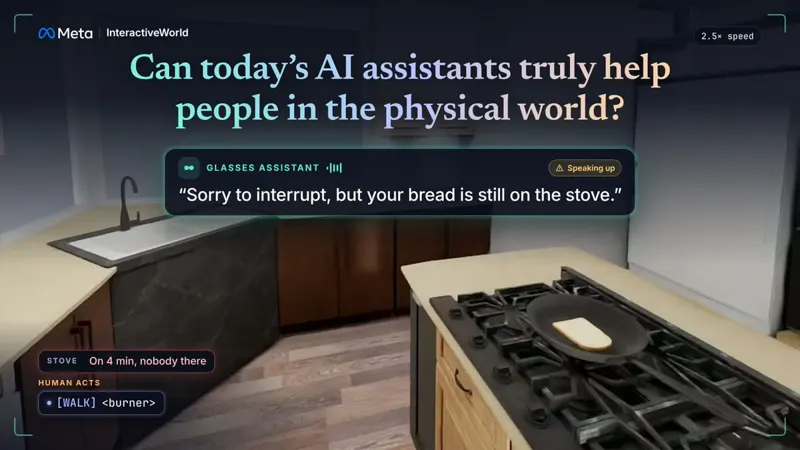
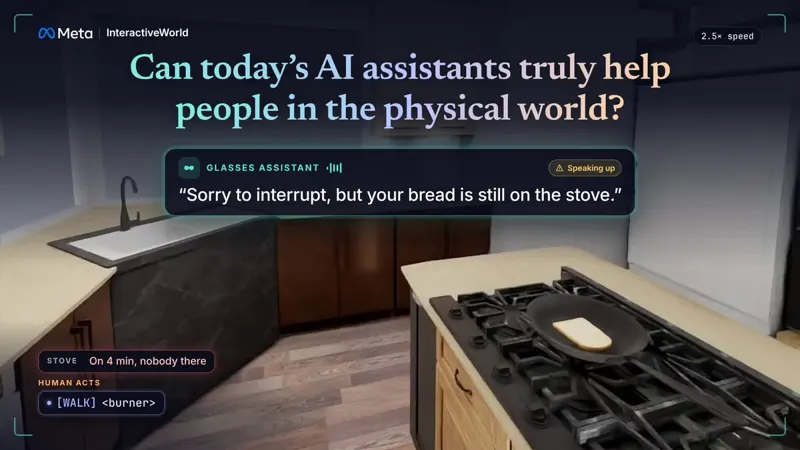
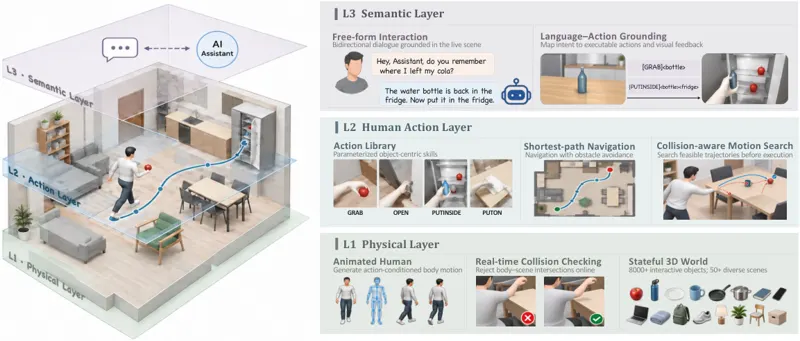
InteractiveWorld: A Verifiable Human-Centric Environment for Building Better Interactive MLLM Assistants2026-10-25InteractiveWorld: A Verifiable Human-Centric Environment for Building Better Interactive MLLM AssistantsPeople have long dreamed of an assistant that is always there to guide them and remind what they forget, from new dishes to lost keys. Powered by multimodal large language models (MLLMs), egocentric AI assistants on wearable devices are bringing this dream within reach: they see what the user sees and give instructions for user's physical work when necessary. However, testing such assistance is challenging and usually requires real people. The expensive and rare real interaction data leaves a key question unanswered: Can today's MLLMs truly help people in physical world? To answer this question, we propose InteractiveWorld, the first verifiable environment for closed-loop interaction between human and AI assistant. Unlike existing robot-centric simulators, InteractiveWorld lets the assistant guide a human agent who observes the scene, understands instructions, and acts independently. It thus realistically simulates how AI assistant collaborates with human: the assistant instructs, the human acts, and the environment executes actions and updates what they see next. Building on it, we introduce InteractiveBench, the first dynamic benchmark for egocentric AI assistants, with 120 multi-turn tasks across six categories. In each task, the assistant guides the human in real time, and every instruction shapes the outcome, which is scored by verifiable, state-based rewards. Experiments with 12 frontier MLLMs show they are still far from reliable assistants. Even the strongest model, Claude Fable 5.1, achieves at most 20% and 25% on long-horizon Guidance and Planning tasks, respectively. Overall, our work offers a verifiable platform and a rigorous evaluation set, laying a solid foundation for research on interactive MLLM assistants that truly help people in the physical world.
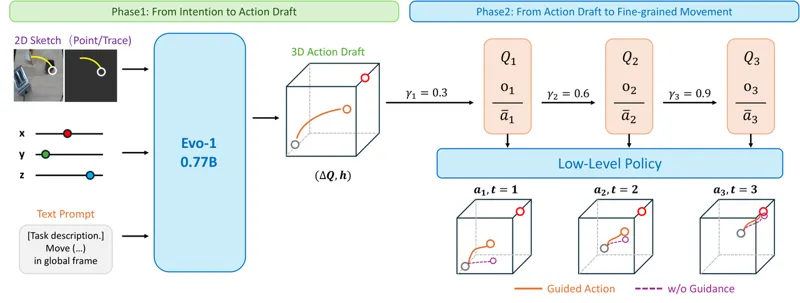
RoboPrompt: Intuitive Robot Policy Steering with Sparse Human Input2026-10-07RoboPrompt: Intuitive Robot Policy Steering with Sparse Human InputEnd-to-end robot policies trained through imitation learning remain constrained by limited data diversity, making reliable zero-shot deployment in real-world settings challenging. Shared-autonomy methods enable human correction through teleoperation, but specialized hardware and operator training hinder deployment at scale. Other approaches incorporate human guidance as additional policy inputs, often requiring architectural changes and dedicated training for steerability, which limits their applicability across policies. We present RoboPrompt, a general-purpose, lightweight robot policy steering system that enables users to guide policy behavior through intuitive, sparse inputs, including drawn traces, target points, and coarse directional instructions. RoboPrompt decouples human-intention translation from the underlying policy: a reusable module converts human guidance into action drafts, which are refined through the diffusion or flow-matching dynamics of the base policy. By controlling action generation in noise space, RoboPrompt balances human intent with the policy prior without modifying the base policy architecture or fine-tuning it for steerability. Experiments demonstrate effective steering across Diffusion Policy, $π_{0.5}$, and FastWAM. We further use steered rollouts for online policy improvement through DAgger. After 2-3 rounds of iteration, average success rates increase by 15.5\% for $π_{0.5}$ across three tasks and by 21.3\% across three policies(Diffusion Policy, $π_{0.5}$, FastWAM) on the Insert Bread task, while average human intervention counts decrease by 44.0\% (2.86 to 1.60) and 81.9\% (2.60 to 0.47), respectively.
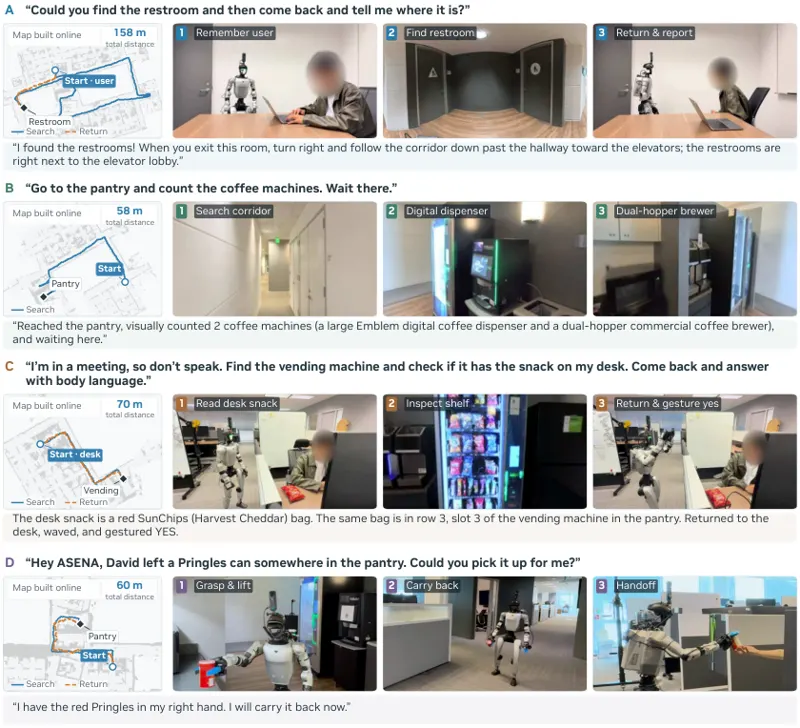
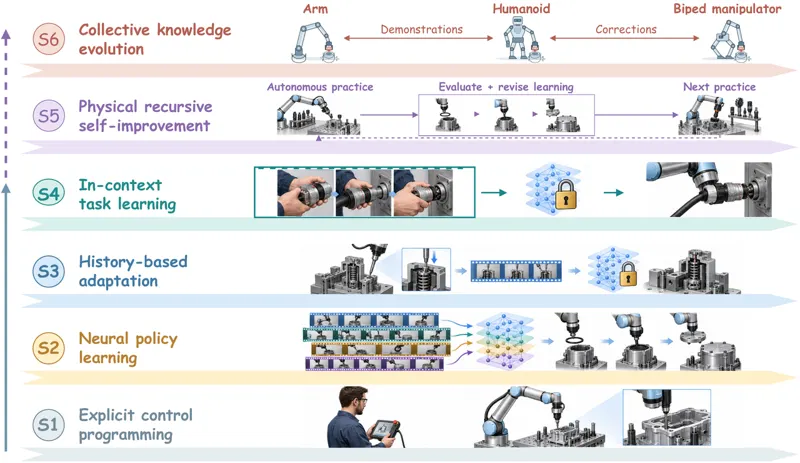
ASENA: Self-evolving Agents for Embodied Navigation2026-09-30ASENA: Self-evolving Agents for Embodied NavigationWe present ASENA, an embodied agent system that enables general-purpose coding agents to program humanoid navigation, manipulation, and interaction. Through a unified robot harness, agents read sensor data, write and execute programs, inspect recorded outcomes, repair failures, and reuse notes and executable skills while keeping their model weights fixed. We also introduce ASENA-VLN, a 4B monocular navigation policy that serves as an optional tool within this programmable system. ASENA-VLN predicts body-frame trajectories for both extended routes and short-horizon behaviors. Its shared vision-language decoder is trained on route instructions, visual question answering, and a newly curated dataset of geometry-derived atomic navigation tasks. As a standalone policy, ASENA-VLN achieves state-of-the-art success rates of 68.7% on R2R and 70.2% on RxR. When integrated with a coding agent, learned navigation improves ASENA's success rate by 11 percentage points on both agentic benchmarks and reduces execution time. Persistent workspace evolution uses simulator feedback to improve success over ten passes through recurring 100-task subsets. Success increases from 72% to 98% on R2R and from 65% to 89% on RxR. On embodied question answering, ASENA achieves state-of-the-art accuracy with fewer interaction steps. On a Unitree G1, we demonstrate search, visual inspection, spatial reasoning, synthesized gestures, and mobile manipulation combining object pickup, carrying, and handoff without a pre-built map. These demonstrations illustrate how online programming extends robot behavior beyond route following and predefined skills.
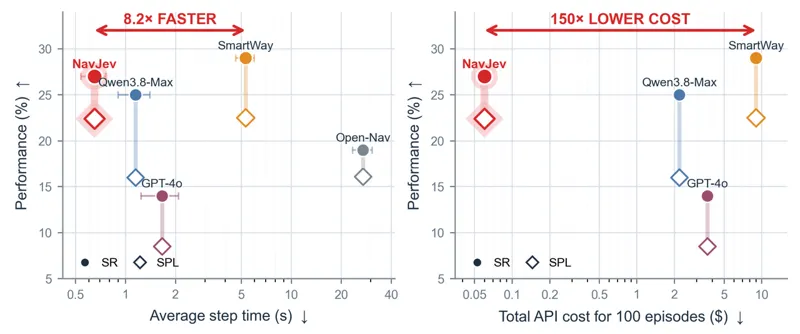
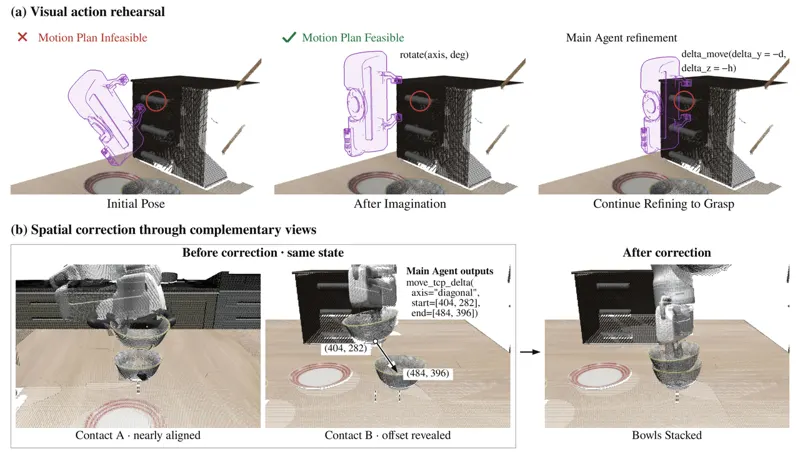
World Action Agent: Harnessing VLMs for Robot Manipulation via World Action Rehearsal2026-09-24World Action Agent: Harnessing VLMs for Robot Manipulation via World Action RehearsalHKUST(GZ), CUHK and Knowin AI present World Action Agent (WAA), a multi-agent harness that changes what the VLM sees and how its decisions take effect — rather than the VLM itself — so a general-purpose VLM can pilot a robot with basic tools (point, drag, preview, execute), making every decision inside one visual action workspace. Three properties: Contact views, whose camera parameters are solved from interaction-region visibility under occlusion, framing compactness, view redundancy and stability, with the feasible set constraining the two views to orthogonal horizontal projections so any alignment error can be read along two independent directions — requiring only a base-frame point cloud, so the perception source (simulation, fused RGB-D, or VGGT reconstruction) is irrelevant; action rehearsal, where each action is an editable proposal planned by cuRobo, overlaid as a translucent robot in every view with a feasibility report, refined by an Imagination Agent in a separate context while the physical scene stays unchanged, and only proposals with executable plans become motion; and in-view correction, where the agent drags from a reference point to the desired location in the Contact view where the error is observed — the reference can be a visible point on the held object, so no conversion into an absolute gripper pose is needed. Skills evolve from expert videos and human Canvas-GUI teaching through Learner, Editor and Reviewer roles under evidence-citing and independent-review constraints. On LIBERO-Pro with Gemini 3.7 Flash, using skills evolved only from LIBERO-90 and frozen before evaluation, WAA reaches a state-of-the-art 75.6% average success, above ASPIRE (72.0%), end-to-end VLAs and the same-backbone Show-Harness (6.7%), scoring 80.0 / 73.3 on the two Spatial splits; an episode costs just 31 model calls, 150 s and $0.1996 versus 120 calls, 874 s and $0.5021 for Show-Harness. The frozen skills transfer to robosuite at 100.0%, and LoRA fine-tuning Qwen3.5-9B on 112 trajectories (1,774 decision steps) as the main agent only raises out-of-domain success from 1.7% to 43.3%.
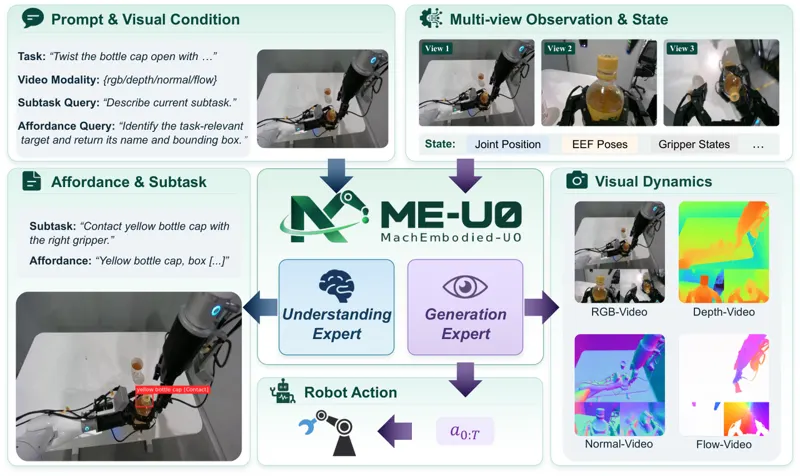
MachEmbodied-U0: Unified Understanding and Generation Model for Embodied Intelligence2026-09-22MachEmbodied-U0: Unified Understanding and Generation Model for Embodied IntelligenceGeneral-purpose robot control requires models to understand task intent, identify where to interact, capture how the scene evolves, and generate precise actions. Vision-language-action models provide strong semantic priors but typically do not explicitly model scene dynamics, while world-action models couple visual prediction with control without necessarily exposing the task-relevant semantic and spatial structure needed for fine-grained manipulation. We present MachEmbodied-U0 (ME-U0), a unified embodied foundation model connecting understanding and generation experts through a Mixture-of-Transformers architecture. Subtask prediction and affordance grounding guide joint visual-dynamics and action generation via flow matching. Visual dynamics encompass future RGB, depth, surface normals, and optical flow, providing complementary supervision for appearance, geometry, and motion. Multi-rate Rotary Position Encoding (MRPE) aligns visual dynamics with fine-grained control. We pretrain ME-U0 on approximately 4,200 hours of curated demonstrations from robotic datasets and egocentric datasets. Using only the supervision natively available in each downstream benchmark, ME-U0 achieves an average score of 17.66 on the RoboDojo simulation benchmark and average success rates of 99.0\% and 82.5\% on LIBERO and LIBERO-Plus, respectively. We additionally validate ME-U0 on real-world robotic manipulation tasks, demonstrating its effectiveness beyond simulation. Without corresponding downstream supervision, ME-U0 further demonstrates zero-shot subtask prediction, affordance grounding, and visual dynamics on simulated and real-world observations. Overall, ME-U0 combines competitive downstream control performance with transferable task-grounding and visual-dynamics capabilities across simulation and the real world.
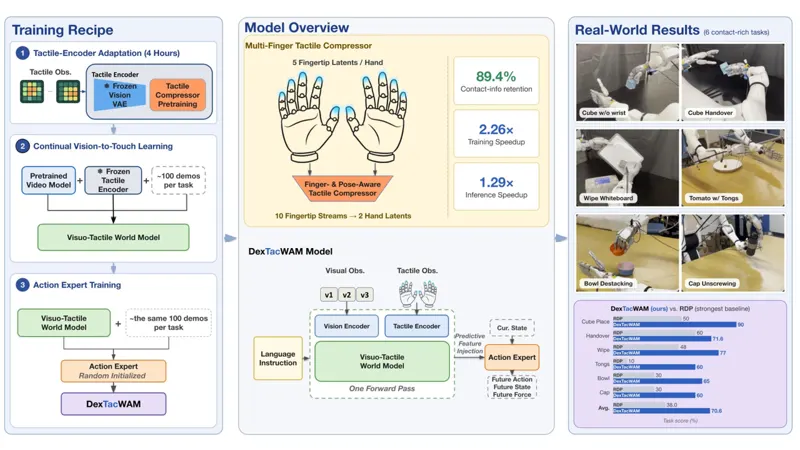
DexTacWAM: A Visuo-Tactile World-Action Model for Dexterous Manipulation2026-09-21DexTacWAM: A Visuo-Tactile World-Action Model for Dexterous ManipulationDexterous manipulation depends on contact dynamics that are often only partially observable from vision. Recent World-Action Models (WAMs) couple predictive video world modeling with action generation, but remain largely vision-centric and therefore cannot directly model these contact dynamics. We present DexTacWAM, a visuo-tactile WAM that encodes each fingertip independently, aggregates the resulting features through a finger- and pose-aware tactile compressor, and injects the tactile latent into a video diffusion world model for joint visuo-tactile world modeling. Across six contact-rich dexterous manipulation tasks on a 22-DoF bimanual platform, DexTacWAM achieves the highest score on every task, averaging 70.6 versus 38.0 for the strongest baseline. Ablations attribute the gain to modeling contact evolution as part of the predicted world state rather than tactile conditioning alone: removing tactile world modeling reduces the four-task mean from 74.7 to 26.6 while keeping the same tactile features and action expert. After four hours of tactile-encoder adaptation with a frozen pretrained vision VAE, our continual vision-to-touch learning extends the pretrained video model to touch using roughly 100 demonstrations per task without tactile midtraining, while retaining visual prediction quality within 0.5 dB of vision-only counterparts. The compressor retains 89.4% of pre-fusion contact recall while enabling 2.26x faster training and 1.29x faster inference. Together, these results show that pretrained video priors can be extended to distributed multi-finger contact dynamics in a data- and compute-efficient manner.
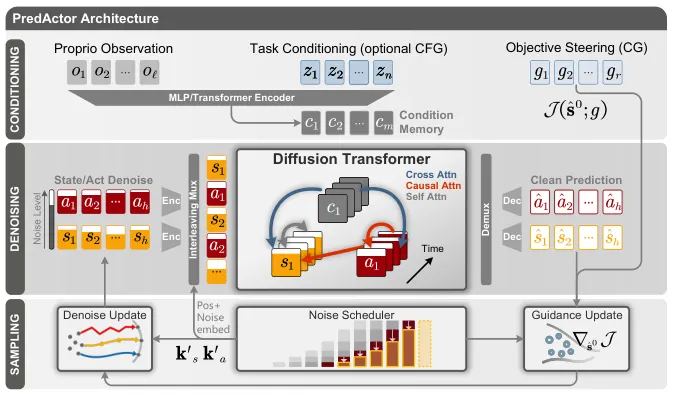
PredActor: Predictive Action Diffusion for Steerable Onboard Humanoid Control2026-09-21PredActor: Predictive Action Diffusion for Steerable Onboard Humanoid ControlDiffusion models provide a flexible framework for motion generation, but turning this flexibility into closed-loop humanoid control remains challenging. Hierarchical generator-tracker systems steer motion through reference trajectories, yet these references may exceed the capabilities of the downstream tracker, leaving physical feasibility and disturbance recovery largely to a separate control module. Action-only diffusion avoids this separation by directly generating executable actions, but provides no explicit future-state trajectory that can be steered toward test-time motion objectives. Joint state-action diffusion offers a natural alternative, but existing controllers often rely on privileged full-body states, while learned behavior selection and test-time motion steering remain only partially integrated. We present PredActor, a predictive action diffusion policy that unifies both steering modes in one directly executed policy using proprioception alone. Given proprioceptive history and optional task context, PredActor jointly predicts actions and an internal future-state trajectory that enables guidance: classifier-free guidance strengthens text-conditioned motion, while classifier guidance steers future states toward test-time objectives. Only actions are executed, requiring neither a motion-reference tracker nor privileged full-body states. In simulation, PredActor reaches 44 of 45 destination targets and achieves a text retrieval score of 0.539 versus 0.424 for conditional action diffusion, with similar disturbance survival. Rolling denoising and computation-preserving runtime optimizations reduce the complete callback to 16.790 ms median and 19.383 ms p95 on a Jetson Orin NX, within the 20 ms control period. Deployed on a Unitree G1, PredActor demonstrates text-conditioned motion, disturbance response, joystick control, and semantic interpolation in simulation and hardware.
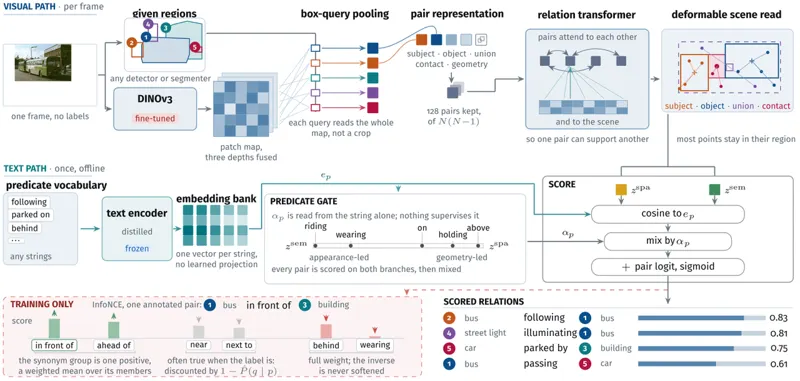
RelateAnything: Real-Time Open-Vocabulary Relation Prediction From Any Inputs2026-09-11RelateAnything: Real-Time Open-Vocabulary Relation Prediction From Any InputsOpen-vocabulary detection accepts any class list at inference, and promptable segmentation returns regions without class names: the taxonomy has left the model and become an input. Relation prediction has not. Scene-graph models are still trained and evaluated on the 50 or 56 predicates of one annotation style, their relation head conditioned on object labels and so tied to one detector. Three obstacles explain this, none primarily modelling: no relation corpus is both free-text and verified, a label-conditioned architecture cannot accept a vocabulary it was not trained on, and the standard metric rewards agreement with the training corpus, so a larger vocabulary scores as a regression. We present RelateAnything, a 53M-parameter model taking an image and regions from any source and returning scored relations over a predicate vocabulary supplied at inference as strings. Object labels are never an input, so the region source can change without retraining, and the vocabulary is a bank of text embeddings, not a learned classifier. It runs at 20 ms/frame. Training over 19,103 predicates requires positive-unlabeled supervision and a text encoder that separates antonyms, which contrastive encoders embed at cosine 0.95. To supply the supervision we build RA-4M, 474k images and 4.3M relations over 10,102 free-text predicates, generated against numbered box markers and geometrically verified. To measure it we build OV-SGG-Bench, six axes scored across datasets that the priors standard recall rewards cannot satisfy. On three cross-dataset benchmarks and a fourth zero-shot, RelateAnything has 2.3-3.5x the mean recall of the strongest open-vocabulary method of comparable scale, margins that survive a real detector, and leads a 3B-VLM scene-graph model on both metrics at under 2% of its parameters. In-domain measurement overstates transfer gains ~5x. Model, corpus and benchmark are public.

Open source

1

Assets you can use now

No installable skill wired to this domain yet.

Boundaries & failure modes

The failure modes in this domain are the quietest and the most expensive. One, detail extraction is unreliable: small text inside an image, numbers in a table, the state of a dense interface - models produce fluent answers with wrong digits and do not express hesitation; document and chart QA score very well on benchmarks while production still requires a human check on any critical number, so every "read a value off an image" conclusion is defaulted down one grade. Two, resolution and tiling strategy are hidden variables: the same image processed differently (whole, tiled, or downsampled) gives very different results and vendors generally do not disclose it, which strips cross-model comparison of meaning. Three, temporal alignment across long video and many images is still weak: a model can describe a single frame but cannot reliably say what happened first, and video understanding starts to forget after tens of seconds. Four, hallucination decouples from visual grounding: models fill in objects that are not in the image using training priors, especially when the image is blurry or the question is leading, and this is the shared upstream problem between this domain and safety. Five, the benchmarks are narrow: MMMU and ChartQA use clean screenshots and well-formed charts, whereas the real world is tilted phone photos, compressed scans and mixed-layout PDFs, and out-of-distribution performance is consistently well below what the board shows. Cost and latency: visual input is billed far more heavily than text (one high-resolution image commonly costs the equivalent of hundreds to over a thousand tokens), multi-turn image conversation grows cost an order of magnitude faster than pure text, and on latency the time to first token is dominated by image encoding, so preprocessing a large image is often slower than generating the answer.

As an Amazon Associate, we earn from qualifying purchases.