Skip to content
KlaskTron: An Open-Source Platform for Physical Adversarial Multi-Agent RL

KlaskTron: An Open-Source Platform for Physical Adversarial Multi-Agent RL

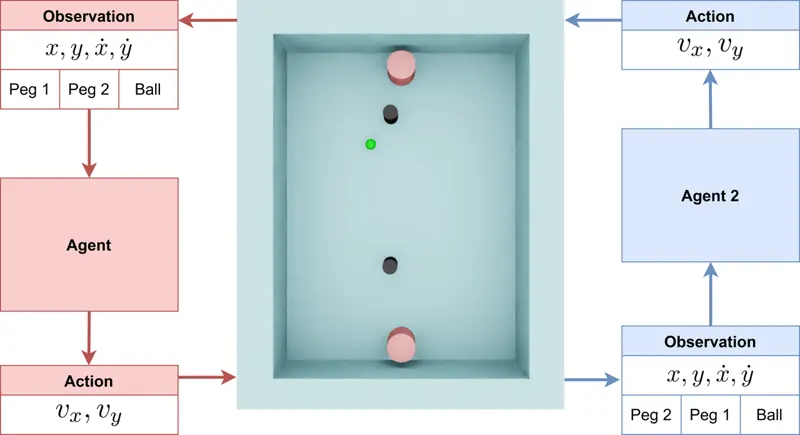
Progress in robot learning, particularly physical multi-agent reinforcement learning (MARL), is currently challenged by a limited availability of accessible, standardized benchmarks. While simulation-based MARL has produced remarkable emergent behaviors, from coordinated team play to complex tool use, translating these advances to physical systems remains difficult. A key barrier is infrastructural: physical platforms are often prohibitively expensive, require specialized facilities, or lack open mechanisms and designs for reproducibility. We introduce KlaskTron, an open-source, low-cost (<$2500 USD), desktop-scale robotic testbed for adversarial MARL based on the dynamic tabletop game KLASK. The platform features dual CoreXY gantries with high-torque brushless motors, enabling the high-speed, precise manipulation required for competitive play. Crucially, we provide a complete ecosystem: hardware designs (CAD, BOM), a GPU-native digital twin in NVIDIA Isaac Lab for high-fidelity modeling and simulation, and a validated sim-to-real baseline using a learned neural actuator model. We demonstrate that this baseline enables zero-shot policy transfer, with trained agents exhibiting emergent adversarial behaviors. To ensure full reproducibility of our results, all project assets are released publicly: hardware CAD/BOM and assembly documentation at [https://idscethzurich.github.io/klask_hardware], inference software stack at [https://github.com/IDSCETHZurich/klask_software] and the simulation and MARL setup at [https://github.com/IDSCETHZurich/klask_rl].

Physical Multi-Agent RLRobot Learning
Aswin Ramachandran, Jona Schulz, Maurus Derungs · 343 views · Nov 2, 2026
Real2Sem2Real: 3D Semantic Augmentations for Robot Learning from a Single Human RGB Demonstration

Real2Sem2Real: 3D Semantic Augmentations for Robot Learning from a Single Human RGB Demonstration

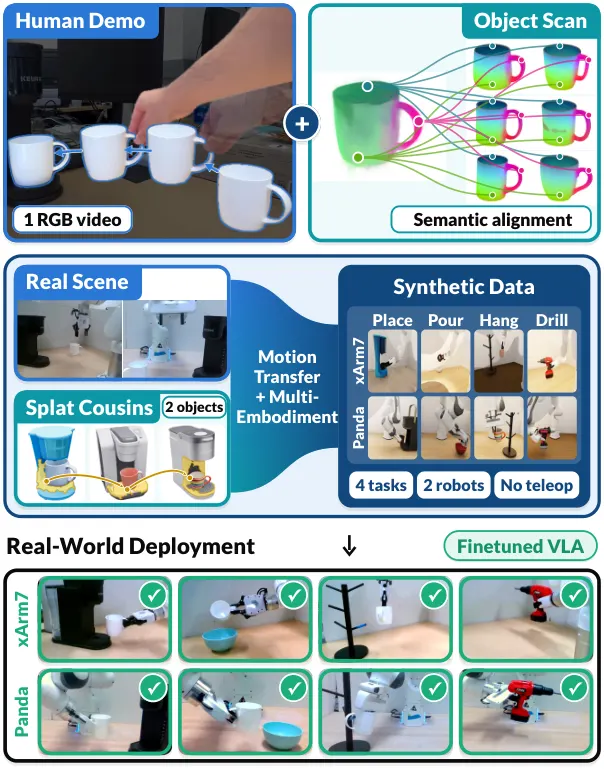
Human video scales easily and does not need robot hardware, but existing methods require depth sensing, overlay the robot onto 2D video, or generate data only for the demonstrated objects. We present Real2Sem2Real (R2Sem2R), a real-to-semantic-to-real pipeline that turns one monocular RGB video of a human demonstration into thousands of robot demonstrations across the semantic object instances of a category. R2Sem2R tracks the SE(3) pose of each object with DINOv3-distilled Gaussian splats, outperforming existing methods and FoundationPose with estimated metric depth. R2Sem2R then aligns digital cousins, each generated from one or a few photographs, to the demonstrated objects with a semantic alignment. This alignment matches whole objects and the functional regions of target objects, such as a coffee machine's tray. R2Sem2R maps the human hand to a feasible robot grasp that extends to the cousins. Robot demonstrations are generated either in IsaacSim, for photorealistic rendering, or MuJoCo, for contact physics, and R2Sem2R can generate over 2,000 episodes in about two hours. On two real robots and four tasks, we train a vision-language-action policy on data from one human video per task, and policies trained on our data match or exceed policies trained on teleoperation across diverse object instances. The project page is available at https://real2sem2real.github.io/.

Robot LearningHuman demonstrations
Matthew Strong, Ankush K. Dhawan, Julien Poffet · 409 views · Oct 20, 2026
Learning Multi-Phase Robot Loco-Manipulation via Phase-Conditioned Policy Optimization

Learning Multi-Phase Robot Loco-Manipulation via Phase-Conditioned Policy Optimization

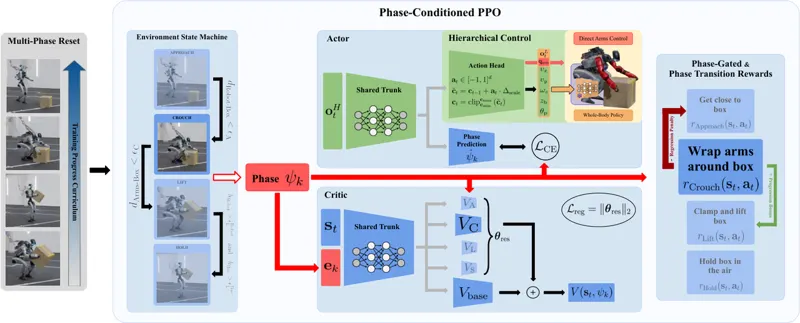
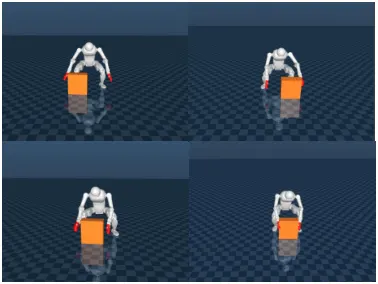
Complex whole-body loco-manipulation requires executing diverse maneuvers, such as crouching, grasping, and locomotion, within a single long-horizon task. While performing simple pick-and-place behaviors is well-established, scaling to complex, long-horizon tasks remains difficult. Currently, this challenge is addressed by relying on human motion data and correspondingly humanoid platforms, which limits platform independence and introduces substantial data processing overhead. Instead, we extend proximal policy optimization (PPO) to train a single policy for multi-phase tasks across diverse robotic hardware, leveraging prior task structure to shape behavior. Our method adapts PPO using a phase-conditioned critic, phase-gated reward functions, and a multi-phase reset curriculum to guide exploration. To support varied hardware, we employ a decoupled hierarchical control architecture that separates lower-level balancing dynamics from high-level phase execution. We demonstrate multi-stage loco-manipulation skills on hardware on both the Unitree G1 and a Boston Dynamics Spot equipped with a manipulator arm, and validate our design choices through ablations. Our approach enables the acquisition of complex loco-manipulation behaviors purely through environment interaction while directly incorporating high-level task structure into policy learning.

Whole-Body Loco-ManipulationPhase-Conditioned PPO
Simone Manni, Annika Wollschläger, Dario Bellicoso · 443 views · Oct 26, 2026
Compliant GMT: Making General Motion Tracking Compliant via Residual Reference Adaptation

Compliant GMT: Making General Motion Tracking Compliant via Residual Reference Adaptation

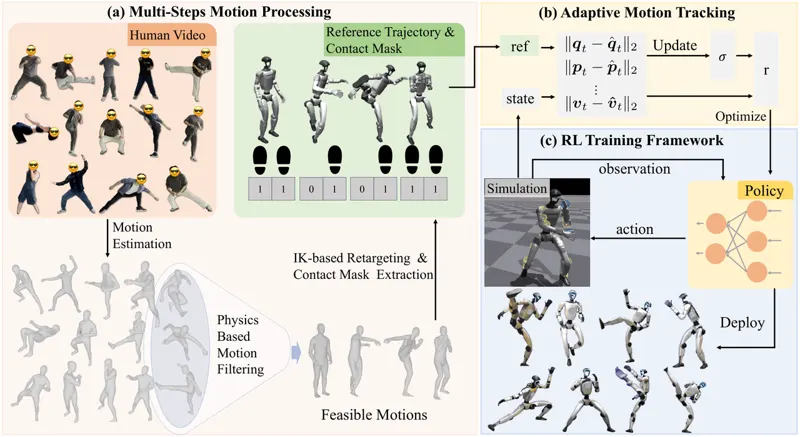
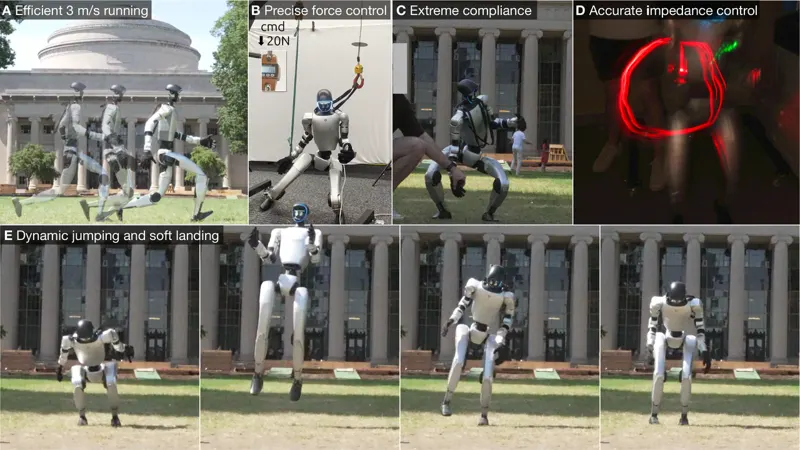
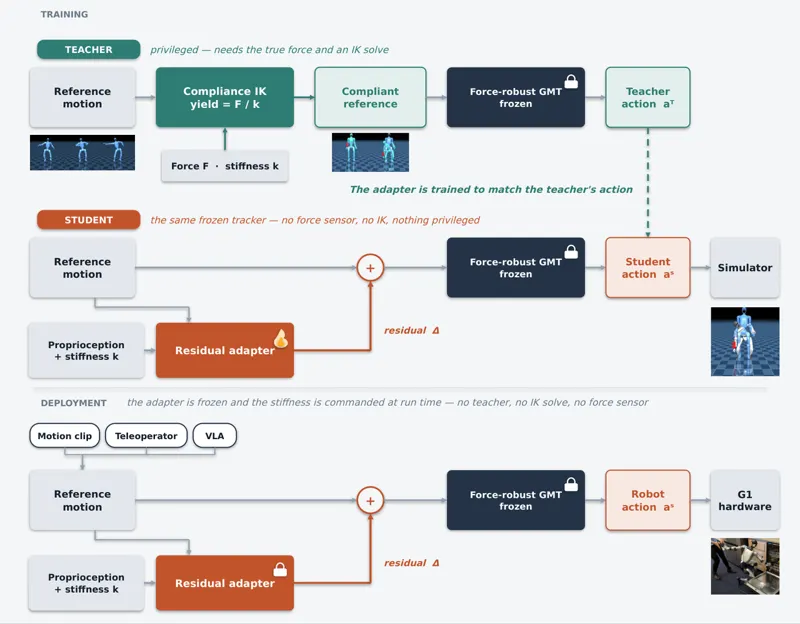
We propose Compliant GMT (C-GMT), a modular framework for full-body compliant responses in general motion tracking. As humanoid robots move into real world deployment, they not only need to perform any motion but also respond safely and robustly to interaction forces. Existing general motion tracking policies can imitate diverse motions but are trained to be stiff, leading to unexpected and unsafe behaviors under disturbance. Prior work in compliant humanoid control trades off compliance and generality. There exist examples of full-body compliant responses, but these are heavily curated to single-reference policies. On the other hand, general motion trackers (GMT) are trained to rigidly imitate massive motion capture datasets. Our key insight is to leverage the generality of pretrained GMTs for motion tracking while introducing compliance from a residual adapter that conditions on a history of proprioception. This enables our approach, C-GMT, to achieve both general motion tracking and whole-body compliant responses. Compared to state-of-the-art general motion trackers and single-motion compliant policies, C-GMT demonstrates competitive performance in both motion tracking accuracy and compliance adherence. We further demonstrate improved safety, robustness, and error tolerance in simulation and real-world G1 experiments.

HumanoidMotion Tracking
Venki Parsuram, Michelle Wang, Jin-Hyuk Hong · 395 views · Oct 15, 2026

As an Amazon Associate, we earn from qualifying purchases.