Skip to content
NavJev: Efficient Vision-Language Navigation via Action-Centric Visual Compression and Discriminative Action-Semantic Memory

NavJev: Efficient Vision-Language Navigation via Action-Centric Visual Compression and Discriminative Action-Semantic Memory

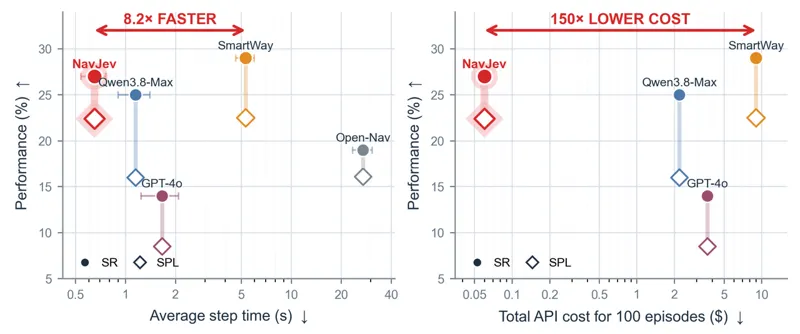
Recent zero-shot Vision-and-Language Navigation (VLN) methods increasingly rely on multimodal large language models (MLLMs) to reason over visual observations, navigation instructions, and candidate actions. Although effective, repeatedly invoking autoregressive multimodal reasoning at every navigation step introduces substantial inference latency, limiting the responsiveness of embodied agents. We propose NavJev, an efficient VLN framework that reformulates online navigation from repeated multimodal generation into compact visual compression followed by lightweight typed action selection. Specifically, Action-Centric Visual Compression (ACVC) integrates waypoint geometry, BLIP captions, and RAM semantic tags into compact representations of candidate actions, while Discriminative Action-Semantic Memory (DASM) filters shared semantics and maintains discriminative action-specific evidence across navigation steps. Based on these representations, Jev directly performs structured probabilistic decisions over the available action set. Experiments on R2R-CE show that NavJev achieves 27.0% SR and 22.4% SPL with only 0.65 s per navigation step, while substantially reducing inference latency and cost compared with MLLM-based VLN methods. The project page is available at https://kai-sheng-caesar.github.io/NavJev/.

Vision-language navigationZero-Shot
Kai Sheng, Liuyi Wang, Jinlong Li · 206 views · Sep 28, 2026
OpenBelief-Nav: Evidence-Preserving Object Memory for Open-Vocabulary Language-Guided Navigation

OpenBelief-Nav: Evidence-Preserving Object Memory for Open-Vocabulary Language-Guided Navigation

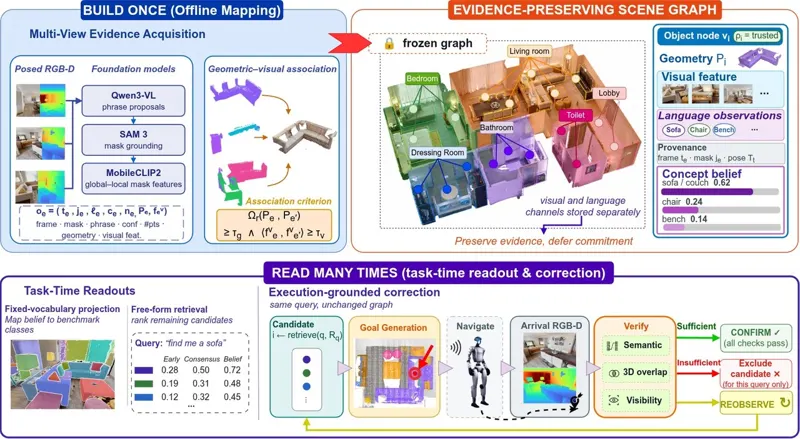
Open-vocabulary 3D scene graphs provide compact semantic memory for language-guided navigation, but mapped objects are often exposed through a single fused feature or committed semantic label. Such commitment can remove minority yet task-relevant hypotheses from the task-time interface. We present OpenBelief-Nav, an evidence-preserving object memory that retains observation-level phrases, reliability cues, and frame-mask provenance while maintaining separate aggregate geometric and visual representations. Semantically related phrases are consolidated into a vocabulary-independent object belief from which task-specific readouts perform fixed-vocabulary projection or free-form retrieval. On five ScanNet200 and eight Replica scenes, full-belief projection achieves mIoU scores of 0.2742 and 0.2912, compared with 0.2393 and 0.2701 for a matched early-commit readout. Across 78 HM3D-YCB navigation trials, consensus and early-commit retrieval each achieve 60/78 successes, compared with 58/78 for belief-weighted retrieval and 55/78 for DualMap. Across 20 Unitree G1 runs organized as 10 matched evaluation cases, a correction policy permitting at most two verified candidate attempts improves target-confirmation success from 6/10 to 8/10 relative to top-1-only execution. Code will be released upon acceptance at https://openbelief-nav.github.io/.

Open-Vocabulary Navigation3D scene graphs
Dinh Tuan Nguyen, Anh Dao, Phuong Nam Dang · 199 views · Aug 14, 2026
RynnUnify: Towards Unified Embodied Brain

RynnUnify: Towards Unified Embodied Brain

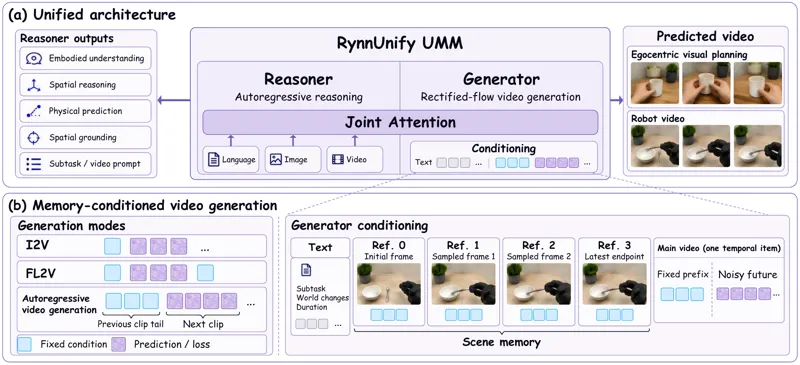
We introduce RynnUnify, a 16B unified embodied model that combines strong embodied understanding with long-horizon visual planning through interleaved video–language reasoning. With capabilities spanning spatial reasoning, physical prediction, and grounding, RynnUnify connects an understanding of the physical world with visual anticipation of how it evolves across successive subtasks. Building on these capabilities, we further develop an agentic extension through reinforcement learning to selectively use video predictions for reasoning about unobserved states and interaction outcomes. We also develop a world-action extension of the full RynnUnify model, translating its understanding and prediction capabilities into robot control. To evaluate these capabilities, we introduce Rynn-VP and Rynn-GEU for long-horizon visual planning and anticipatory reasoning. Experiments show that RynnUnify achieves the highest average embodied understanding score among the evaluated unified multimodal models and improves the Rynn-VP overall score by 9.75 points over Cosmos 3 Nano. Its agentic extension improves the Rynn-GEU average by 6.0 points over direct reasoning, while the world-action extension achieves 51.5% success on 20 selected composite RoboCasa365 tasks and 46.7% average success across three real-robot tasks. Together, these results establish RynnUnify as a shared foundation for embodied understanding, visual planning, and robot control, taking a step toward a unified embodied brain.

RynnUnifyEmbodied AI
Minghao Zhu, Bohan Hou, Kun Xiang · 288 views · Oct 23, 2026
PACE: Temporal-Role Tactile Conditioning for Chunk-Based Insertion Policies

PACE: Temporal-Role Tactile Conditioning for Chunk-Based Insertion Policies

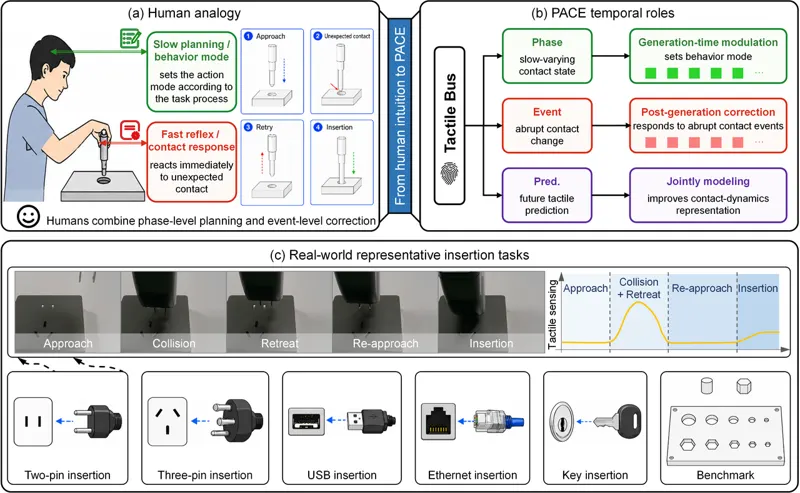
Contact-rich insertion requires a robot to combine visual alignment with tactile adjustment. Existing visuotactile chunk-based policies often collapse tactile feedback into one generation-time pathway, so persistent contact state, abrupt contact events, and the future contact consequences of an action are modeled implicitly in a single representation. PACE assigns one tactile stream three temporal roles. An exponential-smoothed contact state modulates action-chunk generation through layer-wise feature conditioning. A short-window tactile difference forms an event cue and drives a gated residual correction over only the first steps of the chunk. A training-only head predicts future tactile increments from decoder states as an auxiliary representation-learning objective. This preserves chunk-level action continuity while giving slowly varying contact phases and fast collision or jamming events separate pathways. Across five real insertion tasks, PACE reaches 90.7 percent average success, more than 44 percentage points above vision-only and single-path tactile-fusion baselines. It also averages 88.7 percent on six ManipulationNet geometry and clearance settings, including 0.1 mm clearance. Ablations show complementary contributions from Phase, Event, and Pred., while cross-signal and cross-architecture tests extend the principle to force/torque, joint current, and diffusion-policy backbones.

Tactile SensingRobot Manipulation
Zhiyuan Chen, Shixiong Xu, Shuai Chen · 286 views · Oct 12, 2026
Compliant GMT: Making General Motion Tracking Compliant via Residual Reference Adaptation

Compliant GMT: Making General Motion Tracking Compliant via Residual Reference Adaptation

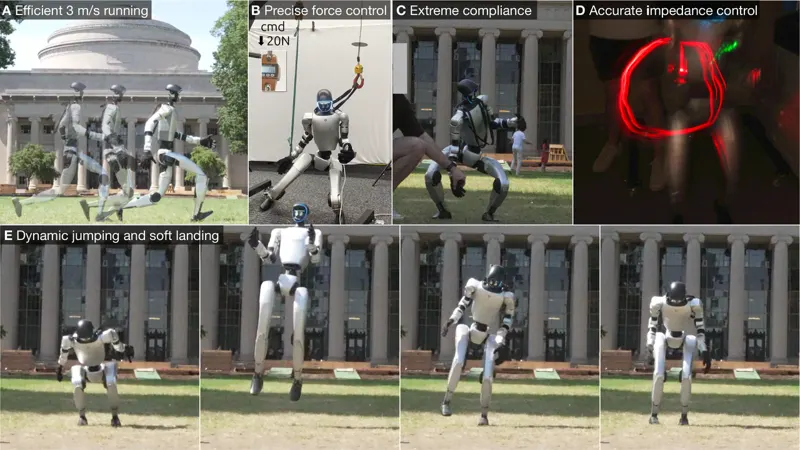
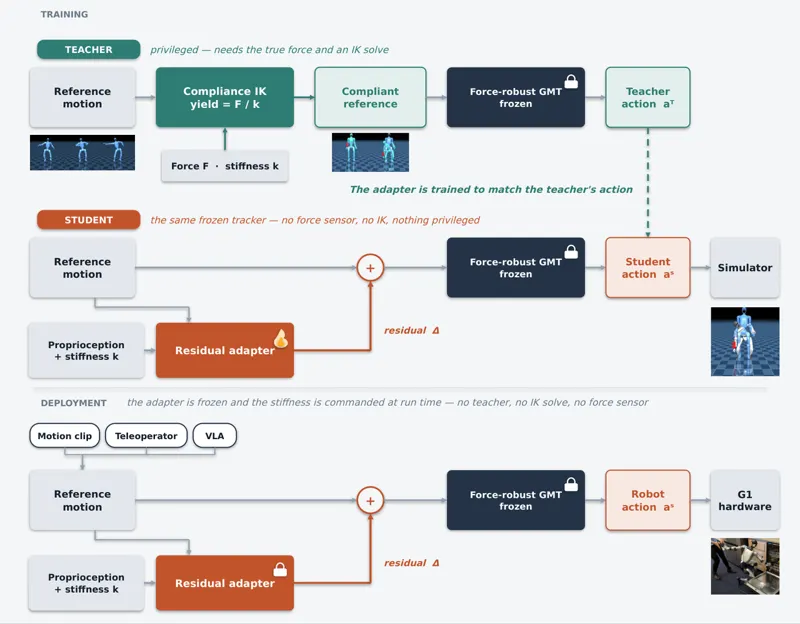
We propose Compliant GMT (C-GMT), a modular framework for full-body compliant responses in general motion tracking. As humanoid robots move into real world deployment, they not only need to perform any motion but also respond safely and robustly to interaction forces. Existing general motion tracking policies can imitate diverse motions but are trained to be stiff, leading to unexpected and unsafe behaviors under disturbance. Prior work in compliant humanoid control trades off compliance and generality. There exist examples of full-body compliant responses, but these are heavily curated to single-reference policies. On the other hand, general motion trackers (GMT) are trained to rigidly imitate massive motion capture datasets. Our key insight is to leverage the generality of pretrained GMTs for motion tracking while introducing compliance from a residual adapter that conditions on a history of proprioception. This enables our approach, C-GMT, to achieve both general motion tracking and whole-body compliant responses. Compared to state-of-the-art general motion trackers and single-motion compliant policies, C-GMT demonstrates competitive performance in both motion tracking accuracy and compliance adherence. We further demonstrate improved safety, robustness, and error tolerance in simulation and real-world G1 experiments.

HumanoidMotion Tracking
Venki Parsuram, Michelle Wang, Jin-Hyuk Hong · 290 views · Oct 15, 2026

As an Amazon Associate, we earn from qualifying purchases.