Skip to content
Blind Precise Assembly: Proprioceptive Sim-to-Real Peg-in-Hole for Diverse Parts

Blind Precise Assembly: Proprioceptive Sim-to-Real Peg-in-Hole for Diverse Parts

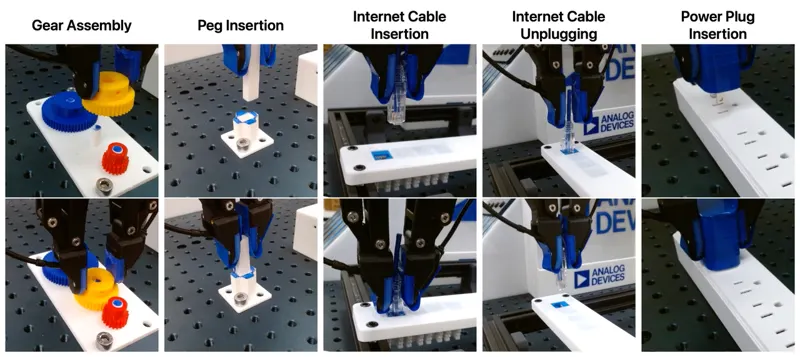
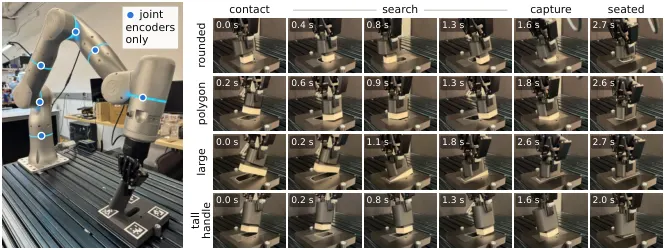
Every robot already carries high-resolution contact sensors: its own joints. Legged robots and humanoids exploit them to walk, run, and track whole-body motions without vision, but there the contacts are large and forceful. Is joint sensing also enough for precise, contact-rich assembly, where the robot must find a millimeter-scale opening, mesh gear teeth, or catch a thread through light contact? We study this question by training blind assembly policies that observe only a short history of joint positions, velocities, and their own actions, without visual, force, torque, or tactile sensing. The poses of both the fixture and the part are unknown to the policy, and the grasp is randomized substantially. The policy must therefore assemble the parts through contact, sensed exclusively through its own proprioception. Trained with reinforcement learning entirely in simulation over randomized parts, grasps, and contacts, such policies learn peg insertion, gear meshing, and nut threading. The peg insertion policy transfers zero-shot to the real world and inserts pegs of different shapes and sizes in 73% of trials. Controlled comparisons with matched visual policies in simulation show that blind policies generalize far better to unseen part shapes and sizes, though they can be slower. Training such policies needs thousands of different assemblies, each simulated with its clearance intact, so we also release an open-source generator that builds them procedurally from exact convex pieces for MuJoCo; it is more accurate and faster than convex decomposition or MuJoCo's signed-distance collision. Videos and interactive simulations are at https://younghyopark.me/blind-proprioceptive-assembly/.

Peg-in-HoleSim-to-Real
Antonia Bronars, Younghyo Park, Kushal Kedia · 374 views · Oct 16, 2026
LoopWAM: Closed-Loop Generalist Policy Improvement from Deployment Rollouts

LoopWAM: Closed-Loop Generalist Policy Improvement from Deployment Rollouts

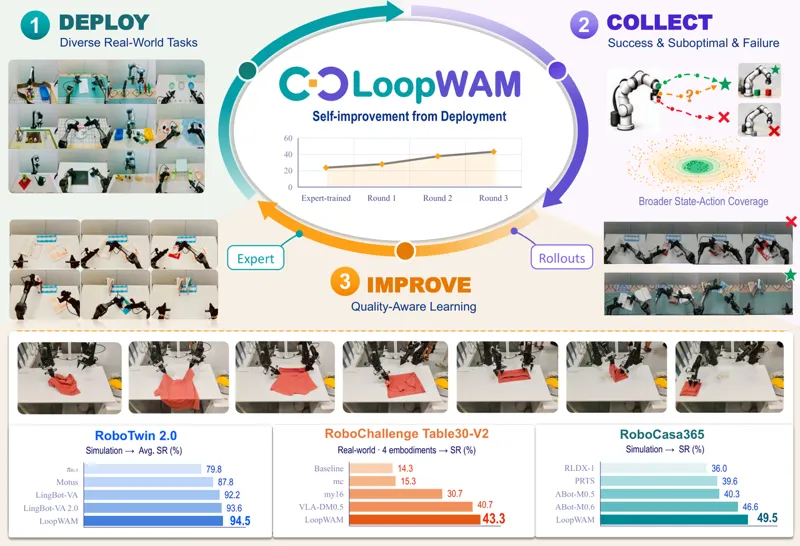
Scaling expert demonstrations alone does not enable generalist robot policies to improve from deployment. Real-world rollouts contain successes, suboptimal behavior, and failures: imitating every recorded action can reinforce poor behavior, while filtering out failures discards evidence of physical interactions and their consequences. We introduce LoopWAM, a closed-loop world-action model that learns directly from this full quality spectrum, using rollouts from both itself and other deployed policies. Source-dependent noise sampling unifies behavior learning and action-conditioned world modeling, while quality steering and quality-weighted supervision retain full video supervision across qualities and regulate action imitation. Video and action tokens interact throughout parallel denoising, allowing learned consequences to inform action generation directly. On RoboChallenge Table30-V2, three deployment-and-training rounds raise success from 23.67% to 43.33%, a 19.7-percentage-point gain, with a final score of 56.80. LoopWAM also achieves 94.5% average success on RoboTwin 2.0 and 49.5% overall success on RoboCasa365 without additional embodied pretraining, obtaining the best overall results among the compared methods across all three benchmarks. On challenging shirt folding task, two rounds of deployment-driven improvement after single-task post-training raise success from 13.20% to 55.56%. These results demonstrate closed-loop improvement from mixed-quality experience under both multi-task learning and single-task post-training. Project page: https://loop-wam.github.io/

World-action modelsSelf-Improvement
Wenxuan Guo, Yingping Liang, Zhaoguo Wang · 395 views · Oct 13, 2026
Agile-WAM: An Agile Tactile World Action Model for Contact-Rich Robot Control

Agile-WAM: An Agile Tactile World Action Model for Contact-Rich Robot Control

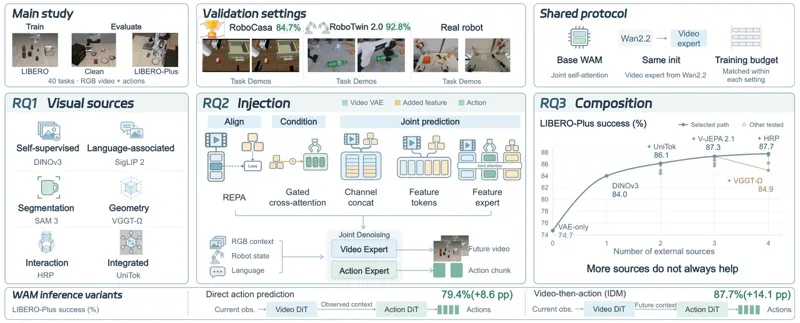
World Action Models (WAMs) advance beyond conventional visuomotor policies by jointly predicting future world states and robot actions, enabling the policy to learn phys- ical dynamics that support effective control. However, recent tactile WAMs often rely on large-scale pretrained generative backbones to capture contact-rich physical dynamics, which limit their inference efficiency and flexible deployment. In this paper, we present Agile-WAM, an agile tactile World Action Model for contact-rich robot control. Agile-WAM encodes visual and tactile observations into a shared latent that serves as the source of a direct vision-tactile-to-action flow-matching process, which can jointly generate latent representations of action chunks and future visual/tactile latents. A key observation is that vision and tactile signals evolve at inherently different timescales: adjacent visual frames are often highly similar, whereas tactile signals can change abruptly upon contact. We therefore introduce multi-horizon multimodal prediction in Agile-WAM, which provides supervision for visual latent at a larger temporal offset while predicting the tactile latent in the next frame to capture fine-grained contact dynamics. Across nine simulated and five real-world contact-rich ma- nipulation tasks, Agile-WAM demonstrates strong and robust performance, outperforming the strongest baseline in success rate while maintaining low inference latency. In particular, in five real-world experiments, Agile-WAM yields a relative gain of 29.4% in overall success rates while achieving inference latency of 11.9 ms. These results demonstrate that multimodal WAM can be achieved with an agile architecture suitable for precise and high-frequency robot control. More details are available on our project page.

World-action modelsFlow Matching
Hanchu Zhou, Brendan Lynch, Raman Goyal · 259 views · Sep 17, 2026
Terminal-RSI: Recursive Self-Improving Terminal Agents via Recursive Self-Rewrite and Policy-Refine

Terminal-RSI: Recursive Self-Improving Terminal Agents via Recursive Self-Rewrite and Policy-Refine

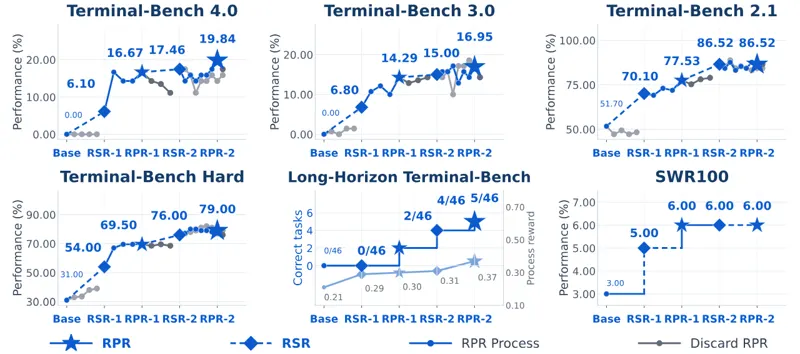
Converting verifier outcomes into useful policy updates and partial progress into complete task resolution is crucial for terminal agents. We present Terminal-RSI, which alternates Recursive Self-Rewrite (RSR) of verified trajectories with critic-inheriting Recursive Policy-Refine (RPR). We formulate Turn-Boundary Skip-Observation GAE (TB-GAE) to retain token-specific baselines while applying decay across interaction turns. Family Dense Reward (FDR) calibrates semantic progress across task families; Success-Prioritized Reward (SPR) separates strict success from bounded partial credit. A Warm-up Critic Model, recursive critic handoff, and stage-specific learning rates coordinate the two refinement phases. The five-stage sequence from Qwen3.8-27B base model through RSR-1, RPR-1, RSR-2, and RPR-2 yields Terminal-RSI-27B: 19.84% on Terminal-Bench 4.0, 86.52% on Terminal-Bench 2.1, 16.95% on Terminal-Bench 3.0, and 79.00% on Terminal-Bench Hard. On LHTB, process reward rises from 0.21 to 0.37 and strict completion from 0/46 to 5/46; SWR100 success doubles from 3.00% to 6.00%. By recursively coupling verified trajectory rewriting with critic-inheriting policy refinement, each retained stage consolidates discovered behaviors and progressively advances the agent from partial local repairs to strict terminal verification.

Terminal AgentReinforcement Learning
Junyao Yang, Zongxia Li, Yucheng Shi · 444 views · Oct 15, 2026
P-BFM: Perceptive Behavioral Foundation Models for Humanoid Control via Unsupervised Reinforcement Learning

P-BFM: Perceptive Behavioral Foundation Models for Humanoid Control via Unsupervised Reinforcement Learning

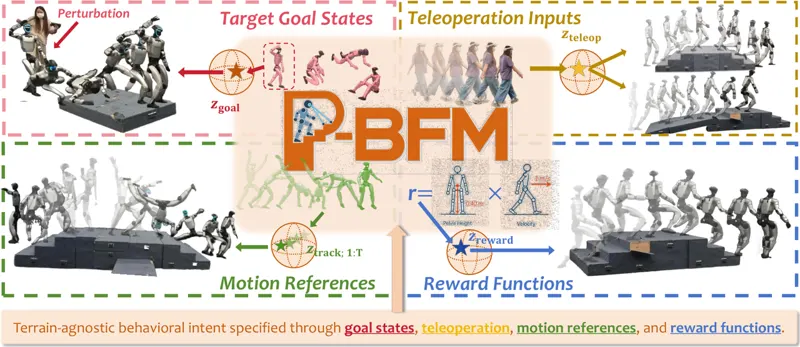
Behavioral foundation models (BFMs) provide humanoids with reusable repertoires of whole-body behaviors; in real-world humanoid control, the same behavioral intent may require fundamentally different motions under different terrain constraints. Covering such variation with terrain-matched demonstrations requires enumerating a combinatorial space of behaviors and terrain geometries. We introduce P-BFM, a perceptive behavioral foundation model that factorizes humanoid control into terrain-invariant intent and terrain-conditioned realization. A forward-backward representation maps motion references, target states, and reward functions into a shared intent space without terrain information, while a perceptive policy learns how to realize each intent under the surrounding terrain geometry. We further identify a complementary limitation of purely latent control: behavioral latents can preserve local motion patterns while losing precise global progress. We therefore introduce Explicit Root Instructions (ERI), which separates global transport (e.g., heading and planar velocity) from behavioral intent, while leaving local whole-body adaptation to the perceptive policy. This decomposition leads to a characteristic capability absent from conventional BFMs: one fixed intent induces different, terrain-appropriate behaviors, including changes in step height, stride, posture, foothold placement, and contacts, without terrain-specific demonstrations. Across challenging terrains, P-BFM improves motion fidelity, root-control precision, and perturbation recovery over strong baselines. A single frozen policy further supports motion tracking, goal reaching, reward inference, teleoperation, and terrain-aware recovery, and transfers zero-shot to a Unitree G1 using onboard depth sensing.

HumanoidUnsupervised Reinforcement Learning
Xue Wang, Yitang Li, Yiming Zhang · 532 views · Oct 11, 2026
Interactive Navigation Beyond Reachability: Benchmark and Agentic Framework

Interactive Navigation Beyond Reachability: Benchmark and Agentic Framework

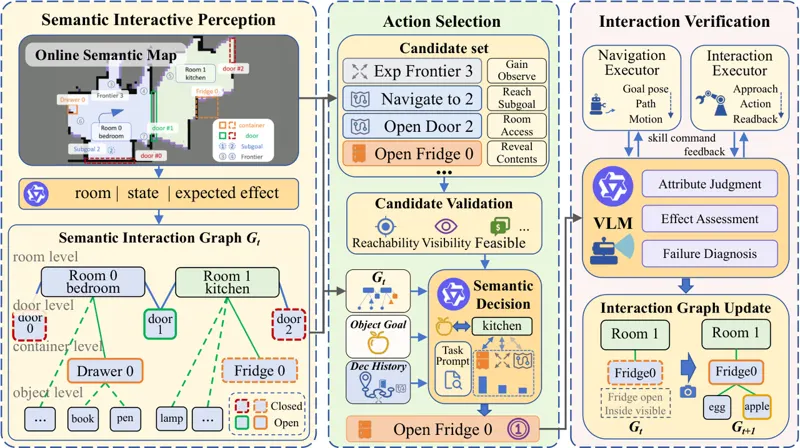
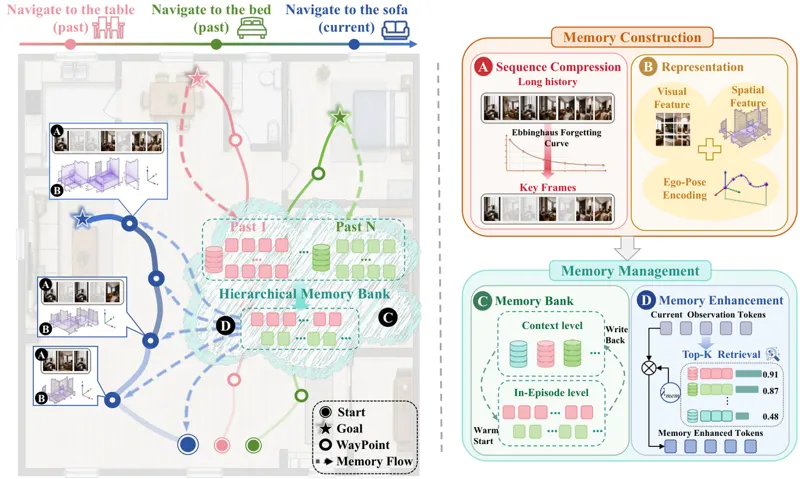
Existing embodied navigation tasks commonly assume that traversability and object states remain fixed during an episode. Yet reaching a goal may require opening a door to access a room and then opening a container to reveal a hidden target. We formulate interactive navigation beyond reachability, unifying channel-induced changes in spatial connectivity, container-induced changes in target visibility, and their sequential dependencies. We introduce MultINav-Bench, a 3K-episode ObjectGoal benchmark in MolmoSpaces spanning channel, container, and mixed tasks, with interaction-necessity annotations covering required and unnecessary episodes. Its data generation pipeline automates task construction across multiple task types. The evaluation protocol separately measures navigation success, interaction effectiveness, and cost. We further propose MultINav-Agent, a three-stage agentic framework built on a persistent, state-conditioned interaction graph. Semantic interactive perception grounds entities and interaction states; a vision-language model selects task-relevant actions based on expected changes in connectivity and target observability; and post-interaction verification updates the graph to guide subsequent navigation, exploration, or interaction. Experiments on MultINav-Bench show that MultINav-Agent consistently outperforms adapted baselines across channel, container, and mixed tasks.

Embodied NavigationInteractive Navigation
Delun Li, Xueyao Wei, Rui Chen · 293 views · Oct 12, 2026
EWAM: Emergent Depth-Wise Specialization in a Unified Embodied Model – From Semantic Understanding through Visual Foresight to Action

EWAM: Emergent Depth-Wise Specialization in a Unified Embodied Model – From Semantic Understanding through Visual Foresight to Action

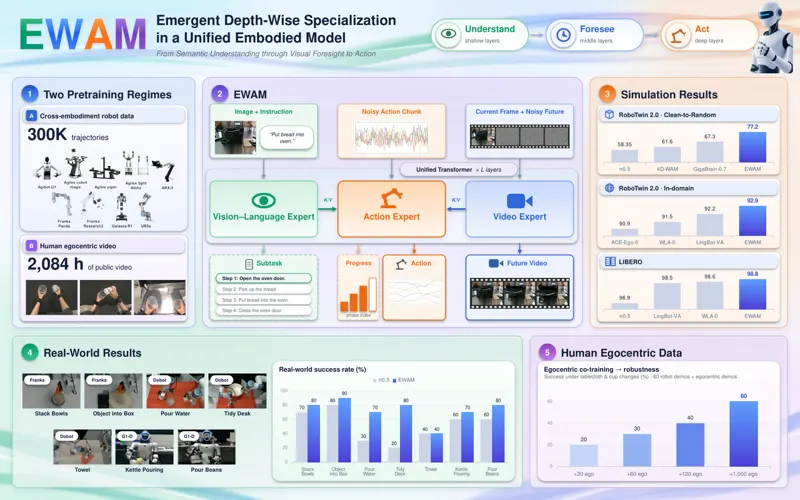
Vision-language-action (VLA) policies emphasize semantic understanding, whereas world-action models (WAMs) learn predictive representations of environment dynamics. Systems that expose a policy to both sources often still concentrate action computation on a single expert. We present EWAM, an action-centric unified embodied model whose asymmetric joint attention lets action tokens read semantic, current-visual, predicted-future, and action information at every layer while the perceptual experts retain their distinct roles. Without layer-wise supervision, EWAM develops an emergent depth-wise specialization: action queries attend mainly to vision-language features in shallow layers, to predicted future frames in intermediate layers, and to action tokens themselves in deep layers. This handoff replicates across tasks and is stable across denoising steps. Checkpoint tracking and causal interventions show that it is learned and that action generation depends on it. EWAM is pretrained in two separate regimes, one on cross-embodiment robot trajectories and one on human egocentric video. In simulation and real-robot experiments, it surpasses existing VLA, WAM, and hybrid baselines. Human egocentric data improve both cross-embodiment transfer and real-robot robustness, and subtask-phase supervision improves long-horizon completion. Together, these results suggest that unified embodied learning can induce an ordered internal progression from semantic understanding, through visual foresight, to action formation.

VLAWorld-action models
Hao Wang, Jiajun Wen, Jingzhi Liu · 213 views · Sep 30, 2026
HOTICE: Whole-Body Humanoid Object Transportation in Cluttered Environments

HOTICE: Whole-Body Humanoid Object Transportation in Cluttered Environments

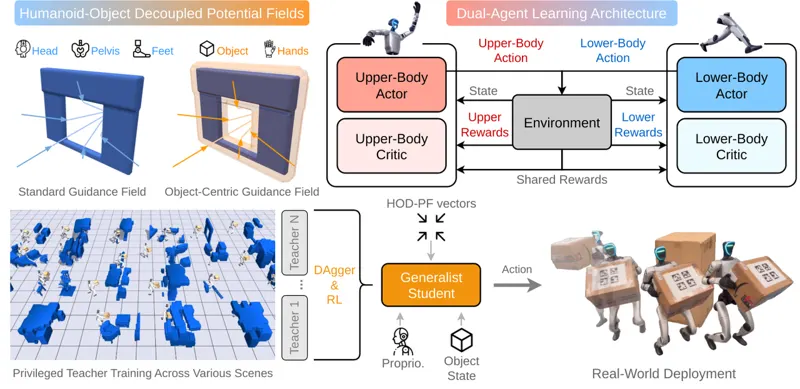
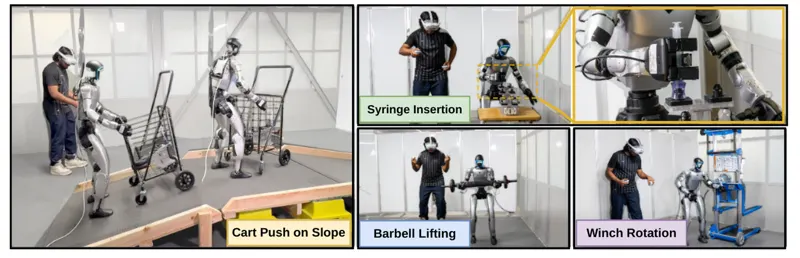
Object transportation is a fundamental capability for humanoid robots operating in real-world, human-centric environments, yet existing methods struggle when clutter constrains free space around both the robot and its carried payload. We present HOTICE, a whole-body humanoid learning framework for transporting objects through such cluttered environments. First, we introduce Humanoid-Object Decoupled Potential Fields, which jointly encode collision-avoidance guidance for the robot and the carried object, enabling coordinated, obstacle-aware motion for both. Second, to address the large action space inherent to whole-body loco-manipulation, we design a dual-agent reinforcement learning architecture that decouples upper- and lower-body control while preserving whole-body coordination via shared state observations and rewards. To train a policy that generalizes across diverse cluttered scenes, we further employ a specialist-to-generalist distillation strategy, in which privileged teacher policies are distilled into a single deployable student policy. We evaluate HOTICE in MuJoCo simulation and on a real Unitree G1 humanoid, demonstrating effective and robust object transportation across cluttered scenarios for objects of varying shapes. Our results show that HOTICE reliably coordinates whole-body motion and object-aware collision avoidance, generalizing effectively to previously unseen cluttered environments while achieving strong performance in sim2real deployment.

HumanoidLoco-manipulation
Toan Nguyen, Weiduo Yuan, Siheng Zhao · 15 views · Sep 21, 2026
The Agentic Scientist: Orchestrating Coding Agents for Automated Scientific (Co-)Discovery

The Agentic Scientist: Orchestrating Coding Agents for Automated Scientific (Co-)Discovery

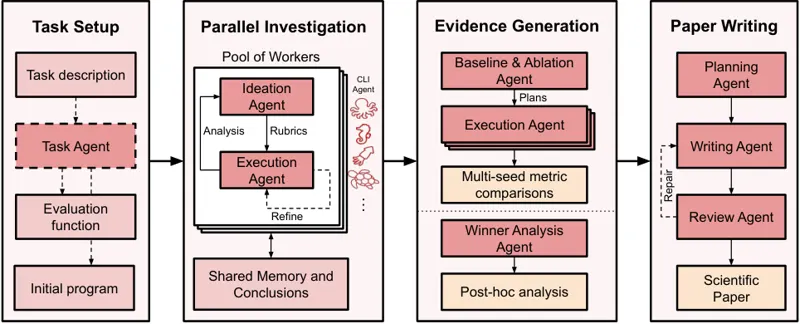
Modern coding agents are fundamentally reshaping the role of human input for computational research: they write code, launch in silico experiments, analyze their results, and autonomously operate with ever-increasing time horizons. Despite these developments, fully autonomous research agents suffer from a limited ideation radius and myopic hill-climbing search dynamics. To bridge this gap, we introduce The Agentic Scientist, an end-to-end distributed pipeline for human researchers to conduct computational research alongside modern coding agents. Building on its predecessor, our system decomposes research into task drafting, idea generation, planning, sandboxed experimentation, result aggregation, baseline and ablation construction, post-hoc analysis, and report writing. Importantly, each step in the pipeline is powered by the next generation of coding agents and leverages agentic self-verification. The overall research process is driven by a meta-controller that manages parallel research agents and enforces rubric verification at each stage. This design enables the same orchestration layer to be reused across heterogeneous domains with different execution environments, agentic coding harnesses, and evaluation metrics. Our system can be used across a spectrum of autonomy: either as a co-scientist tool or to perform end-to-end scientific investigation. Within the co-scientist setting, we leveraged a development version of our system to submit a single research paper, which got accepted for publication at ALIFE 2026. We further apply The Agentic Scientist fully autonomously to open problem-solving tasks in machine learning, and demonstrate the system's capability of scientific discovery across different domains of computational research. Our ablations suggest that reliable scientific autonomy depends not only on base model capabilities, but also on the cross-agent orchestration layer.

AI ScientistCoding Agent
Robert Tjarko Lange, Luca Grillotti, Yutaro Yamada · 521 views · Oct 13, 2026

As an Amazon Associate, we earn from qualifying purchases.