PAPER DEEP DIVE
HOTICE: Whole-Body Humanoid Object Transportation in Cluttered Environments
Object transportation is a fundamental capability for humanoid robots operating in real-world, human-centric environments, yet existing methods struggle when clutter constrains free space around both the robot and its carried payload. We present HOTICE, a whole-body humanoid learning framework for transporting objects through such cluttered environments. First, we introduce Humanoid-Object Decoupled Potential Fields, which jointly encode collision-avoidance guidance for the robot and the carried object, enabling coordinated, obstacle-aware motion for both. Second, to address the large action space inherent to whole-body loco-manipulation, we design a dual-agent reinforcement learning architecture that decouples upper- and lower-body control while preserving whole-body coordination via shared state observations and rewards. To train a policy that generalizes across diverse cluttered scenes, we further employ a specialist-to-generalist distillation strategy, in which privileged teacher policies are distilled into a single deployable student policy. We evaluate HOTICE in MuJoCo simulation and on a real Unitree G1 humanoid, demonstrating effective and robust object transportation across cluttered scenarios for objects of varying shapes. Our results show that HOTICE reliably coordinates whole-body motion and object-aware collision avoidance, generalizing effectively to previously unseen cluttered environments while achieving strong performance in sim2real deployment.
Paper: HOTICE: Whole-Body Humanoid Object Transportation in Cluttered Environments
Authors: Toan Nguyen (co-first), Weiduo Yuan (co-first), Siheng Zhao, Yue Wang (co-advising), Daniel Seita (co-advising)
Affiliation: University of Southern California (USC Physical Superintelligence Lab)
Link: https://arxiv.org/abs/2609.25363 (arXiv:2609.25363v1 [cs.RO], September 21, 2026)
Project page: https://hotice2027.github.io (anonymous at submission)
Code status: Not released as of ingestion. Neither the paper nor the project page links a repository, and GitHub searches for HOTICE and HumanoidPF return no matching repo. Training runs on the open-source MuJoCo Playground (google-deepmind/mujoco_playground); the potential-field and scene pipeline descend from HumanoidPF (Xue et al., RA-L 2026, "Collision-free Humanoid Traversal in Cluttered Indoor Scenes"), and the dual-agent layout follows FALCON (Zhang et al., L4DC 2026).
One-Sentence Summary
HOTICE writes the robot's own collision avoidance and that of its carried box as two decoupled potential-field vector maps, lets an upper-body and a lower-body PPO agent chase separate reward streams while staying coupled through shared observations and shared rewards, and distills 75 scene-specialist teachers into one deployable generalist: 88.5% success over 20,000 simulated trials in 20 scenes with 0.130 m mean distance to goal, and 16 of 18 real trials on a Unitree G1 across side, overhead, and ground obstacles.
Background and Motivation
Object transportation underpins last-mile delivery, warehouse logistics, and household assistance. The three platforms that traditionally carry it each rely on assumptions that break outdoors: fixed-base arms have a limited workspace and cannot reposition around obstacles; wheeled bases need relatively flat, traversable ground and choke on thresholds and narrow irregular passages; drones offer small payloads and demand open airspace.
The humanoid form factor answers exactly these failures. Whole-body loco-manipulation lets it step over ground-level obstacles and duck under overhead obstructions while keeping a stable hold on the payload; a human-scale footprint lets it thread narrow side clearances and clutter built for people; and a single embodiment generalizes across environments instead of requiring a bespoke platform per scene.
The difficulty stacks up just as fast. Whole-body loco-manipulation already coordinates upper and lower body in a high-dimensional action space; clutter forces extreme, non-default postures to balance and pass at once; and a heavy or bulky payload adds dynamics while shrinking the clearance that those postures must fit through.
The literature gap sits at the intersection of two lines. Humanoid traversal work — vision-based parkour, contact-driven whole-body control, narrow-terrain balance, terrain-conditioned skill composition, HumanoidPF, and text-driven TANGO — assumes an unencumbered robot whose collision geometry follows entirely from its own kinematics. Humanoid transportation work — planning-based joint trajectories, sim2real box carrying, contact-based embracing of bulky objects, load-aware controllers, and exteroceptive loco-manipulation over uneven terrain — mostly targets open or lightly obstructed scenes where clearance can be recovered by walking around. Real clutter constrains from the ground, the sides, and above simultaneously: robot and payload must both fit through what free space remains.
The task is therefore stated cleanly: starting at $\mathbf{s}$ while holding object $\mathscr{O}$, deliver it to goal $\mathbf{g}$ without colliding with obstacles $\mathscr{C}$; success means reaching within 0.1 m of the goal within 5 s with no fall, no drop, and no collision by either robot or box. The paper centers on cuboid boxes (up to 3.5 kg and 40×40×40 cm, matched to the G1's payload and scale) yet generalizes to cylinders and spheres; a separate pickup policy lifts the box from a support surface to complete the pipeline, while the method and main experiments assume the object is already held.

Figure 1: The task family. (1)(2) side obstacles, (3) an overhead bar, (4) a ground pole — the same carton, different whole-body postures (paper Figure 1).
Prerequisites: Potential Fields, Keypoint Queries, Teacher-Student Distillation
Artificial potential fields (Khatib, 1986) sum an attractive and a repulsive field and follow the negative gradient; the classic weaknesses are local minima and missing global structure. HumanoidPF contributes the two fixes HOTICE inherits: the attractive field uses geodesic distance that does not cut through obstacles, and the field is queried at multiple body keypoints, turning single-point avoidance into a set of whole-body avoidance directions.
Keypoint querying deserves emphasis: the policy never sees the field itself, only guidance vectors sampled at keypoints (head, pelvis, feet, ...), and rewards align each part's Cartesian velocity with its guidance vector. The field thus acts as a generalizable representation — the same scene yields the same vector map for any policy, and the policy only learns how to follow.
The third prerequisite is privileged teacher-student distillation: teachers see noiseless, delay-free privileged states and specialize per scene; the student sees only deployable observations (proprioception, object state, guidance vectors), is aligned by DAgger, then refined with PPO while sensor noise and control delays are simulated to shrink the sim2real gap. HOTICE reuses HumanoidPF's scene pipeline: procedurally generated scenes that push policy limits plus realistic indoor scenes cropped from 3D-FRONT that keep the distribution honest.
Method in Detail
Two fields: Standard and Object-Centric Guidance
The Standard Guidance Field (SGF) follows HumanoidPF: an attractive field proportional to geodesic distance and a repulsive field piecewise in the signed distance,
$$\mathbf{U}_{\text{att}}(\mathbf{x}) = \eta\,\mathrm{D}_{\text{geo}}(\mathbf{x},\mathbf{g})$$
$$\mathbf{U}_{\text{rep}}(\mathbf{x}) = \begin{cases} \tfrac{1}{2}\xi\left(\tfrac{1}{\mathrm{sdf}(\mathbf{x})}-\tfrac{1}{d_{0}}\right)^{2}, & \mathrm{sdf}(\mathbf{x}) \leq d_{0} \\ 0, & \mathrm{sdf}(\mathbf{x}) > d_{0} \end{cases}$$
where $\mathrm{D}_{\text{geo}}$ is the shortest obstacle-free path length and $\mathrm{sdf}$ the signed distance to $\mathscr{C}$. The guidance field is the negative gradient of the summed potential,
$$\mathbf{F}_{\text{standard}}(\mathbf{x}) = -\nabla_{\mathbf{x}}\Big(\mathbf{U}_{\text{att}}(\mathbf{x}) + \mathbf{U}_{\text{rep}}(\mathbf{x})\Big)$$
with $d_{0}=0.2$ m, $\eta=0.6$, $\xi=1\times 10^{-3}$ inherited from HumanoidPF. SGF vectors are queried at head, shoulders, torso, pelvis, knees, and feet; for head, pelvis, and feet the reward maximizes the cosine similarity between $\mathbf{F}_{\text{standard}}(\mathbf{x})$ and the part's Cartesian velocity $\mathbf{v}$.
The Object-Centric Guidance Field (OGF) is the first key change: inflate obstacles by margin $m=8$ cm into $\mathscr{C}_{\text{inflated}}$, then compute the same attractive, repulsive, and guidance quantities with respect to the inflated set. Two motivations drive the margin. The object is not directly actuated by joints, so the margin buys robustness to sensor noise and control delay. And object avoidance must be more anticipatory: feet can step over a ground bar just as they reach it, whereas a heavy or bulky object becomes very hard to reposition once close to an obstacle, so it must start yielding earlier. Figure 2 shows the orange OGF bending away sooner than the blue SGF near the obstacle.
OGF vectors are queried at object keypoints (the eight corners of a box) and at the hands that control it. Because the state-based policy is a lightweight MLP, keypoint count does not hurt latency and the granularity stays controllable — the hook that later lets shape changes live entirely in keypoint placement.
The OGF steering reward is a relative quantity: maximize the cosine similarity between $\left[\mathbf{F}_{\text{object}}(\mathbf{x})-\mathbf{c}\right]$ and $\left[\mathbf{v}-\mathbf{c}\right]$, where $\mathbf{c}$ aggregates the overall navigation command from the SGF vectors of head, pelvis, and feet. Subtracting $\mathbf{c}$ removes the motion locomotion already produces, so the reward credits only the residual, obstacle-driven adjustments the hands are actually responsible for — otherwise the hands would free-ride on walking displacement.
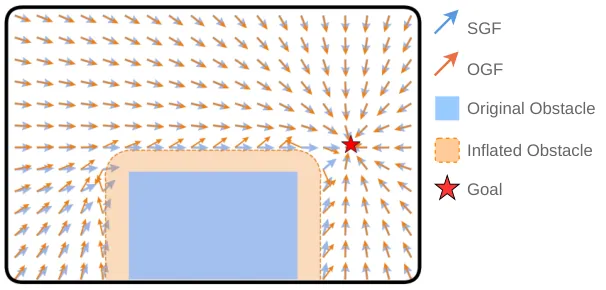
Figure 2: SGF (blue) versus OGF (orange) in one scene. OGF is computed against the inflated obstacle (beige) and bends earlier at its boundary, granting the payload headroom (paper Figure 3).
Dual agents: splitting 20 dimensions into 8 + 12
Following FALCON's spirit, HOTICE refuses to treat the whole policy as one learner: an upper-body agent controls 8 arm joints and a lower-body agent controls 12 leg joints (waist and wrist joints are dropped as unnecessary). Each agent keeps its own actor and privileged critic, yet both read the same observation and share termination conditions — coupling happens through the environment rather than a monolithic network. The actors emit $\mathbf{a}_{\text{low}}\in\mathbb{R}^{12}$ and $\mathbf{a}_{\text{up}}\in\mathbb{R}^{8}$, concatenated into the 20D action fed to a PD controller.
Reward terms split into three sets: $\mathcal{L}$ (locomotion, balance), $\mathcal{U}$ (object reaching, grasp maintenance), and $\mathcal{S}$ (object lifting plus HOD-PF rewards whose values depend jointly on arm articulation and torso pose). The two reward streams are
$$r_{\text{low}}=\sum_{i\in\mathcal{L}\cup\mathcal{S}}w_{i}r_{i},\qquad r_{\text{up}}=\sum_{i\in\mathcal{U}\cup\mathcal{S}}w_{i}r_{i}$$
Each agent forms its own advantage $\hat{A}_{\text{low}}$, $\hat{A}_{\text{up}}$ from its own stream and value function, and the two clipped PPO objectives are optimized jointly:
$$\mathcal{J}=\mathcal{J}^{\text{PPO}}_{\text{low}}\big(\hat{A}_{\text{low}}\big)+\mathcal{J}^{\text{PPO}}_{\text{up}}\big(\hat{A}_{\text{up}}\big)$$
Because the shared set $\mathcal{S}$ enters both streams, both agents remain jointly accountable for the carry, while locomotion and grasping signals no longer compete inside a single advantage estimate — precisely the pathology that makes the single-agent variant unstable in extreme postures.
Specialist to generalist: 75 teachers into one student
Scene-specific teachers train in parallel with privileged states and without any scene-specific reward tuning — the decoupled potential fields already serve as a generalizable representation and reward structure. Teachers are distilled into a single student via DAgger, the student is refined with PPO under the same dual-agent framework, and sensor noise plus control delays are simulated during its training. Everything runs in MuJoCo Playground. The main experiment trains teachers for 400M timesteps on 20 scenes; the generalization experiment scales to 75 teachers on 75 scenes before testing the generalist on 50 unseen environments.
Shape generalization lives in the keypoints
For cylinders the field is queried at four evenly spaced points on the top rim and four on the bottom rim; for spheres, at eight fixed world-frame octant directions at the sphere's radius. Every shape uses exactly eight keypoints, so observation layout, network architecture, and action space stay unchanged; only minimal shape-specific reward adaptations (hand placement, object uprightness) are added while all other reward terms, weights, and hyperparameters are inherited from the box policy. Shape information collapses into one question: where do the eight queries sit?
Real-robot deployment: SLAM map plus AprilTag box pose
On hardware, the G1 first walks the empty environment to reconstruct obstacles via SLAM. At inference, HOD-PF guidance vectors come from real-time localization and joint angles, and the box pose is estimated from AprilTags on the box plus the head camera; the pickup and transportation policies both run at 50 Hz. Live LiDAR reconstruction is possible in principle, but the G1's single LiDAR has its field of view occluded by the carried box — a hardware limitation, the authors stress, not a method limitation.
flowchart TD
  SCN["Cluttered scene: side, overhead, ground obstacles"] --> SDF["Obstacle signed distance field"]
  SDF --> SGF["Standard Guidance Field queried at head, shoulders, torso, pelvis, knees, feet"]
  SDF --> INF["Obstacle inflation by 8 cm margin"]
  INF --> OGF["Object-Centric Guidance Field queried at 8 object keypoints and both hands"]
  SGF --> OBS["Shared observation: guidance vectors, proprioception, object state"]
  OGF --> OBS
  OBS --> UP["Upper-body actor and privileged critic: 8 arm joints"]
  OBS --> LO["Lower-body actor and privileged critic: 12 leg joints"]
  UP --> RUP["Reward stream r_up from U set plus S set"]
  LO --> RLO["Reward stream r_low from L set plus S set"]
  RUP --> JOINT["Joint PPO objective J; shared S set keeps the body coupled"]
  RLO --> JOINT
  JOINT --> PD["20D action through PD controller to torques"]
  PD --> TEA["Scene-specialist privileged teachers trained in parallel, no per-scene tuning"]
  TEA --> DAG["DAgger distillation plus PPO refinement with noise and delays"]
  DAG --> STU["Generalist student policy"]
  STU --> REAL["Real Unitree G1: SLAM map, AprilTag box pose, 50 Hz"]
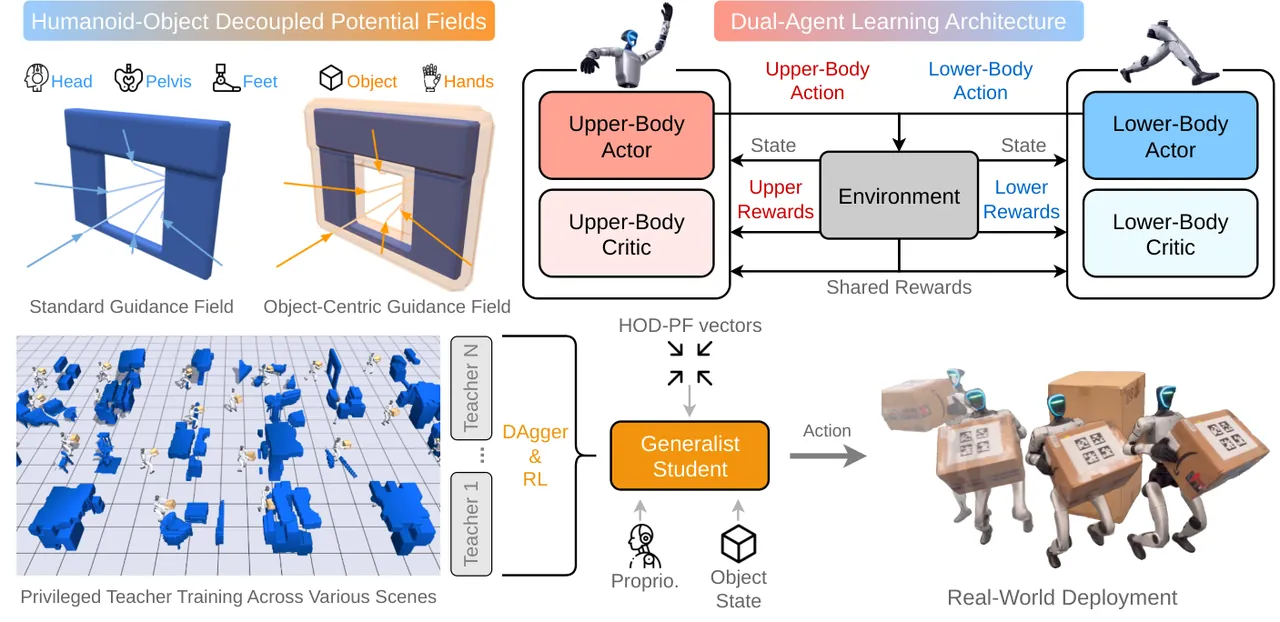
Figure 3: Method overview. Top left: the two decoupled guidance fields. Top right: the dual-agent architecture with shared observations and shared rewards. Bottom: teacher-student distillation into the deployed policy (paper Figure 2).
Experiments
With no prior method addressing this setting, the main comparison is self-ablation: SGF only (a naive application of HumanoidPF to all robot and object keypoints), single-agent with HOD-PF, and single-agent with SGF. All four methods train teachers for 400M timesteps on 20 scenes and distill them into students; box mass and size are randomized; evaluation injects input noises, delays, and perturbations; 20 scenes × 1,000 rollouts give 20,000 trials. Metrics are success rate (reach within 0.1 m of the target within 5 s without falling, dropping, or colliding) and mean distance to goal (mDist).
| Method | SR (%) ↑ | mDist (m) ↓ |
|---|---|---|
| Single-Agent & SGF | 58.7 | 0.296 |
| Single-Agent & HOD-PF | 65.7 | 0.267 |
| Dual-Agent & SGF | 77.1 | 0.195 |
| Dual-Agent & HOD-PF (HOTICE) | 88.5 | 0.130 |
Table 1: Simulation main results over 20,000 trials in 20 scenes (paper Table I).
Reading the grid contribution by contribution: adding OGF under a single agent lifts SR from 58.7 to 65.7 (+7.0); the dual-agent architecture with SGF alone already reaches 77.1 (+18.4 over single-agent SGF); only both together reach 88.5 (+11.4 over dual-agent SGF). mDist falls from 0.296 m to 0.130 m, a 56% reduction. Figure 4(A) shows the two failure modes side by side: Dual-Agent & SGF clips the obstacle with hand and box — right architecture, coupled field — while Single-Agent & HOD-PF loses balance and drops the box stepping over a ground bar — right field, fragile architecture. The contributions are complementary, not redundant.
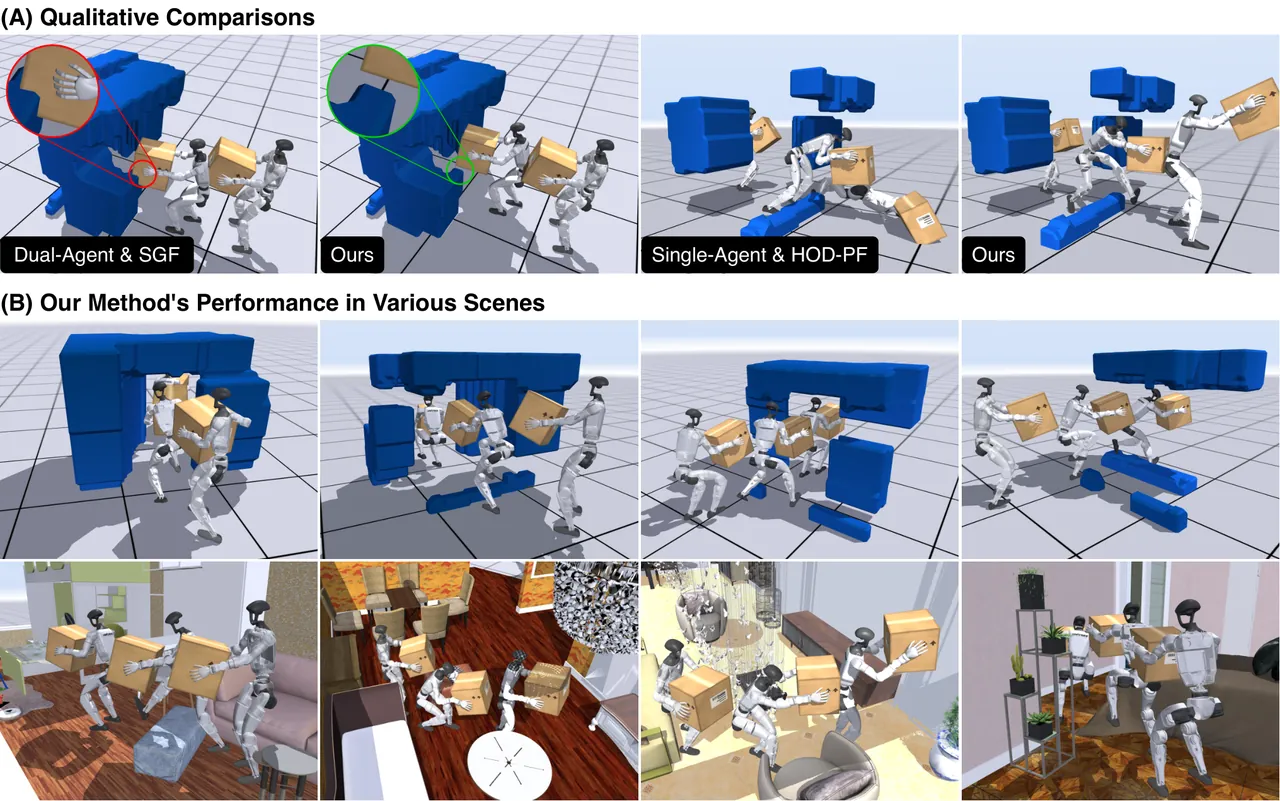
Figure 4: (A) Ablation comparisons — decoupled fields prevent hand/box clipping (left pair), the dual-agent architecture preserves balance over a ground bar (right pair). (B) Procedurally generated scenes (top) and realistic 3D-FRONT interiors (bottom), all without scene-specific reward tuning (paper Figure 4).
The generalization study scales teachers to 75 scenes and evaluates the distilled generalist on 50 unseen environments. Scene similarity is measured in the method's own representation: SGF and OGF of an unseen scene and a training scene are discretized at $(0.04\,\mathrm{m})^{3}$ resolution, guidance vectors at corresponding positions are compared by cosine similarity averaged across both fields and all positions, and the maximum over training scenes defines the unseen scene's similarity. Success rate declines and mDist grows as scenes become more novel, but gracefully: 80.1% average SR (floor around 70%) and 0.270 m average mDist, with least-squares fit RMSE of 6.1 and 0.092 respectively.
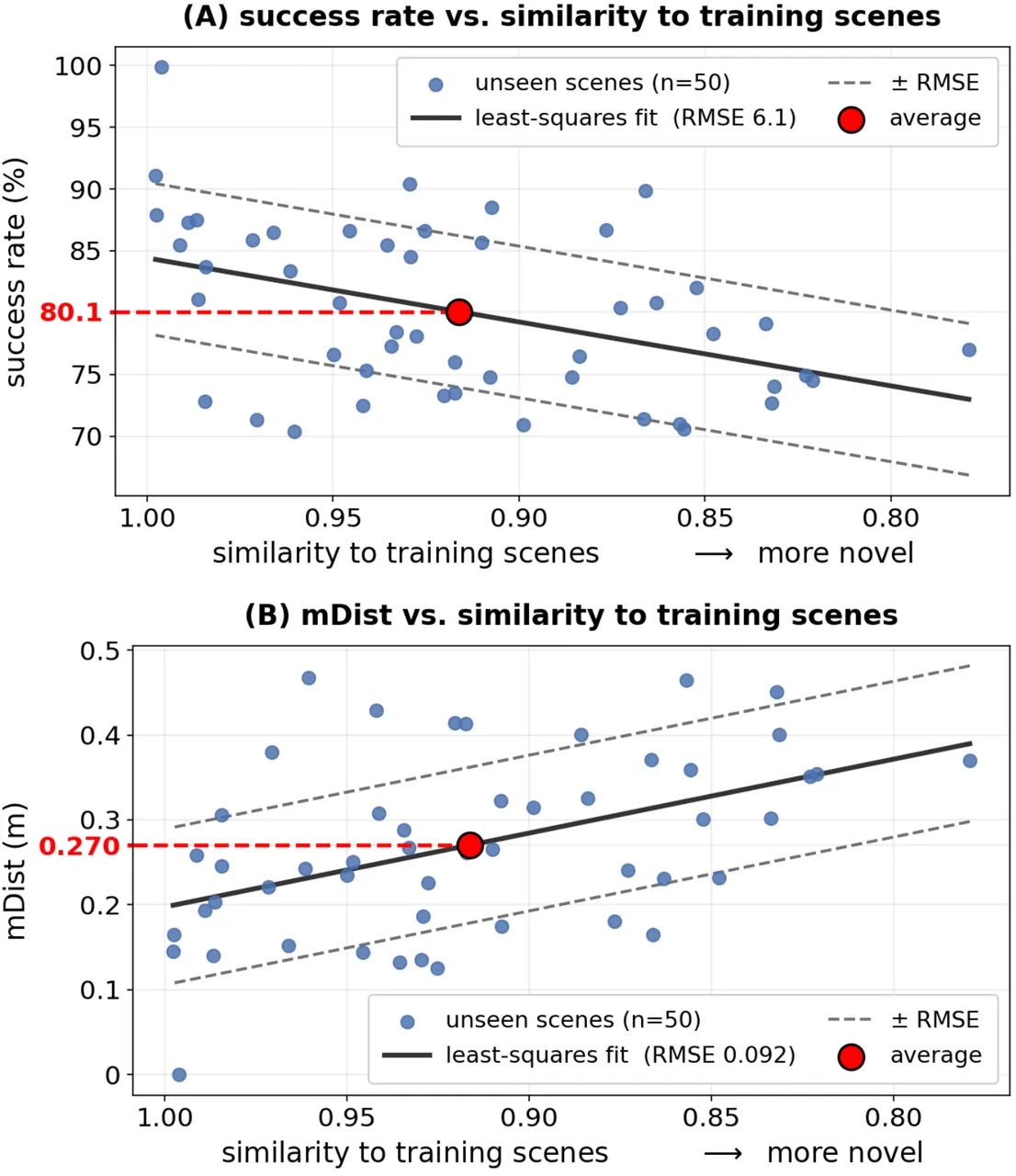
Figure 5: 50 unseen scenes. (A) success rate versus training-set similarity, mean 80.1%, fit RMSE 6.1; (B) mDist versus similarity, mean 0.270 m, fit RMSE 0.092 (paper Figure 5).
| Unseen-scene metric | Mean | Least-squares fit RMSE | Sample |
|---|---|---|---|
| Success rate (%) | 80.1 | 6.1 | 50 unseen scenes |
| mDist (m) | 0.270 | 0.092 | 50 unseen scenes |
Table 2: Generalist statistics on unseen scenes (read from paper Figure 5 annotations and text).
Shape results are almost suspiciously flat: cuboid 88.5 / 0.130, cylinder 86.7 / 0.127, sphere 87.2 / 0.131 — within 1.8 points on SR and identical to three decimals on mDist. That flatness is the design paying off: shape enters the policy only through where the eight keypoints sit, while observation layout, network, and action space remain untouched and only two minor reward terms adapt.
| Object shape | OGF keypoint placement | SR (%) ↑ | mDist (m) ↓ |
|---|---|---|---|
| Cuboid | 8 corners | 88.5 | 0.130 |
| Cylinder | 4 top-rim + 4 bottom-rim points | 86.7 | 0.127 |
| Sphere | 8 world-frame octant directions at radius | 87.2 | 0.131 |
Table 3: Shape-specific policies on the same 20 scenes; the cuboid row equals our method in Table 1 (paper Table II).
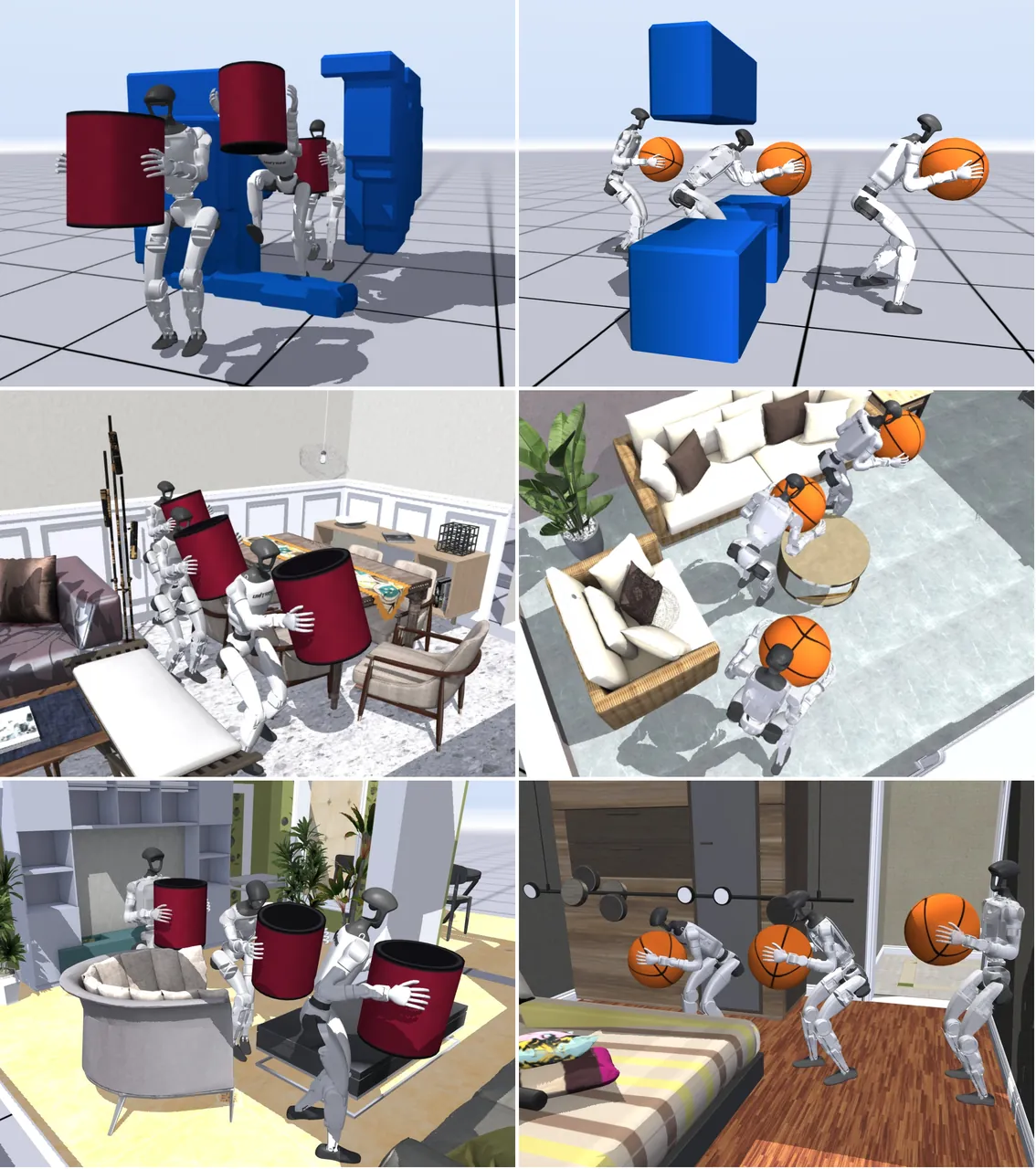
Figure 6: Cylinder (left) and sphere (right) transportation in procedural and realistic scenes with only minimal shape-specific reward tuning (paper Figure 6).
On the real Unitree G1, each method gets 6 trials per obstacle type; a shared pickup policy lifts the box first, then the transportation policy takes over, both at 50 Hz. HOTICE scores 6/6 on side, 5/6 on overhead, and 5/6 on ground obstacles — 16 of 18 — against 12/18 for the best baseline. Two details deserve attention. The ranking of components flips relative to simulation: Single-Agent & HOD-PF (11/18) loses to Dual-Agent & SGF (12/18), suggesting that on real hardware stability (the dual-agent contribution) is scarcer than field decoupling. And ground obstacles are hardest for everyone (worst case 1/6), because hurdling demands extreme single-leg support postures. Figure 7 makes all three stories visible: HOTICE threads a side pole, an office chair, and a ground tube; Dual-Agent & SGF collides with the side box; Single-Agent & HOD-PF catches the ground tube and falls.
| Method | Side | Overhead | Ground | Total |
|---|---|---|---|---|
| Single-Agent & SGF | 3/6 | 3/6 | 1/6 | 7/18 |
| Single-Agent & HOD-PF | 6/6 | 3/6 | 2/6 | 11/18 |
| Dual-Agent & SGF | 4/6 | 4/6 | 4/6 | 12/18 |
| Dual-Agent & HOD-PF (HOTICE) | 6/6 | 5/6 | 5/6 | 16/18 |
Table 4: Real-world results, 6 trials per obstacle type (paper Table III). With 6 trials per cell, one trial is worth 16.7 percentage points, so single-trial gaps are not statistically significant and the paper reports no confidence intervals.
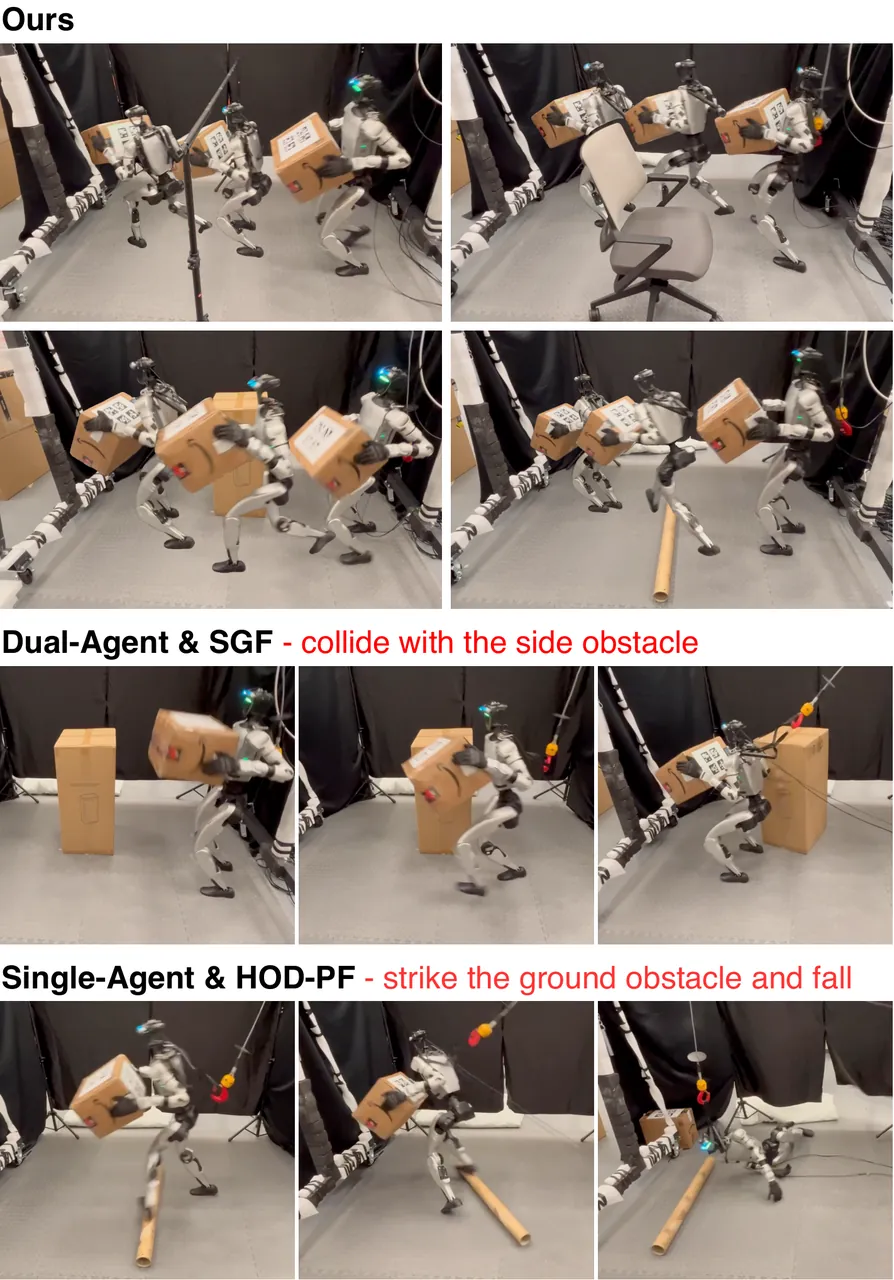
Figure 7: Real rollouts. Top: HOTICE clearing a side pole, an office chair, side boxes, and a ground tube. Middle: Dual-Agent & SGF colliding with the side obstacle. Bottom: Single-Agent & HOD-PF striking the ground obstacle and falling (paper Figure 7).
Limitations
The authors list four. Post-collision behavior is not modeled: a disturbance beyond the robot's recovery capacity ends in a fall. Richer carrying strategies — shouldering the object, tucking it against the hip — remain out of reach. Dynamic scenes with moving obstacles are untouched. And "acceptable" collisions plus active obstacle interaction — leaning on a wall to thread a tight gap, brushing a bean bag without penalty, kicking small obstacles aside with the feet, pushing a door with the back — are left as future work.
Three further judgments of my own. First, the perception loop is not closed: scenes must be pre-mapped by SLAM and the box must wear AprilTags for pose estimation, making this a localization-dependent system rather than a perception-complete one; the authors themselves note that live LiDAR reconstruction is blocked by the single-LiDAR field of view. Second, the generalization metric is circular by construction: unseen-scene similarity is defined in the method's own SGF/OGF representation, so "looks similar" and "encodable by the representation" are nearly the same statement; an external similarity measure would test the claim more honestly. Third, payload and grasp scope are narrow: 3.5 kg and a 40 cm cube cap with the object assumed already held leaves grasp synthesis, heavy loads, and off-center payloads out of scope, while field hyperparameters $d_{0}$, $\eta$, $\xi$ are inherited and the 8 cm margin is justified only by a balance argument, with no sweep reported.
Conclusion and Outlook
HOTICE answers "how should a humanoid carry things through clutter" in three layers: encode geometry as two decoupled potential fields so robot and object each get a map; split control into dual agents with separate reward streams kept coupled by shared observations and shared rewards; and consolidate experience by distilling 75 scene specialists into one deployable generalist. The numbers back each layer: 88.5% / 0.130 m over 20,000 simulated trials, 80.1% / 0.270 m on 50 unseen scenes, and 16 of 18 real trials.
The open directions are equally legible: post-collision recovery, dynamic obstacles, acceptable contact and active obstacle interaction, richer carrying postures, and a perception loop free of AprilTags and pre-mapping. For humanoids heading into warehouses and homes, "carrying something through a doorway" is a more frequent daily act than empty-handed parkour — HOTICE turns that daily act into a trainable, distillable, deployable control problem for the first time.
Golden Line
The robot may lift its feet only at the last instant before a bar, but the box in its arms must start yielding half a meter early — HOTICE writes that time difference into two potential fields, and lets the hands claim credit only for the residual adjustment that is truly theirs.
SOURCE LINKS