Skip to content
← Tags

#Video Generation (92)

Video GenerationMediaTopA

Gemini Omni: moving the unit of video delivery from one attempt to a conversational editing process

Google DeepMind's video and multimodal generation model, officially create anything from any input, starting with video: it edits video through step-by-step conversation, each edit building on the last and keeping the scene coherent, raising the unit of delivery from one shot to footage you can keep revising; the other two surfaces are real-world knowledge and arbitrary reference composition. Read the level with its votes: on the Artificial Analysis arena (2026-09-22) gemini-omni-1.1-flash is #1 for text-to-video at Elo 1516 with only 1,784 votes and a ±15 CI, while #2 is the sibling at 1513 with 26,576 votes and ±9, a 3-point gap far smaller than either CI, so statistically indistinguishable: the honest statement is that the Omni family ties for the top. For image-to-video minimax-h3 leads (1495, 57,112 votes) with Omni #2 at 1488 on 3,734 votes. Pricing: $1.50 per million input tokens, $9.00 text and $17.50 video output, 720p about $0.10 per second and a 30-second clip roughly $3. GA to paid-tier developers, none on the free tier. Closed, not self-hostable, not fine-tunable. Graded A (confirmed), the first A-grade video asset; A means the reading is credible and checkable, not undisputed first place.
1516Arena T2V Elo (1,784 votes)Confirmed · 2026-09
ProductGoogle DeepMindSite
Gemini Omni: moving the unit of video delivery from one attempt to a conversational editing process
Video GenerationMediaTopC

Seedance 2.5: raising the unit of video delivery from one shot to a 30-second story beat

ByteDance Seed line for video generation. The 1.x tiers were silent short clips from text or image; from 2.0 the architecture is a unified multimodal audio-video joint generator taking text, image, audio and video as inputs; 2.5 raises the unit of delivery to a 30-second story beat with two further extensions, white-model control, green-screen editing, professional camera work and performance direction. Its third-party reading is the strongest part: on the Artificial Analysis arena (2026-09-22), dreamina-seedance-2.5-720p is #4 for image-to-video (Elo 1477), with 2.0 #5 (1479) and 2.5 #7 (1474) for text-to-video. Closed, reachable only through Dreamina / Volcano Engine / BytePlus, no self-hosting or fine-tuning; SeedVideoBench-2.0 is internal and cannot be reproduced. Not independently benchmarked; graded C (vendor-stated).

30sNarrative duration per generationVendor Claim · 2026-09
ProductByteDance SeedSite
Seedance 2.5: raising the unit of video delivery from one shot to a 30-second story beat
Video GenerationMediaTopC

Wan: the open-weights baseline on the video side, letting the whole ecosystem iterate on its own hardware

Alibaba Tongyi's Wan releases video generation weights under Apache-2.0, making it the most important public baseline in the video domain. Its value differs from a closed service: not "best-looking output today" but that it is fine-tunable, reproducible and runnable on your own inference stack - the whole ecosystem of LoRAs, ControlNet-style conditioning, quantisation and few-step distillation builds on it. For an intelligence site, an open-weights baseline means the question "what can video generation do today" finally has a reference can be verified directly instead of trusting vendor-selected samples. The licence and the public repository, verified; picture quality and physical plausibility remain C-grade vendor claims.

Apache-2.0Open-weight licenceVendor Claim · 2025-07
ProductAlibaba TongyiSiteRepo
Wan: the open-weights baseline on the video side, letting the whole ecosystem iterate on its own hardware
Video GenerationMediaTopC

Kling 3.0 series: native audio, 4K frames, and parameterised camera language as the moat

Kuaishou Kling was among the first Chinese video lines to reach a level where it can take commercial work, and its lasting strength is not raw text-to-video but image-to-video plus camera control: lock composition and character in the image stage, then let the video model interpolate from that fixed keyframe, with first/last-frame constraints and push/pull/pan/truck/orbit/follow parameters producing predictable clips. The 3.0 series (official release-note banner: API fully available) brings three substantive jumps - audio generated natively (5s/10s/12s audio tiers), native 2K/4K for both image and video, and storyboarding plus element reference turning multi-shot coherence from an editing problem into something the model controls; the line-up is 3.0 / 3.0 Omni / 3.0 Turbo, Kling Image 3.0 and -omni, Native 4K Video and Motion Control. The arena reading, stated plainly: image-to-video kling-v3-pro is #19 (Elo 1354), behind MiniMax h3, gemini-omni, wan3.0 and seedance-2.5. No authoritative release date for the 3.0 series could be obtained, so the metric date is recorded only at the verifiable month, 2026-09. Closed, vendor API only; not independently benchmarked, graded C.

3.0 / Omni / TurboCurrent flagship seriesVendor Claim · 2026-09
ProductKuaishouSite
Kling 3.0 series: native audio, 4K frames, and parameterised camera language as the moat
RynnUnify: Towards Unified Embodied Brain

RynnUnify: Towards Unified Embodied Brain

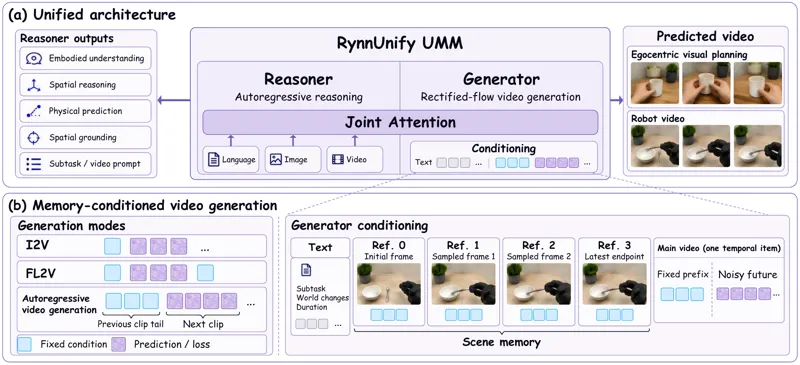
We introduce RynnUnify, a 16B unified embodied model that combines strong embodied understanding with long-horizon visual planning through interleaved video–language reasoning. With capabilities spanning spatial reasoning, physical prediction, and grounding, RynnUnify connects an understanding of the physical world with visual anticipation of how it evolves across successive subtasks. Building on these capabilities, we further develop an agentic extension through reinforcement learning to selectively use video predictions for reasoning about unobserved states and interaction outcomes. We also develop a world-action extension of the full RynnUnify model, translating its understanding and prediction capabilities into robot control. To evaluate these capabilities, we introduce Rynn-VP and Rynn-GEU for long-horizon visual planning and anticipatory reasoning. Experiments show that RynnUnify achieves the highest average embodied understanding score among the evaluated unified multimodal models and improves the Rynn-VP overall score by 9.75 points over Cosmos 3 Nano. Its agentic extension improves the Rynn-GEU average by 6.0 points over direct reasoning, while the world-action extension achieves 51.5% success on 20 selected composite RoboCasa365 tasks and 46.7% average success across three real-robot tasks. Together, these results establish RynnUnify as a shared foundation for embodied understanding, visual planning, and robot control, taking a step toward a unified embodied brain.

Minghao Zhu, Bohan Hou, Kun Xiang · 250 views · Oct 23, 2026
RynnUnifyEmbodied AI
Oct 23, 2026

As an Amazon Associate, we earn from qualifying purchases.