Skip to content
← Tags

#Robot Learning (77)

KlaskTron: An Open-Source Platform for Physical Adversarial Multi-Agent RL

KlaskTron: An Open-Source Platform for Physical Adversarial Multi-Agent RL

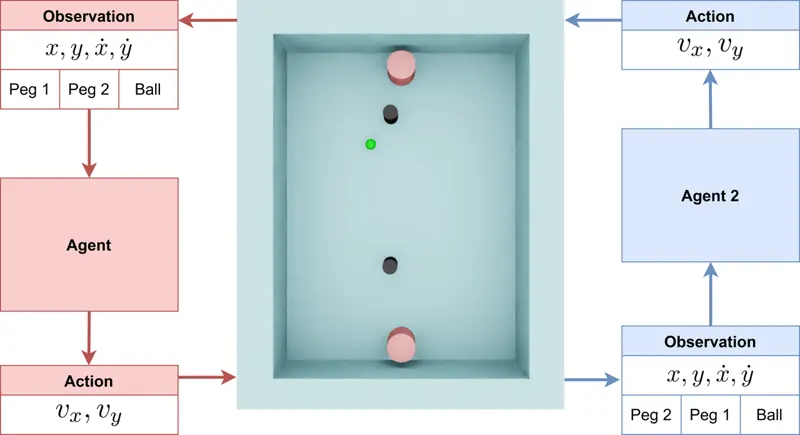
Progress in robot learning, particularly physical multi-agent reinforcement learning (MARL), is currently challenged by a limited availability of accessible, standardized benchmarks. While simulation-based MARL has produced remarkable emergent behaviors, from coordinated team play to complex tool use, translating these advances to physical systems remains difficult. A key barrier is infrastructural: physical platforms are often prohibitively expensive, require specialized facilities, or lack open mechanisms and designs for reproducibility. We introduce KlaskTron, an open-source, low-cost (<$2500 USD), desktop-scale robotic testbed for adversarial MARL based on the dynamic tabletop game KLASK. The platform features dual CoreXY gantries with high-torque brushless motors, enabling the high-speed, precise manipulation required for competitive play. Crucially, we provide a complete ecosystem: hardware designs (CAD, BOM), a GPU-native digital twin in NVIDIA Isaac Lab for high-fidelity modeling and simulation, and a validated sim-to-real baseline using a learned neural actuator model. We demonstrate that this baseline enables zero-shot policy transfer, with trained agents exhibiting emergent adversarial behaviors. To ensure full reproducibility of our results, all project assets are released publicly: hardware CAD/BOM and assembly documentation at [https://idscethzurich.github.io/klask_hardware], inference software stack at [https://github.com/IDSCETHZurich/klask_software] and the simulation and MARL setup at [https://github.com/IDSCETHZurich/klask_rl].
Aswin Ramachandran, Jona Schulz, Maurus Derungs · 28 views · Nov 2, 2026
Physical Multi-Agent RLRobot Learning
Nov 2, 2026
D&A: Decoupling Description and Assessment Enables VLMs as Zero-Shot Robotic Reward Models

D&A: Decoupling Description and Assessment Enables VLMs as Zero-Shot Robotic Reward Models

Vision-Language Models (VLMs) hold promise for zero-shot video task-progress estimation in robot learning, yet existing frameworks frequently suffer from confirmation bias, hallucinating progress in failed executions due to implicit success assumptions or relative temporal ranking designs. Naive prompting of frontier models collapses into a binary success detector that fails to capture nuanced, non-linear progress and failures. While post-training approaches can mitigate this through explicit training, they demand expensive real-world robotics data and require computationally intensive post-training for every individual base model. To resolve these limitations, we introduce D&A (Describe & Assess): our approach decouples progress estimation into an objective, task-grounded textual description of scene dynamics followed by an assessment phase using explicit rubrics. By compelling the VLM to synthesize an explicit, text-based definition of absolute success before scoring, the framework anchors evaluations to an external, global criterion rather than the video's internal timeline. Empirical results demonstrate that our method calibrates zero-shot estimates and mitigates confirmation bias, providing fine-grained, partial progress metrics that accurately penalize failed executions while correctly interpolating successful runs. Being purely prompt-based, D&A generalizes across tasks, embodiments, and benchmarks—matching or surpassing post-trained reward models—and its reward estimates enable efficient downstream reinforcement learning.

Marius Memmel, Shawn Yin, Urvi Rutia · 40 views · Nov 2, 2026
VLMRobot Reward Modeling
Nov 2, 2026
Real2Sem2Real: 3D Semantic Augmentations for Robot Learning from a Single Human RGB Demonstration

Real2Sem2Real: 3D Semantic Augmentations for Robot Learning from a Single Human RGB Demonstration

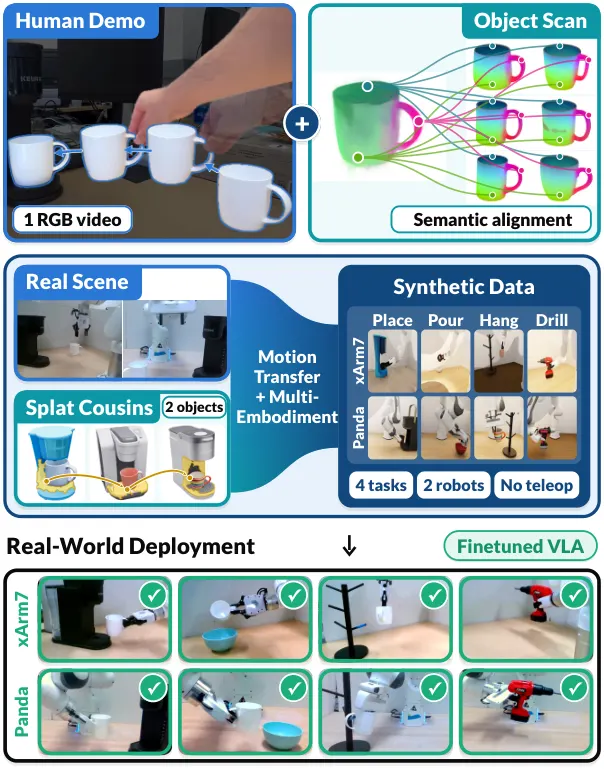
Human video scales easily and does not need robot hardware, but existing methods require depth sensing, overlay the robot onto 2D video, or generate data only for the demonstrated objects. We present Real2Sem2Real (R2Sem2R), a real-to-semantic-to-real pipeline that turns one monocular RGB video of a human demonstration into thousands of robot demonstrations across the semantic object instances of a category. R2Sem2R tracks the SE(3) pose of each object with DINOv3-distilled Gaussian splats, outperforming existing methods and FoundationPose with estimated metric depth. R2Sem2R then aligns digital cousins, each generated from one or a few photographs, to the demonstrated objects with a semantic alignment. This alignment matches whole objects and the functional regions of target objects, such as a coffee machine's tray. R2Sem2R maps the human hand to a feasible robot grasp that extends to the cousins. Robot demonstrations are generated either in IsaacSim, for photorealistic rendering, or MuJoCo, for contact physics, and R2Sem2R can generate over 2,000 episodes in about two hours. On two real robots and four tasks, we train a vision-language-action policy on data from one human video per task, and policies trained on our data match or exceed policies trained on teleoperation across diverse object instances. The project page is available at https://real2sem2real.github.io/.

Matthew Strong, Ankush K. Dhawan, Julien Poffet · 51 views · Oct 20, 2026
Robot LearningHuman demonstrations
Oct 20, 2026
CanonNav: Disentangling Navigation Behavior from Camera Geometry in Cross-Platform Visual Navigation

CanonNav: Disentangling Navigation Behavior from Camera Geometry in Cross-Platform Visual Navigation

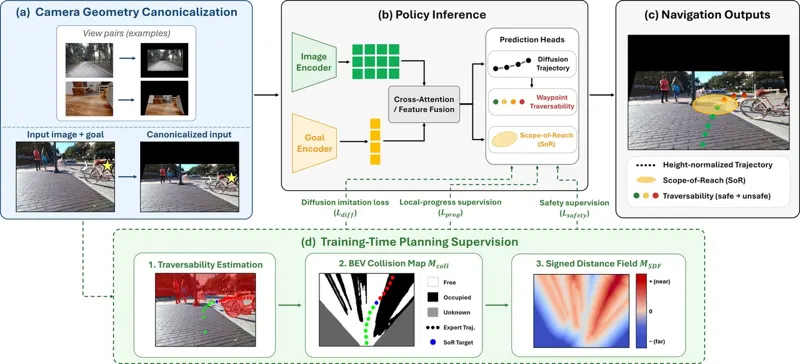
While visual navigation has advanced through imitation learning from cross-platform demonstrations, fully leveraging such data remains challenging. First, directly learning from image-trajectory pairs entangles navigation behavior with platform-dependent camera geometry. This hinders consistent learning by forcing the policy to implicitly infer camera geometry from visual observations, an inherently ill-posed problem. Second, imitation learning from demonstrated trajectories captures the expert's chosen motion but leaves the intermediate decisions underlying that motion implicit. To address these issues, we propose CanonNav, a visual navigation framework that disentangles navigation behavior from camera geometry and incorporates complementary planning supervision into learning from cross-platform demonstrations. CanonNav introduces camera geometry canonicalization, which transforms visual observations and trajectories into a camera-consistent representation space. Building on this representation, we derive safety and local-progress supervision using pseudo-labels from an offline traversability estimator. Safety supervision penalizes unsafe trajectories, while local-progress supervision guides where the robot should advance. Experiments across diverse camera configurations and environments show that, despite using only RGB at inference, CanonNav consistently outperforms RGB-based baselines and even surpasses RGB-D-based methods in challenging scenarios.

Dong-Wook Kim, Ji-Hoon Hwang, E-In Son · 186 views · Aug 31, 2026
Visual navigationCross-Platform
Aug 31, 2026

As an Amazon Associate, we earn from qualifying purchases.