Skip to content
← Tags

#Quadrotor (5)

RAVEN: A Unified Active SLAM System for Rapid Autonomous Visual Exploration with Aerial Robots under Localization Uncertainty

RAVEN: A Unified Active SLAM System for Rapid Autonomous Visual Exploration with Aerial Robots under Localization Uncertainty

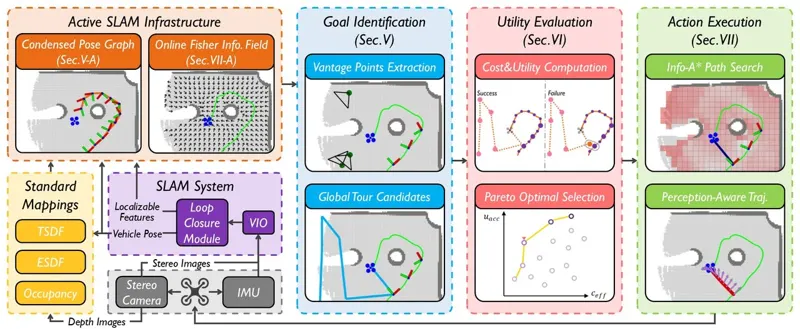
Active simultaneous localization and mapping (SLAM) addresses the problem of planning robot motion to build complete and accurate maps of unknown environments through efficient exploration while maintaining high localization accuracy. This raises a dilemma between exploring unknown spaces to expand coverage and exploiting visited regions to perform active loop closures. Despite numerous prior works on ground robots, aerial robots with high agility and constrained sensor suites face more significant localization drift and thereby demand dedicated active SLAM planning. Moreover, a unified strategy that adapts performance based on task-specific priorities remains an open question. In this article, we introduce RAVEN, a unified active SLAM framework for Rapid Autonomous Visual ExploratioN using quadrotors, which systematically accounts for localization uncertainty. The framework starts with identifying frontiers and active loop closure candidates, from which global tour candidates are generated. These candidates are evaluated using a utility vector that separately quantifies exploration efficiency and localization accuracy, and the final tour is selected according to a prioritization parameter ranging from [0,1]. Finally, a perception-aware navigation planner generates smooth execution trajectories that minimize visual state estimation error based on the online Fisher information field that provides visual localization information in real-time. Benchmark evaluations demonstrate that RAVEN outperforms state-of-the-art active SLAM methods, highlighting its advantages in producing a spectrum of performance across prioritizations. Fully onboard field experiments with a customized stereo-inertial quadrotor further validate its practical applicability in challenging environments. The source code will be released to benefit the community.
Xinyi Chen, Yichen Zhang, Chenxing Jiang · 7 views · Oct 27, 2026
Aerial RoboticsActive SLAM
Oct 27, 2026
Safe Interval Motion Planning for Quadrotors in Dynamic Environments

Safe Interval Motion Planning for Quadrotors in Dynamic Environments

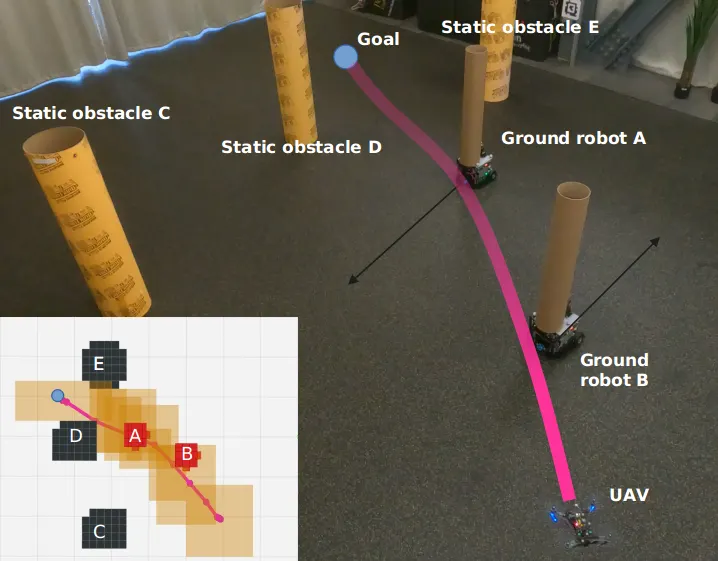
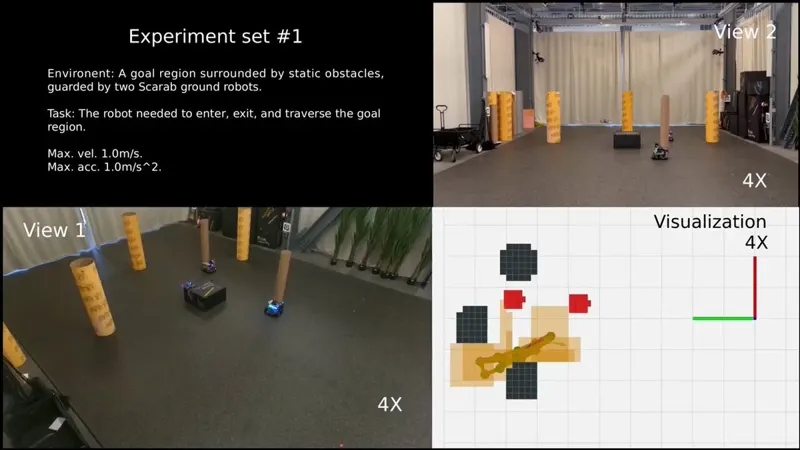
Trajectory generation in dynamic environments presents a significant challenge for quadrotors, particularly due to the non-convexity in the spatial-temporal domain. Many existing methods either assume simplified static environments or struggle to produce optimal solutions in real-time. In this work, we propose an efficient safe interval motion planning framework for navigation in dynamic environments. A safe interval refers to a time window during which a specific configuration is safe. Our approach addresses trajectory generation through a two-stage process: a front-end graph search step followed by a back-end gradient-based optimization. We ensure completeness and optimality by constructing a dynamic connected visibility graph and incorporating low-order dynamic bounds within safe intervals and temporal corridors. To avoid local minima, we propose a Uniform Temporal Visibility Deformation (UTVD) for the complete evaluation of spatial-temporal topological equivalence. We represent trajectories with B-Spline curves and apply gradient-based optimization to navigate around static and moving obstacles within spatial-temporal corridors. Through simulation and real-world experiments, we show that our method can achieve a success rate of over 95% in environments with different density levels, exceeding the performance of other approaches, demonstrating its potential for practical deployment in highly dynamic environments.

Songhao Huang, Yuwei Wu, Yuezhan Tao · 226 views · Sep 16, 2024
QuadrotorMotion Planning
Sep 16, 2024
AeroAct: Action-Centered World-Action Models for Language-Conditioned Quadrotor Flight

AeroAct: Action-Centered World-Action Models for Language-Conditioned Quadrotor Flight

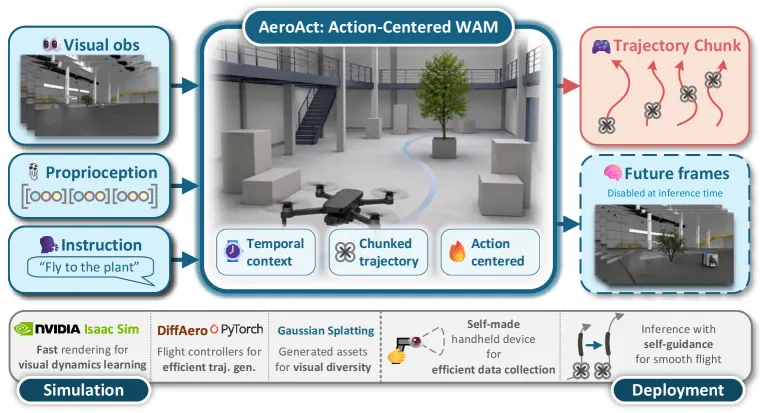
Language-conditioned quadrotor flight requires a policy to ground semantic goals, anticipate the visual consequences of ego-motion, and output control references that remain smooth and dynamically executable under rapidly changing first-person views. Existing aerial vision-language navigation and vision-language-action methods commonly use discrete actions, high-level waypoints, or instantaneous velocity commands, which provide limited supervision about how flight actions change future observations. We present AeroAct, an action-centered world-action model (WAM) for quadrotor navigation. To the best of our knowledge, AeroAct is the first WAM instantiated and demonstrated for real-world aerial flight. The model adapts a pretrained video diffusion Transformer to predict local trajectory-action chunks from egocentric visual history, proprioception, and language. Future first-person frames are used during training as dense consequence supervision, while deployment directly decodes actions without generating future video. To obtain aligned visual, state, language, and dynamically feasible action data, we build a DiffAero-based pipeline with complementary Isaac Lab and 3D Gaussian splatting renderers. We further introduce a low-cost handheld collection device that couples camera observations with motion estimates to recreate flight-like egocentric trajectories, and a self-guidance procedure that improves temporal consistency across overlapping trajectory chunks. Closed-loop simulation and real-world experiments show that temporal visual context improves target tracking and object-search performance, and that WAM-based policies can be executed on a physical quadrotor.

Xinhong Zhang, Qiyuan Zhu, Yubo Huang · 681 views · Jul 16, 2026
UAVQuadrotor
Jul 16, 2026

As an Amazon Associate, we earn from qualifying purchases.