Temporal cascading of planning and control in one quadrotor MPC: high-fidelity control nearby, point-mass planning far ahead, up to 75% lower closed-loop cost
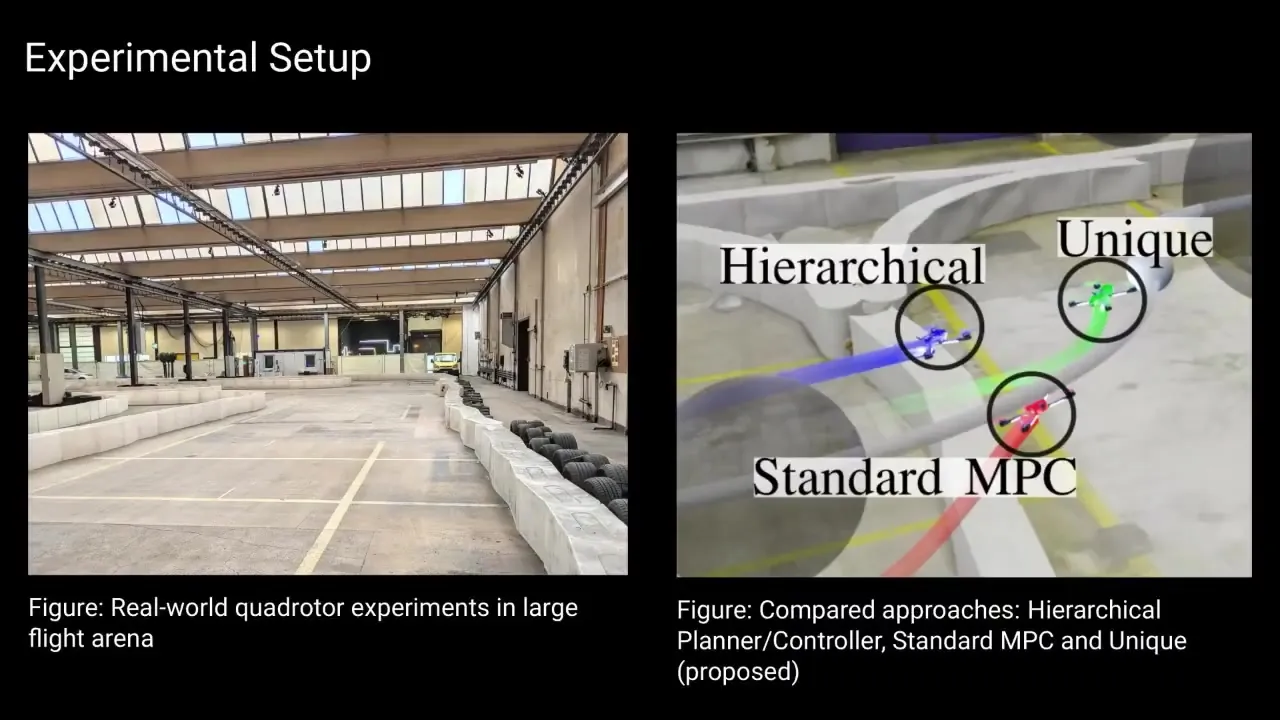
A University of Zurich team (Rudolf Reiter, Chao Qin, Leonard Bauersfeld et al.; IEEE T-RO paper, arXiv:2512.12427) introduces temporal cascading for quadrotor MPC: instead of separating planning and control (a simplified model plans a long-horizon trajectory for a high-fidelity controller to track), both live in one MPC optimization — a high-fidelity quadrotor model controls the near future while a computationally cheap point-mass model plans the long horizon. The two horizons are not merely stacked but coupled through transition and feasibility constraints, so what the simplified model plans remains executable by the real quadrotor; parallel low-fidelity planners and progressive obstacle smoothing escape local minima in cluttered environments without slowing the real-time loop. Result: long-horizon planning with iteration times below 5 ms, and in simulation and real-world flights up to 75% lower closed-loop cost than standard MPC and conventional hierarchical planner-controller stacks under comparable compute. Narrated video: youtu.be/CefIqpld9N8.