NSL-SLAM: High-Fidelity Neural Structured-Light Depth for Practical SLAM and Reconstruction
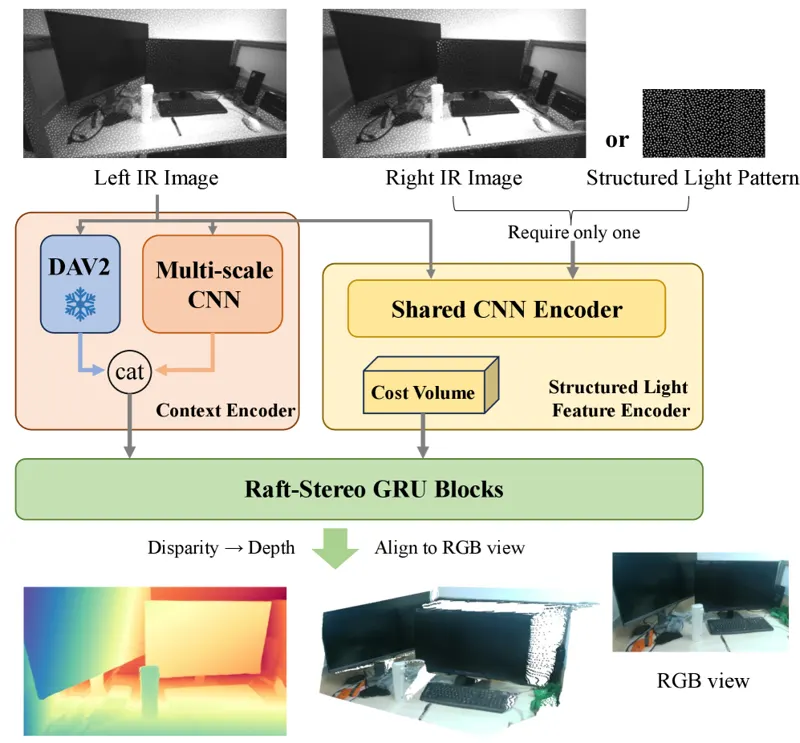
Structured-light (SL) cameras power depth sensing in millions of devices, and recent neural SL decoding methods have substantially improved their depth quality. SLAM systems can benefit greatly from such strong depth sensing, where reliable geometry enables stable tracking and faithful reconstruction. In this work, we present NSL-SLAM, a practical SLAM system tailored for high-fidelity structured-light depth. We first strengthen SL depth sensing: inspired by the neural structured-light (NSL) method, we further incorporate strong monocular depth priors into the SL stereo decoding, reducing depth RMSE by 35% on Replica-SL compared to NSL. We then build a depth-centric SLAM pipeline with this stronger depth: because structured-light geometry is dense and metrically accurate, we keep it as the primary tracking signal, and add only sparse visual correspondences for geometrically degenerate cases and lightweight bundle adjustment for long-range drift. Our depth estimator and SLAM design reinforce each other: stronger depth makes a simple SLAM pipeline effective, and the depth-centric pipeline ensures this advantage transfers to downstream reconstruction. Experimentally, on the synthetic Replica-SL benchmark, NSL-SLAM achieves the best tracking accuracy and improves reconstruction F-score by 1.6 points over the SOTA baseline under a shared-depth protocol. On a real benchmark of 8 challenging scenes, it is the only method that avoids catastrophic failure on all sequences while achieving 43.3% lower trajectory deviation than selected baselines. The SLAM system runs online at 20.9 FPS, demonstrating that stronger structured-light depth and depth-centric system design together enable practical, robust SLAM.
Jiaheng Li, Binsheng Zhang, Xinhai Chang·Jul 27, 2026
SLAMStructured Light DepthNeural Depth EstimationJul 27, 2026
 0:27
0:27