Skip to content
Compliant GMT: Making General Motion Tracking Compliant via Residual Reference Adaptation

Compliant GMT: Making General Motion Tracking Compliant via Residual Reference Adaptation

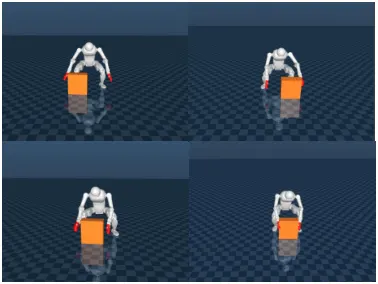
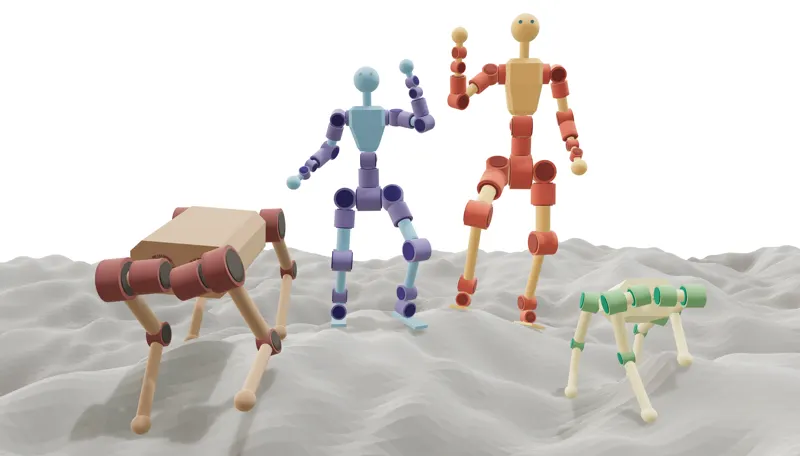
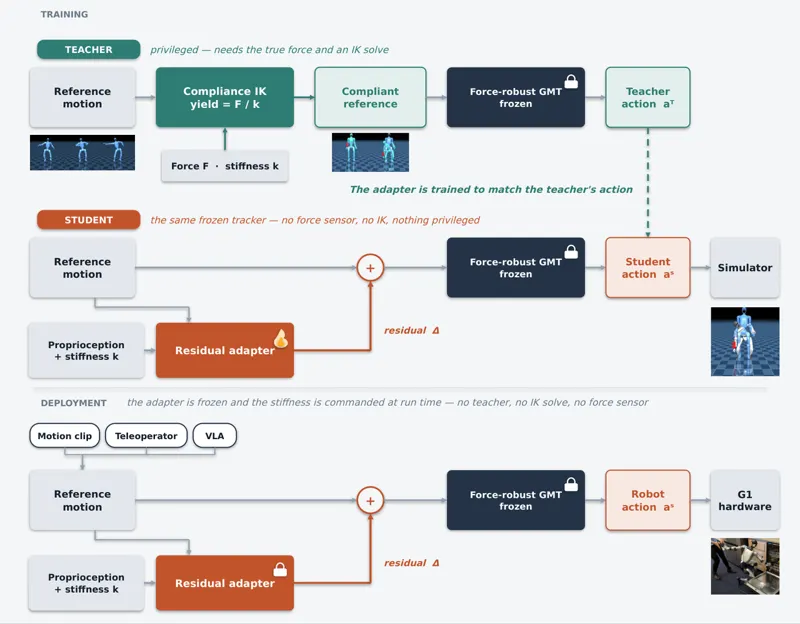
We propose Compliant GMT (C-GMT), a modular framework for full-body compliant responses in general motion tracking. As humanoid robots move into real world deployment, they not only need to perform any motion but also respond safely and robustly to interaction forces. Existing general motion tracking policies can imitate diverse motions but are trained to be stiff, leading to unexpected and unsafe behaviors under disturbance. Prior work in compliant humanoid control trades off compliance and generality. There exist examples of full-body compliant responses, but these are heavily curated to single-reference policies. On the other hand, general motion trackers (GMT) are trained to rigidly imitate massive motion capture datasets. Our key insight is to leverage the generality of pretrained GMTs for motion tracking while introducing compliance from a residual adapter that conditions on a history of proprioception. This enables our approach, C-GMT, to achieve both general motion tracking and whole-body compliant responses. Compared to state-of-the-art general motion trackers and single-motion compliant policies, C-GMT demonstrates competitive performance in both motion tracking accuracy and compliance adherence. We further demonstrate improved safety, robustness, and error tolerance in simulation and real-world G1 experiments.

HumanoidMotion Tracking
Venki Parsuram, Michelle Wang, Jin-Hyuk Hong · 290 views · Oct 15, 2026
Humanoid Mobility via Attention-based Contacts

Humanoid Mobility via Attention-based Contacts

Humanoid mobility over complex terrain requires accurate foot placement and coordinated whole-body motion capable of robust adaptation. Reinforcement learning (RL) policies trained without motion references generalize well across terrains, yet eliciting effective whole-body coordination through reward design and exploration alone remains challenging. In contrast, reference-based methods yield natural motions but struggle to adapt beyond the predefined trajectories in their training data. We introduce a learning framework that bridges these two approaches by using motion data strictly as a training prior. An explicit, self-supervised, attention-based contact planner predicts future body-environment contacts, while a contact-conditioned tracker translates these plans into coordinated whole-body motion. Together, they establish contact as an interface between sensory observations and control actions. This abstraction allows the policy to internalize the contact-aware structure of locomotion rather than directly replicating kinematics. Consequently, a single policy can exploit data-driven motion priors for natural whole-body coordination while retaining the flexibility to discover environment-dependent behaviors through reinforcement learning. Building on the learned contact planner and tracker, a subsequent fine-tuning stage bootstraps their acquired capabilities to explore environment variations beyond those covered by the original motion data. Operating entirely from onboard observations without any reference inputs at deployment, this framework enables versatile humanoid mobility in challenging environments.

HumanoidLocomotion
Junzhe He, Kehan Wen, Chong Zhang · 429 views · Oct 22, 2026
DONIC: Generalist Dexterous Bimanual Tracking Control from Human Demonstrations

DONIC: Generalist Dexterous Bimanual Tracking Control from Human Demonstrations

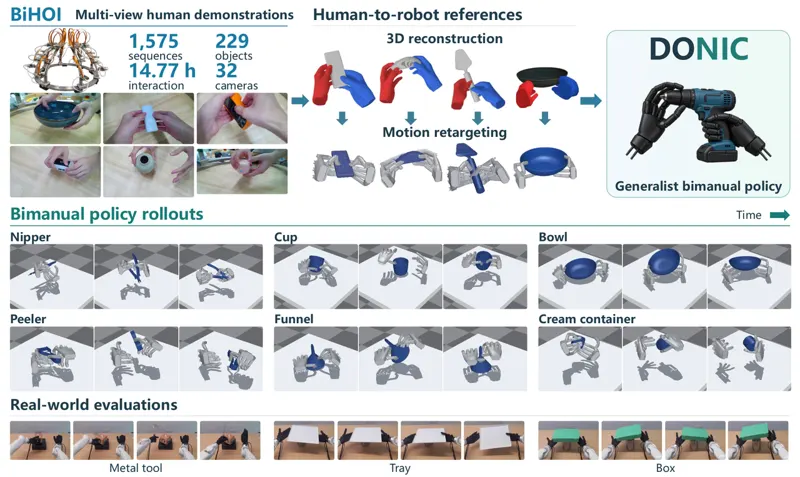
Despite recent progress in dexterous reference tracking, existing models focus primarily on single-hand manipulation and a limited range of interactions, leaving the bimanual dexterous behaviors common in real life unaddressed. The scarcity of contact-rich bimanual manipulation data and the increased complexity of coordinating contacts make developing a generalist bimanual tracker particularly challenging. Therefore, we present 1) DONIC, the first generalist bimanual tracker jointly trained across operation categories and human-motion sources, together with 2) BiHOI, a multi-view dataset of 1,575 sequences spanning 229 objects and emphasizing sustained bimanual interaction, where reconstructed interactions are retargeted into robot references. DONIC combines proximal policy optimization with behavioral cloning in a feedback loop that recycles verified successful executions into training demonstrations. An object-centered per-hand reward maintains object-motion feedback while supervising each hand according to its reference contact role. Clip-Centered Advantages remove reference-dependent advantage offsets while preserving within-trajectory differences. Together, these designs enable one single policy to learn coordinated manipulation across heterogeneous references. Without finetuning, a single checkpoint achieves 86.79% success on unseen trajectories of training objects and 57.32% on held-out objects, surpassing the state-of-the-art bimanual tracking baselines by 77.36 and 45.73 percentage points.

Dexterous ManipulationBimanual Manipulation
Mingze Sun, Ziang Cao, Yuan Fei · 241 views · Oct 21, 2026
SimpleVLN: Towards Simple and Frontier Vision-Language Navigation

SimpleVLN: Towards Simple and Frontier Vision-Language Navigation

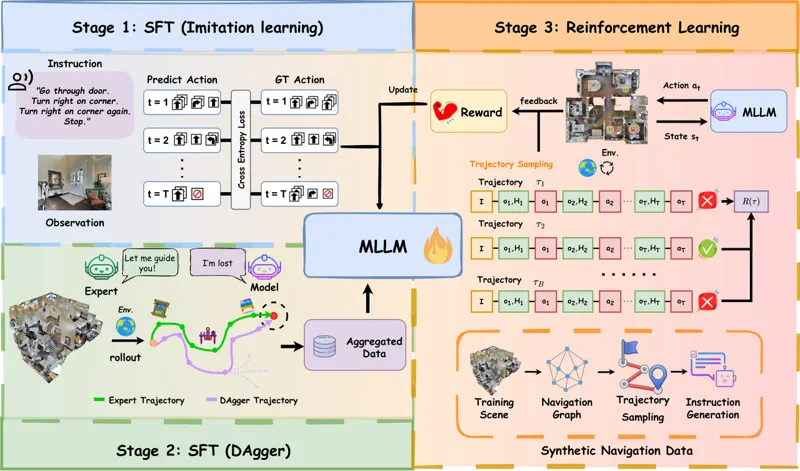
Vision-and-Language Navigation (VLN) requires embodied agents to ground language in visual observations and make long-horizon decisions. Existing methods often address these demands through task-specific architectures. As multimodal large language models (MLLMs) become increasingly capable, an important question remains: Have we truly unlocked the potential of native MLLMs for VLN before introducing task-specific architecture? We present SimpleVLN, an architecture-preserving framework developed through studies of navigation formulation, data construction, and optimization. At the formulation level, SimpleVLN combines single-turn decision inputs with fixed-budget global-local memory to efficiently use navigation history without unbounded context growth, while action chunks enable efficient output of multiple primitive actions per model invocation. For data construction, we combine expert demonstrations with policy-dependent DAgger experience and develop a scalable synthesis pipeline that generates large-scale tasks for reinforcement learning. At the optimization level, a progressive IL-DAgger-RL pipeline advances from action imitation to task-level outcome optimization. Comprehensive experiments validate the effectiveness of these three aspects. We instantiate SimpleVLN across multiple MLLM backbones and model sizes, demonstrating its generality. SimpleVLN achieves 76.7% and 80.1% success rates on the R2R-CE and RxR-CE splits, respectively, substantially outperforming existing methods. These results show that the navigation capabilities of native MLLMs can be effectively unlocked without task-specific architectural designs.

Vision-language navigationEmbodied AI
Lingyi Hong, Weiren Cai, Jiayu Chen · 315 views · Oct 16, 2026
Agent World Model in the Wild: Computer-Use Agent Environment Synthesis

Agent World Model in the Wild: Computer-Use Agent Environment Synthesis

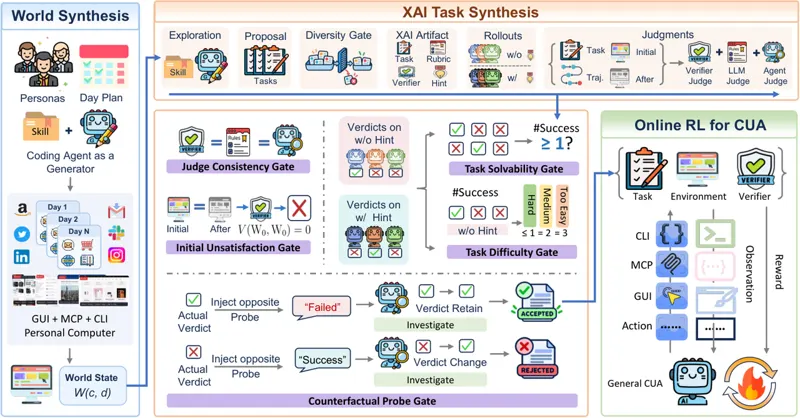
Agent learning is shifting from learning from human data toward learning through interaction with the world. However, scaling such learning directly in real-world computer systems is challenging and can introduce substantial security risks. We therefore propose Agent World Model in the Wild (WildAWM), a scalable pipeline for synthesizing controllable environments and tasks for training general computer-use agents (CUAs). Whereas existing approaches typically specialize in a single agent interaction interface, we construct executable environments that jointly support graphical user interfaces, model context protocol services, and command-line interfaces, allowing agents to flexibly combine visual interaction, tool use, and code execution. WildAWM is entirely powered by open-source models, demonstrating that high-quality computer-use environments can be generated without proprietary frontier models. Beyond environments, we address three recurring challenges in task synthesis: ensuring solvability, maintaining sufficient difficulty, and producing reliable verifiers, by introducing execution-based quality gates that combine heterogeneous agent rollouts, cross-judge consistency checks, and counterfactual probes of judgment robustness. The resulting pipeline synthesizes 341 long-horizon environment-task pairs that can require over 100 agent steps to solve and remain challenging even for frontier models, with GPT-6-Astra solving only 60% of them. We train two Qwen models of different sizes exclusively in these synthetic worlds. Both models achieve substantial gains across 8 out-of-distribution benchmarks spanning web, claw, and computer-use agents, demonstrating that learning in WildAWM's synthesized worlds generalizes broadly to unseen computer-use tasks. The code is publicly available at https://github.com/MSR-Orchard/WildAWM.

Computer-Use AgentWorld Models
Zhaoyang Wang, Qianhui Wu, Haorui Wang · 360 views · Oct 19, 2026
Perceptive Humanoid Parkour: Chaining Dynamic Human Skills via Motion Matching

Perceptive Humanoid Parkour: Chaining Dynamic Human Skills via Motion Matching

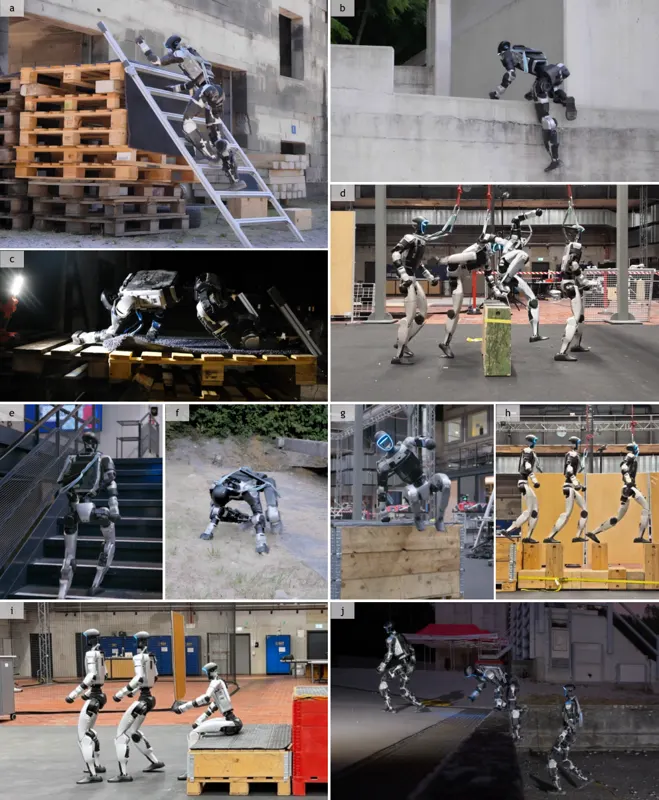
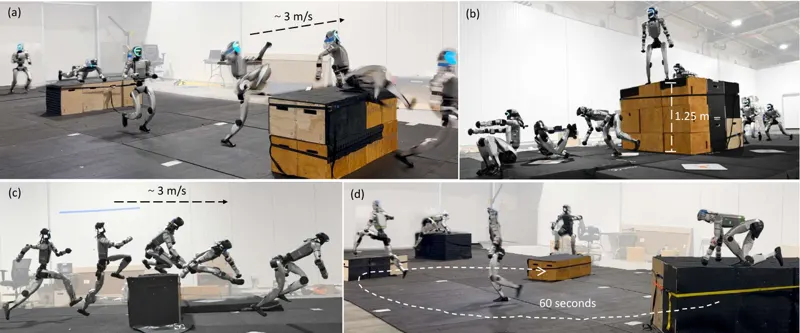
While recent advances in humanoid locomotion have achieved stable walking on varied terrains, capturing the agility and adaptivity of highly dynamic human motions remains an open challenge. In particular, agile parkour in complex environments demands not only low-level robustness, but also human-like motion expressiveness, long-horizon skill composition, and perception-driven decision-making. In this paper, we present Perceptive Humanoid Parkour (PHP), a modular framework that enables humanoid robots to autonomously perform long-horizon, vision-based parkour across challenging obstacle courses. Our approach first leverages motion matching, formulated as nearest-neighbor search in a feature space, to compose retargeted atomic human skills into long-horizon kinematic trajectories. This framework enables the flexible composition and smooth transition of complex skill chains while preserving the elegance and fluidity of dynamic human motions. Next, we train motion-tracking reinforcement learning (RL) expert policies for these composed motions, and distill them into a single depth-based, multi-skill student policy, using a combination of DAgger and RL. Crucially, the combination of perception and skill composition enables autonomous, context-aware decision-making: using only onboard depth sensing and a discrete 2D velocity command, the robot selects and executes whether to step over, climb onto, vault or roll off obstacles of varying geometries and heights. We validate our framework with extensive real-world experiments on a Unitree G1 humanoid robot, demonstrating highly dynamic parkour skills such as climbing tall obstacles up to 1.25m (96% robot height), as well as long-horizon multi-obstacle traversal with closed-loop adaptation to real-time obstacle perturbations.

HumanoidParkour
Zhen Wu, Xiaoyu Huang, Lujie Yang · 256 views · Feb 17, 2026
Blind Precise Assembly: Proprioceptive Sim-to-Real Peg-in-Hole for Diverse Parts

Blind Precise Assembly: Proprioceptive Sim-to-Real Peg-in-Hole for Diverse Parts

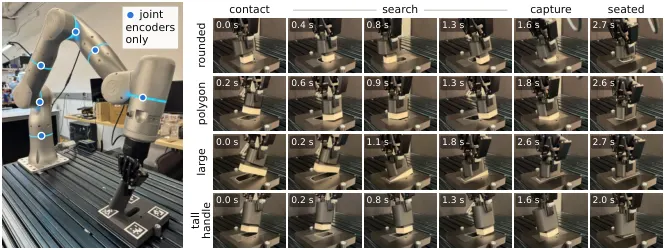
Every robot already carries high-resolution contact sensors: its own joints. Legged robots and humanoids exploit them to walk, run, and track whole-body motions without vision, but there the contacts are large and forceful. Is joint sensing also enough for precise, contact-rich assembly, where the robot must find a millimeter-scale opening, mesh gear teeth, or catch a thread through light contact? We study this question by training blind assembly policies that observe only a short history of joint positions, velocities, and their own actions, without visual, force, torque, or tactile sensing. The poses of both the fixture and the part are unknown to the policy, and the grasp is randomized substantially. The policy must therefore assemble the parts through contact, sensed exclusively through its own proprioception. Trained with reinforcement learning entirely in simulation over randomized parts, grasps, and contacts, such policies learn peg insertion, gear meshing, and nut threading. The peg insertion policy transfers zero-shot to the real world and inserts pegs of different shapes and sizes in 73% of trials. Controlled comparisons with matched visual policies in simulation show that blind policies generalize far better to unseen part shapes and sizes, though they can be slower. Training such policies needs thousands of different assemblies, each simulated with its clearance intact, so we also release an open-source generator that builds them procedurally from exact convex pieces for MuJoCo; it is more accurate and faster than convex decomposition or MuJoCo's signed-distance collision. Videos and interactive simulations are at https://younghyopark.me/blind-proprioceptive-assembly/.

Peg-in-HoleSim-to-Real
Antonia Bronars, Younghyo Park, Kushal Kedia · 374 views · Oct 16, 2026
Terminal-RSI: Recursive Self-Improving Terminal Agents via Recursive Self-Rewrite and Policy-Refine

Terminal-RSI: Recursive Self-Improving Terminal Agents via Recursive Self-Rewrite and Policy-Refine

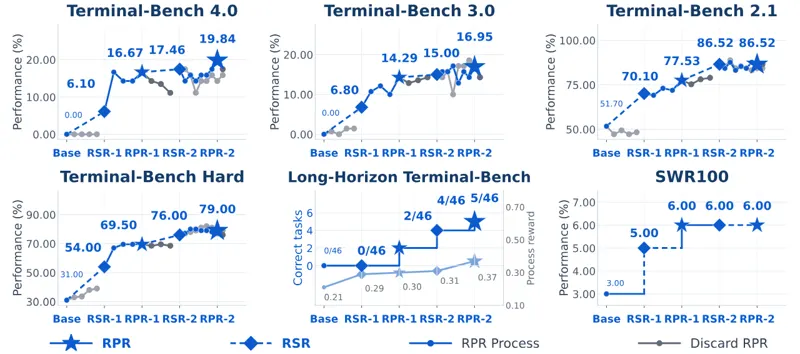
Converting verifier outcomes into useful policy updates and partial progress into complete task resolution is crucial for terminal agents. We present Terminal-RSI, which alternates Recursive Self-Rewrite (RSR) of verified trajectories with critic-inheriting Recursive Policy-Refine (RPR). We formulate Turn-Boundary Skip-Observation GAE (TB-GAE) to retain token-specific baselines while applying decay across interaction turns. Family Dense Reward (FDR) calibrates semantic progress across task families; Success-Prioritized Reward (SPR) separates strict success from bounded partial credit. A Warm-up Critic Model, recursive critic handoff, and stage-specific learning rates coordinate the two refinement phases. The five-stage sequence from Qwen3.8-27B base model through RSR-1, RPR-1, RSR-2, and RPR-2 yields Terminal-RSI-27B: 19.84% on Terminal-Bench 4.0, 86.52% on Terminal-Bench 2.1, 16.95% on Terminal-Bench 3.0, and 79.00% on Terminal-Bench Hard. On LHTB, process reward rises from 0.21 to 0.37 and strict completion from 0/46 to 5/46; SWR100 success doubles from 3.00% to 6.00%. By recursively coupling verified trajectory rewriting with critic-inheriting policy refinement, each retained stage consolidates discovered behaviors and progressively advances the agent from partial local repairs to strict terminal verification.

Terminal AgentReinforcement Learning
Junyao Yang, Zongxia Li, Yucheng Shi · 443 views · Oct 15, 2026

As an Amazon Associate, we earn from qualifying purchases.