Skip to content
Humanoid Mobility via Attention-based Contacts

Humanoid Mobility via Attention-based Contacts

Humanoid mobility over complex terrain requires accurate foot placement and coordinated whole-body motion capable of robust adaptation. Reinforcement learning (RL) policies trained without motion references generalize well across terrains, yet eliciting effective whole-body coordination through reward design and exploration alone remains challenging. In contrast, reference-based methods yield natural motions but struggle to adapt beyond the predefined trajectories in their training data. We introduce a learning framework that bridges these two approaches by using motion data strictly as a training prior. An explicit, self-supervised, attention-based contact planner predicts future body-environment contacts, while a contact-conditioned tracker translates these plans into coordinated whole-body motion. Together, they establish contact as an interface between sensory observations and control actions. This abstraction allows the policy to internalize the contact-aware structure of locomotion rather than directly replicating kinematics. Consequently, a single policy can exploit data-driven motion priors for natural whole-body coordination while retaining the flexibility to discover environment-dependent behaviors through reinforcement learning. Building on the learned contact planner and tracker, a subsequent fine-tuning stage bootstraps their acquired capabilities to explore environment variations beyond those covered by the original motion data. Operating entirely from onboard observations without any reference inputs at deployment, this framework enables versatile humanoid mobility in challenging environments.

HumanoidLocomotion
Junzhe He, Kehan Wen, Chong Zhang · 429 views · Oct 22, 2026
Action-Aligned Latent Planning for Versatile Humanoid Loco-Manipulation

Action-Aligned Latent Planning for Versatile Humanoid Loco-Manipulation

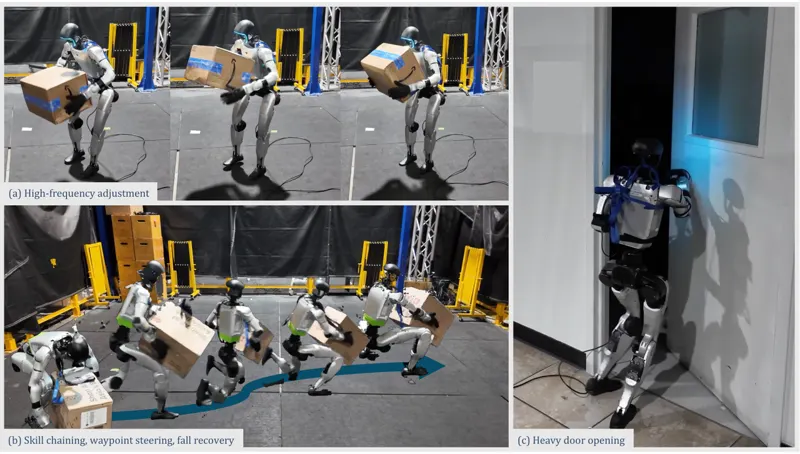
FIBER addresses a representation problem at the heart of versatile humanoid loco-manipulation: high-level planners need a compact abstraction, but kinematic or contact targets do not encode the state-dependent control responses that make contact-rich interaction succeed, while predicting low-level actions forces an offline planner to model high-frequency closed-loop feedback. FIBER resolves this by using the executable latent space of a frozen behavioral foundation model (BFM) as the shared planning representation. Its latent policy projection (LPP) maps each independently acquired task expert into that space by identifying latent commands whose BFM-induced actions match the expert's local control responses in physical joint-target space, regularized by a semantic term that anchors each command to the BFM backward representation of the same state. Because projection only requires the expert's actions, experts may differ in observations, objectives, and training pipelines, and are discarded once projected. Closed-loop latent rollouts from all projected skills are then aggregated to train a single perceptive flow-matching planner entirely offline, conditioned on egocentric depth, proprioception, and steering tokens derived from language or waypoints; at deployment it replans in a receding-horizon loop while the frozen BFM supplies 50 Hz state feedback. The paper further contributes AH-BFM, an adaptive-horizon BFM trained with multi-gamma forward-backward learning that keeps both short-horizon tracking fidelity and long-horizon behavioral coherence in one latent space, and successor-feature-guided behavior reuse, which composes an acquired interaction such as box carrying with native whole-body behaviors like crouching or running. In IsaacSim, across 128 variations per task, FIBER reaches 42.0% mean success versus 11.6% for projected latent replay and 3.5% for kinematic planning; on a real Unitree G1 it transfers zero-shot with 6/10 box pickup, 4/10 door opening, and 2/10 object grasping, running a 5 Hz TensorRT planner and the 50 Hz BFM on a single laptop GPU.

HumanoidMobile Manipulation
Yutang Lin, Guanya Shi, C. Karen Liu · 293 views · Oct 17, 2026
Perceptive Humanoid Parkour: Chaining Dynamic Human Skills via Motion Matching

Perceptive Humanoid Parkour: Chaining Dynamic Human Skills via Motion Matching

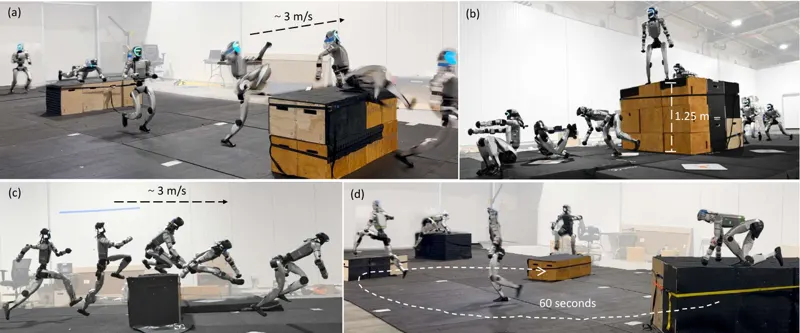
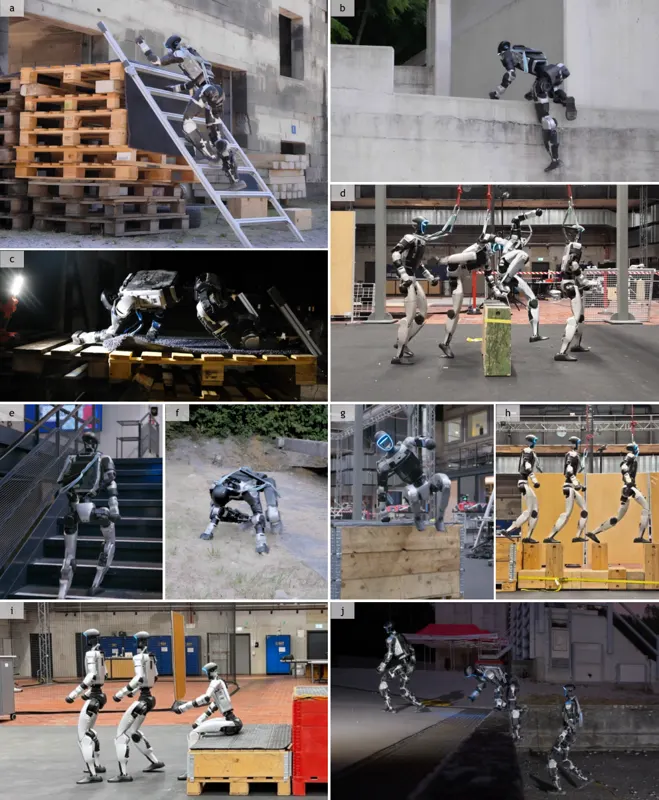
While recent advances in humanoid locomotion have achieved stable walking on varied terrains, capturing the agility and adaptivity of highly dynamic human motions remains an open challenge. In particular, agile parkour in complex environments demands not only low-level robustness, but also human-like motion expressiveness, long-horizon skill composition, and perception-driven decision-making. In this paper, we present Perceptive Humanoid Parkour (PHP), a modular framework that enables humanoid robots to autonomously perform long-horizon, vision-based parkour across challenging obstacle courses. Our approach first leverages motion matching, formulated as nearest-neighbor search in a feature space, to compose retargeted atomic human skills into long-horizon kinematic trajectories. This framework enables the flexible composition and smooth transition of complex skill chains while preserving the elegance and fluidity of dynamic human motions. Next, we train motion-tracking reinforcement learning (RL) expert policies for these composed motions, and distill them into a single depth-based, multi-skill student policy, using a combination of DAgger and RL. Crucially, the combination of perception and skill composition enables autonomous, context-aware decision-making: using only onboard depth sensing and a discrete 2D velocity command, the robot selects and executes whether to step over, climb onto, vault or roll off obstacles of varying geometries and heights. We validate our framework with extensive real-world experiments on a Unitree G1 humanoid robot, demonstrating highly dynamic parkour skills such as climbing tall obstacles up to 1.25m (96% robot height), as well as long-horizon multi-obstacle traversal with closed-loop adaptation to real-time obstacle perturbations.

HumanoidParkour
Zhen Wu, Xiaoyu Huang, Lujie Yang · 256 views · Feb 17, 2026
P-BFM: Perceptive Behavioral Foundation Models for Humanoid Control via Unsupervised Reinforcement Learning

P-BFM: Perceptive Behavioral Foundation Models for Humanoid Control via Unsupervised Reinforcement Learning

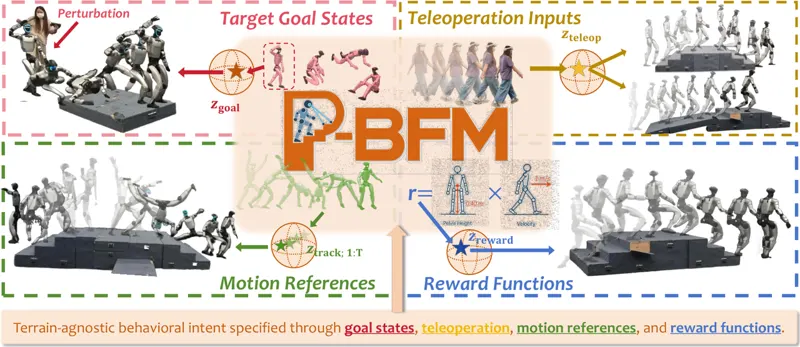
Behavioral foundation models (BFMs) provide humanoids with reusable repertoires of whole-body behaviors; in real-world humanoid control, the same behavioral intent may require fundamentally different motions under different terrain constraints. Covering such variation with terrain-matched demonstrations requires enumerating a combinatorial space of behaviors and terrain geometries. We introduce P-BFM, a perceptive behavioral foundation model that factorizes humanoid control into terrain-invariant intent and terrain-conditioned realization. A forward-backward representation maps motion references, target states, and reward functions into a shared intent space without terrain information, while a perceptive policy learns how to realize each intent under the surrounding terrain geometry. We further identify a complementary limitation of purely latent control: behavioral latents can preserve local motion patterns while losing precise global progress. We therefore introduce Explicit Root Instructions (ERI), which separates global transport (e.g., heading and planar velocity) from behavioral intent, while leaving local whole-body adaptation to the perceptive policy. This decomposition leads to a characteristic capability absent from conventional BFMs: one fixed intent induces different, terrain-appropriate behaviors, including changes in step height, stride, posture, foothold placement, and contacts, without terrain-specific demonstrations. Across challenging terrains, P-BFM improves motion fidelity, root-control precision, and perturbation recovery over strong baselines. A single frozen policy further supports motion tracking, goal reaching, reward inference, teleoperation, and terrain-aware recovery, and transfers zero-shot to a Unitree G1 using onboard depth sensing.

HumanoidUnsupervised Reinforcement Learning
Xue Wang, Yitang Li, Yiming Zhang · 530 views · Oct 11, 2026
HOTICE: Whole-Body Humanoid Object Transportation in Cluttered Environments

HOTICE: Whole-Body Humanoid Object Transportation in Cluttered Environments

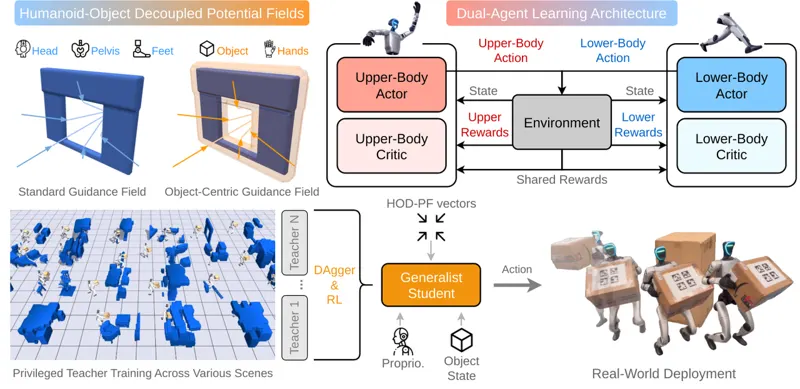
Object transportation is a fundamental capability for humanoid robots operating in real-world, human-centric environments, yet existing methods struggle when clutter constrains free space around both the robot and its carried payload. We present HOTICE, a whole-body humanoid learning framework for transporting objects through such cluttered environments. First, we introduce Humanoid-Object Decoupled Potential Fields, which jointly encode collision-avoidance guidance for the robot and the carried object, enabling coordinated, obstacle-aware motion for both. Second, to address the large action space inherent to whole-body loco-manipulation, we design a dual-agent reinforcement learning architecture that decouples upper- and lower-body control while preserving whole-body coordination via shared state observations and rewards. To train a policy that generalizes across diverse cluttered scenes, we further employ a specialist-to-generalist distillation strategy, in which privileged teacher policies are distilled into a single deployable student policy. We evaluate HOTICE in MuJoCo simulation and on a real Unitree G1 humanoid, demonstrating effective and robust object transportation across cluttered scenarios for objects of varying shapes. Our results show that HOTICE reliably coordinates whole-body motion and object-aware collision avoidance, generalizing effectively to previously unseen cluttered environments while achieving strong performance in sim2real deployment.

HumanoidLoco-manipulation
Toan Nguyen, Weiduo Yuan, Siheng Zhao · 15 views · Sep 21, 2026
ASENA: Self-evolving Agents for Embodied Navigation

ASENA: Self-evolving Agents for Embodied Navigation

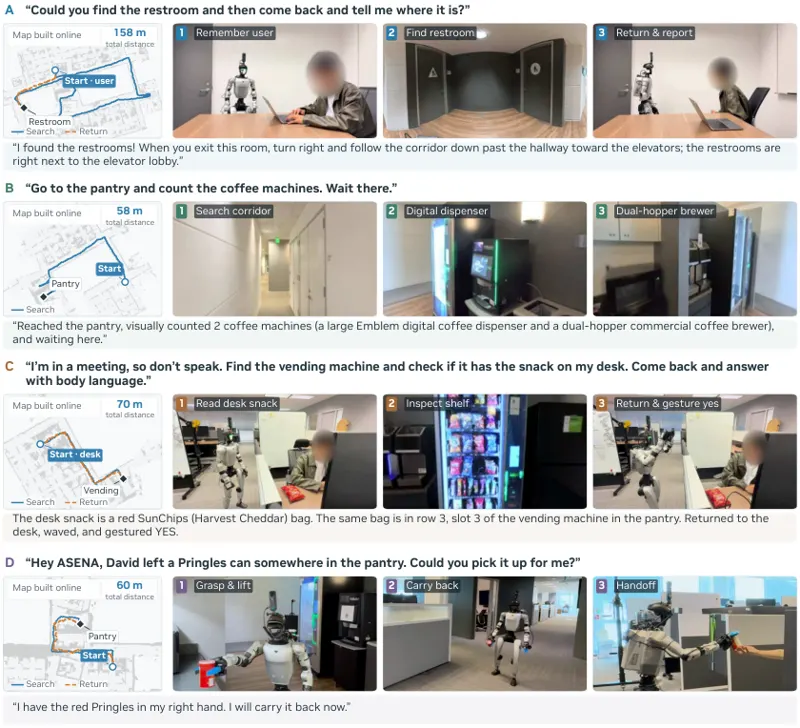
We present ASENA, an embodied agent system that enables general-purpose coding agents to program humanoid navigation, manipulation, and interaction. Through a unified robot harness, agents read sensor data, write and execute programs, inspect recorded outcomes, repair failures, and reuse notes and executable skills while keeping their model weights fixed. We also introduce ASENA-VLN, a 4B monocular navigation policy that serves as an optional tool within this programmable system. ASENA-VLN predicts body-frame trajectories for both extended routes and short-horizon behaviors. Its shared vision-language decoder is trained on route instructions, visual question answering, and a newly curated dataset of geometry-derived atomic navigation tasks. As a standalone policy, ASENA-VLN achieves state-of-the-art success rates of 68.7% on R2R and 70.2% on RxR. When integrated with a coding agent, learned navigation improves ASENA's success rate by 11 percentage points on both agentic benchmarks and reduces execution time. Persistent workspace evolution uses simulator feedback to improve success over ten passes through recurring 100-task subsets. Success increases from 72% to 98% on R2R and from 65% to 89% on RxR. On embodied question answering, ASENA achieves state-of-the-art accuracy with fewer interaction steps. On a Unitree G1, we demonstrate search, visual inspection, spatial reasoning, synthesized gestures, and mobile manipulation combining object pickup, carrying, and handoff without a pre-built map. These demonstrations illustrate how online programming extends robot behavior beyond route following and predefined skills.

Vision-language navigationEmbodied AI
An-Chieh Cheng, Isabella Liu, Edmund Bu · 416 views · Sep 30, 2026
PanTact: Teaching Whole-Body Dexterity with a Wearable Contact Interface

PanTact: Teaching Whole-Body Dexterity with a Wearable Contact Interface

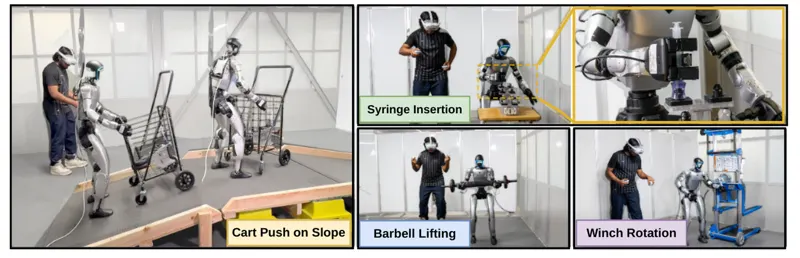
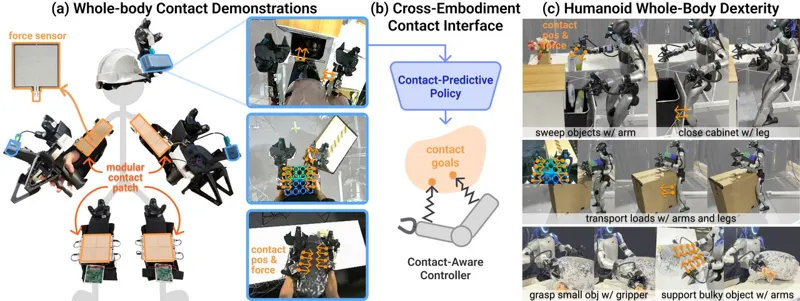
PanTact treats contact, not joint trajectories, as the transfer currency from people to humanoids. Wearable patches are assembled magnetically from 44x44 mm FSR modules; a custom 50x50 mm PCB streams 16 channels at 1 kHz over a CRC-checked RS-485 daisy chain, one Vive tracker per patch maps sensor centers into the world frame, and contact states are binarized against a per-channel adaptive baseline with threshold max(0.35 beta, r_min). The policy observes body-masked 3D egocentric point clouds, both wrist images and proprioception, and at 10 Hz predicts an action chunk of H=16 steps containing a look-at point, EEF poses with gripper widths, and per-sensor contact goals (binary state plus 3D position). A soft-minimum proximity d(p,q) with T = 0.02 m hands each active contact to whichever robot surface is currently nearest, and active goals are offset by delta along the pressing direction to form virtual goals that generate pressing force, so the G1 holds objects without any tactile sensor on its body. Three control formulations trade off differently: training-free upper-body IK, WBIK whose dense reference is executed by SONIC, and a sparse contact tracker trained with PPO over 4096 simulation environments for 30k iterations (50 Hz, 29 joints, S=8 upper-body / S=16 whole-body contact slots). On a 29-DoF Unitree G1: Grasp-and-Embrace reaches 85% with upper-body IK and 80% with the sparse tracker against 0% for Humanoid UMI; Sweep-and-Stow reaches 90.63% end to end while Humanoid UMI++ scores 18.75% on each stage and 0% end to end; Carry-and-Push is 90% versus 40%. In simulation replay, adding contact goals lowers contact distance for all three controllers at almost no cost in EEF accuracy.

Whole-Body ManipulationTactile Sensing
Xu, Xiaomeng, Zhang, Han, Ruan, Zhian · 604 views · Oct 8, 2026

As an Amazon Associate, we earn from qualifying purchases.