PAPER DEEP DIVE
SuperMimic: Scaling Humanoid Whole-Body Control with One Differentiable World Model
SuperMimic fits one differentiable world model from simulator transitions and uses short imagined rollouts to train a general humanoid tracker. It surpasses SONIC in three hours on one H100, then reaches zero failures on 129,514 motions after 9.8 hours on two H100s.
One-Sentence Summary
SuperMimic makes the shared dynamics of a humanoid body reusable: one differentiable world model is fitted from simulator transitions, a tracking policy is improved by backpropagating through short imagined rollouts, and a critic extends the effective horizon far enough that a single-H100 run outperforms a 128-GPU motion-tracking baseline in three hours.
Why Motion Scaling Runs into a Compute Wall
The most practical route to a general humanoid controller is to collect motion clips, retarget them to the robot, and train a policy to reproduce those trajectories under contact, friction, joint-limit, and actuator constraints. A small library can produce a capable walker. A library with hundreds of thousands of clips promises a controller that can walk, run, crawl, fall, rise, roll, jump, and recover without a separate skill selector for every behavior.
The difficult part is not storage of the clips. It is the repeated estimation of consequences. Model-free reinforcement learning treats the rigid-body simulator as a black box. PPO samples actions, observes the resulting states and rewards, and uses many trajectories to estimate which changes in policy parameters are useful. The same robot body, contact solver, actuator model, and reward construction appear in every clip, yet the method does not preserve that shared structure as a reusable computational object.
SONIC shows what the brute-force version of this strategy requires: 128 L40 GPUs for seven days, approximately 21,000 GPU-hours, to train a single tracking policy over a large collection of motions. BeyondMimic follows another route. It trains specialists on individual motions and distills them into a general tracker. That reduces the difficulty of each optimization, but it introduces a population of experts and a distillation stage that can lose information.
The paper's premise is that both routes spend too much compute relearning the same physical response. If the policy is trained with conventional model-free RL, every new action distribution creates fresh gradient estimation. If experts are distilled, each specialist must first acquire a local controller. SuperMimic instead learns a differentiable approximation to the simulator once, then reuses it to calculate policy gradients across the entire motion corpus.
This is not merely an implementation trick for faster neural inference. It changes where policy gradients come from. The simulator remains the source of ground-truth transitions, but it no longer has to be differentiated through contact events. MuJoCo Warp and similar systems provide high-throughput simulation, while non-smooth contacts and solver internals make end-to-end differentiation difficult or unavailable. SuperMimic learns a smooth local model from logged transitions and places that model directly on the optimization path.
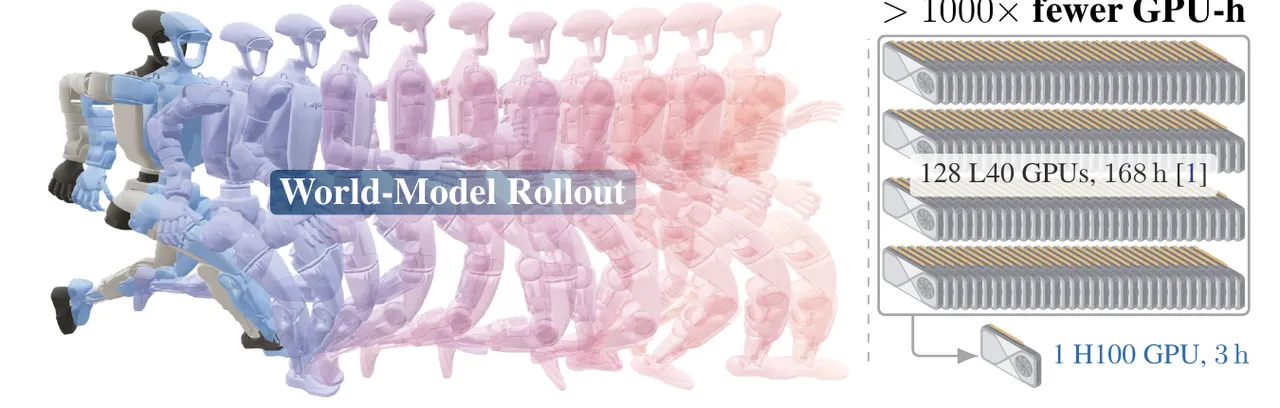
Figure 1: The policy acts inside a learned model of the robot's consequences. The paper contrasts a 128-GPU, seven-day SONIC run with a three-hour SuperMimic run on one H100. Source: paper Figure 1.
Problem Setting: Goal-Conditioned Control from Partial Observations
The paper formulates whole-body control as a goal-conditioned partially observable Markov decision process. At time $t$, the simulator has a state $s_t$, the policy receives an observation $o_t$, and a task supplies a goal $g_t$. The agent selects action $a_t$, after which the environment returns a reward $r_{t+1}$, a termination flag $d_t$, and a next state $s_{t+1}$. The policy is deterministic:
$$a_t = \pi_\theta(o_t,g_t)$$The action is not a direct torque command. It is a normalized joint setpoint centered on the robot's default posture $q_0$ and mapped through a scalar scale $\alpha$ into a low-level PD target:
$$q_t^{sp} = \alpha a_t + q_0$$Because the PD gains are soft, this target behaves more like a torque proxy than a command that forces immediate joint tracking. The resulting action interface is useful across motion imitation, velocity tracking, and end-effector pose control. Those tasks may use different goal spaces and rewards, but they still operate through the same body and low-level controller.
The observation is deliberately modeled as a noisy view of an underlying clean signal. The world model predicts the clean observation, while the policy sees a sensor-corrupted version:
$$o_t = \bar{o}_t + \eta_t$$This separation matters during imagination. If a learned rollout stayed in the clean representation, the policy would be optimized for states it never receives at execution time. SuperMimic instead lets the world model advance the clean state and then adds observation noise before each policy decision. The model and the policy therefore share a latent physical trajectory without sharing an unrealistically clean input distribution.
Termination is the second place where the differentiable surrogate must differ from the simulator. A real episode terminates with a hard binary event. A hard event can be recorded and used as a label, but it does not naturally provide a useful gradient that tells the policy how close an unsuccessful rollout was to survival. SuperMimic predicts a continuous termination probability $\hat{d}_t$ and converts it into a cumulative survival coefficient:
$$c_0 = 1,\qquad c_{t+1}=c_t(1-\hat{d}_{t+1})$$The coefficient multiplies future reward. A transition with a high predicted failure probability receives a smaller weight than a transition that is likely to preserve a valid episode. This is a differentiable relaxation of the termination mechanism, not a claim that the simulator's hard failure should be replaced everywhere. The simulator still defines the evaluation episodes. The continuous signal exists to create a useful optimization path through near-failure states.
The Training Loop: Collect, Fit, Imagine
SuperMimic alternates between three operations. First, the current policy collects transitions in simulation and appends them to a fixed-size replay buffer. New transitions replace the oldest ones. Second, the system samples eight-step windows and trains one autoregressive world model to predict states, rewards, clean observations, and termination labels along each action sequence. Third, the model is frozen while the policy imagines 32 steps from replay-buffer start states and is updated by backpropagation through time.
flowchart LR
    P[Current policy] -->|collect in rigid-body simulator| B[Fixed replay buffer]
    B -->|sample 8-step windows| W[Fit differentiable world model]
    W -->|freeze parameters| I[Imagine 32 steps]
    B -->|initial states and simulator context| I
    I --> A[Backpropagate return to actor]
    I --> C[Regress critic to lambda returns]
    A --> P
    C --> P
    P -->|new distribution| B
The role of the replay buffer is broader than in ordinary off-policy RL. It supplies training data for the world model and initial conditions for imagined policy optimization. Each stored transition also carries simulator context such as friction and calibration variables. Moving the world model away from the live policy therefore does not make the data obsolete: the underlying body dynamics remain relevant even when the policy changes.
The freeze boundary is a central design choice. During world-model fitting, gradients update only the surrogate. During policy optimization, the surrogate provides gradients but its parameters are held fixed. Without that boundary, the policy could reduce its objective by changing the model's predictions rather than changing its behavior. Alternating the two objectives also avoids a simultaneous game in which the model chases the current policy while the policy exploits the model's newest inaccuracies.
The policy still needs exploratory data. The paper applies action noise while collecting transitions, which broadens state-action coverage. The noise is not treated as part of the deployed controller. During imagination, the system adds the known observation noise to the model's clean output and asks the policy to act from that imperfect signal. This produces a clean division between exploration noise, sensor noise, and model error.
A Shared World Model with Four Prediction Heads
The world model advances the physical state using the current state estimate, the action, and a simulator-context vector:
$$\hat{s}_{t+1}=f_\omega(\hat{s}_t,a_t,\xi)$$Reward depends on the task goal as well as the physical transition. The observation head reconstructs the clean observation, while the termination head compares the predicted state and goal to estimate episode survival. The paper writes the auxiliary predictions as:
$$\hat{r}_{t+1}=r_\omega(\hat{s}_t,a_t,g_t),\qquad \hat{\bar{o}}_t=g_\omega(\hat{s}_t,\xi),\qquad \hat{d}_t=d_\omega(\hat{s}_t,g_t)$$The context $\xi$ contains randomized simulator parameters rather than a motion ID. It includes ground friction, per-joint calibration offsets, and center-of-mass offsets. The paper uses foot friction coefficients sampled from $U[0.3,1.2]$, joint-zero offsets sampled from $U[-0.01,0.01]$ radians, and random center-of-mass shifts in three axes. The model is therefore conditioned on a family of plausible bodies and contacts, not on a lookup table of named actions.
External pushes are intentionally excluded from the deterministic model context. A push creates a sudden state jump that is difficult to infer from the previous state, action, and slow-varying parameter vector. Leaving such discontinuities out means the model is not asked to solve a partially observed disturbance problem before the policy has a stable controller. Robustness to pushes is instead tested after training and is discussed later through the critic ablation.
The model is fitted on windows of length $k=8$. The first state comes from the logged trajectory. Every later prediction is fed back as the next input, so the model cannot reset to a ground-truth state halfway through the window. The loss combines state, reward, clean-observation, and termination terms:
$$L_{WM}=\mathbb{E}_{B}\sum_{j=1}^{k} \left[ \lVert\hat{s}_j-s_j\rVert^2+ (\hat{r}_j-r_j)^2+ \lVert\hat{\bar{o}}_j-\bar{o}_j\rVert^2+ \mathrm{BCE}(\hat{d}_j,d_j) \right]$$Not every quantity must be learned when its value can be computed analytically. The four-head formulation identifies the parts that are difficult to express in closed form, especially the state increment and the continuous failure estimate. The dynamics trunk is a three-layer MLP with width 2048, and the termination head uses a smaller 64-by-64 network.
Why should one network represent the dynamics of more than 129,000 clips? The clips provide different trajectories, rewards, and goals, but the robot's mass distribution, joint arrangement, actuator limits, and contact geometry remain largely shared. Motion and goal inputs act as conditions on the same physical system. More data broadens the visited state-action region rather than forcing the network to relearn an unrelated transition function for every clip.
Imagined Policy Improvement with a Finite Differentiable Horizon
Policy optimization starts from a state stored in replay. The actor queries the world model for a clean next observation, receives a noisy observation, and chooses the next action. This repeats for $H=32$ steps. The objective is the discounted imagined reward plus a critic value at the end of the window:
$$\hat{J}(\theta)=\mathbb{E}\left[ \sum_{t=0}^{H-1}\gamma^t\hat{c}_t\hat{r}_{t+1} +\gamma^H\hat{c}_H V_\psi(\hat{s}_H,g_H,\xi) \right]$$Here $\gamma=0.99$ and $\hat{c}_t$ is the predicted survival coefficient. The actor is not required to make the world model accurate for the entire episode. It is required to make it locally accurate along the 32-step path used for credit assignment. The critic supplies an estimate of what happens after that path, which lets recovery behavior receive value even when the relevant reward lies beyond the BPTT horizon.
The distinction from PPO is direct. PPO treats the simulator as a black box and multiplies a sampled advantage by the score of the log-policy. SuperMimic obtains $\partial\hat{s}_{t+1}/\partial a_t$ from the world model and propagates the gradient of the return through the imagined trajectory. The resulting first-order signal can use the local slope of the dynamics instead of requiring many random trajectories to estimate which action direction was better.
The critic is trained on lambda returns computed over the same imagined segment. Starting from the terminal value estimate, the target is recursively constructed as:
$$\hat{R}_t= \hat{r}_{t+1} +\gamma(1-\hat{d}_{t+1}) \left[(1-\lambda)V_{t+1}+\lambda\hat{R}_{t+1}\right]$$with $\lambda=0.95$. The critic is fitted by squared error against these targets:
$$L_V(\psi)=\mathbb{E}\sum_{t=0}^{H-1} \left(V_t-\hat{R}_t\right)^2$$The targets are computed once per rollout and held fixed during the critic update. The implementation does not rely on a slowly updated target network. Shorter imagined horizons need the critic more, because the actor sees fewer steps before its return is replaced by a value estimate. Longer horizons are not automatically better: they multiply both model error and the depth of the BPTT graph.
Reading the Method through an Unofficial Implementation
The authors did not release an official codebase with the paper. The independent reproduction nevertheless exposes two useful correspondences with the method. In src/supermimic/world_model/world_model.py::window_loss, the loss repeatedly calls one step function and feeds the updated state into the next call. The loop mirrors the autoregressive structure of the world-model equation instead of constructing eight independent one-step predictions.
for j in range(k):
    s, sq, bce, logits = step_fn(
        s, a_exec[j], xi, states[j + 1], done[j], refs[j].root_pos_w
    )
    total_state = total_state + sq.sum(-1).mean()
    total_term = total_term + bce.mean()
loss = total_state / k + self.cfg.term_loss_weight * total_term / k
In src/supermimic/imagination/objective.py, policy_objective accumulates discounted rewards weighted by the survival coefficient and adds the terminal critic value. The neighboring gae_targets function walks backward through the rollout to form lambda returns. These are structural checks, not an independent validation of the reported GPU-hour results.
J = (disc[:, None] * ro.survival[:-1] * ro.rewards).sum(0)
J = J + (gamma ** H) * ro.survival[-1] * terminal_values
R = rewards[t] + gamma * (1.0 - dhat_next[t]) * (
    (1.0 - lam) * values[t + 1] + lam * R
)
The useful lesson is that the paper's efficiency claim is tied to a concrete computational graph. The world model is not merely used for visualization or data augmentation. Its predictions and their derivatives occupy the actor update. Any reproduction that replaces the analytic gradient with an ordinary PPO update would test a different method.
Experiment 1: Matching a Cluster Baseline with One GPU
The headline comparison uses SONIC as the external baseline. Both systems use the same BeyondMimic action-tracking reward and a G1 retargeting pipeline. SuperMimic trains on a 264.56-hour public subset of BONES-SEED, while SONIC uses roughly 611 hours, so SuperMimic has about 2.3 times less motion data. The common evaluation set contains 129,514 motions, each started from its first frame and evaluated with the same protocol.
| System | Training resources | GPU-hours | Motion data | Reported outcome |
|---|---|---|---|---|
| SONIC | 128 L40 GPUs, 168 hours | About 21,000 | About 611 hours | Normalized return 0.90 and 179 failures |
| SuperMimic | 1 H100, 3 hours | 3 | 264.56 hours | Return above SONIC and 25 failures |
| SuperMimic extended | 2 H100s, 9.8 hours | 19.6 | 264.56 hours | Zero failures on the 129,514-motion evaluation set |
The paper describes the result conservatively as more than 50 times less wall-clock time and more than 1,000 times fewer GPU-hours. The raw ratios are larger. Dividing 168 hours by three hours gives 56, and dividing approximately 21,000 GPU-hours by three gives about 7,200. Those numbers should not be interpreted as a controlled algorithmic speedup because the hardware, data volume, baseline tuning, and implementation maturity differ. They do show that a 2.3-times data reduction and a hardware advantage cannot by themselves explain a three-order-of-magnitude compute gap.
The failure distribution is more informative than the aggregate return because it shows where the learned controller changes behavior. SONIC fails on all 22 side rolls, all 44 clips in the combined 360-, 180-, and 90-degree flip group, and all eight dances. The three-hour SuperMimic run reduces those groups to 2, 1, and 0 failures respectively. Its 25 failures are concentrated in a small number of difficult motion families, and no category has more failures than SONIC.
| Motion family | Clips | SONIC failures | SuperMimic, 1 H100 x 3 h | SuperMimic, 2 H100 x 9.8 h |
|---|---|---|---|---|
| Side roll | 22 | 22 | 2 | 0 |
| 360, 180, and 90 degree flips | 44 | 44 | 1 | 0 |
| Hula-hoop turns | 20 | 3 | 3 | 0 |
| Crossed-leg motions | 10 | 9 | 0 | 0 |
| Lying, resting, and rising | 99 | 28 | 8 | 0 |
| Standing long jump | 24 | 15 | 0 | 0 |
| Dance routines | 8 | 8 | 0 | 0 |
| All other motions | 129,287 | 50 | 11 | 0 |
| Total | 129,514 | 179 | 25 | 0 |
These categories require distinct forms of physical reasoning. A side roll includes ground contact across the torso and limbs. A flip combines airborne rotation with a safe landing. Rising begins from a configuration where ordinary foot support is unavailable. The improvement therefore suggests more than faster optimization of an easy walking reward. The critic and imagined dynamics are helping the policy assign credit across contact-rich and transient phases.
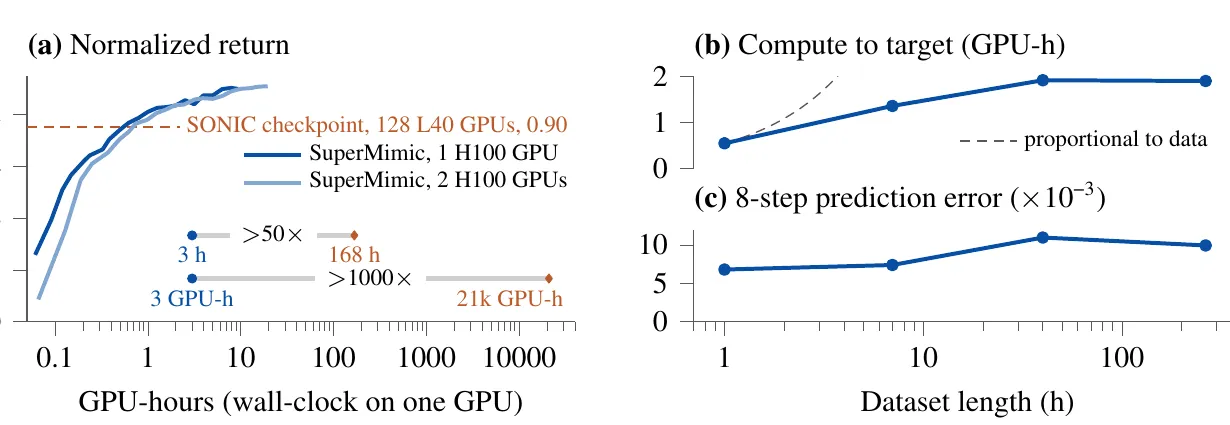
Figure 3: The paper combines three scaling views: return versus compute, GPU-hours needed to reach a target return, and multi-step prediction error as the dataset grows. Source: paper Figure 3.
The scaling evidence is equally important. As the training corpus grows from 1 to 264 hours, the eight-step prediction error remains between approximately 0.007 and 0.011. The compute needed to reach a target return grows more slowly than the amount of data. This supports the amortization story: additional clips expose more of the shared dynamics instead of requiring a linearly larger model-fitting campaign or one new specialist per clip.
Experiment 2: A Same-Reward PPO Baseline Still Scales Poorly
External comparisons can be confounded by differences in rewards, observations, termination rules, and network sizes. The authors therefore build PPO-Sim on LAFAN1 with 40 motions and 2.45 hours of data. PPO-Sim shares the action space, observation construction, reward, termination logic, domain randomization, actor and critic dimensions, and evaluation procedure with SuperMimic. Its PPO hyperparameters follow BeyondMimic, and it runs 8,192 environments per GPU, twice the SuperMimic count of 4,096.
| LAFAN1 setup | Hardware | Training result | Normalized return |
|---|---|---|---|
| SuperMimic | 1 H100 | Reaches target in 1.2 hours | 0.82 |
| PPO-Sim | 1 H100 | Does not reach target within 18 hours | 0.60 |
| PPO-Sim | 4 H100s | Does not reach target within 18 hours | 0.70 |
| PPO-Sim | 8 H100s | Does not reach target within 18 hours | 0.72 |
The return rises from 0.60 to 0.70 when the PPO-Sim allocation grows from one GPU to four, then only to 0.72 with eight. More parallel workers increase sample collection, but they do not remove the statistical cost of estimating a policy gradient from noisy returns. SuperMimic also depends on simulation for its replay data, but the collected samples serve a different role: they fit a local transition model whose derivative can be reused across many policy updates.
The paper separates three possible sources of efficiency. First, the learned model may be a better use of data than model-free trial and error. Second, imagined rollouts may be faster than running the simulator at practical batch sizes. Third, first-order gradients may need fewer imagined transitions than PPO-WM. The reported throughput advantage is above 10 times from 2,000 to 16,000 parallel environments and reaches 62 times at 64,000. Reaching the best PPO-WM return requires about 64 times fewer imagined steps with SuperMimic's first-order objective.
The comparison is not a claim that world models are always cheap. Training the surrogate consumes compute, and the model must be refreshed as the replay buffer changes. SuperMimic wins because the same simulator context and physical dynamics recur across a large action corpus. On a narrow one-motion task, the fixed cost of fitting and maintaining a model could erase the benefit. The method's scaling argument is strongest when many behaviors share one body.
Why the Critic Is Not Optional
The 32-step window is short relative to the duration of a fall, rise, or recovery. The critic connects that short differentiable segment to a value estimate for the remaining task. The paper's ablation shows that without a critic, horizons of 16 steps or fewer are insufficient. With a critic, 16 imagined steps can match the training progress of a 32-step actor-only run, while the default 32-step configuration reaches the target fastest.
Extending the horizon from 32 to 64 or 128 steps does not create a proportional gain. It increases the depth of backpropagation, compounds model error, and raises training time while lowering final return. This is consistent with the intended division of labor: the world model should be accurate over a local window, and the critic should estimate long-run value beyond that window. The model is not forced to become a perfect full-episode simulator.
A push-recovery probe makes the role of the critic observable outside the training objective. With a static T-pose subject to velocity pushes from 0.5 to 4 meters per second, the policy trained with a critic stabilizes within 0.5 to 2.4 seconds. The no-critic variant stumbles continuously even at 0.5 meters per second and falls under the stronger push. The critic therefore contributes to recovery behavior that a merely local tracking objective may undervalue.
One Decoder, Multiple Task Interfaces
The paper also tests whether the same body model can support a target interface other than motion tracking. Each task has its own goal encoder, reward, and termination condition, but the output head is a shared action decoder. For velocity control, the authors compare a reinforcement-learning encoder trained directly with the velocity reward and a distilled encoder trained through the motion-tracking reward.
Across 672 velocity commands, the reinforcement-learning encoder has lower steady-state error on 650 responses. The distilled encoder is better on 15 commands, with the remaining comparison not separately broken out in the reported count. Their median relative errors are 0.16 and 0.49 respectively. The distilled version also falls on all seven commands that combine high-speed motion with sharp turning. Those combinations have little coverage in the motion corpus.
This experiment is a useful probe, but it also exposes a coupling in the implementation. The velocity reward updates the velocity encoder, not the shared decoder. The decoder remains trained by the motion-tracking objective. The current result therefore shows that one decoder can be reused with different conditioning, rather than demonstrating that all task losses shape the shared controller equally.
Real-robot tests use a Unitree G1 and one general tracker without per-motion fine-tuning. The policy performs a jump-rope-like hop, a side roll with torso and limb contact, a 90-degree flip, and an in-place 360-degree flip. The sequence in Figure 6 demonstrates airborne phases, sustained ground contact, and full-body reorientation. These are qualitatively broader than ordinary walking and are relevant to the paper's claim that a single policy can cover high-dynamic motion families.
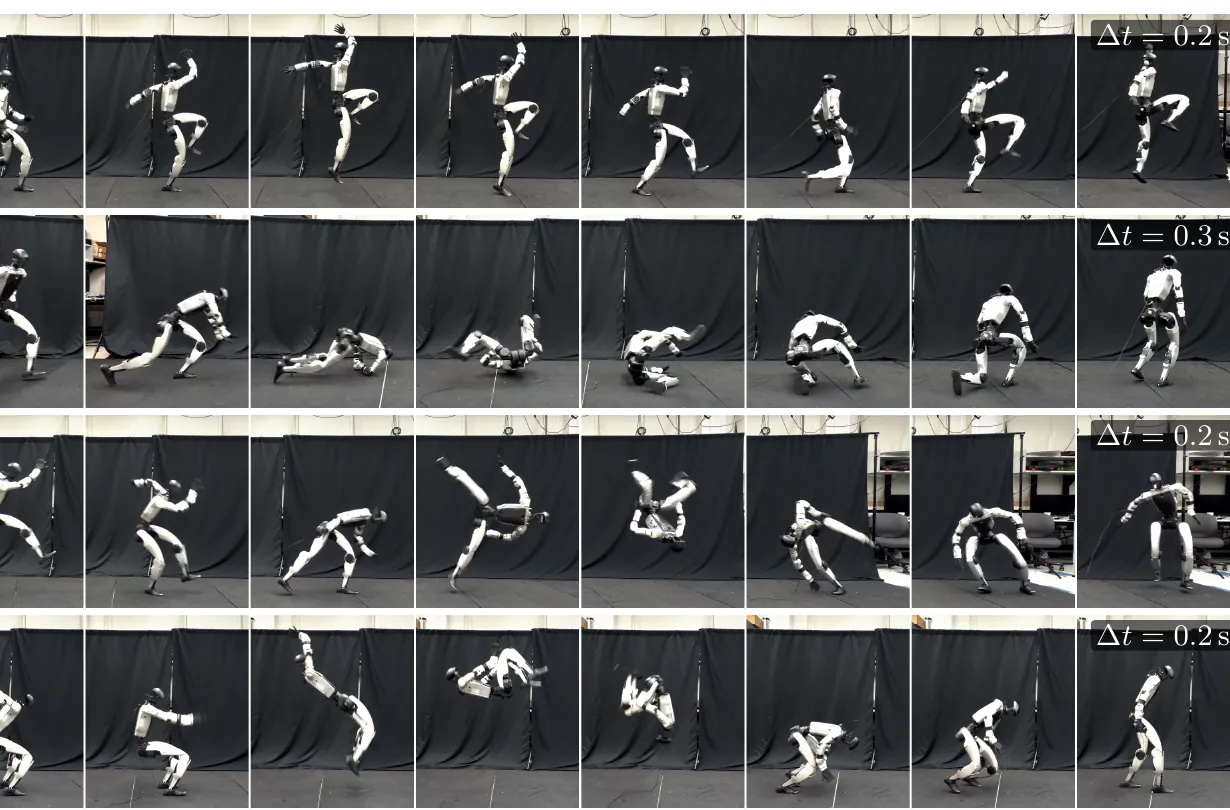
Figure 6: Consecutive frames from one general policy deployed on a physical Unitree G1. The demonstrated behaviors include a hop, side roll, 90-degree flip, and in-place 360-degree flip. Source: paper Figure 6.
Data Curation and the Default Training Recipe
The starting BONES-SEED G1 retargeting contains 142,220 clips, but not every clip is executable by a planar, standing humanoid. Some motions assume stairs, boxes, ladders, chairs, or other objects. The authors first remove clips whose names indicate an unavailable terrain or object interaction. They then use MuJoCo forward kinematics to inspect torso and foot trajectories, rejecting sequences with impossible support, floor penetration, or long intervals where both feet are unsupported when the motion requires contact.
| Filtering stage | Remaining clips | Fraction of the raw collection |
|---|---|---|
| Raw BONES-SEED G1 retargeting | 142,220 | 100.0% |
| After semantic name filtering | 129,667 | 91.2% |
| After kinematics feasibility filtering | 129,514 | 91.1% |
The policy observation has 93 dimensions: 29 joint positions relative to the default pose, 29 joint velocities, three IMU angular velocities, three projected gravity terms, and 29 previous actions. The actor uses a ten-frame history. A motion encoder reads ten future reference frames. The dynamics MLP has widths 2048, 2048, and 2048. The motion encoder and shared decoder use widths 2048, 1024, 512, and 256, while the critic uses 256 and 128.
The main training configuration uses $\gamma=0.99$, $\lambda=0.95$, a world-model window of $k=8$, an imagination horizon of $H=32$, 4,096 environments per GPU, 4,096 imagined trajectories per iteration, and an update-to-data ratio of 0.4. The single-GPU world-model learning rate is $2\times10^{-4}$ and is scaled for two-GPU data parallelism. Collection uses action noise with standard deviation 0.1, and gradients are clipped to a global norm of 1.0.
The ten-frame history and future motion window reduce the ambiguity of a single observation. Joint velocity and projected gravity give immediate body motion, while previous actions expose control history. The model still has to infer hidden dynamics such as contact state and the unobserved consequences of calibration offsets. Conditioning on simulator context and autoregressive training make that inference part of the learned transition function rather than an external estimator handled by the policy alone.
What Figure 2 Adds to the Equations
Figure 2 is valuable because it separates two loops that are easy to conflate. The outer loop refreshes replay data with the current policy. The inner loop alternates between fitting the world model and improving the actor-critic pair from stored starts. The actor and critic consume imagined trajectories, but only the actor differentiates through the model to choose actions. The critic is trained to estimate value and does not need to generate analytic gradients through the transition model.
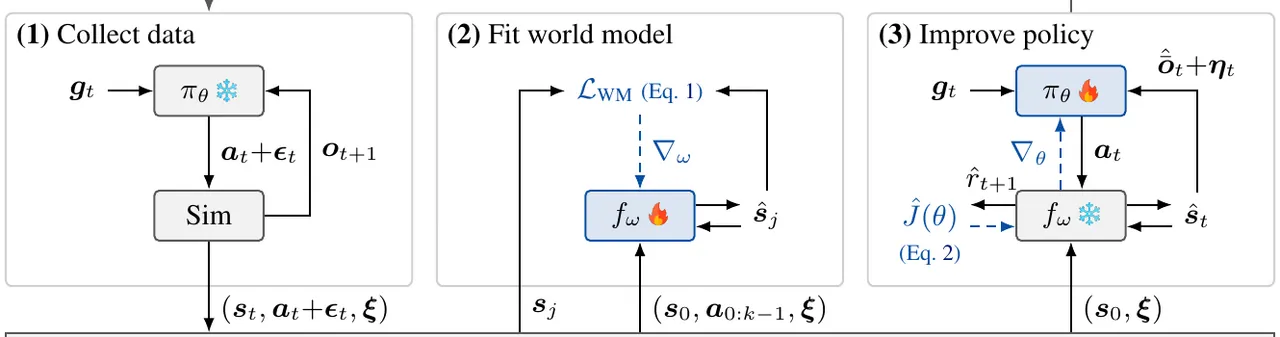
Figure 2: SuperMimic separates simulator data collection, world-model fitting, and policy improvement. The frozen model provides gradients to the policy while remaining fixed during an actor update. Source: paper Figure 2.
The outer loop also explains how the method scales across motions. A new clip changes the distribution of goals and reference trajectories, but it does not invalidate all previously observed body dynamics. Old transitions remain useful for fitting friction, contact responses, and joint behavior. The policy's changing behavior affects where the next samples are collected, while the model accumulates an increasingly broad map of the shared transition function.
The price is a moving-data problem. Replay-buffer replacement can remove transitions from rare motion families, the model sees a non-stationary state-action distribution, and the policy can exploit any local error in the surrogate. The paper handles this through exploration noise, small action changes through a deterministic policy, regular model refitting, and a critic that prevents the actor from treating the model's terminal value as ground truth. These choices do not make model exploitation impossible, but they keep the imagined optimization tied to simulator-grounded states and rewards.
Limitations and Unexplained Boundaries
The first limitation is stated by the authors: multi-interface training is preliminary. The velocity reward updates the velocity encoder, while the shared decoder remains trained by motion tracking. The experiment therefore does not yet establish whether true joint training over several task losses produces a stronger shared controller. A more complete test would let velocity and tracking gradients both reach the decoder and measure interference, transfer, and forgetting.
The second author-stated limitation is that the world model learns only from simulator transitions. It does not ingest real-robot data, so it cannot automatically represent hardware-specific friction, actuator wear, latency, or contact differences. The paper suggests that real data could refine the model and that differentiability could support system identification. No real-data adaptation experiment is reported, so this remains an extension rather than demonstrated capability.
The third author-stated limitation is the training domain: flat ground only. SuperMimic does not train on slopes, stairs, deformable terrain, movable objects, or manipulation. Extending the model would add geometric constraints, external forces, and contact modes that are not represented by the current context vector. The real-G1 demonstrations do not remove this limitation because they still consist of whole-body motions on a mostly planar support surface.
A separate methodological limitation is that the benchmark motions are the training motions for both methods. The reported failure counts measure training-set coverage under a fixed initial-state protocol, not zero-shot success on held-out motion clips. A zero-failure result is valuable for a general tracking controller, but it does not show that the policy interpolates or extrapolates safely to unseen choreography, new speeds, or new combinations of turning and locomotion.
The compute comparison also has boundaries. SONIC uses L40 GPUs, SuperMimic uses H100s, and the data volumes differ. The paper's argument does not require the raw 7,200-times ratio to be a perfectly controlled benchmark; it shows that the remaining factors cannot plausibly explain the entire gap. A precise algorithmic speedup would still require matched hardware, matched data, and equally tuned baselines.
Finally, the trained model is a local approximation. The paper demonstrates stable prediction error and successful closed-loop behavior across a wide corpus, but it does not provide a guarantee that imagined rollouts remain valid outside the replay distribution. This matters when the policy deliberately explores, when the robot encounters a new contact mode, or when a rare motion produces a large state jump. The critic and short horizon reduce exposure to model error, but they do not turn the surrogate into a certified simulator.
Conclusion: Scaling the Shared Physics, Not the Cluster
SuperMimic's central contribution is not the generic statement that a world model can predict future states. It is the placement of one differentiable model inside the policy-gradient path for a very large, heterogeneous motion corpus. The model absorbs the shared dynamics of the humanoid body, short BPTT converts local dynamics derivatives into actor updates, and a critic supplies value beyond the differentiable window. The replay buffer connects the learned simulation to the changing policy without discarding old physical evidence.
The experiments support the claim that this architecture changes the cost curve. A one-H100 run surpasses SONIC's reported return in three hours and reduces failures from 179 to 25. A two-H100 run removes the remaining failures on the 129,514-motion training benchmark. Prediction error stays stable while the data grows from one to 264 hours, and a same-reward PPO-Sim baseline does not reach the LAFAN1 target even after 18 hours on eight GPUs.
The work does not close the harder questions. The controller has not demonstrated held-out motion generalization, real-world online adaptation, terrain, object interaction, or true multi-task training through a fully shared decoder. Those questions are now easier to study because the compute barrier is lower, not because they have disappeared. SuperMimic turns a potentially prohibitive scaling experiment into a tractable systems problem.
The reusable object is not a library of trajectories and not a collection of specialists. It is the differentiable physical behavior that remains when the motion name is removed.
Golden quote: SuperMimic scales a humanoid controller by learning the one thing every motion shares, then differentiating through it.