Skip to content
MobileVISTA: Generative Data Augmentation for Pose Generalization in Mobile Manipulation

MobileVISTA: Generative Data Augmentation for Pose Generalization in Mobile Manipulation

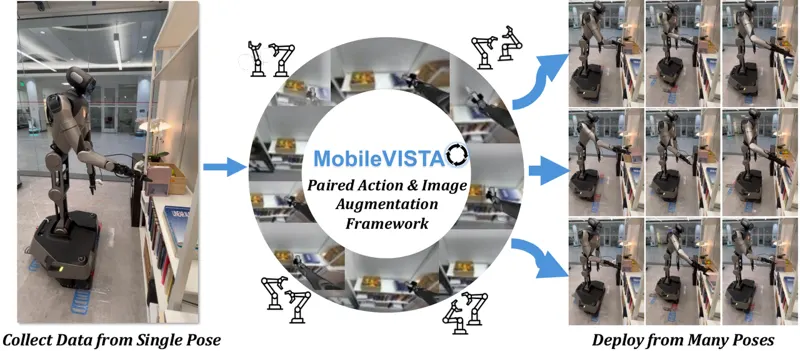
Mobile manipulators such as humanoid robots are increasingly deployed in dynamic, unstructured environments to perform dexterous manipulation tasks. However, end-to-end manipulation policies trained to imitate demonstration data collected from a single robot pose are brittle: even centimeter-scale deviations in robot pose at deployment can drive ego-centric observations and end-effector trajectories out of the training distribution, leading to sharp drops in performance. We introduce MobileVISTA, a data generation framework that transforms demonstrations captured at canonical poses into diverse, pose-perturbed training data by jointly (1) augmenting egocentric visual observations and (2) retargeting actions to compensate for base pose changes. Unlike prior methods, which assume a camera rigidly mounted off the actuated chain or non-trivial articulated robot geometry largely out of frame, MobileVISTA targets compatibility with egocentric platforms (e.g., humanoids) where the camera is both influenced by and must observe the robot's kinematic chain as it moves. We study MobileVISTA in simulated tasks spanning humanoid and bimanual embodiments, and on a real Galaxea R1 Pro. We find policies trained on MobileVISTA-augmented data demonstrate improved robustness to previously out-of-distribution poses encountered at test time, without additional demonstration collection or a trained generative model. Additionally, we find MobileVISTA's benefit is largest on tested humanoids, where the camera rides the actuated chain and the robot fills much of the frame. Additional videos and appendix can be found on our website: https://mobilevista.github.io

Mobile ManipulationData Augmentation
Wistreich, Suzannah, Tian, Stephen, Huang, Isabella · 332 views · Oct 5, 2026
PredActor: Predictive Action Diffusion for Steerable Onboard Humanoid Control

PredActor: Predictive Action Diffusion for Steerable Onboard Humanoid Control

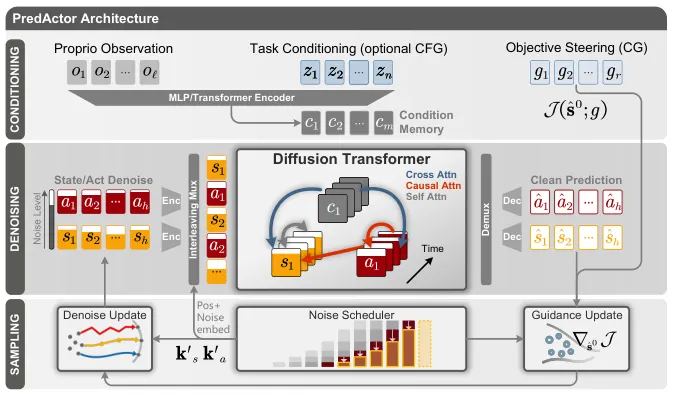
Diffusion models provide a flexible framework for motion generation, but turning this flexibility into closed-loop humanoid control remains challenging. Hierarchical generator-tracker systems steer motion through reference trajectories, yet these references may exceed the capabilities of the downstream tracker, leaving physical feasibility and disturbance recovery largely to a separate control module. Action-only diffusion avoids this separation by directly generating executable actions, but provides no explicit future-state trajectory that can be steered toward test-time motion objectives. Joint state-action diffusion offers a natural alternative, but existing controllers often rely on privileged full-body states, while learned behavior selection and test-time motion steering remain only partially integrated. We present PredActor, a predictive action diffusion policy that unifies both steering modes in one directly executed policy using proprioception alone. Given proprioceptive history and optional task context, PredActor jointly predicts actions and an internal future-state trajectory that enables guidance: classifier-free guidance strengthens text-conditioned motion, while classifier guidance steers future states toward test-time objectives. Only actions are executed, requiring neither a motion-reference tracker nor privileged full-body states. In simulation, PredActor reaches 44 of 45 destination targets and achieves a text retrieval score of 0.539 versus 0.424 for conditional action diffusion, with similar disturbance survival. Rolling denoising and computation-preserving runtime optimizations reduce the complete callback to 16.790 ms median and 19.383 ms p95 on a Jetson Orin NX, within the 20 ms control period. Deployed on a Unitree G1, PredActor demonstrates text-conditioned motion, disturbance response, joystick control, and semantic interpolation in simulation and hardware.

Humanoid ControlDiffusion policies
Ye, Lei, Gao, Haibo, Li, Yitang · 390 views · Sep 21, 2026
Agile and Generalized Legged Locomotion via Attention-Based Neural Map Encoding

Agile and Generalized Legged Locomotion via Attention-Based Neural Map Encoding

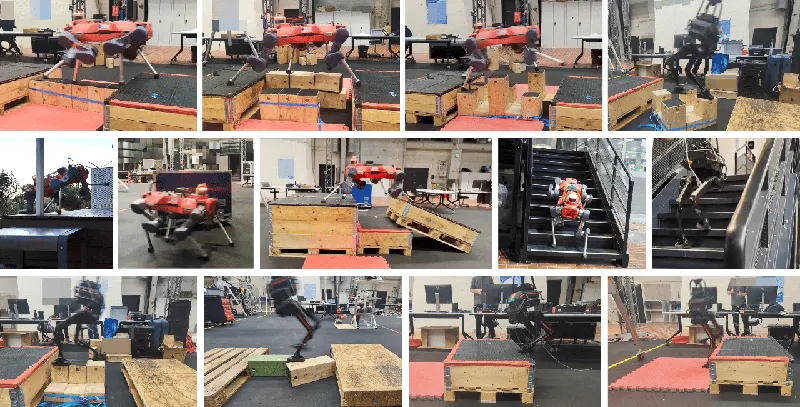
Achieving agile and generalized legged locomotion across terrains requires tight integration of perception and control, especially under occlusions and sparse footholds. Existing methods have demonstrated agility on parkour courses but often rely on end-to-end sensorimotor models with limited generalization and interpretability. By contrast, methods targeting generalized locomotion typically exhibit limited agility and struggle with visual occlusions. We introduce a unified reinforcement learning (RL) framework for agile and generalized locomotion that incorporates a novel attention-based map encoder in the control policy. This encoder extracts local and global mapping features and uses attention mechanisms to focus on salient regions, producing an interpretable and generalized embedding for RL-based control. We further propose a learning-based mapping pipeline that provides fast, uncertainty-aware terrain representations robust to noise and occlusions, serving as policy inputs. It uses neural networks to convert depth observations into local elevations with uncertainties, and fuses them with odometry. The pipeline also integrates with parallel simulation so that we can train controllers with online mapping, aiding sim-to-real transfer. We validate our framework with the proposed mapping pipeline on a quadruped and a biped robot, and the resulting controllers demonstrate strong agility and generalization to unseen terrains in simulation and in real-world experiments.

Legged LocomotionReinforcement Learning
Chong Zhang, Victor Klemm, Fan Yang · 517 views · Jan 13, 2026
Beyond Data Scaling: Representation-Centric Continued Pre-training for Vision-Language-Action Models

Beyond Data Scaling: Representation-Centric Continued Pre-training for Vision-Language-Action Models

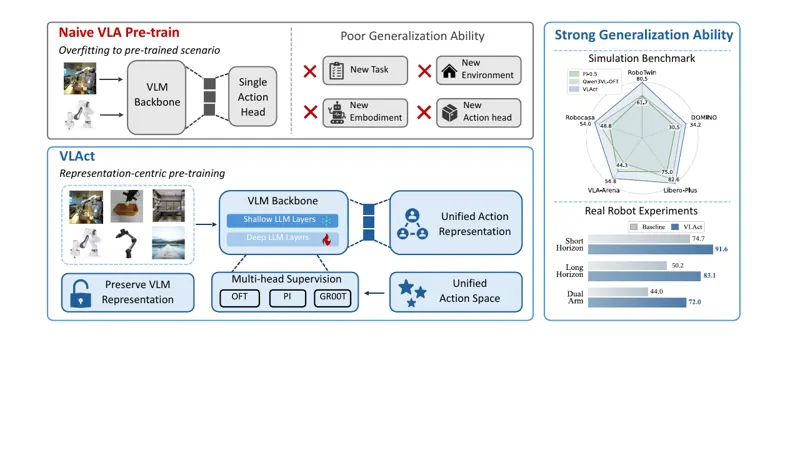
Scaling robot data is crucial for building generalist Vision-Language-Action (VLA) models, yet robot trajectories are harder to scale than web-scale image-text data because embodied collection is costly and sparsely covers the physical world. This makes representation quality a central bottleneck: under a fixed robot-data budget, continued pre-training must turn limited trajectories into transferable visual-action knowledge rather than merely fit actions. We propose VLAct, a VLA-oriented VLM backbone trained on broad, heterogeneous, multi-embodiment robot data before task-specific fine-tuning. VLAct preserves the broad VLM prior and encourages shared action semantics across embodiments through VLM-prior preservation, multi-head continuous action co-supervision, and a partially unified cross-embodiment action layout, while allowing task-specific action heads during fine-tuning. Across simulation, real-world, and unseen-embodiment transfer, VLAct consistently improves downstream performance under fixed fine-tuning protocols. On LIBERO-Plus and RoboTwin 2.0, VLAct surpasses industrial VLA systems including ABot-M0 and LingBot-VLA, achieving success rates of 82.6% and 92.5%. On RoboDojo, VLAct ranks sixth among all policies by success rate and outperforms all explicitly designated world-action model (WAM) entries on both metrics. Most notably, on RoboCasa-GR1, an unseen humanoid embodiment, VLAct using only 20% of downstream trajectories outperforms the full-data GR00T-N1.6 baseline. These results are obtained using fully open-source data and only a 16-GPU training setup, showing that representation-centric continued pre-training can deliver highly competitive performance under a modest compute budget and is an important independent axis of VLA progress beyond data scaling.

VLAContinued Pre-training
Senqiao Yang, Chengyao Wang, Yuxin Chen · 401 views · Aug 27, 2026
HuMBLE: Human Motion-Driven Behavior Learning for Embodied Locomotion

HuMBLE: Human Motion-Driven Behavior Learning for Embodied Locomotion

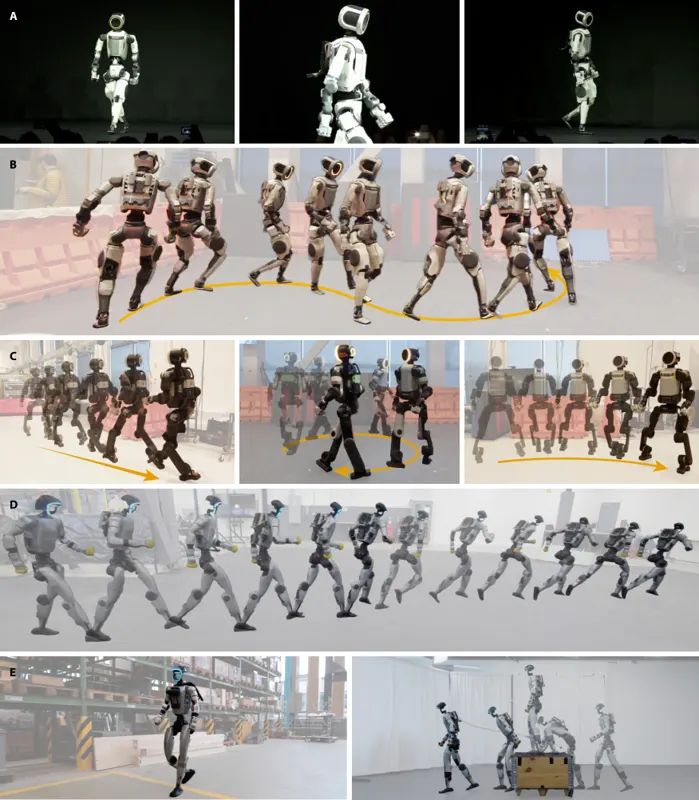
Despite recent advances in humanoid locomotion, controllers optimized for command tracking and robustness tend to produce mechanical gaits, whereas controllers tied to human motion data often fail to generalize to commands outside the data distribution. This work introduces a learning framework that balances these competing objectives to synthesize real-time steerable, robust, and biomimetic locomotion policies from human data. Using an in-house curated locomotion dataset covering diverse speeds and directions, we first learn a natural locomotion prior policy through a teacher-student distillation process. Specifically, we train a full-body reference-conditioned policy with Reinforcement Learning (RL), then distill it into a lightweight prior policy conditioned solely on proprioception and a planar torso-velocity steering command. Next, we fine-tune the prior policy with multi-task RL to expand command coverage and robustness beyond the data distribution, pairing a goal-conditioned task that tracks arbitrary commands with a reference-guided task that tracks the human data as an explicit style regularizer. We validate our framework on three humanoid robots: the Boston Dynamics Atlas R1, Atlas D1, and Unitree G1. Experimental results demonstrate robust performance across real-world scenarios, including direct user-controlled locomotion in indoor and outdoor environments, and integration as the locomotion layer within hierarchical control stacks. Benchmarks against Tabula Rasa RL policies trained without human data and ablation studies confirm that our framework yields a lightweight, deployable policy that reconstructs coordinated whole-body behavior from a steering command, retaining the human gait characteristics while remaining robust and fully steerable.

Humanoid LocomotionMotion Imitation
Mike Zhang, Dongho Kang, Kevin Bergamin · 759 views · Oct 7, 2026

As an Amazon Associate, we earn from qualifying purchases.