Skip to content
RynnUnify: Towards Unified Embodied Brain

RynnUnify: Towards Unified Embodied Brain

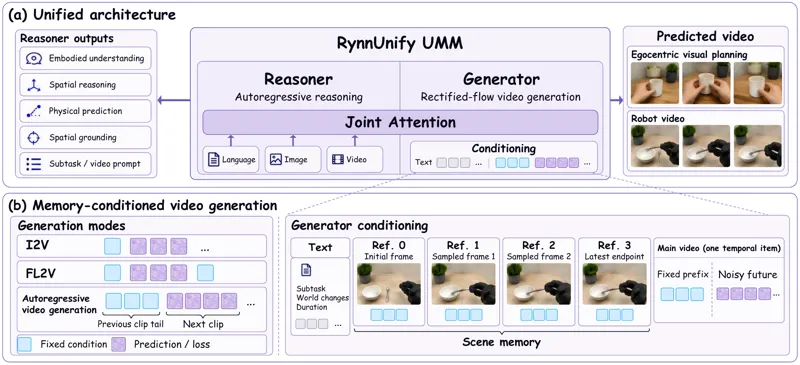
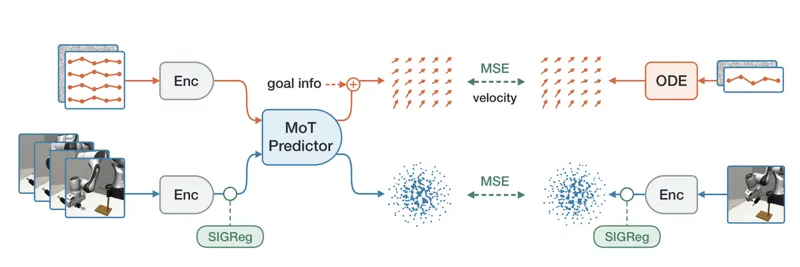
We introduce RynnUnify, a 16B unified embodied model that combines strong embodied understanding with long-horizon visual planning through interleaved video–language reasoning. With capabilities spanning spatial reasoning, physical prediction, and grounding, RynnUnify connects an understanding of the physical world with visual anticipation of how it evolves across successive subtasks. Building on these capabilities, we further develop an agentic extension through reinforcement learning to selectively use video predictions for reasoning about unobserved states and interaction outcomes. We also develop a world-action extension of the full RynnUnify model, translating its understanding and prediction capabilities into robot control. To evaluate these capabilities, we introduce Rynn-VP and Rynn-GEU for long-horizon visual planning and anticipatory reasoning. Experiments show that RynnUnify achieves the highest average embodied understanding score among the evaluated unified multimodal models and improves the Rynn-VP overall score by 9.75 points over Cosmos 3 Nano. Its agentic extension improves the Rynn-GEU average by 6.0 points over direct reasoning, while the world-action extension achieves 51.5% success on 20 selected composite RoboCasa365 tasks and 46.7% average success across three real-robot tasks. Together, these results establish RynnUnify as a shared foundation for embodied understanding, visual planning, and robot control, taking a step toward a unified embodied brain.

RynnUnifyEmbodied AI
Minghao Zhu, Bohan Hou, Kun Xiang · 288 views · Oct 23, 2026
Agentic World Action Models

Agentic World Action Models

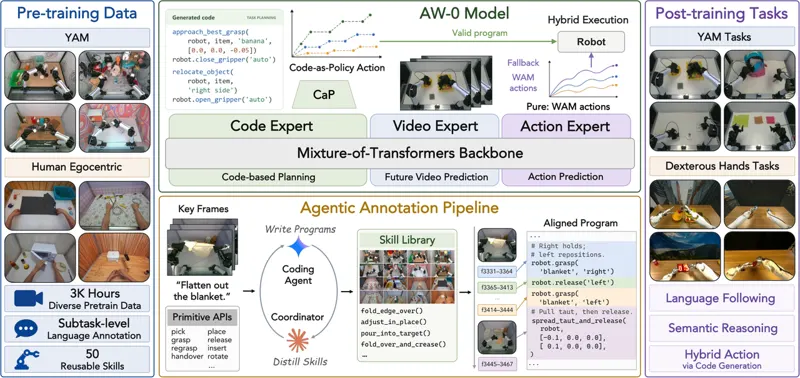
Recent world action models provide visual foresight and future prediction for robot manipulation, but lack explicit mechanisms for compositional skill reuse. Agentic robotics combines code-based planning and reasoning with reusable skills, but often lacks predictive grounding in physical dynamics. We introduce AW-0, an agentic world action model framework that integrates code-based planning with joint video and action prediction. We jointly model code, future video, and robot actions as three coupled generative streams within a unified mixture-of-transformers architecture. Within this architecture a code expert generates parameterized skill routines and control logic while video and action experts generate future visual states and low-level motor commands. Code serves two complementary roles: it structures multi-step prediction and control within the world model and represents skills as reusable programs for subsequent agentic execution. We further introduce an automated curation pipeline that labels robot and human video trajectories with aligned programs and consolidates recurring routines into reusable skill libraries. Evaluations on RoboTwin 2.0 and physical bimanual manipulation tasks show improved task performance over VLA and WAM baselines, alongside gains in language following, semantic reasoning and robustness, demonstrating that agentic code enables connection between planning, prediction and execution within WAMs.

World-action modelsVision-language-action (VLA)
Liu, Zhuoyang, Niu, Dantong, Zhang, Botong · 295 views · Oct 21, 2026
Thinker-WM: A Unified World Model with Shared Multimodal Representations for Embodied Intelligence

Thinker-WM: A Unified World Model with Shared Multimodal Representations for Embodied Intelligence

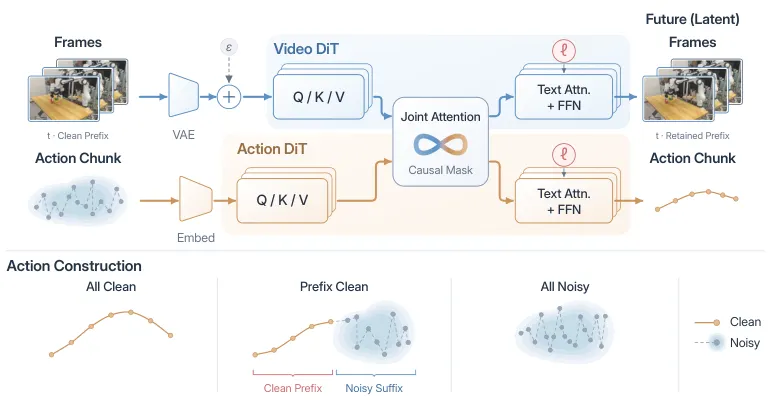
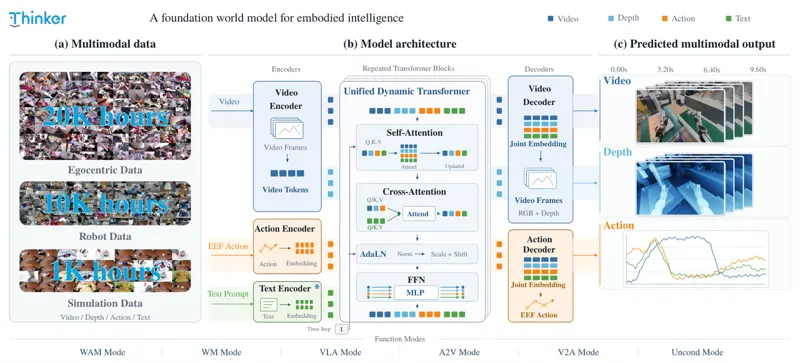
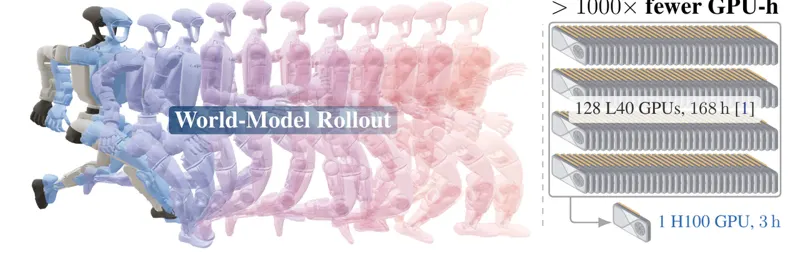
World models have emerged as a promising paradigm for embodied AI, yet existing systems often remain fragmented in the modalities they model and the functions they support. In particular, visual dynamics, geometric structure, and executable action are commonly coupled through separate interfaces or downstream modules rather than being jointly represented and evolved within a shared dynamics model. In this work, we present Thinker-WM, a unified multimodal world model that jointly models and generates RGB, metric depth, and robot action through a shared intermediate Unified Dynamics Transformer with modality-specific encoders and decoders. The model performs multimodal unification at the representation level: appearance, geometry, and action are transformed into a common dynamic representation and jointly evolved by shared parameters, while their distinct output structures are preserved. The same parameterization supports multiple functions, including joint video-action generation, world prediction, policy inference, action-conditioned generation, video-to-action generation, and inverse dynamics. To examine whether the shared representation captures action-related information, we introduce a lightweight motion probe that shows the frozen visual representation contains recoverable motion information. Thinker-WM is trained on a heterogeneous corpus comprising approximately 20K hours of egocentric video, 10K hours of real-robot data, and 1K hours of simulation data, including approximately 4K hours of real-robot data with aligned depth supervision. Extensive experiments demonstrate strong performance across embodied world-model evaluations. Thinker-WM ranks first on EWMBench, WorldOlympiad and WorldArena, while controlled studies further demonstrate the benefits of action conditioning, geometric interaction, and multi-function training within the shared representation.

World ModelsEmbodied AI
Thinker Team, Peng Gao, Jichao Jiao · 285 views · Oct 13, 2026
Agent World Model in the Wild: Computer-Use Agent Environment Synthesis

Agent World Model in the Wild: Computer-Use Agent Environment Synthesis

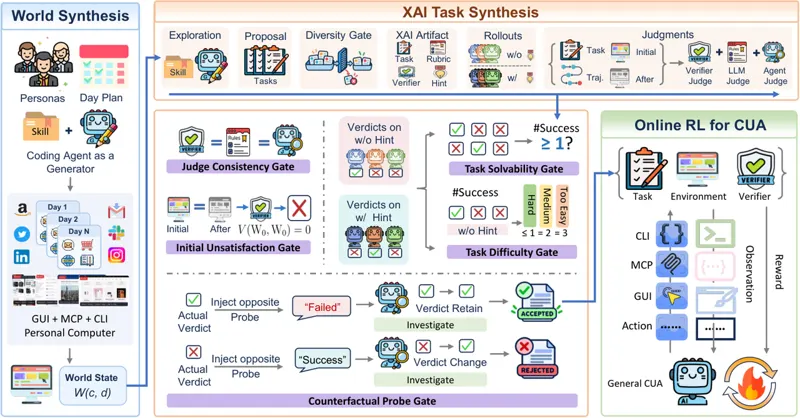
Agent learning is shifting from learning from human data toward learning through interaction with the world. However, scaling such learning directly in real-world computer systems is challenging and can introduce substantial security risks. We therefore propose Agent World Model in the Wild (WildAWM), a scalable pipeline for synthesizing controllable environments and tasks for training general computer-use agents (CUAs). Whereas existing approaches typically specialize in a single agent interaction interface, we construct executable environments that jointly support graphical user interfaces, model context protocol services, and command-line interfaces, allowing agents to flexibly combine visual interaction, tool use, and code execution. WildAWM is entirely powered by open-source models, demonstrating that high-quality computer-use environments can be generated without proprietary frontier models. Beyond environments, we address three recurring challenges in task synthesis: ensuring solvability, maintaining sufficient difficulty, and producing reliable verifiers, by introducing execution-based quality gates that combine heterogeneous agent rollouts, cross-judge consistency checks, and counterfactual probes of judgment robustness. The resulting pipeline synthesizes 341 long-horizon environment-task pairs that can require over 100 agent steps to solve and remain challenging even for frontier models, with GPT-6-Astra solving only 60% of them. We train two Qwen models of different sizes exclusively in these synthetic worlds. Both models achieve substantial gains across 8 out-of-distribution benchmarks spanning web, claw, and computer-use agents, demonstrating that learning in WildAWM's synthesized worlds generalizes broadly to unseen computer-use tasks. The code is publicly available at https://github.com/MSR-Orchard/WildAWM.

Computer-Use AgentWorld Models
Zhaoyang Wang, Qianhui Wu, Haorui Wang · 360 views · Oct 19, 2026

As an Amazon Associate, we earn from qualifying purchases.