Skip to content
←Back to Papers

PAPER DEEP DIVE

NVIDIAHumanoidFoundation Models

GR00T N1: NVIDIA Humanoid Robot Foundation Model

GR00T N1 is NVIDIA's humanoid foundation model combining vision-language understanding with action generation for cross-platform transfer.

GR00T N1 is NVIDIA's humanoid foundation model combining vision-language understanding with action generation for cross-platform transfer.

Related Papers

FLORA: An Open Model Suite for Scaling Robotics Data Engines

FLORA: An Open Model Suite for Scaling Robotics Data Engines

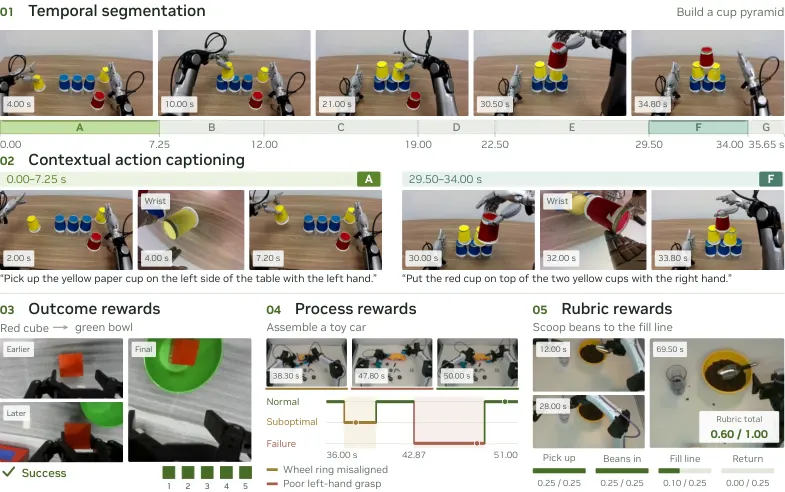
The life-cycle of robotics foundation models crucially depends on data labels. Outcome reward labels are needed for monitoring real-world deployments. Process reward labels are needed during RL post-training. Timestamped captions are needed for filtering and balancing pretraining data. We present Flora, an industrial-quality data engine used for training GR00T models, that simultaneously covers these capabilities. Flora achieves SOTA scores on the captioning benchmark WGO-Bench and reward benchmarks RoboReward and Robometer. On internal benchmarks it is competitive with GPT-6 Astra while beating other frontier models. The model is substantially cheaper than API-based alternatives, roughly 125 times cheaper than GPT-6 Astra. Flora is battle tested at scale, labeling 200,000 hours of data per day across 512 GB300s. By open-sourcing our data engine, we enable researchers to scale custom robotics datasets and explore emerging applications such as physical auto-research and human-to-robot transfer.

Sicong Leng, Yunze Man, Zhiqi Li · 148 views · Oct 22, 2026
Robotics Data EngineTemporal Action Segmentation
Oct 22, 2026
ASPIRE: Agentic /Skills Discovery for Robotics

ASPIRE: Agentic /Skills Discovery for Robotics

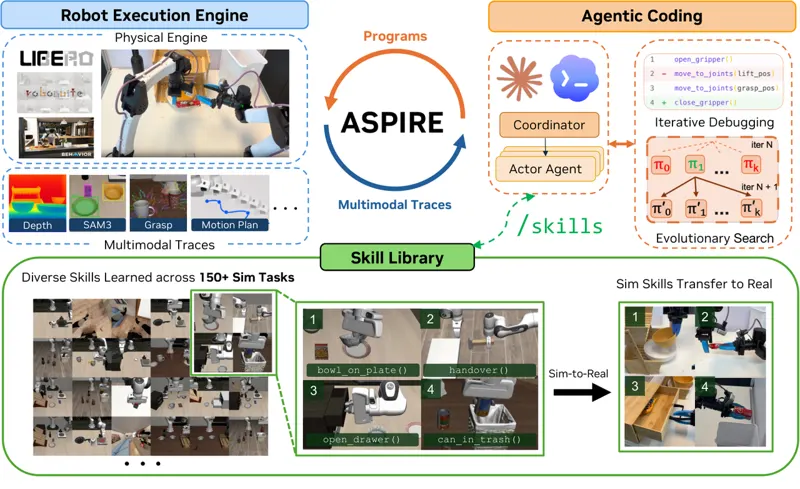
ASPIRE diagnoses robot-program failures from multimodal traces, repairs executable policies through evolutionary search, and compounds verified fixes into a reusable skill library that transfers across tasks, embodiments, and real robots.

Runyu Lu, Yubo Wu, Ethan Kou · 377 views · Jun 30, 2026
ASPIREAgentic Robotics
Jun 30, 2026
Agentic World Action Models

Agentic World Action Models

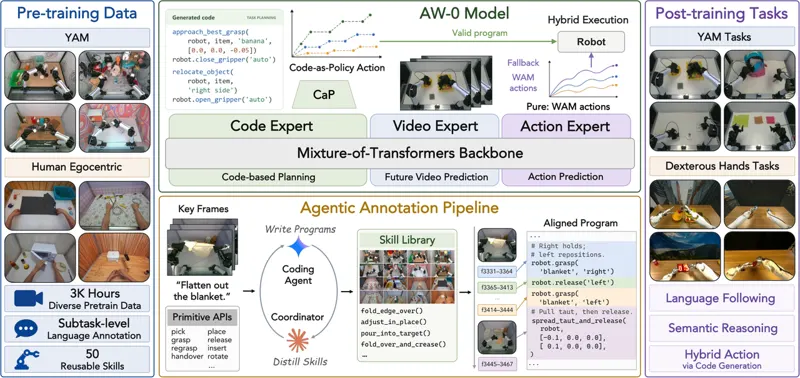
Recent world action models provide visual foresight and future prediction for robot manipulation, but lack explicit mechanisms for compositional skill reuse. Agentic robotics combines code-based planning and reasoning with reusable skills, but often lacks predictive grounding in physical dynamics. We introduce AW-0, an agentic world action model framework that integrates code-based planning with joint video and action prediction. We jointly model code, future video, and robot actions as three coupled generative streams within a unified mixture-of-transformers architecture. Within this architecture a code expert generates parameterized skill routines and control logic while video and action experts generate future visual states and low-level motor commands. Code serves two complementary roles: it structures multi-step prediction and control within the world model and represents skills as reusable programs for subsequent agentic execution. We further introduce an automated curation pipeline that labels robot and human video trajectories with aligned programs and consolidates recurring routines into reusable skill libraries. Evaluations on RoboTwin 2.0 and physical bimanual manipulation tasks show improved task performance over VLA and WAM baselines, alongside gains in language following, semantic reasoning and robustness, demonstrating that agentic code enables connection between planning, prediction and execution within WAMs.

Liu, Zhuoyang, Niu, Dantong, Zhang, Botong · 268 views · Oct 21, 2026
World-action modelsVision-language-action (VLA)
Oct 21, 2026
Into the LidarVerse: A Real-Time Unified LiDAR World Model Across Tasks and Sensors

Into the LidarVerse: A Real-Time Unified LiDAR World Model Across Tasks and Sensors

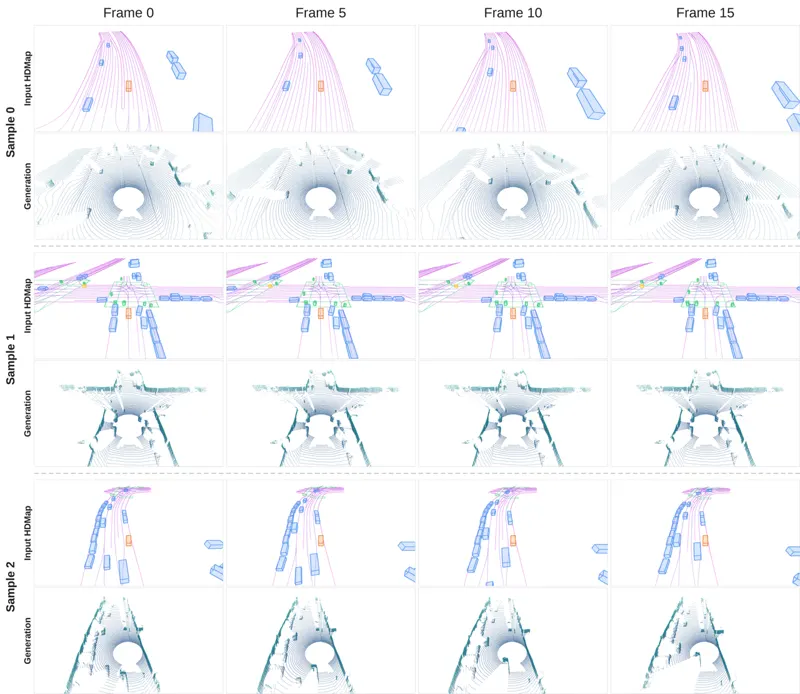
We present LidarVerse, a real-time unified LiDAR world model for sensor simulation across tasks and sensors. Existing LiDAR simulators largely follow one of two complementary paradigms: reconstruction-based methods preserve the geometry of a captured scene but require lengthy per-scene optimization, whereas generative methods amortize learning across data but lack the consistency needed for long-horizon rollouts. LidarVerse brings both paradigms into a single, unified conditional generative framework. A universal tokenizer maps LiDAR range sequences into a shared latent space, where a bidirectional teacher learns a common interface for conditioning on a LiDAR prefix, an HD-Map, a persistent spatial cache, and optionally, text. Varying the available scene evidence turns the same model into a generator of new worlds, a point-cloud forecaster, or a generalizable resimulator of observed scenes without per-scene optimization. We distill the teacher into a four-step autoregressive causal student and maintain both a rolling temporal K/V cache and a world-aligned spatial cache, enabling persistent long-horizon rollouts with real-time inference at 11 FPS on a single H100 GPU. LidarVerse achieves state-of-the-art performance on most reported metrics across all three evaluation protocols, while its tokenizer supports 32-, 64-, and 128-beam LiDAR and generalizes to an unseen scanning pattern. These results demonstrate that generative and reconstruction-grounded LiDAR simulation can be realized within one model, providing the core capabilities for future closed-loop sensor simulation.

Che, Henry, Ren, Xuanchi, Fidler, Sanja · 359 views · Oct 13, 2026
LiDARWorld Models
Oct 13, 2026

As an Amazon Associate, we earn from qualifying purchases.