P-BFM: Perceptive Behavioral Foundation Models for Humanoid Control via Unsupervised Reinforcement Learning
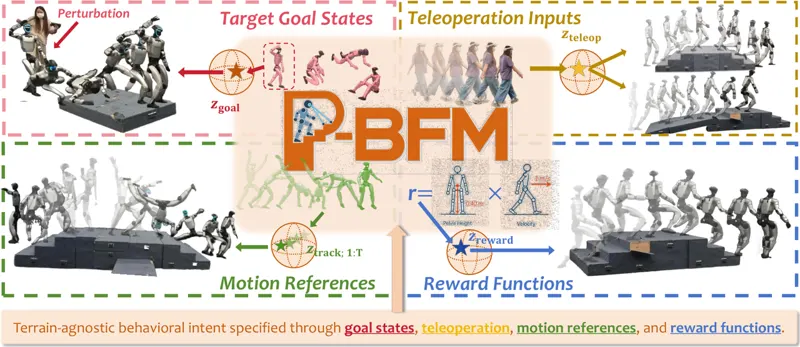
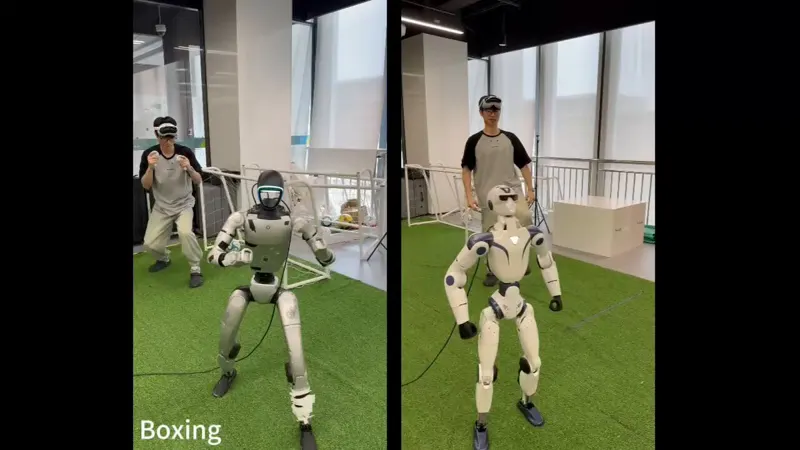
Behavioral foundation models (BFMs) provide humanoids with reusable repertoires of whole-body behaviors; in real-world humanoid control, the same behavioral intent may require fundamentally different motions under different terrain constraints. Covering such variation with terrain-matched demonstrations requires enumerating a combinatorial space of behaviors and terrain geometries. We introduce P-BFM, a perceptive behavioral foundation model that factorizes humanoid control into terrain-invariant intent and terrain-conditioned realization. A forward-backward representation maps motion references, target states, and reward functions into a shared intent space without terrain information, while a perceptive policy learns how to realize each intent under the surrounding terrain geometry. We further identify a complementary limitation of purely latent control: behavioral latents can preserve local motion patterns while losing precise global progress. We therefore introduce Explicit Root Instructions (ERI), which separates global transport (e.g., heading and planar velocity) from behavioral intent, while leaving local whole-body adaptation to the perceptive policy. This decomposition leads to a characteristic capability absent from conventional BFMs: one fixed intent induces different, terrain-appropriate behaviors, including changes in step height, stride, posture, foothold placement, and contacts, without terrain-specific demonstrations. Across challenging terrains, P-BFM improves motion fidelity, root-control precision, and perturbation recovery over strong baselines. A single frozen policy further supports motion tracking, goal reaching, reward inference, teleoperation, and terrain-aware recovery, and transfers zero-shot to a Unitree G1 using onboard depth sensing.
Xue Wang, Yitang Li, Yiming Zhang · 495 views · Oct 11, 2026
HumanoidUnsupervised Reinforcement Learning
Oct 11, 2026
 2:17