Skip to content
← Tags

#World-action models (52)

UniWAM: Unified World-Action Model

UniWAM: Unified World-Action Model

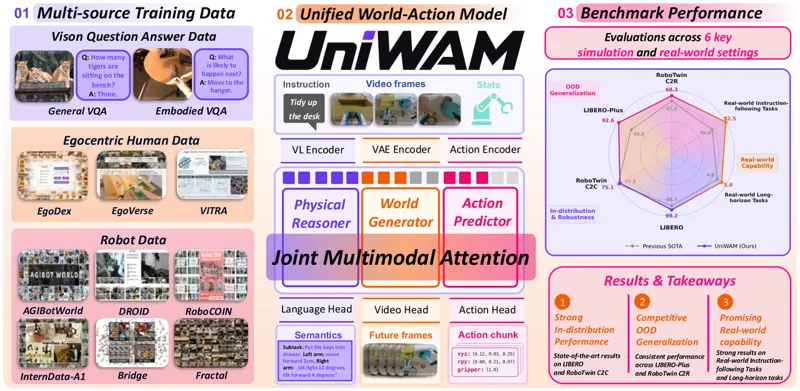
Vision-language-action models benefit from the understanding and reasoning capabilities of pretrained vision-language models, but action-only supervision provides limited grounding in world dynamics. Conversely, world-action models inherit spatiotemporal priors from video generation models, yet remain limited in semantic understanding and reasoning under distribution shifts. We introduce UniWAM, a unified architecture that integrates a physical reasoner, a world generator, and an action predictor to jointly learn semantic understanding of the physical world, visual generation, and action prediction. To ensure the quality of the training data, we developed a rigorous data cleaning and annotation pipeline for both human egocentric data and robot data. To adapt the vision-language component to embodied tasks while preserving its inherited language capabilities, we represent low-level actions in natural language and introduce a pre-training recipe that assigns complementary supervision from visual question answering (VQA) data, human egocentric data, and robot demonstrations to the appropriate model components. During post-training, future visual noise augmentation reduces reliance on precise future predictions, while history-conditioned flow matching uses encoded action history to initialize action generation. Together, these designs significantly reduce denoising steps while maintaining performance. UniWAM achieves state-of-the-art (SOTA) performance across multiple evaluations, including in-distribution performance, robustness, generalization, instruction following, and long-horizon task execution. Furthermore, we uncover a log-linear scaling law of unified human-robot co-training, demonstrating the effectiveness of large-scale pre-training on a mixture of human and robot data.
Wenxuan Song, Jiayi Chen, Jingbo Wang · 128 views · Oct 1, 2026
World-action modelsVision-language-action (VLA)
Oct 1, 2026
Agentic World Action Models

Agentic World Action Models

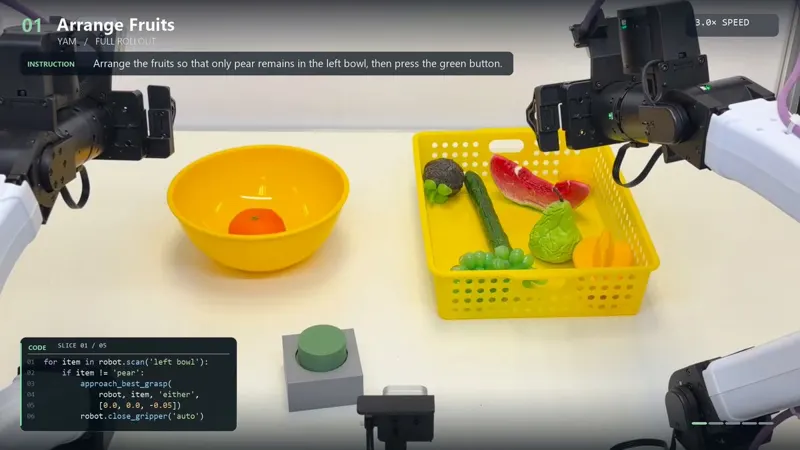
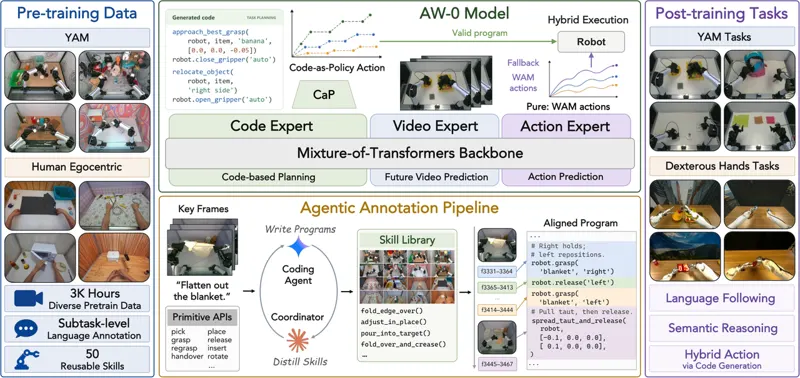
Recent world action models provide visual foresight and future prediction for robot manipulation, but lack explicit mechanisms for compositional skill reuse. Agentic robotics combines code-based planning and reasoning with reusable skills, but often lacks predictive grounding in physical dynamics. We introduce AW-0, an agentic world action model framework that integrates code-based planning with joint video and action prediction. We jointly model code, future video, and robot actions as three coupled generative streams within a unified mixture-of-transformers architecture. Within this architecture a code expert generates parameterized skill routines and control logic while video and action experts generate future visual states and low-level motor commands. Code serves two complementary roles: it structures multi-step prediction and control within the world model and represents skills as reusable programs for subsequent agentic execution. We further introduce an automated curation pipeline that labels robot and human video trajectories with aligned programs and consolidates recurring routines into reusable skill libraries. Evaluations on RoboTwin 2.0 and physical bimanual manipulation tasks show improved task performance over VLA and WAM baselines, alongside gains in language following, semantic reasoning and robustness, demonstrating that agentic code enables connection between planning, prediction and execution within WAMs.

Liu, Zhuoyang, Niu, Dantong, Zhang, Botong · 377 views · Oct 21, 2026
World-action modelsVision-language-action (VLA)
Oct 21, 2026
Data-Free Continual Learning for World Action Model with Rectified Generative Replay

Data-Free Continual Learning for World Action Model with Rectified Generative Replay

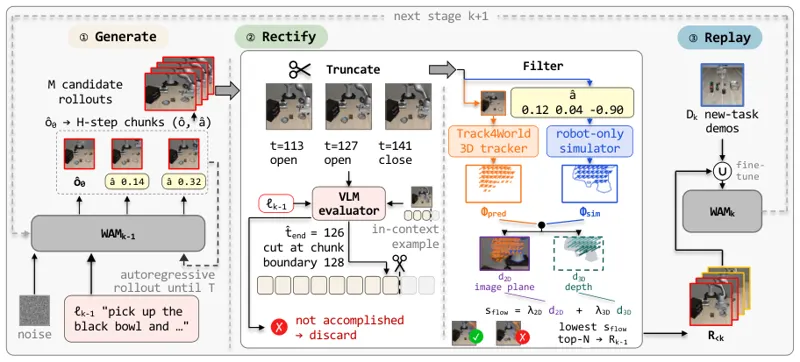
World action models (WAMs) built on pretrained video generation models adapt quickly to new robotic tasks, but they forget previously learned tasks under sequential fine-tuning. Experience replay (ER) mitigates such forgetting by rehearsing data of previous tasks, yet this data is often unavailable in robotics, where a policy is deployed as weights only and its training data is not shared along with it. In this work, we ask whether a WAM can achieve data-free continual learning by regenerating its own past. Our key observation is that a WAM can indeed autoregressively regenerate complete rollouts of previously learned tasks and replay them to mitigate forgetting. However, replaying such raw rollouts still lags far behind replaying real data, which we attribute to two issues. First, the WAM is unable to recognize task completion and keeps generating purposeless motion after the task is done. Second, under open-loop generation, the generated actions gradually drift away from the generated observations. To address both issues, we present rectified generative replay (R²-WAM), which truncates generated rollouts at task completion with an agentic evaluator and filters out rollouts whose actions are physically inconsistent with the observations. On the four LIBERO suites and five real-world tasks, R²-WAM reduces forgetting by over 90% relative to sequential fine-tuning and nearly matches ER without accessing any data from previous tasks. Our analysis further reveals that forgetting in WAMs concentrates in inverse dynamics modeling: a forgotten WAM still produces visually plausible observations of previous tasks while its generated actions fail. Project page: https://kaipengfang.github.io/r2-wam/

Kaipeng Fang, Hangxu Liu, Chaojian Shi · 267 views · Oct 13, 2026
Continual learningWorld-action models
Oct 13, 2026
LoopWAM: Closed-Loop Generalist Policy Improvement from Deployment Rollouts

LoopWAM: Closed-Loop Generalist Policy Improvement from Deployment Rollouts

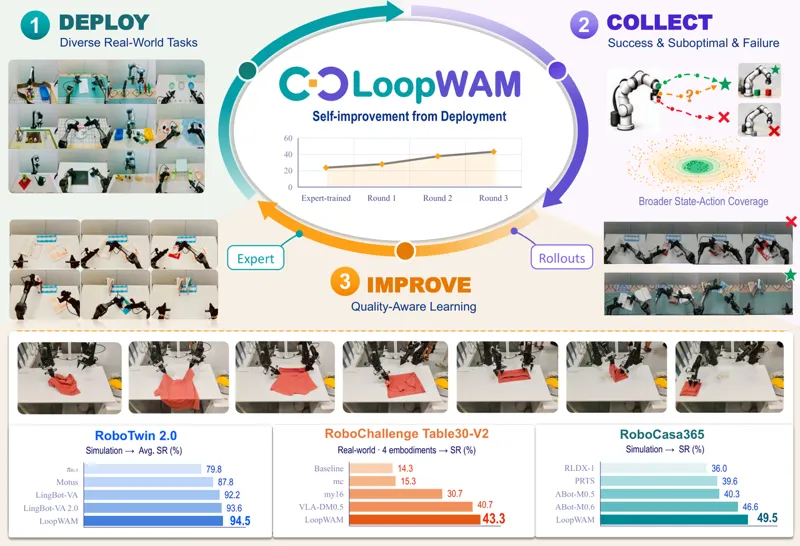
Scaling expert demonstrations alone does not enable generalist robot policies to improve from deployment. Real-world rollouts contain successes, suboptimal behavior, and failures: imitating every recorded action can reinforce poor behavior, while filtering out failures discards evidence of physical interactions and their consequences. We introduce LoopWAM, a closed-loop world-action model that learns directly from this full quality spectrum, using rollouts from both itself and other deployed policies. Source-dependent noise sampling unifies behavior learning and action-conditioned world modeling, while quality steering and quality-weighted supervision retain full video supervision across qualities and regulate action imitation. Video and action tokens interact throughout parallel denoising, allowing learned consequences to inform action generation directly. On RoboChallenge Table30-V2, three deployment-and-training rounds raise success from 23.67% to 43.33%, a 19.7-percentage-point gain, with a final score of 56.80. LoopWAM also achieves 94.5% average success on RoboTwin 2.0 and 49.5% overall success on RoboCasa365 without additional embodied pretraining, obtaining the best overall results among the compared methods across all three benchmarks. On challenging shirt folding task, two rounds of deployment-driven improvement after single-task post-training raise success from 13.20% to 55.56%. These results demonstrate closed-loop improvement from mixed-quality experience under both multi-task learning and single-task post-training. Project page: https://loop-wam.github.io/

Wenxuan Guo, Yingping Liang, Zhaoguo Wang · 459 views · Oct 13, 2026
World-action modelsSelf-Improvement
Oct 13, 2026
Agile-WAM: An Agile Tactile World Action Model for Contact-Rich Robot Control

Agile-WAM: An Agile Tactile World Action Model for Contact-Rich Robot Control

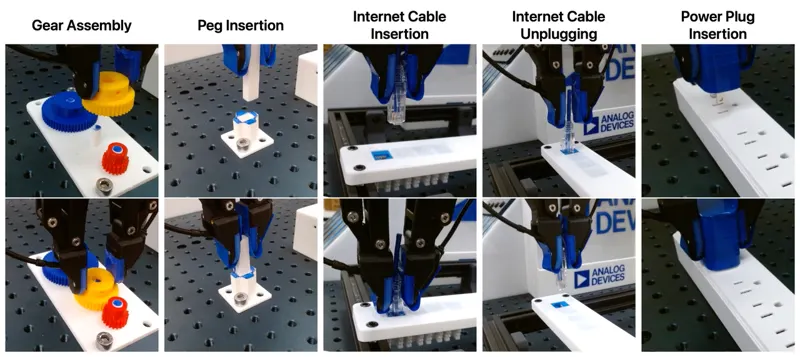
World Action Models (WAMs) advance beyond conventional visuomotor policies by jointly predicting future world states and robot actions, enabling the policy to learn phys- ical dynamics that support effective control. However, recent tactile WAMs often rely on large-scale pretrained generative backbones to capture contact-rich physical dynamics, which limit their inference efficiency and flexible deployment. In this paper, we present Agile-WAM, an agile tactile World Action Model for contact-rich robot control. Agile-WAM encodes visual and tactile observations into a shared latent that serves as the source of a direct vision-tactile-to-action flow-matching process, which can jointly generate latent representations of action chunks and future visual/tactile latents. A key observation is that vision and tactile signals evolve at inherently different timescales: adjacent visual frames are often highly similar, whereas tactile signals can change abruptly upon contact. We therefore introduce multi-horizon multimodal prediction in Agile-WAM, which provides supervision for visual latent at a larger temporal offset while predicting the tactile latent in the next frame to capture fine-grained contact dynamics. Across nine simulated and five real-world contact-rich ma- nipulation tasks, Agile-WAM demonstrates strong and robust performance, outperforming the strongest baseline in success rate while maintaining low inference latency. In particular, in five real-world experiments, Agile-WAM yields a relative gain of 29.4% in overall success rates while achieving inference latency of 11.9 ms. These results demonstrate that multimodal WAM can be achieved with an agile architecture suitable for precise and high-frequency robot control. More details are available on our project page.

Hanchu Zhou, Brendan Lynch, Raman Goyal · 289 views · Sep 17, 2026
World-action modelsFlow Matching
Sep 17, 2026
EWAM: Emergent Depth-Wise Specialization in a Unified Embodied Model – From Semantic Understanding through Visual Foresight to Action

EWAM: Emergent Depth-Wise Specialization in a Unified Embodied Model – From Semantic Understanding through Visual Foresight to Action

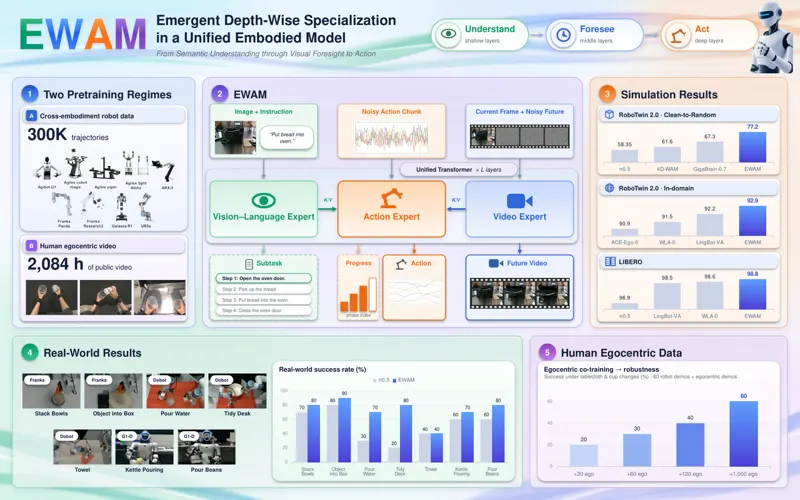
Vision-language-action (VLA) policies emphasize semantic understanding, whereas world-action models (WAMs) learn predictive representations of environment dynamics. Systems that expose a policy to both sources often still concentrate action computation on a single expert. We present EWAM, an action-centric unified embodied model whose asymmetric joint attention lets action tokens read semantic, current-visual, predicted-future, and action information at every layer while the perceptual experts retain their distinct roles. Without layer-wise supervision, EWAM develops an emergent depth-wise specialization: action queries attend mainly to vision-language features in shallow layers, to predicted future frames in intermediate layers, and to action tokens themselves in deep layers. This handoff replicates across tasks and is stable across denoising steps. Checkpoint tracking and causal interventions show that it is learned and that action generation depends on it. EWAM is pretrained in two separate regimes, one on cross-embodiment robot trajectories and one on human egocentric video. In simulation and real-robot experiments, it surpasses existing VLA, WAM, and hybrid baselines. Human egocentric data improve both cross-embodiment transfer and real-robot robustness, and subtask-phase supervision improves long-horizon completion. Together, these results suggest that unified embodied learning can induce an ordered internal progression from semantic understanding, through visual foresight, to action formation.

Hao Wang, Jiajun Wen, Jingzhi Liu · 258 views · Sep 30, 2026
VLAWorld-action models
Sep 30, 2026

As an Amazon Associate, we earn from qualifying purchases.