Dream Labs Comes Out of Stealth With $90M Seed: World Action Model Dream-1 Drives 27 Unseen Robots Zero-Shot at $3 an Hour
Dream Labs emerges from stealth with $90M in seed funding and Dream-1, a World Action Model that drives 27 robots it was never trained on over a public API at $3 an hour, about $0.0013 per action.
Dream Labs has come out of stealth with $90M in seed funding and a model called Dream-1, and the claim it is making is unusually specific. Dream-1 is a World Action Model (WAM): it controls robots it has never seen, on tasks it was never shown, in places it has never been, and it is served over a public API at $3 per hour of robot operation. That works out to roughly $0.0013 per model call, since each call returns 1.6 seconds of actions.
The interesting part is not the price. It is that the model was pointed at 27 robot embodiments in simulation that contributed no training data whatsoever — including a Willow Garage PR2, an 18-year-old design — plus 21 clips on real bimanual machines at a dozen beta sites from Shenzhen to New York, and it did useful work on most of them out of the box. Zero-shot cross-embodiment transfer has been a promised land in robot learning for years. This is one of the first reported cases of it happening on completely unseen bodies, and Dream Labs published the per-robot numbers, including the ones where it fails.
01 · The chicken-and-egg problem robotics never escaped
The argument for Dream-1 starts with a structural defect in the robotics business rather than with a benchmark. For decades the field has been caught in a loop: a robot has to be useful before anyone buys it, but making it useful requires data from that exact robot, and that data only exists once enough people are already using it.
Self-driving found a way around the same cold start. Cars were useful on day one with zero autonomy, so millions of people drove them every day and generated the data that trained increasingly capable models. Most other robots never had that advantage: an arm in a lab is not a product anyone drives to work.
flowchart LR
  A["Cheaper hardware"] --> B["More robots in the world"]
  B --> C["Models that generalize zero-shot"]
  C --> D["Useful earlier, without robot-specific data"]
  D --> E["Every deployed robot emits new data"]
  E --> C
Two things are changing that, according to Dream Labs. First, hardware is cheap enough to reach far more people — a capable bimanual arm setup can now cost as little as $2k. Second, a robot may no longer need a large dataset of its own before it is useful: if a model generalizes zero-shot to unseen environments, tasks and even robots, a new robot starts with useful capabilities instead of starting from nothing. Put those together and the flywheel can finally turn — cheaper hardware puts more robots into the world, generalizable models make them useful earlier, useful robots generate data, and that data improves the model for the next robot.
02 · Cheap robots are the other half of the argument
| Number | What it buys | Note |
|---|---|---|
| $2,000 | A capable bimanual arm setup | MakerMods Maker Arm, as of today |
| 7 | Semi-humanoids under $15k | Wheels, two arms, parallel grippers |
| $399 | Hugging Face Microduck | Launched late August 2026 |
| 10,000+ | Microducks sold | Within four days of launch |
The Microduck number is the one worth dwelling on. A $399 robot whose main job is to be delightful — it walks, waddles and roller-skates — sold more than 10,000 units within four days of pre-orders opening on 28 August. Dream Labs reads this as a statement about who actually buys the first generation of cheap robots: consumers, prosumers and small teams, not enterprises.
The distinction matters because an enterprise buyer is making a spreadsheet decision. If the robot does not beat a person on cost, speed or reliability, it does not get bought — a high bar. Consumers are different: 10,000 people paid $399 in four days for something cute. Somewhere between that and a fully capable home robot sits a sweet spot, a machine affordable enough to be an easy yes and useful enough to earn its place in the house. Once robots reach that point, adoption compounds, and every robot in a home becomes a source of new training data. The image the post offers is two Microducks folding laundry, using their beaks as grippers.
03 · The 30-minute result that started the company
In February 2026 the same team released DreamZero, the paper that introduced World Action Models, and the community has since adopted WAMs as one of the more promising paradigms in robot learning. The result that surprised its own authors came afterwards: after post-training DreamZero on just 30 minutes of YAM robot data, it generalized zero-shot to tasks it had never seen. That kind of transfer used to require hundreds or even thousands of hours of embodiment-specific data.
The inference they drew is the founding thesis of Dream Labs. If 30 minutes of data from a given robot is enough to move general-purpose task knowledge onto that robot, then breaking the chicken-and-egg loop stops looking impossible. Combined with the hardware wave above, the timing looked right, and the company was formed. Six months later, Dream-1 is the result: what they describe as early signs of zero-shot embodiment generalization, something they say was only possible because the model is a world action model.
04 · What Dream-1 did before launch
Rather than a lab demo, the release is documented as a distributed one. Twelve beta sites ran Dream-1 on their own hardware in their own rooms, and Dream Labs added 18 autonomous in-house runs. The tasks are mundane on purpose, and the videos on the source page run at 8x speed for beta sites and 4x in-house.
| Site | Location | Task |
|---|---|---|
| Anvil Robotics | Caribbean | Sort the candy into containers |
| BitRobot | Shenzhen, China | Pull out a tissue |
| Cortex | Singapore | Stack the white cup on top of the pink cup |
| Eastworld | Kuala Lumpur, Malaysia | Place the apple in the brown box |
| Hugging Face | Paris, France | Pick up the red cube and put it in the green container |
| KAIST | Seoul, Korea | Fold the box |
| XDOF | Jakarta, Indonesia | Find the marker and pick it up |
| RoboCurve | San Francisco, USA | Stand all three bottles upright |
| Scale AI | San Francisco, USA | Stack the cubes into a single tower |
| Robo Inc. | Los Angeles, USA | Move chips to tray |
| Mecka | New York, USA | Lift a test tube from the loose rack |
| AgiBot | Shanghai, China | Pick apple to plate |
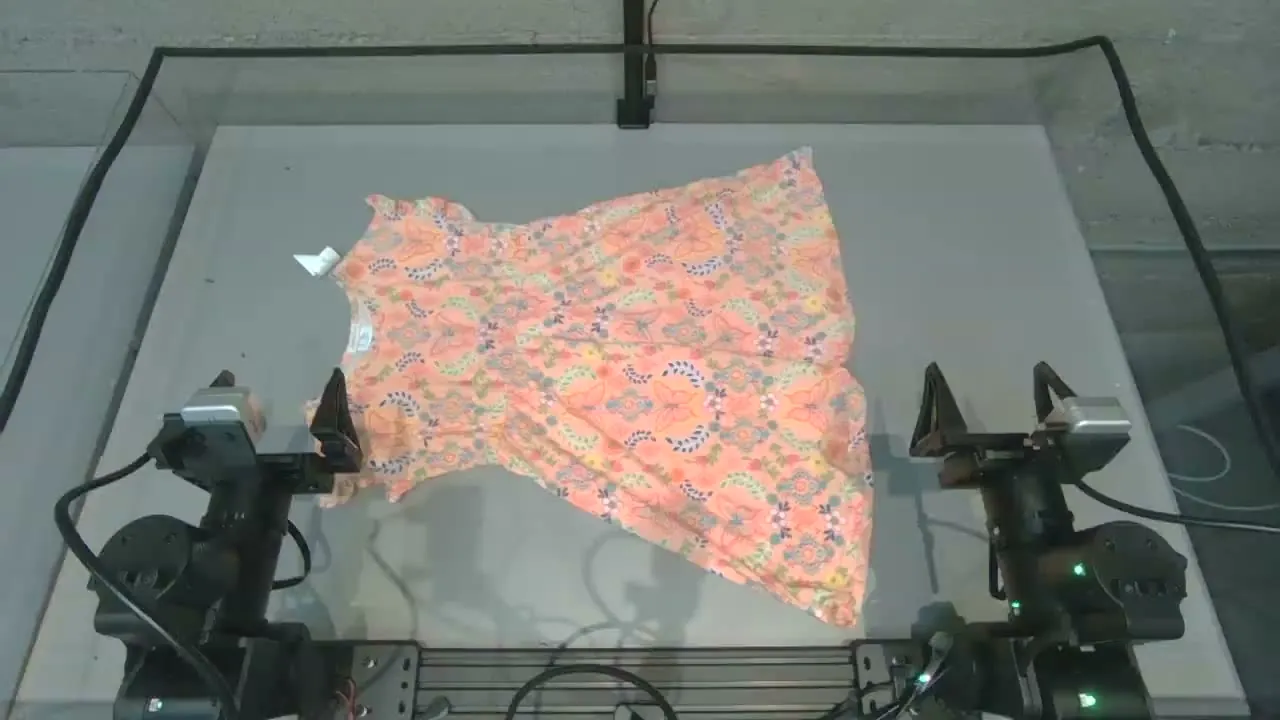
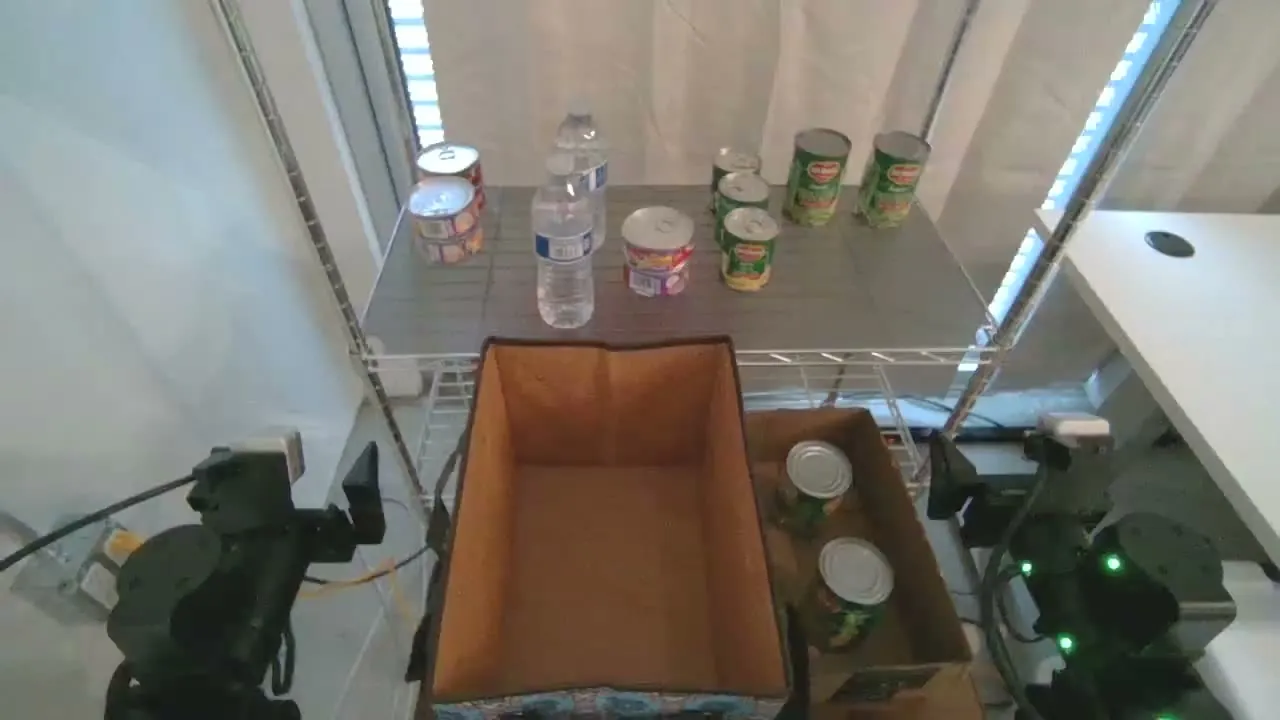
The in-house runs are longer-horizon household work: fold the dress, clear the dishes from the countertop into the sink, hang the mug on the mug hook, scoop the cat litter, restock food cans from a box onto a shelf, put the egg in the empty spot in the carton, wipe the countertop with the blue sponge, dry a plate and put it on the rack, slide the middle book out from a stack of three.
04.1 Five lines of client code
Dream Labs says it wants generalizable robotics to be reachable by anyone with a robot, not just large labs, so the integration surface is deliberately thin: connect the robot, point it at the API, run. No machine-learning background is required, and the team runs internal hackathons every week specifically to keep time-to-deploy short.
import dream

client = dream.DreamClient(api_key=<API_KEY>)
client.policy({"checkpoint": "dreamlabs/dream-1"})

client.set_observation(observation)
action = client.get_action()

client.close()
04.2 Zero-shot on robots it has never seen
The headline evidence is a wall of rollouts: 27 unseen robots in simulation, up to five picked rollouts each, and 21 clips on real bimanual gripper robots. No embodiment-specific data was used for any of them. The list reads like a census of the last two decades of manipulation hardware — ALOHA, Baxter, Franka FR3 pairs, Kinova Gen3 pairs, KUKA LBR iiwa 14, UR5e pairs, Sawyer pairs, WidowX 250, xArm 7, YuMi, Galaxea A1Z, Unitree R1, Hugging Face SO-101, Seeed reBot B601-DM, MakerMods Maker Arm and Metal Arm, Anvil OpenYAM, I2RT YAM-7 and YAM with a UMI gripper, and the original PR2 from Willow Garage.
The PR2 is the rhetorical flourish, and it lands: a general-purpose bimanual research robot released 18 years ago, controlled zero-shot by a model trained on a different body entirely.
Performance is not uniform, and Dream Labs publishes the spread rather than a single average. Each embodiment was evaluated over 300 rollouts: 150 rollouts across 50 tasks to quantify language following, and 150 rollouts across 150 tasks to quantify unseen-task generalization. Scores below are relative to YAM, the robot Dream-1 was actually trained on, set at 100.
| Robot | Maker | Score |
|---|---|---|
| YAM (reference) | I2RT | 100.0 |
| PiPER, two arms | AgileX Robotics | 91.2 |
| Trossen Workbench | Trossen Robotics | 82.8 |
| OpenYAM | Anvil Robotics | 82.7 |
| Metal Arm | MakerMods | 80.5 |
| ARX X5 | ARX | 77.4 |
| PR2 | Willow Garage | 73.8 |
| UR5e, two arms | Universal Robots | 69.8 |
| Gen3, two arms | Kinova | 66.9 |
| reBot B601-DM | Seeed Studio | 66.1 |
| xArm 7, two arms | UFactory | 65.7 |
| Unitree R1 | Unitree | 63.9 |
| Maker Arm | MakerMods | 63.1 |
| ALOHA | Trossen (Interbotix) | 63.1 |
| LBR iiwa 14 | KUKA | 62.4 |
| WidowX 250, two arms | Trossen (Interbotix) | 62.2 |
| Sawyer, two arms | Rethink Robotics | 60.5 |
| YuMi | ABB | 59.4 |
| YAM + UMI gripper | I2RT x GenRobot.AI | 58.7 |
| Baxter | Rethink Robotics | 58.7 |
| Franka FR3, two arms | Franka Robotics | 58.3 |
| AI Worker | ROBOTIS | 57.0 |
| SO-101 | Hugging Face | 54.2 |
| Galaxea A1Z | Galaxea | 54.1 |
| OpenArm 2.0 | Enactic | 53.9 |
| Mantis | Blue Worm | 45.8 |
| YAM-7 | I2RT | 38.0 |
| Bracket Bot | Bracket Bot | 36.6 |
Read the distribution, not the mean. The top of the table is genuinely close to the trained-on robot — PiPER at 91.2, Trossen Workbench at 82.8, OpenYAM at 82.7 — while the bottom third sits between 36 and 55, and YAM-7 lands at 38.0 despite being a YAM variant. Zero-shot is real, and it is also a per-robot lottery whose odds depend on how much the new body resembles what the model already knows.
04.3 The mechanism: end-effector poses plus predicted video
Two things make the transfer work, and only one of them is obvious.
The obvious one is the action space. Robot policies commonly output joint angles, which ties them to one specific body. Dream-1 can do that for embodiments it supports natively, but it can also predict end-effector (EEF) poses: where each gripper should be and whether it should be open or closed. Every robot with two arms and parallel grippers shares that EEF action space, and its own inverse-kinematics solver turns the poses into joint commands. That shared interface gives the model a common way to command robots it has never seen — but on its own it is not enough to make zero-shot transfer work.
The non-obvious one is perception, and it is where the world model does the work. Dream-1 sees the world through three cameras: a head view plus a wrist view on each arm. Prior work on the Universal Manipulation Interface (UMI) showed that policies can transfer zero-shot across arms when every arm uses the same gripper and the policy relies only on wrist cameras — from the wrist's point of view, the robots look identical. That shortcut has a hard limit: it only works when the gripper hardware matches exactly, and it gives up the head camera's view of the whole scene.
A WAM learns to predict video and actions together, so controlling a robot and imagining what that robot will do are the same problem. And every robot shows up the same way: as pixels.
The head camera sees a UMI gripper, a two-finger gripper, or an arm Dream-1 has never met as nothing more than shapes moving through a scene, which makes video the one representation every robot type shares. If the model can predict what a robot will look like as it completes a task, it can produce the actions that get it there. That is why it can control robots with grippers that look nothing like UMI's, and entirely new bodies seen through the head camera.
The post is equally clear about what predicting EEF poses costs. Compared with joint-angle prediction plus per-embodiment adaptation:
- Performance depends on the quality of each robot's IK solver.
- Dream-1 does not control how the arm reaches a pose, only where the gripper ends up — which matters around obstacles and near joint limits.
- Robots whose workspace or kinematics and dynamics differ sharply from what the model has seen may be given future-state predictions that are simply infeasible.
04.4 An independent scorecard, and the real price
Before launch, Robocurve — a Public Benefit Corporation that measures and reports frontier robotics capabilities — evaluated Dream-1 independently on RoboDojo-RC Tier 1 (report dated 18 October 2026, CC BY 4.0). Their chart scores mean performance per task attempt, and Dream-1 sits above the next best models, Opus 5.5 and Gemini 4 Argon, at 16x lower cost per task attempt than Gemini 4 Argon and 1.7x faster than the fastest LLM measured, GPT-6 Astra. The framing Dream Labs draws from it: current LLMs excel at planning, but robots still need a fast, general System 1 to act, and that is what Dream-1 is built to be.
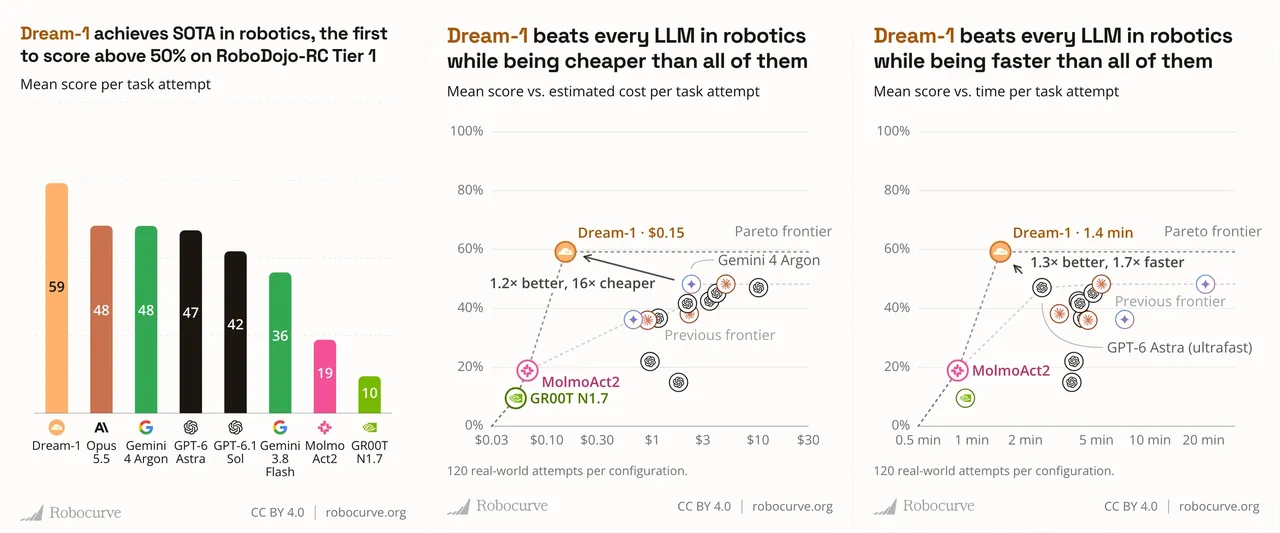
The cost model is stated plainly enough to check. Dream-1 runs at $3 per hour; Dream-1-flash, the faster and lighter variant, runs at $2 per hour. Each call returns 1.6 seconds of actions, so one hour of continuous operation is 2,250 calls: about $0.0013 per action for Dream-1 and $0.0009 for flash. Anything a builder earns above the hourly cost is theirs to keep, which is the economic shape the post keeps returning to — it wants robot owners to behave like forward-deployed engineers, finding tasks people will pay for, collecting a little data, adapting and deploying.
Capability is broken into eight task categories, tabulated here for the two embodiments the source page exposes: YAM itself and YAM fitted with a UMI gripper. The gap between progress score and success rate is the honest part of this table — the model usually gets most of the way through a task long before it finishes it.
| Category | YAM progress | YAM success | YAM + UMI gripper progress | YAM + UMI gripper success |
|---|---|---|---|---|
| Pick & place | 69 ± 4 | 40 ± 6 | 68 ± 4 | 38 ± 6 |
| Push & slide | 50 ± 4 | 19 ± 5 | 60 ± 4 | 28 ± 6 |
| Cloth & soft | 52 ± 4 | 19 ± 5 | 60 ± 4 | 18 ± 5 |
| Insert & fit | 58 ± 4 | 24 ± 6 | 55 ± 3 | 11 ± 4 |
| Reorient | 50 ± 3 | 14 ± 5 | 52 ± 3 | 11 ± 4 |
| Pour & scoop | 55 ± 3 | 10 ± 4 | 49 ± 3 | 8 ± 4 |
| Tool use | 44 ± 3 | 6 ± 3 | 45 ± 3 | 6 ± 3 |
| Open & close | 42 ± 4 | 16 ± 5 | 39 ± 3 | 11 ± 4 |
Dream-1 is a research beta. It will make mistakes, and it has not been validated for safety-critical use. Test it in controlled settings, and take extra care whenever a robot is running near people. Unsafe behavior should be reported to safety@dreamlabs.ai.
04.5 One-shot embodiment learning: five minutes of your own data
When zero-shot is not enough, Dream Labs fine-tunes the model on the customer's robot — Fine-tuning-as-a-Service, FaaS. The claim is that the data requirement is small enough to be collected in one sitting, and the evidence is a pair of timelapses: five minutes of data collection on two partner robots, reBot B601-DM on the left and Maker Arm on the right, shown at 8x.
After adapting on just those five minutes, the difference is shown side by side with the zero-shot run on the same instruction — "go ahead and put the banana in the bowl." Dream-1 now understands the affordance and kinematics of that specific robot a little better.
Some embodiments sit much further from what Dream-1 already knows, and closing a gap that large takes more of the robot's own data. Dexmate fitted with Sharpa dexterous hands grasps with hands instead of grippers and needed 77 minutes. On YAM, swapping in different end effectors for one task — a compliant gripper and a modified knife gripper — took 98 minutes.
Across twelve robots from the FaaS beta partners, fine-tuning lifts the language-following score on ten of them. The two exceptions are Bracket Bot, essentially flat at 32 to 31, and Unitree R1, which regresses from 42 to 31 — a result Dream Labs leaves in the chart rather than explaining away.
| Robot | Zero-shot | After FaaS | Delta |
|---|---|---|---|
| Trossen | 71 | 88 | +17 |
| Metal Arm | 76 | 87 | +11 |
| reBot B601-DM | 65 | 87 | +22 |
| AI Worker | 44 | 84 | +40 |
| Maker Arm | 56 | 75 | +19 |
| SO-101 | 51 | 73 | +22 |
| OpenArm 2.0 | 45 | 70 | +25 |
| ROBO-T1 | 28 | 68 | +40 |
| Mantis | 28 | 57 | +29 |
| Galaxea A1Z | 42 | 49 | +7 |
| Bracket Bot | 32 | 31 | -1 |
| Unitree R1 | 42 | 31 | -11 |
The pattern is that FaaS helps most where zero-shot was weakest: the two 28s become 68 and 57, while Metal Arm, already at 76, gains 11. One-shot adaptation still outperforms zero-shot overall, so a gap remains, and closing it is stated as one of the team's main goals — the better zero-shot gets, the closer any new robot comes to working out of the box.
05 · Looking forward
Dream-1 today is a manipulation policy for bimanual robots with parallel grippers, and the post says so directly: it is a starting point. The belief underneath it is that a strong, general robot foundation model can extend to mobile manipulators, dexterous hands and bodies nobody has imagined yet, which would open up far more of what people actually want robots to do. Robotics will not be solved on day one, and Dream-1 has real limits, which the release tries to show transparently.
The loop it is aimed at is still the same one from section 01: every new robot or task demands new data and a custom policy, often with limited generalization. Shipping this as an API is the bet — put robot intelligence into more people's hands so that everyday users, not only researchers, can find the applications. The 27-robot table is the strongest argument for that bet, and the 36.6 at the bottom of it is the strongest argument for patience.
Notes and references
- MakerMods, Maker Arm — a bimanual arm setup from about $2k.
- Yahoo Tech, "Hugging Face's $399 Microduck robot has already sold more than 10,000 units", 1 September 2026 — more than 10,000 units since pre-orders opened on 28 August.
- DreamZero, the paper that introduced World Action Models, February 2026.
- LAP also showed signs of embodiment generalization: Zha et al., LAP: Language-Action Pre-Training Enables Zero-shot Cross-Embodiment Transfer.
- Chi et al., Universal Manipulation Interface: In-The-Wild Robot Teaching Without In-The-Wild Robots, RSS 2024 — zero-shot transfer across arms that share one gripper, from wrist cameras alone.
- Robocurve, a Public Benefit Corporation measuring and reporting frontier robotics capabilities: Dream-1 on RoboDojo-RC Tier 1, 18 October 2026, CC BY 4.0.
@misc{dreamlabs2026dream1,
  title  = {Zero-Shot to New Robots: Introducing Dream-1},
  author = {Dream Labs},
  year   = {2026},
  url    = {https://dreamlabs.ai/research/dream-1}
}
Source: Dream Labs, "Zero-Shot to New Robots: Introducing Dream-1", October 2026 — https://dreamlabs.ai/research/dream-1/. All figures, videos, evaluation numbers and quotes in this article come from that post; the charts on the source page are interactive, and their underlying values are reproduced here as tables. Evaluation scores are self-reported by Dream Labs except the RoboDojo-RC Tier 1 result, which is Robocurve's independent measurement.
Source:Dream Labs Researchhttps://dreamlabs.ai/research/dream-1/