Skip to content
← Tags
handsomestWei/patent-disclosure-skillMIT

patent-disclosure-skill

patent-disclosure-skill (China Patents skill) is an open-source Agent Skills suite (MIT, Python 3.9+, Playwright-powered) covering the full Chinese patent workflow, built so that hands-on R&D engineers stop getting stuck at "how do I mine patentable points, write the prior-art search, and deliver figures plus an editable Word file". Eight sub-skills: patent-disclosure drafts invention/utility/design disclosures (mines protectable points from design docs and code, runs prior-art checks, sanitizes, writes, and iterates with multi-version archives and change traces, plus protective 1+N portfolio planning); patent-application converts disclosures into claims, spec, abstract and figures; patent-docket runs a disclosure-engineer-vs-patent-attorney role-play workflow that plans autonomously and asks rather than fabricates; patent-reader turns a publication number or PDF into plain-language notes and graphs, accumulating into a private Obsidian patent knowledge base; patent-map renders semantic terrain maps, applicant quadrants, family citation networks, tech-effect matrices and dashboards, all locally; patent-oa assists office-action responses (clause-by-clause Q&A plus RAG over distilled practitioner expertise); patent-search queries by name/company/classification and reverse-engineers search strings from a product photo or a claim; patent-exam-policy tracks CNIPA announcements and flags which drafting techniques may be outdated. It reads and generates figures: design line art from product photos, structure line drawings with part-number callouts, and isometric multi-view projections from CAD models. Disclosures land as timestamped output directories with mermaid diagrams; revisions coexist as new versions.

patentObsidian
Python11k1.1k29
Blind Precise Assembly: Proprioceptive Sim-to-Real Peg-in-Hole for Diverse Parts

Blind Precise Assembly: Proprioceptive Sim-to-Real Peg-in-Hole for Diverse Parts

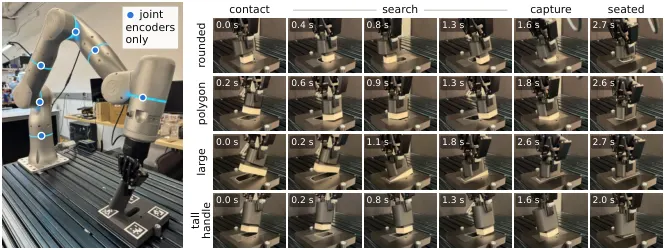
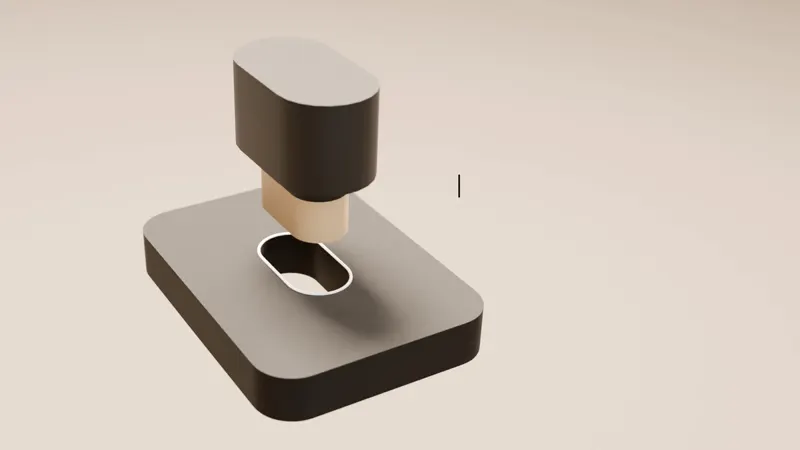
Every robot already carries high-resolution contact sensors: its own joints. Legged robots and humanoids exploit them to walk, run, and track whole-body motions without vision, but there the contacts are large and forceful. Is joint sensing also enough for precise, contact-rich assembly, where the robot must find a millimeter-scale opening, mesh gear teeth, or catch a thread through light contact? We study this question by training blind assembly policies that observe only a short history of joint positions, velocities, and their own actions, without visual, force, torque, or tactile sensing. The poses of both the fixture and the part are unknown to the policy, and the grasp is randomized substantially. The policy must therefore assemble the parts through contact, sensed exclusively through its own proprioception. Trained with reinforcement learning entirely in simulation over randomized parts, grasps, and contacts, such policies learn peg insertion, gear meshing, and nut threading. The peg insertion policy transfers zero-shot to the real world and inserts pegs of different shapes and sizes in 73% of trials. Controlled comparisons with matched visual policies in simulation show that blind policies generalize far better to unseen part shapes and sizes, though they can be slower. Training such policies needs thousands of different assemblies, each simulated with its clearance intact, so we also release an open-source generator that builds them procedurally from exact convex pieces for MuJoCo; it is more accurate and faster than convex decomposition or MuJoCo's signed-distance collision. Videos and interactive simulations are at https://younghyopark.me/blind-proprioceptive-assembly/.

Antonia Bronars, Younghyo Park, Kushal Kedia · 349 views · Oct 16, 2026
Peg-in-HoleSim-to-Real
Oct 16, 2026

As an Amazon Associate, we earn from qualifying purchases.