Skip to content
Tags

#Gaussian Splatting (8)

WilLaGS: Latent-Conditional 3D Appearance Fields for Robust Gaussian Splatting In-the-Wild

WilLaGS: Latent-Conditional 3D Appearance Fields for Robust Gaussian Splatting In-the-Wild

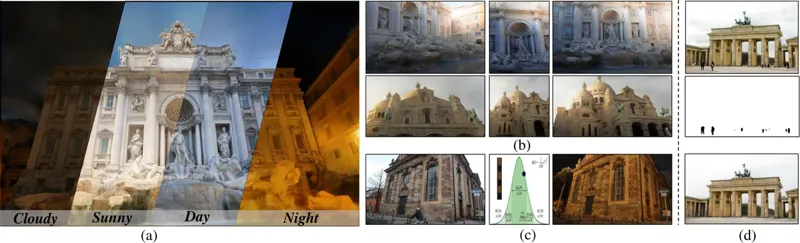
3D Gaussian Splatting (3DGS) delivers real-time and high-fidelity rendering but remains challenged by unconstrained in-the-wild scenes, where drastic appearance variations and transient objects violate multi-view consistency. Existing methods are fundamentally limited by independent and discrete embeddings that struggle to capture continuous environmental changes or model spatially-varying local illumination. To address these limitations, we propose WilLaGS, a unified framework for robust 3D scene reconstruction and generative appearance synthesis under unconstrained settings. Specifically, we introduce a generative appearance model where a β-VAE learns a structured and continuous manifold of global appearance. Conditioned on the latent code, we construct a 3D neural appearance field that generates dynamic Tri-Plane features to encode spatially-varying local illumination effects. Furthermore, to suppress transient artifacts, we present a self-supervised perceptual masking mechanism that leverages a Teacher-Student (EMA) architecture to derive a stable scene consensus, robustly identifying inconsistent regions via perceptual discrepancies. Extensive experiments on multiple datasets demonstrate that WilLaGS achieves state-of-the-art performance in reconstruction quality and novel view appearance synthesis, while maintaining real-time rendering efficiency.

Yuhao Bai, Qianqiu Tan, Lilong ChenAug 28, 2026
3D Gaussian SplattingGaussian Splattingβ-VAEAug 28, 2026
DL-SLAM: Enabling High-Fidelity Gaussian Splatting SLAM in Dynamic Environments based on Dual-Level Probability

DL-SLAM: Enabling High-Fidelity Gaussian Splatting SLAM in Dynamic Environments based on Dual-Level Probability

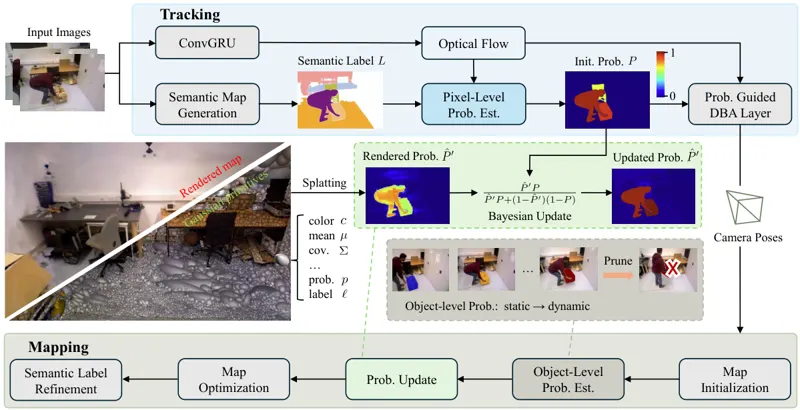
Recent advances in 3D Gaussian Splatting (3DGS) have enabled significant progress in dense dynamic Simultaneous Localization And Mapping (SLAM). Prevailing methods typically discard predefined dynamic objects, ignoring that transiently static objects offer valuable geometric constraints for pose estimation. A recent work attempts to leverage this potential by employing per-pixel uncertainty maps to quantify the magnitude of motion. While this approach enables transiently static objects to enhance pose estimation, it erroneously integrates these objects into the static map, resulting in persistent artifacts. Moreover, its reliance on purely geometric information leads to ambiguous object boundaries in the uncertainty maps. To overcome these limitations, we present DL-SLAM, a monocular Gaussian Splatting SLAM system built upon a novel dual-level probabilistic framework. Our method computes dynamic probability maps by combining semantic and geometric information. These pixel-level probabilities are lifted to 3D and aggregated to derive an object-level dynamic probability for each instance. Object-level probability enables the categorical pruning of dynamic Gaussians, resulting in an artifact-free static map. The static map, in turn, provides a geometrically consistent guidance to refine the pixel-wise probabilities, enhancing their reliability. Experimental results demonstrate that DL-SLAM outperforms existing approaches, improving tracking accuracy by up to 13% while generating high-fidelity semantic maps.

Ziheng Xu, Qingfeng Li, Xuefeng LiuJul 2, 2026
Dynamic EnvironmentSLAM3D Gaussian SplattingJul 2, 2026