Skip to content
Tags
HIL-UMI: Bringing Human-in-the-Loop Post-Training of Vision-Language-Action Models to Universal Manipulation Interface

HIL-UMI: Bringing Human-in-the-Loop Post-Training of Vision-Language-Action Models to Universal Manipulation Interface

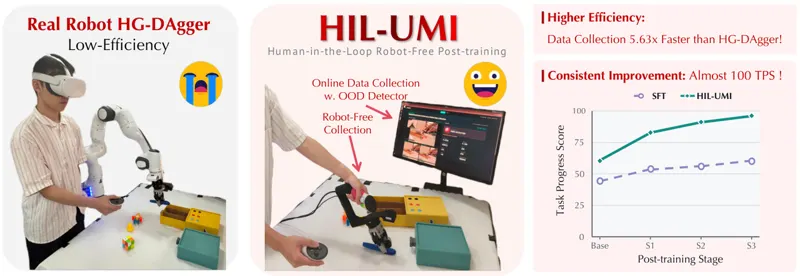
Large-scale vision-language-action (VLA) models provide powerful priors for robot manipulation, yet adapting them to a specific deployment remains challenging. Supervised fine-tuning (SFT) on task-specific demonstrations provides a step toward deployment, but faces two persistent limitations: static data provide limited coverage of out-of-distribution states, and standard imitation objectives do not distinguish progressing behavior from less useful data. Interactive post-training can address these limitations, but typically requires repeated policy execution and human intervention on a physical robot. We introduce HIL-UMI, a policy-guided Universal Manipulation Interface (UMI) framework for robot-free human-in-the-loop VLA post-training. During handheld UMI demonstrations, HIL-UMI queries the current policy on the same observation stream without executing its predictions. The Energy Score compares the human action trajectory with policy inference and triggers collection when their discrepancy indicates an out-of-distribution region. In a separate feedback loop, low online advantage predictions identify essential segments for refining a progress-based advantage estimator. The updated estimator then guides advantage-conditioned behavioral cloning using a balanced mixture of base demonstrations and new policy data. This design preserves the iterative and policy-aware nature of human-in-the-loop learning while decoupling data collection from robot deployment. Experiments on four real-world tasks spanning long-horizon and precise manipulation show that HIL-UMI achieves consistent improvement over SFT and benefits from both targeted collection and advantage refinement. Moreover, HIL-UMI outperforms HG-DAgger on Clean Up Table with lower per-frame collection time, suggesting a scalable path for VLA post-training across operators and locations.
Han, Zimu, Zeng, Yiming, Zhang, JiyaoSep 17, 2026
VLAHuman-in-the-LoopPost-trainingSep 17, 2026
Why Does Action Chunking Improve Behavioral Cloning Performance in Robotic Control?

Why Does Action Chunking Improve Behavioral Cloning Performance in Robotic Control?

Action chunking—predicting and executing multiple actions instead of a single action—has proven to be a critical component for learning effective robotic control policies. However, our precise understanding of why action chunking improves performance has remained limited. In this work we seek to close this gap. Through rigorous experimental evaluations in both simulated and real-world settings, we show that existing hypotheses for the success of action chunking—temporal consistency, horizon reduction, and representation learning—fail to explain the success of action chunking. Instead, we find that action chunking benefits from greater non-Markovian expressivity and reduced compounding error compared to Markovian policies, but, in many settings of interest, these effects can be fully captured by delayed policies, which at each step predict a single action based on the observation k steps in the past. We then show that there exists an additional benefit of action chunking that we refer to as implicit ensembling. In particular, by learning a diversity of temporal relationships (that is, aₜ | oₜ, aₜ | o_t-1, …), action-chunked policies exhibit behavior matching that of a model ensemble, increasing their robustness and generalization ability over policies that only learn a single temporal relationship. Building on these insights, we show that in simulated and real-world robotic control settings, we can match the performance of action chunking without action chunking—by deploying an action chunking policy as an ensemble of policies with randomized delays. Furthermore, we propose a policy class that amplifies the benefits of action chunking by explicitly instantiating an ensemble, and which we show significantly improves over the performance of action chunking in many domains.

Filippo Lazzati, Kyle Stachowicz, William ChenAug 3, 2026
FrankaAction chunkingBehavioral cloningAug 3, 2026