Skip to content
CanonNav: Disentangling Navigation Behavior from Camera Geometry in Cross-Platform Visual Navigation

CanonNav: Disentangling Navigation Behavior from Camera Geometry in Cross-Platform Visual Navigation

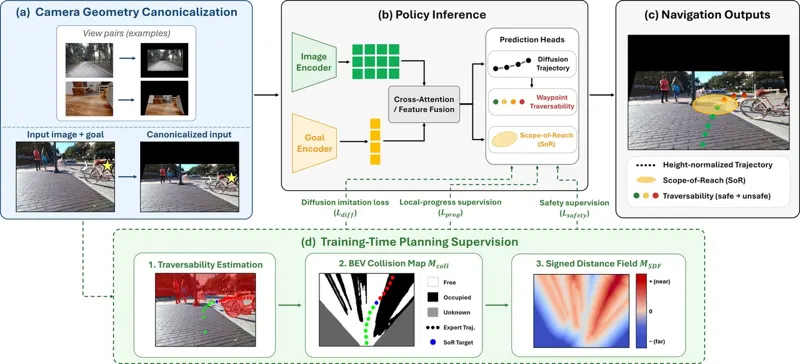
While visual navigation has advanced through imitation learning from cross-platform demonstrations, fully leveraging such data remains challenging. First, directly learning from image-trajectory pairs entangles navigation behavior with platform-dependent camera geometry. This hinders consistent learning by forcing the policy to implicitly infer camera geometry from visual observations, an inherently ill-posed problem. Second, imitation learning from demonstrated trajectories captures the expert's chosen motion but leaves the intermediate decisions underlying that motion implicit. To address these issues, we propose CanonNav, a visual navigation framework that disentangles navigation behavior from camera geometry and incorporates complementary planning supervision into learning from cross-platform demonstrations. CanonNav introduces camera geometry canonicalization, which transforms visual observations and trajectories into a camera-consistent representation space. Building on this representation, we derive safety and local-progress supervision using pseudo-labels from an offline traversability estimator. Safety supervision penalizes unsafe trajectories, while local-progress supervision guides where the robot should advance. Experiments across diverse camera configurations and environments show that, despite using only RGB at inference, CanonNav consistently outperforms RGB-based baselines and even surpasses RGB-D-based methods in challenging scenarios.

Visual navigationCross-Platform
Dong-Wook Kim, Ji-Hoon Hwang, E-In Son · 210 views · Aug 31, 2026
DONIC: Generalist Dexterous Bimanual Tracking Control from Human Demonstrations

DONIC: Generalist Dexterous Bimanual Tracking Control from Human Demonstrations

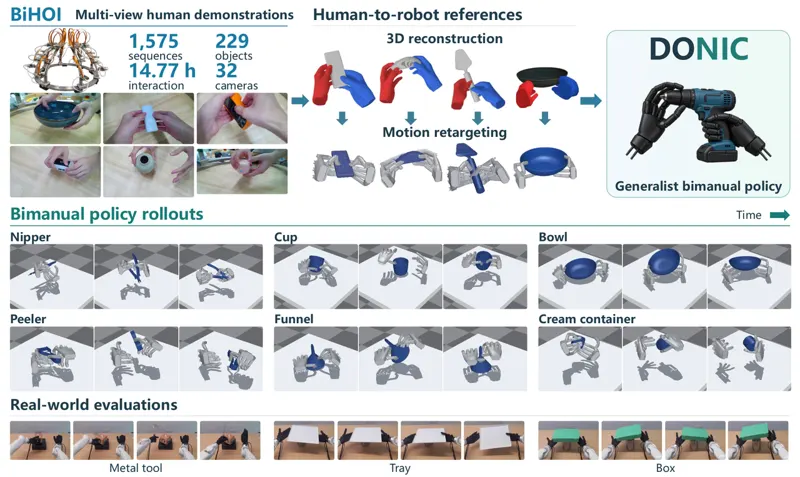
Despite recent progress in dexterous reference tracking, existing models focus primarily on single-hand manipulation and a limited range of interactions, leaving the bimanual dexterous behaviors common in real life unaddressed. The scarcity of contact-rich bimanual manipulation data and the increased complexity of coordinating contacts make developing a generalist bimanual tracker particularly challenging. Therefore, we present 1) DONIC, the first generalist bimanual tracker jointly trained across operation categories and human-motion sources, together with 2) BiHOI, a multi-view dataset of 1,575 sequences spanning 229 objects and emphasizing sustained bimanual interaction, where reconstructed interactions are retargeted into robot references. DONIC combines proximal policy optimization with behavioral cloning in a feedback loop that recycles verified successful executions into training demonstrations. An object-centered per-hand reward maintains object-motion feedback while supervising each hand according to its reference contact role. Clip-Centered Advantages remove reference-dependent advantage offsets while preserving within-trajectory differences. Together, these designs enable one single policy to learn coordinated manipulation across heterogeneous references. Without finetuning, a single checkpoint achieves 86.79% success on unseen trajectories of training objects and 57.32% on held-out objects, surpassing the state-of-the-art bimanual tracking baselines by 77.36 and 45.73 percentage points.

Dexterous ManipulationBimanual Manipulation
Mingze Sun, Ziang Cao, Yuan Fei · 242 views · Oct 21, 2026
Thinker-WM: A Unified World Model with Shared Multimodal Representations for Embodied Intelligence

Thinker-WM: A Unified World Model with Shared Multimodal Representations for Embodied Intelligence

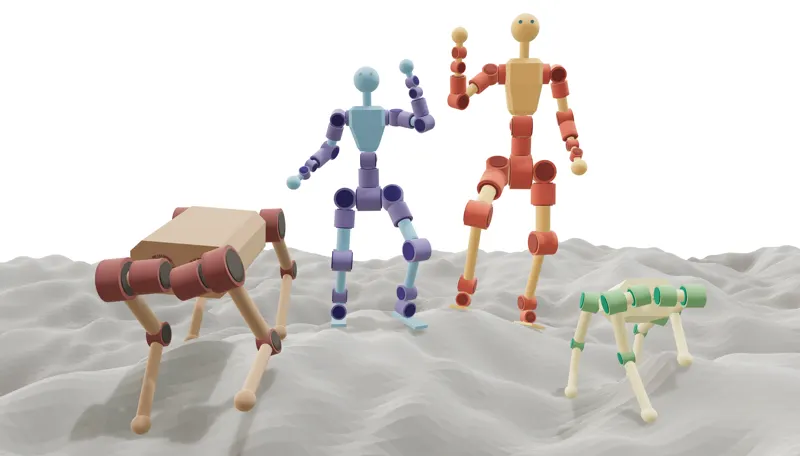
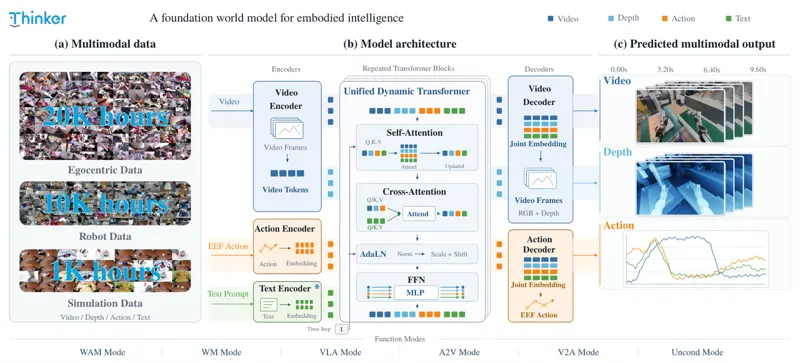
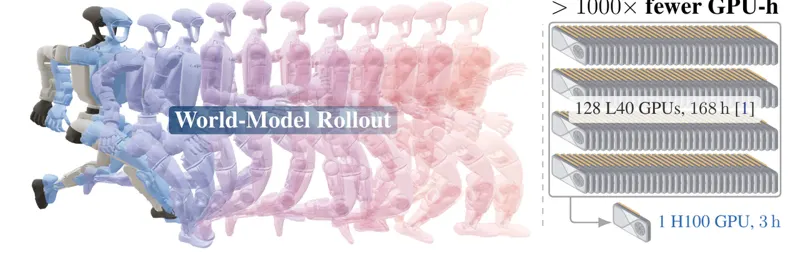
World models have emerged as a promising paradigm for embodied AI, yet existing systems often remain fragmented in the modalities they model and the functions they support. In particular, visual dynamics, geometric structure, and executable action are commonly coupled through separate interfaces or downstream modules rather than being jointly represented and evolved within a shared dynamics model. In this work, we present Thinker-WM, a unified multimodal world model that jointly models and generates RGB, metric depth, and robot action through a shared intermediate Unified Dynamics Transformer with modality-specific encoders and decoders. The model performs multimodal unification at the representation level: appearance, geometry, and action are transformed into a common dynamic representation and jointly evolved by shared parameters, while their distinct output structures are preserved. The same parameterization supports multiple functions, including joint video-action generation, world prediction, policy inference, action-conditioned generation, video-to-action generation, and inverse dynamics. To examine whether the shared representation captures action-related information, we introduce a lightweight motion probe that shows the frozen visual representation contains recoverable motion information. Thinker-WM is trained on a heterogeneous corpus comprising approximately 20K hours of egocentric video, 10K hours of real-robot data, and 1K hours of simulation data, including approximately 4K hours of real-robot data with aligned depth supervision. Extensive experiments demonstrate strong performance across embodied world-model evaluations. Thinker-WM ranks first on EWMBench, WorldOlympiad and WorldArena, while controlled studies further demonstrate the benefits of action conditioning, geometric interaction, and multi-function training within the shared representation.

World ModelsEmbodied AI
Thinker Team, Peng Gao, Jichao Jiao · 285 views · Oct 13, 2026
SimpleVLN: Towards Simple and Frontier Vision-Language Navigation

SimpleVLN: Towards Simple and Frontier Vision-Language Navigation

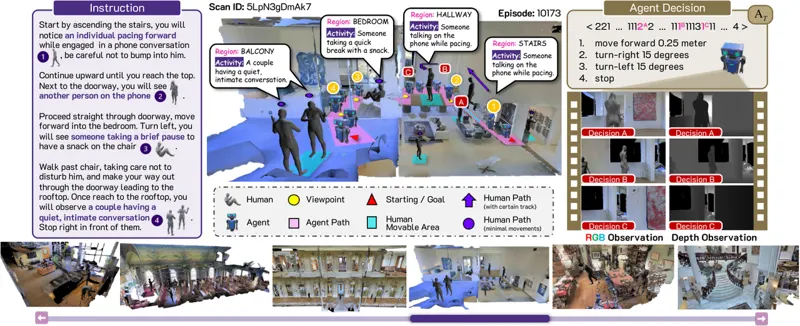
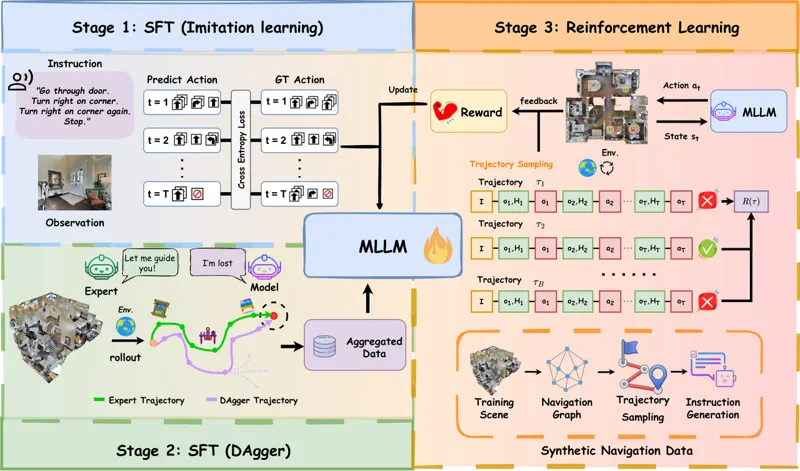
Vision-and-Language Navigation (VLN) requires embodied agents to ground language in visual observations and make long-horizon decisions. Existing methods often address these demands through task-specific architectures. As multimodal large language models (MLLMs) become increasingly capable, an important question remains: Have we truly unlocked the potential of native MLLMs for VLN before introducing task-specific architecture? We present SimpleVLN, an architecture-preserving framework developed through studies of navigation formulation, data construction, and optimization. At the formulation level, SimpleVLN combines single-turn decision inputs with fixed-budget global-local memory to efficiently use navigation history without unbounded context growth, while action chunks enable efficient output of multiple primitive actions per model invocation. For data construction, we combine expert demonstrations with policy-dependent DAgger experience and develop a scalable synthesis pipeline that generates large-scale tasks for reinforcement learning. At the optimization level, a progressive IL-DAgger-RL pipeline advances from action imitation to task-level outcome optimization. Comprehensive experiments validate the effectiveness of these three aspects. We instantiate SimpleVLN across multiple MLLM backbones and model sizes, demonstrating its generality. SimpleVLN achieves 76.7% and 80.1% success rates on the R2R-CE and RxR-CE splits, respectively, substantially outperforming existing methods. These results show that the navigation capabilities of native MLLMs can be effectively unlocked without task-specific architectural designs.

Vision-language navigationEmbodied AI
Lingyi Hong, Weiren Cai, Jiayu Chen · 316 views · Oct 16, 2026

As an Amazon Associate, we earn from qualifying purchases.