Skip to content
DeFM: Learning Foundation Representations from Depth for Robotics

DeFM: Learning Foundation Representations from Depth for Robotics

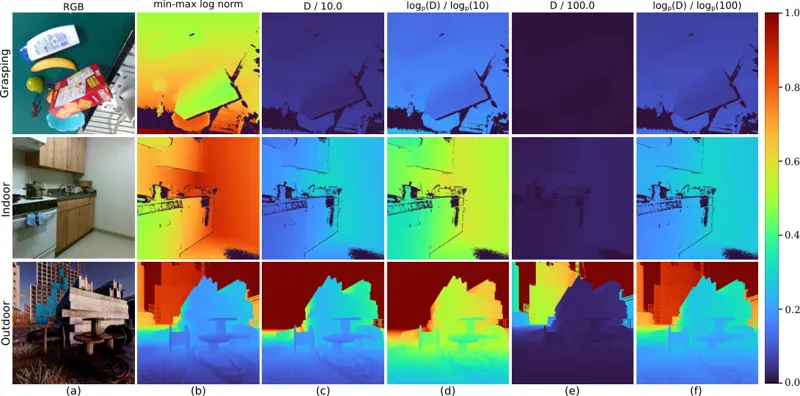
Depth sensors are widely deployed across robotic platforms, and advances in fast, high-fidelity depth simulation have enabled robotic policies trained on depth observations to achieve robust sim-to-real transfer for a wide range of tasks. Despite this, representation learning for depth modality remains underexplored compared to RGB, where large-scale foundation models now define the state of the art. To address this gap, we present DeFM, a self-supervised foundation model trained entirely on depth images for robotic applications. Using a DINO-style self-distillation objective on a curated dataset of 60M depth images, DeFM learns geometric and semantic representations that generalize to diverse environments, tasks, and sensors. To retain metric awareness across multiple scales, we introduce a novel input normalization strategy. We further distill DeFM into compact models suitable for resource-constrained robotic systems. When evaluated on depth-based classification, segmentation, navigation, locomotion, and manipulation benchmarks, DeFM achieves state-of-the-art performance and demonstrates strong generalization from simulation to real-world environments. We release all our pretrained models, which can be adopted off-the-shelf for depth-based robotic learning without task-specific fine-tuning. Webpage: https://de-fm.github.io/

DepthSelf-Supervised Learning
Manthan Patel, Jonas Frey, Mayank Mittal · 166 views · Jan 26, 2026
Learning Multi-Phase Robot Loco-Manipulation via Phase-Conditioned Policy Optimization

Learning Multi-Phase Robot Loco-Manipulation via Phase-Conditioned Policy Optimization

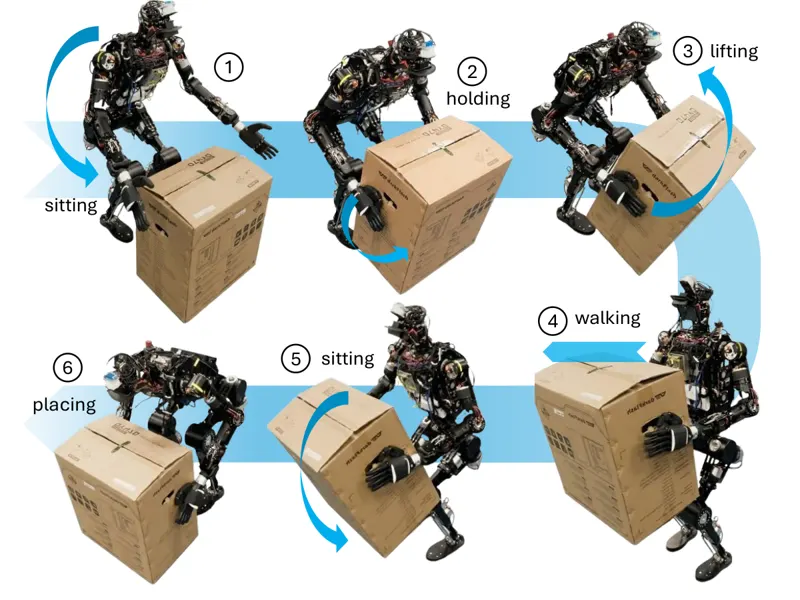
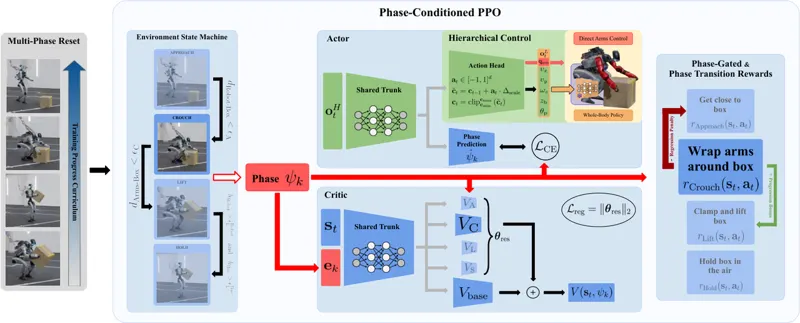
Complex whole-body loco-manipulation requires executing diverse maneuvers, such as crouching, grasping, and locomotion, within a single long-horizon task. While performing simple pick-and-place behaviors is well-established, scaling to complex, long-horizon tasks remains difficult. Currently, this challenge is addressed by relying on human motion data and correspondingly humanoid platforms, which limits platform independence and introduces substantial data processing overhead. Instead, we extend proximal policy optimization (PPO) to train a single policy for multi-phase tasks across diverse robotic hardware, leveraging prior task structure to shape behavior. Our method adapts PPO using a phase-conditioned critic, phase-gated reward functions, and a multi-phase reset curriculum to guide exploration. To support varied hardware, we employ a decoupled hierarchical control architecture that separates lower-level balancing dynamics from high-level phase execution. We demonstrate multi-stage loco-manipulation skills on hardware on both the Unitree G1 and a Boston Dynamics Spot equipped with a manipulator arm, and validate our design choices through ablations. Our approach enables the acquisition of complex loco-manipulation behaviors purely through environment interaction while directly incorporating high-level task structure into policy learning.

Whole-Body Loco-ManipulationPhase-Conditioned PPO
Simone Manni, Annika Wollschläger, Dario Bellicoso · 291 views · Oct 26, 2026
InteractiveWorld: A Verifiable Human-Centric Environment for Building Better Interactive MLLM Assistants

InteractiveWorld: A Verifiable Human-Centric Environment for Building Better Interactive MLLM Assistants

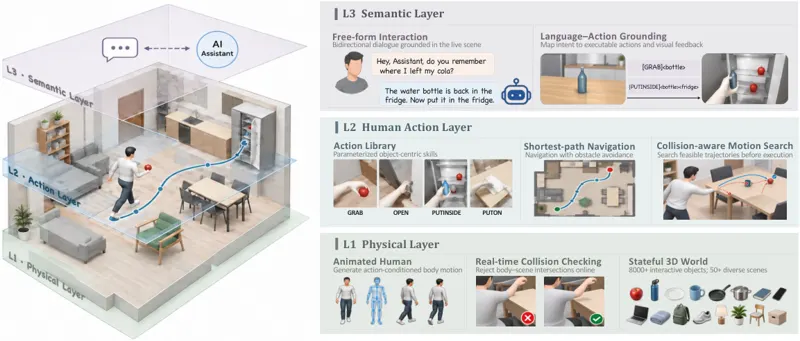
People have long dreamed of an assistant that is always there to guide them and remind what they forget, from new dishes to lost keys. Powered by multimodal large language models (MLLMs), egocentric AI assistants on wearable devices are bringing this dream within reach: they see what the user sees and give instructions for user's physical work when necessary. However, testing such assistance is challenging and usually requires real people. The expensive and rare real interaction data leaves a key question unanswered: Can today's MLLMs truly help people in physical world? To answer this question, we propose InteractiveWorld, the first verifiable environment for closed-loop interaction between human and AI assistant. Unlike existing robot-centric simulators, InteractiveWorld lets the assistant guide a human agent who observes the scene, understands instructions, and acts independently. It thus realistically simulates how AI assistant collaborates with human: the assistant instructs, the human acts, and the environment executes actions and updates what they see next. Building on it, we introduce InteractiveBench, the first dynamic benchmark for egocentric AI assistants, with 120 multi-turn tasks across six categories. In each task, the assistant guides the human in real time, and every instruction shapes the outcome, which is scored by verifiable, state-based rewards. Experiments with 12 frontier MLLMs show they are still far from reliable assistants. Even the strongest model, Claude Fable 5.1, achieves at most 20% and 25% on long-horizon Guidance and Planning tasks, respectively. Overall, our work offers a verifiable platform and a rigorous evaluation set, laying a solid foundation for research on interactive MLLM assistants that truly help people in the physical world.

MLLMEgocentric AI Assistant
Qinsi Wang, Wei Wen, Chong Zhou · 225 views · Oct 25, 2026

As an Amazon Associate, we earn from qualifying purchases.