PAPER DEEP DIVE
Motion Mamba 2.0: Autoregressive Diffusion Mamba for Long-Horizon Humanoid Control
Motion Mamba 2.0 is a streaming autoregressive diffusion model that generates Unitree G1 humanoid motion window by window at 25 Hz. It combines local attention, resumable Mamba-3 states, and a persistent content memory (PCM) that turns compressed recurrent history into attention-readable content slots, enabling accurate terminal control over rollouts up to 39.52 s with a bounded cache. CUDA Graph replay and fused kernels cut median complete-window latency from 1685.35 ms to 276.14 ms (a 6.138x paired speedup with bitwise-identical outputs). On the physical G1, the integrated generation-and-SONIC-tracking system completes 94 of 100 trials with zero falls, supporting multi-stage text-guided action composition and live keyboard/mouse teleoperation.
Paper Information
Title: Motion Mamba 2.0: Autoregressive Diffusion Mamba for Long-Horizon Humanoid Control
Authors: Yue Huang, Tianshan Zhang, Zeyu Zhang, Jayeon Kang, Akide Liu, Sungjoon Choi, Dacheng Tao, Hao Tang.
Paper: arXiv 2611.29897 (2026-11-23, cs.RO / cs.CV); Code: AIGeeksGroup/MotionMamba2.0 (released, with weights and data on HuggingFace). This reading corresponds to commit 573880dd73b35948b1edb3476c097dfd8f158713. The conference predecessor is Motion Mamba (ECCV 2024); this manuscript substantially extends it in method, data, and real-robot evaluation.
Subject: A streaming autoregressive diffusion model that generates Unitree G1 humanoid motion window by window at 25 Hz. Conditioned on text instructions, spatial targets, and accepted motion history, it emits 52-frame (2.08 s) windows and tracks them on the physical robot with the SONIC whole-body controller, supporting mid-walk direction changes, superimposing upper-body actions such as waving or bowing, and live keyboard/mouse teleoperation.
One-Sentence Summary
Motion Mamba 2.0 combines local attention, resumable Mamba-3 states, and a persistent content memory (PCM) that turns compressed recurrent history into attention-readable content slots, enabling accurate terminal control over rollouts up to 39.52 s with a bounded cache; CUDA Graph replay and fused kernels then cut median complete-window latency from 1685.35 ms to 276.14 ms (a 6.138x paired speedup with bitwise-identical outputs), and the integrated system completes 94 of 100 physical G1 trials with zero falls.
Background: The Two-Horned Dilemma of Interactive Motion
Interactive animation and humanoid robotics do not need an offline clip synthesized once; they need motion that can be revised while it is being executed. A user may ask for a turn mid-walk, request an upper-body action while locomotion continues, or specify a future target that has not yet been reached. The generator must start before the full instruction sequence is known, preserve useful context, accept newly arriving commands, and produce references fast enough for interactive use and compatible with a downstream tracking controller. This pushes the problem from text-to-motion toward streaming, controllable, long-horizon generation.
Diffusion models produce diverse text-conditioned human motion, and recent work extends them through temporal composition, autoregressive prediction, and direct spatial conditioning into window-by-window synthesis. The authors identify two tightly coupled difficulties. First, a bounded attention cache evicts older motion features, while an unbounded cache grows storage and computation with the sequence. Second, repeated denoising of short windows incurs substantial execution overhead even when each model evaluation is small. These concern different aspects of the problem: fewer sampling steps do not extend the history available to the model, and a compact historical state alone does not remove denoising overhead.
State-space models offer another route: summarize a sequence in a fixed-size recurrent state rather than storing every historical token. Mamba and its combination with autoregressive diffusion have shown the value of efficient temporal modeling. But the authors stress an overlooked distinction: a compressed recurrent state and an attention cache expose history differently. The former carries evolving context; the latter permits direct retrieval of explicit features. Simply placing both branches in a network does not make the recurrent history directly accessible to attention. This motivates learning a state-to-attention interface rather than relying on either mechanism alone.
Diffusion adds a semantic trap: successive noisy candidates describe alternatives for the same output window, not successive moments of the accepted motion stream. Persisting those intermediate candidates would mix sampling iterations with physical time. The paper therefore treats the boundary between prediction and history commitment as part of the streaming formulation: history is updated only after a clean motion window is accepted.
The starting point is thus clear. A useful system needs a compact representation that carries history across windows, an interface that lets local attention actually use that history, and an implementation that makes repeated denoising affordable on hardware. Missing any one of these, long-horizon real-time controllable generation does not stand up.
Preliminaries: Hybrid Representation and Streaming Formulation
The output is divided into windows of $C$ tokens, each token representing $P$ consecutive frames. At window $t$, the conditions comprise a text instruction $s_t$, spatial targets $\mathbf{g}_t$, and their validity mask $\mathbf{v}_t$; the memory $\mathcal{M}_{t-1}$ is built from the accepted motion prefix. The conditional distribution factorizes over windows:
$$p_{\theta}(\mathbf{x}_{0:T}\mid\mathbf{s},\mathbf{g},\mathbf{v})=\prod_{t=0}^{T}p_{\theta}\bigl(\mathbf{x}_{t}\mid s_{t},\mathbf{g}_{t},\mathbf{v}_{t};\mathcal{M}_{t-1}\bigr).\tag{1}$$Targets may lie within or beyond the current window; they provide conditioning without requiring the model to emit the intervening future motion in advance. The representation follows ARDY's hybrid scheme: an explicit root trajectory is retained while articulation is compressed by a causal motion codec. Per frame, the root comprises position $\mathbf{p}\in\mathbb{R}^3$ and heading $\psi$; body features include joint rotations, positions, velocities, and contact indicators. A token concatenates a root patch $\mathbf{r}_i\in\mathbb{R}^{5P}$ with a body latent $\mathbf{b}_i\in\mathbb{R}^{L}$:
$$\mathbf{m}_{r}=[\mathbf{p};\cos\psi;\sin\psi],\qquad \mathbf{x}_{i}=[\mathbf{r}_{i};\mathbf{b}_{i}].\tag{2}$$The encoder $\mathcal{E}$ maps explicit motion to body latents, and the decoder $\mathcal{D}$ reconstructs articulation from these latents and local root features. This exposes the trajectory directly to spatial control while reducing the dimensionality of articulated motion. The forward process perturbs a clean window with Gaussian noise on a predefined schedule:
$$\mathbf{z}_{t,\tau}=\sqrt{\bar{\alpha}_{\tau}}\,\mathbf{x}_{t}+\sqrt{1-\bar{\alpha}_{\tau}}\,\bm{\epsilon},\quad \bm{\epsilon}\sim\mathcal{N}(\mathbf{0},\mathbf{I}),\quad \bar{\alpha}_{\tau}=\prod_{s=1}^{\tau}(1-\beta_{s}).\tag{4}$$The denoiser predicts clean hybrid features; a fixed sampling schedule repeatedly refines the noisy window while its accepted-history memory remains unchanged. The data foundation is a unified G1 representation: 29 degrees of freedom, 414 physical features, 25 Hz, with a training pool of 156,819 records and 588.92 hours (BONES Seed 124,658, HumanML3D 14,612, HiPHI 17,549), where human motion is retargeted to G1 via General Motion Retargeting (GMR).
Method Overview: Two-Stage Root-Body Denoising with a Three-Way Mixer
As shown below (paper Fig. 4), conditioned on text, spatial controls, and accepted history, the framework generates motion autoregressively through a two-stage diffusion denoiser. At each denoising step the root network predicts the global trajectory, whose local features condition body prediction; both networks combine attention and Mamba-3 in a hybrid sequence mixer; history states are updated for subsequent generation only after a clean window is accepted.
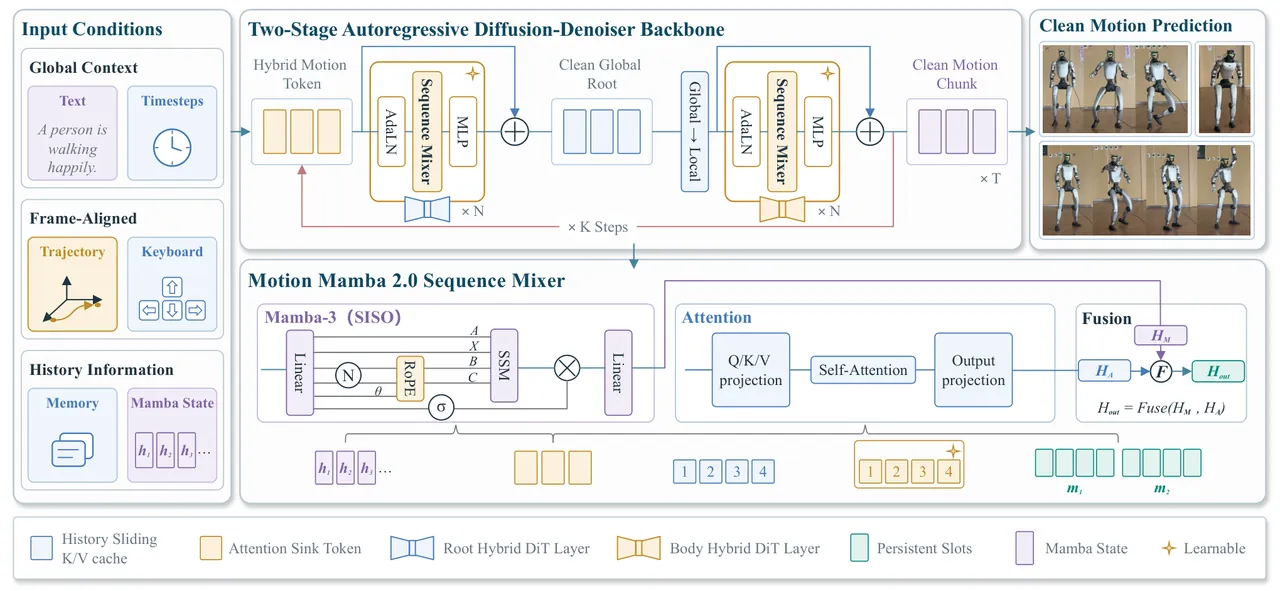
Figure 1: Paper Fig. 4 overview. Left: input conditions (text, timesteps, trajectory, keyboard, memory, Mamba state). Middle: the two-stage root-body DiT denoising backbone and the sequence mixer (Mamba-3 SISO + attention + persistent-slot fusion). Right: clean motion prediction.
Concretely, each diffusion evaluation first predicts the global root, then predicts articulation conditioned on that root. The root input $\mathbf{u}^{r}_{t,\tau}$ contains noisy hybrid features and temporally aligned controls; the body input $\mathbf{u}^{b}_{t,\tau}$ concatenates local features of the predicted root, noisy body latents, and aligned observations. The two networks are denoted $\mathcal{F}^{r}_{\theta}$ and $\mathcal{F}^{b}_{\theta}$:
$$\widehat{\mathbf{r}}_{t,0}=\mathcal{F}^{r}_{\theta}(\mathbf{u}^{r}_{t,\tau},\mathbf{c}_{t,\tau};\mathcal{M}^{r}_{t-1}),\qquad \widehat{\mathbf{b}}_{t,0}=\mathcal{F}^{b}_{\theta}\bigl(\mathbf{u}^{b}_{t,\tau},\mathbf{c}_{t,\tau};\mathcal{M}^{b}_{t-1}\bigr).\tag{5}$$The sampler consumes the concatenated clean prediction $[\widehat{\mathbf{r}}_{t,0};\widehat{\mathbf{b}}_{t,0}]$, so root prediction is refreshed before body prediction at every diffusion step; the two stacks have separate parameters and layer-specific memories. This decomposition exposes global translation and heading for direct spatial conditioning while letting articulated motion adapt to the predicted root trajectory. Because the root-conditioned body input is updated at each step, the two predictions remain coupled throughout sampling rather than being combined only after generation.
flowchart TD
    C["Conditions: text s_t, spatial g_t, mask v_t"] --> R["Root DiT denoiser F_r"]
    M["Immutable accepted history M_(t-1): KV cache + Mamba-3 state + PCM slots"] --> R
    R --> RT["Clean global root r_hat"]
    RT --> GL["Global to Local conversion"]
    GL --> B["Body DiT denoiser F_b"]
    M --> B
    B --> X["Clean window x_hat = concat root and body"]
    X --> DDIM["10-step DDIM, 3-branch CFG (2,2)"]
    DDIM --> ACC{"Window accepted?"}
    ACC -->|yes| CAN["Canonical clean pass at diffusion time 0"]
    CAN --> COMMIT["Atomic commit: FIFO cache + Mamba state + PCM write"]
    COMMIT --> M
    COMMIT --> EMIT["Emit 52-frame window at 25 Hz"]
    ACC -->|no| M
    EMIT --> NEXT["Next window t+1"]
    NEXT --> C
Figure 2: Streaming generation loop drawn from the paper method (Sec. IV and Algorithm 1). History is read-only during denoising; only after a clean window is accepted are the cache, recurrent state, and PCM slots committed atomically in one canonical pass.
Core Method I: Resumable Mamba-3 Recurrence
Each stack consists of diffusion transformer layers with adaptive normalization and a gated residual MLP. Inside the sequence mixer, attention and Mamba process the same normalized, condition-modulated features: attention retrieves recent features, Mamba resumes its state from the accepted prefix, and their outputs are combined by a learned layerwise gate. The paper adopts the resumable SISO Mamba-3 scan. For one head, let $\mathbf{u}_i$ be the value projection, $\mathbf{B}_i,\mathbf{C}_i$ the normalized state-input and readout vectors, $A_i$ the step-size term, $\lambda_i\in(0,1)$ the trapezoidal coefficient, $\bm{\theta}_i$ the phase parameter, and $\mathcal{R}$ the operator rotating paired state coordinates. The recurrence is:
$$\bm{\phi}_{i}=\bm{\phi}_{i-1}+\pi\Delta_{i}\tanh(\bm{\theta}_{i}),\quad \widetilde{\mathbf{B}}_{i}=\mathcal{R}(\bm{\phi}_{i})\mathbf{B}_{i},\quad \widetilde{\mathbf{C}}_{i}=\mathcal{R}(\bm{\phi}_{i})\mathbf{C}_{i},\tag{6a}$$ $$\alpha_{i}=\exp(\Delta_{i}A_{i}),\quad \beta_{i}=(1-\lambda_{i})\Delta_{i}\alpha_{i},\quad \gamma_{i}=\lambda_{i}\Delta_{i},\tag{6b}$$ $$\mathbf{H}_{i}=\alpha_{i}\mathbf{H}_{i-1}+\beta_{i}\mathbf{u}_{i-1}\widetilde{\mathbf{B}}_{i-1}^{\top}+\gamma_{i}\mathbf{u}_{i}\widetilde{\mathbf{B}}_{i}^{\top},\qquad \mathbf{y}_{i}=\mathbf{H}_{i}\widetilde{\mathbf{C}}_{i}+D\mathbf{u}_{i}.\tag{6c}$$Equation (6) combines adjacent state inputs through a trapezoidal update and represents relative phase through accumulated rotations, providing a mechanism for retaining evolving dynamics. The carried state includes the recurrent matrix, accumulated phase, and the previous state-input and value vectors needed to resume the scan; its size is independent of the accepted sequence length, which is the source of the bounded computational context. PCM augments the attention path (below) but does not replace the recurrent branch.
Core Method II: Persistent Content Memory (PCM)
The recurrent state and attention cache play complementary roles: the bounded cache directly exposes recent keys and values but evicts older features, while Mamba carries a fixed-size compressed history that is not itself an attention token. PCM learns a state-to-attention mapping that turns recurrent summaries, their changes, and text conditions into content slots, making accumulated motion context available to subsequent windows. The authors explicitly state that the slots are not designed to reproduce arbitrary early instructions verbatim.
In each layer, the cache $\mathcal{C}^{\ell}_{t-1}$ stores projected keys, values, and validity masks from the latest $W$ accepted windows. Base attention concatenates learned sink tokens, historical keys/values, and current tokens; current-window attention is bidirectional because the noisy window is denoised jointly, and the sinks are static parameters that remain available when the cache is short or empty but do not store an episode's past motion. PCM maintains $S$ memory slots $\mathbf{P}^{\ell}_{t}\in\mathbb{R}^{S\times d}$ per layer, initialized to zero. A projector $\Pi^{\ell}$ pools the accepted recurrent matrix, applies a learned projection, and normalizes the summary, whose difference from the previous accepted window is:
$$\overline{\mathbf{s}}_{t}^{\ell}=\Pi^{\ell}(\mathbf{H}_{t}^{\ell}),\qquad \mathbf{d}_{t}^{\ell}=\overline{\mathbf{s}}_{t}^{\ell}-\overline{\mathbf{s}}_{t-1}^{\ell}.\tag{8}$$The summary captures accumulated context; the difference describes the latest accepted transition. The pooled text embedding $\mathbf{e}_t$ is projected and layer-normalized, then predicts featurewise modulation parameters that condition the normalized state difference on the active instruction:
$$\widetilde{\mathbf{d}}_{t}^{\ell}=(1+\tanh\bm{\gamma}_{t}^{\ell})\odot\operatorname{LN}(\mathbf{d}_{t}^{\ell})+\bm{\beta}_{t}^{\ell}.\tag{10}$$The summary, text-modulated difference, and projected text embedding are concatenated into candidate slot content and normalized along the feature dimension; a gate that reads both the joint representation and the previous memory then controls the write rate:
$$\mathbf{j}_{t}^{\ell}=[\overline{\mathbf{s}}_{t}^{\ell};\widetilde{\mathbf{d}}_{t}^{\ell};\mathbf{e}_{t}^{\ell}],\quad \mathbf{Z}_{t}^{\ell}=\operatorname{LN}\bigl(f_{p}^{\ell}(\mathbf{j}_{t}^{\ell})\bigr),\tag{11}$$ $$\mathbf{w}_{t}^{\ell}=\eta\,\sigma\!\left(f_{w}^{\ell}\!\left([\mathbf{j}_{t}^{\ell};\operatorname{vec}(\mathbf{P}_{t-1}^{\ell})]\right)\right),\qquad \mathbf{P}_{t}^{\ell}=(1-\mathbf{w}_{t}^{\ell})\odot\mathbf{P}_{t-1}^{\ell}+\mathbf{w}_{t}^{\ell}\odot\mathbf{Z}_{t}^{\ell}.\tag{12}$$The write-rate cap $\eta\in(0,1]$ bounds each gate value, limiting the contribution of candidate content per update. Text conditions both candidate-content generation and write gating, so the same state transition produces different memory updates under different instructions; the slots accumulate session-specific content rather than serving as fixed learned vectors. At readout, the current window reads $\mathbf{P}^{\ell}_{t-1}$ without modifying it: projected slots are inserted immediately after the sinks to form augmented keys/values, base and augmented attention share the same query, a learned scalar $\rho_\ell$ controls the attention difference, and $\zeta_\ell$ controls the Mamba contribution:
$$\mathbf{Y}^{\ell}=\mathbf{A}^{\ell}_{0}+\tanh(\rho_{\ell})\bigl(\mathbf{A}^{\ell}_{P}-\mathbf{A}^{\ell}_{0}\bigr)+\sigma(\zeta_{\ell})\mathbf{M}^{\ell}.\tag{13}$$Initializing $\rho_\ell$ to zero recovers the Native mixer output exactly despite the extra slots; this differs from initializing slot values to zero, since extra keys can still change attention normalization. PCM leaves query construction unchanged: state summaries enter through content writing rather than a state-dependent query. This design is verbatim verifiable in the released code: configs/model.yaml sets content_memory_slots: 2 and content_memory_max_write_rate: 0.25 (i.e. $\eta=0.25$, two slots per layer), and motion_mamba2/model/content_memory.py's propose() is exactly Eqs. (10)-(12):
# motion_mamba2/model/content_memory.py :: PersistentContentMemory.propose()
conditioned_delta = delta_features * (1.0 + torch.tanh(gamma)) + beta   # Eq.(10)
context = torch.cat([state_summary, conditioned_delta, condition_features], dim=-1)  # Eq.(11) j
proposal = self.content_decoder(context).view(-1, self.slots, self.d_model)          # Eq.(11) Z
gate = (self.max_write_rate * torch.sigmoid(self.write_gate(gate_input))).unsqueeze(-1)  # Eq.(12) w, eta=0.25
slots = (1.0 - gate) * previous + gate * proposal                                    # Eq.(12) P_t
The read_residual_scale property returns torch.tanh(self.read_gate) with read_scale_init=0.0, matching the Eq. (13) design where zero-initialized $\rho$ recovers Native. Paper method and source code align exactly here.
Core Method III: Accepted-Only Updates and State-Preserving Efficient Inference
Each denoising evaluation reads an immutable snapshot. The denoiser may produce a temporary proposal $\widetilde{\mathcal{M}}_{t,\tau}$, but it is not committed during sampling. After sampling, the accepted window is recentered and materialized as clean history in a canonical pass at diffusion time zero, updating only accepted motion tokens; layerwise cache append, recurrent-state replacement, and PCM writing are committed together across the root and body stacks, and if the pass fails both stacks retain their previous state. The exact cache grows only to $W$ windows, and each recurrent state and slot bank has fixed size, so for a fixed output window and conditioning budget, memory and computation per new window do not grow with elapsed generation time. This bound concerns computational context; it does not imply error-free motion over arbitrary durations.
The inference optimizations come in three state-preserving moves. First, read-only execution: during denoising, state proposals and diagnostics that are consumed by neither prediction nor a later commit are not materialized. Second, a fusion kernel: Mamba transition preprocessing (decay activation, decay floor, step-size transformation, and the product $\Delta_i A_i$) is fused into a single traversal, with intermediate values kept in FP32 registers before outputs are written in the scan's required layout. Third, CUDA Graph replay: the root and body DiT sequence stacks use separate graphs, and within each stack the text-conditioned, spatially conditioned, and unconditional CFG branches execute serially and are captured together; input projections, conditioning preparation, root-output processing, root-to-local conversion, and body-input construction remain outside the graphs, as do sampling updates, random-number handling, recentering, and accepted-state commits. The fused preprocessing (paper Eq. 17) is:
$$\chi(a)=\max(a,0)+(1-\min(a,0))^{-1},\quad A_{i}=\min(-\chi(a_{i}),-a_{\min}),\quad \Delta_{i}=\operatorname{softplus}(d_{i}+b_{\Delta}),\quad \Xi_{i}=\Delta_{i}A_{i}.\tag{17}$$This corresponds line by line to the Triton kernel _adt in motion_mamba2/kernels/fused_recurrence.py: av = min(-(pos + 1/(1-neg)), -FLOOR) is $A_i$, v = where(u>20, u, log1p(exp(u))) is $\Delta_i$, and ADT = av*v is $\Xi_i$, with enable_fp_fusion=False disabling multiply-add contraction to guarantee bitwise equivalence. The three-branch classifier-free guidance combines as:
Training Objective and Protocol
Training optimizes clean-window prediction with four terms: the hybrid term $\mathcal{L}_{\mathrm{hyb}}$ applies Smooth L1 to explicit root patches and body latents; the decoded-body term $\mathcal{L}_{\mathrm{body}}$ applies L1 to reconstructed articulation; the goal term $\mathcal{L}_{\mathrm{goal}}$ applies L1 only to observed coordinates inside the generated window; and the consistency term $\mathcal{L}_{\mathrm{FK}}$ measures Euclidean disagreement between joint positions obtained from decoded rotations through forward kinematics and those represented directly by decoded position features:
$$\mathcal{L}=\lambda_{\mathrm{hyb}}\mathcal{L}_{\mathrm{hyb}}+\lambda_{\mathrm{body}}\mathcal{L}_{\mathrm{body}}+\lambda_{\mathrm{goal}}\mathcal{L}_{\mathrm{goal}}+\lambda_{\mathrm{FK}}\mathcal{L}_{\mathrm{FK}}.\tag{15}$$The codec is frozen during denoiser training; histories, generation regions, and future observations use explicit validity masks, and outputs outside the generation region are excluded from the supervised reduction. The complete denoiser including PCM is present from the start of training, with no separate PCM initialization or fine-tuning stage; each training example predicts a single 52-frame window conditioned on sampled clean ground-truth history rather than an autoregressively generated prefix, and training does not unroll multiple generated windows or perform cross-window truncated backpropagation. The root-to-local conditioning path is detached before body prediction, so body losses do not backpropagate into the root denoiser. Optimization uses AdamW for 100,000 updates at global batch size 512, with the learning rate rising linearly from $10^{-6}$ to $5\times10^{-5}$ (500 updates) then cosine-decaying to $10^{-5}$, gradient clipping at 1.0, and a maximum sampled training history of 196 frames (7.84 s). All baselines and architectural variants are independently retrained on the same G1 corpus under the matched 100k-update budget, and evaluation uses the resulting G1-adapted checkpoints rather than original pretrained releases. Sampling uses 10-step deterministic DDIM ($\eta=0$) with text/spatial guidance scales $(2,2)$.
Experiment I: Long-Horizon Spatial Control (HiPHI)
Evaluation runs at 25 Hz in 52-frame windows; HiPHI covers 1/4/9/19 windows (2.08-39.52 s), with 128 held-out initialization families times three noise seeds yielding 384 rollouts under paired conditions per horizon. Metrics include Root CE (horizontal root-position error in the world X-Z plane, cm), End CE (3D positional error of the constrained wrist or ankle at the terminal deadline, cm), Cmd. (coarse root-motion state agreement), R@3 (text-motion retrieval), L2-FID, and per-window latency. The table below (excerpt of paper Table 1) gives the 39.52 s long-horizon comparison:
| Method (39.52 s / 19 windows) | Root CE ↓ (cm) | End CE ↓ (cm) | Cmd. ↑ (%) | R@3 ↑ (%) | L2-FID ↓ | Latency ↓ (ms) |
|---|---|---|---|---|---|---|
| MotionStreamer | 7.78 | 21.67 | 18.85 | 13.02 | 0.645 | 159.8 |
| ARDY | 10.09 | 14.84 | 23.53 | 15.32 | 0.489 | 105.1 |
| TACD | 54.43 | 59.40 | 28.03 | 17.81 | 0.496 | 208.0 |
| OMG | 161.76 | 163.49 | 24.52 | 19.61 | 0.473 | 167.8 |
| Motion Mamba (conference) | 125.74 | 130.17 | 25.77 | 17.18 | 0.482 | 310.5 |
| Motion Mamba 2.0 | 7.55 | 13.64 | 46.05 | 23.68 | 0.409 | 333.4 |
Motion Mamba 2.0 achieves the lowest Root CE at every duration and the lowest or tied-lowest End CE. At 18.72 s, Root/End CE reach 2.87/8.45 cm versus 6.17/18.07 cm for MotionStreamer and 8.15/11.06 cm for ARDY; at 39.52 s, 7.55/13.64 cm reduces Root CE by 3.0% relative to MotionStreamer (7.78 cm) and beats ARDY's best competing End CE of 14.84 cm by 8.1%. It also attains the highest Cmd. and R@3 across all four horizons (46.05% and 23.68% at 39.52 s) and the lowest L2-FID at 8.32, 18.72, and 39.52 s. This shows that long-horizon terminal constraint satisfaction can coexist with command agreement and retrieval rather than trading semantics for control.
Experiment II: Short Horizons and Architectural Ablations
On native G1 trajectories (BONES Seed) and retargeted HumanML3D at 1/4 windows, the model again achieves the lowest Root/End CE. The table summarizes 8.32 s results (excerpt of paper Tables 2/3):
| Dataset (8.32 s) | Method | Root CE ↓ (cm) | End CE ↓ (cm) | R@3 ↑ (%) | L2-FID ↓ |
|---|---|---|---|---|---|
| BONES Seed | ARDY | 4.96 | 10.16 | 34.26 | 0.568 |
| BONES Seed | Motion Mamba 2.0 | 1.86 | 6.86 | 35.58 | 0.459 |
| HumanML3D | ARDY | 4.75 | 9.82 | 48.21 | 0.491 |
| HumanML3D | Motion Mamba 2.0 | 2.17 | 7.03 | 49.72 | 0.490 |
On BONES Seed, Root CE drops from ARDY's 4.96 to 1.86 cm (a 62.5% relative reduction); on HumanML3D, from 4.75 to 2.17 cm (54.3%). The authors honestly note that semantic metrics are not uniformly best: single-window R@3 on HumanML3D is 84.29%, below MotionStreamer's 96.40%, and single-window L2-FID on BONES Seed favors OMG (0.345 versus 0.573). This reveals that precise constraint control and single-window text retrieval / distributional quality are different dimensions.
The architectural ablation (paper Table 4) isolates recurrent modeling and PCM. At 39.52 s, the Minimal configuration without the Mamba branch has Root/End CE as high as 60.00/64.86 cm; introducing Mamba (Native) drops this sharply to 9.36/15.54 cm, and the complete model further to 7.55/13.64 cm. Partial-PCM variants ablating text conditioning or the state-difference feature (8.62/14.62 and 8.30/14.18) retain worse long-horizon Root/End CE than the complete model. The table excerpt at 39.52 s:
| Configuration (39.52 s) | Root CE ↓ (cm) | End CE ↓ (cm) | Cmd. ↑ (%) | R@3 ↑ (%) |
|---|---|---|---|---|
| Minimal (no Mamba) | 60.00 | 64.86 | 35.27 | 17.26 |
| Native (Mamba, no PCM) | 9.36 | 15.54 | 32.20 | 17.44 |
| Native + PCM (no text) | 8.62 | 14.62 | 33.34 | 21.18 |
| Native + PCM (no delta) | 8.30 | 14.18 | 32.65 | 21.11 |
| Full Motion Mamba 2.0 | 7.55 | 13.64 | 46.05 | 23.68 |
The benefit of recurrent modeling becomes more pronounced as the horizon grows, and PCM's compressed-state-to-attention interface adds further gains in long-horizon spatial control and command matching. Yet some short-horizon Cmd./R@3/L2-FID scores favor other variants, indicating that the roles of state changes and text-conditioned writing are targeted rather than universally improving.
Experiment III: Inference Efficiency (Bitwise Equivalence)
The efficiency study uses one RTX 4090, batch size one, ten denoising steps, three CFG branches, and four windows of history; attention stays FP32, the BF16 boundaries inside Mamba are retained, and TF32 is disabled. Each timing includes the complete accepted window (state restoration through decoding and CPU snapshot/export); paired variants start from identical session and random states, with 30 matched pairs in each of five independent processes and 10,000 process-block bootstrap resamples for confidence intervals. Results (paper Table 7):
| Flow simplification | Fusion kernel | CUDA Graph | p50 (ms) ↓ | p95 (ms) ↓ | Median paired speedup ↑ |
|---|---|---|---|---|---|
| — | — | — | 1685.35 | 2471.65 | 1.000x |
| yes | — | — | 1102.82 | 1647.52 | 1.525x |
| yes | yes | — | 1069.52 | 1588.74 | 1.578x |
| yes | — | yes | 285.20 | 352.22 | 5.943x |
| yes | yes | yes | 276.14 | 345.82 | 6.138x |
The complete scheme reduces p50 from 1685.35 to 276.14 ms (83.6%) and p95 from 2471.65 to 345.82 ms (86.0%), with a median paired speedup of 6.138x (95% CI [6.094, 6.290]); for a 2.08 s window this corresponds to a real-time factor of 0.133. Notably, the speedup comes mainly from CUDA Graph replay reducing repeated host dispatch (285.20 ms even without fusion), while the fused kernel adds only a further 1.029x, so the complete speedup cannot be attributed to the fused kernel alone. The execution profile shows ordinary host launches falling from 83,777 to 5,519 (93.4%), GPU kernels from 86,849 to 44,877 (48.3%), and synchronization calls from 10,194 to 1,330. The optimized path preserves bitwise-identical generated outputs and committed states across four 100-window rollouts with different seeds.
Real-World Evaluation: Continuous and Responsive Execution on Unitree G1
The deployment comprises a remote RTX 4090 server (text encoding and motion generation), an intermediate workstation (communication and interaction), and the onboard G1 controller (tracking). Generated references are transmitted via ZeroMQ and SSH tunneling at a 50 Hz transport rate, distinct from the model's 25 Hz representation; the SONIC controller tracks the received references without running the generator onboard. Tasks include T1 sequential action composition and T2 expressive motion (20 trials each), and T3 keyboard-controlled and T4 mouse-controlled locomotion (30 trials each). Full-task success requires completing all prescribed stages without a fall, protective stop, or human intervention. The figure below (paper Fig. 8) shows real-robot frames alongside Viser references and the complete prompt sequences:
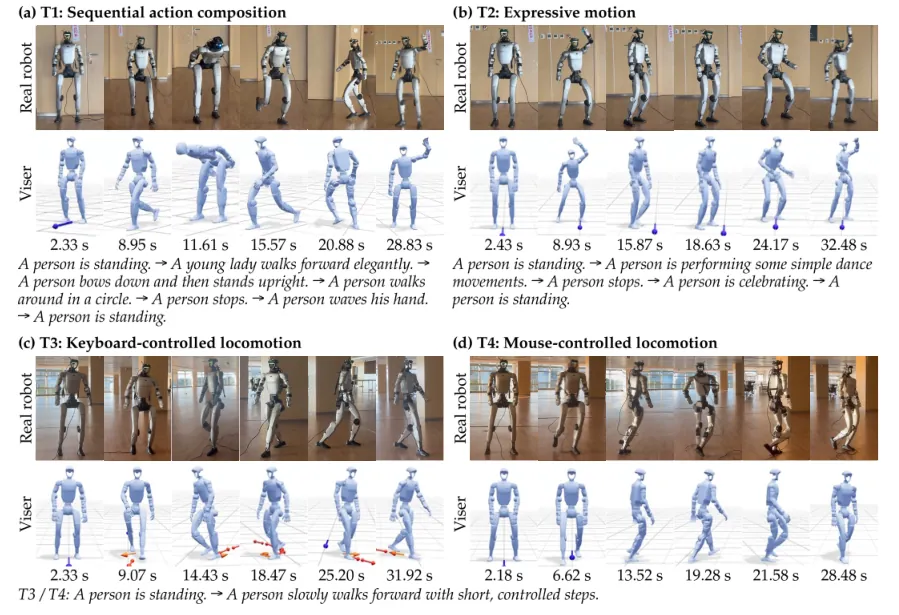
Figure 3: Paper Fig. 8 real-world qualitative results. (a) T1 sequential action composition (bow at 11.61 s, raised-arm gesture at 28.83 s); (b) T2 expressive motion (dance, celebrating, extending to 32.48 s); (c) T3 keyboard-controlled locomotion; (d) T4 mouse-controlled locomotion. Each panel shows real-robot frames, Viser references, timestamps, and the prompt sequence.
Quantitatively (paper Tables 8/9): full-task success is 18/20 (90.0%) for T1, 19/20 (95.0%) for T2, 29/30 (96.7%) for T3, and 28/30 (93.3%) for T4; across all four tasks, 94/100 trials achieve full-task success, 97/100 meet the stability criterion, and no falls are observed. Under interactive control, keyboard/mouse speed RMSEs are 0.041/0.045 m/s, heading MAEs 4.6/5.1 degrees, and median physical-response latencies 351/360 ms (handoff 246/251 ms); within the 1.5 s response deadline, 296/300 (98.7%) keyboard and 292/300 (97.3%) mouse events succeed, with stance-slip velocities of only 1.5/1.7 cm/s. The task-completion and stability excerpt:
| Task | Full success | SR (%) [95% CI] | Stages | Text switches | Stable | Falls |
|---|---|---|---|---|---|---|
| T1 action composition | 18/20 | 90.0 [69.9, 97.2] | 136/140 | 117/120 | 19/20 | 0 |
| T2 expressive motion | 19/20 | 95.0 [76.4, 99.1] | 99/100 | 78/80 | 20/20 | 0 |
| T3 keyboard control | 29/30 | 96.7 [83.3, 99.4] | 59/60 | 30/30 | 29/30 | 0 |
| T4 mouse control | 28/30 | 93.3 [78.7, 98.2] | 58/60 | 29/30 | 29/30 | 0 |
The paper also performs physics-based tracking with SONIC in MuJoCo (Fig. 9): the upper row shows simulated execution and the lower row a kinematic Viser visualization of the same reference at matching timestamps, covering forward-to-backward-to-stand, walk-turn-left-to-stand, wave-to-walk, and kung-fu-to-walk instruction sequences, qualitatively illustrating transfer of generated sequences to a tracking controller under changing instructions.
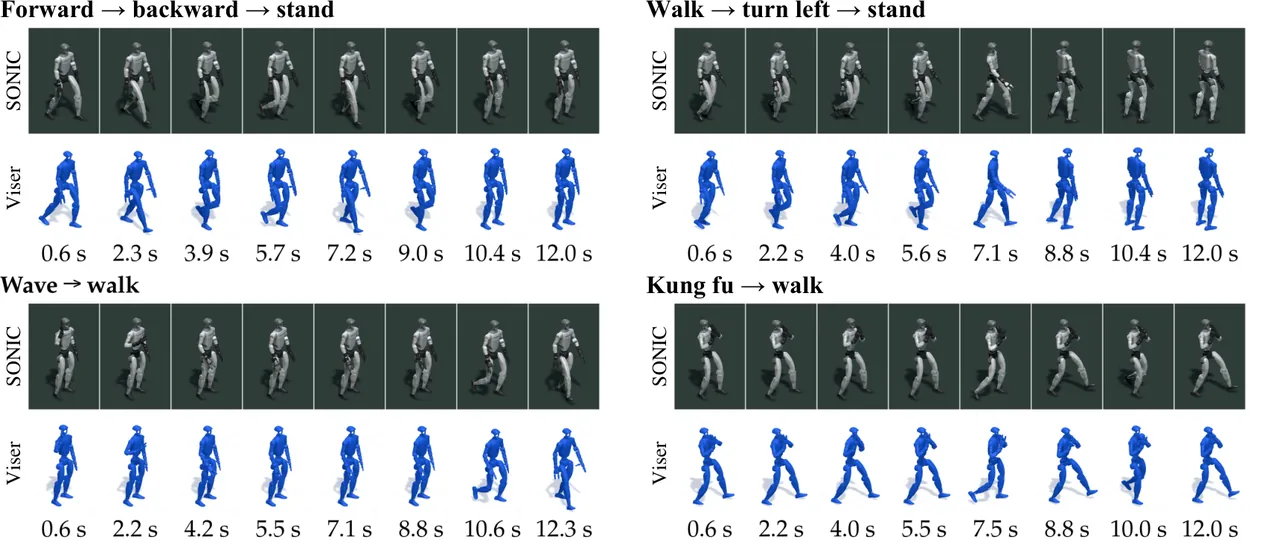
Figure 4: Paper Fig. 9 SONIC simulated tracking. Each quadrant compares physics-based execution (upper row) with the Viser reference (lower row) at matching timestamps.
Interactive controllability is also visible in Fig. 2: four panels (root trajectory, root waypoints, full-body keyframes, selected joint positions) show reference motion under text and spatial constraints such as walking forward continuously, walking in a circle, waving the right hand naturally, doing kung fu, and walking backward naturally, with red overlays marking trajectories, waypoints, and joint locations.
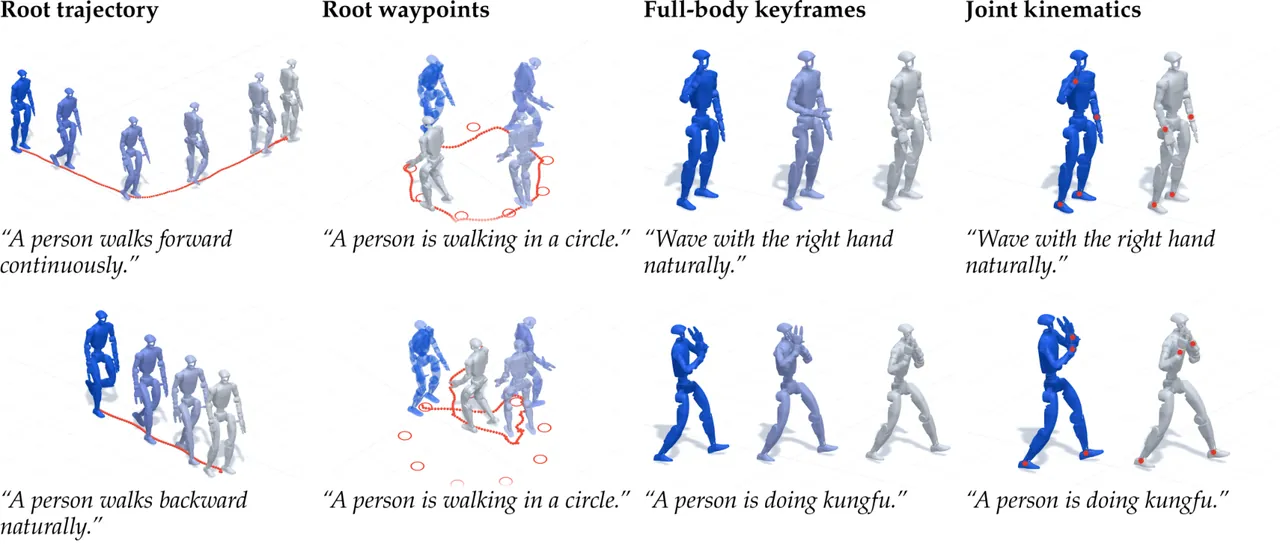
Figure 5: Paper Fig. 2 interactive motion generation. Left to right: root trajectory, root waypoints, full-body keyframes, joint kinematics; blue-to-gray indicates temporal progression and red overlays mark trajectories, waypoints, and joint locations.
Data Foundation: Unified G1 Corpus and Retargeting Quality
The training pool unifies BONES Seed (robot references), HumanML3D, and HiPHI (human recordings with descriptions) into a 29-DoF, 414-D, 25 Hz G1 representation. For HiPHI, only the high-precision human-motion subset is selected and the object-interaction subset excluded; human motion is retargeted via GMR (HumanML3D reconstructed from AMASS SMPL-H parameters, HiPHI via BVH forward kinematics), with rest-pose transforms, pelvis-height scaling, 25 Hz resampling, position-plus-orientation solving under joint limits, and temporal refinement. The figure below (paper Fig. 3) shows corpus composition, lower-body target alignment, and retargeted examples:
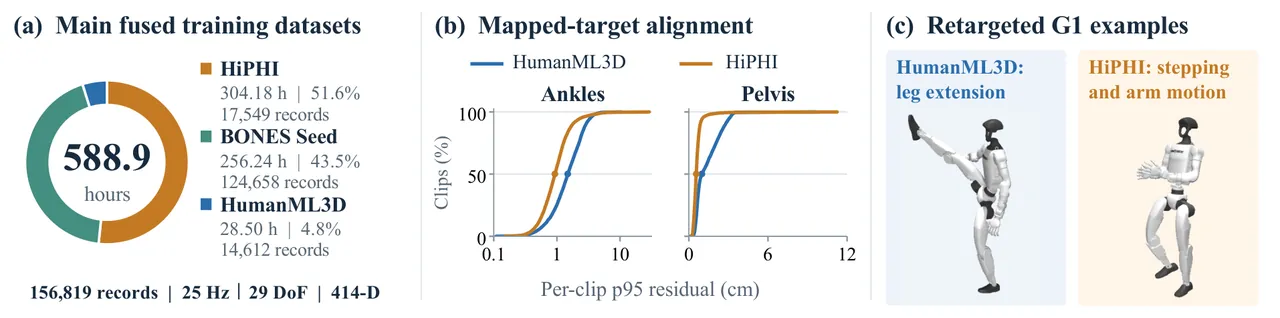
Figure 6: Paper Fig. 3. (a) Training-set composition (588.9 hours, 156,819 records, 25 Hz, 29 DoF, 414-D); (b) mapped-target alignment (per-clip p95 residual CDF for ankles and pelvis); (c) retargeted G1 examples (HumanML3D leg extension, HiPHI stepping and arm motion).
Retargeting quality is measured by the 95th-percentile distance between a robot body origin and its scaled, offset human target: cross-clip median ankle residuals are 1.49 cm on HumanML3D and 0.93 cm on HiPHI, with corresponding 95th percentiles of 3.37 and 2.39 cm, and median pelvis residuals of 0.99 and 0.56 cm; the maximum round-trip position discrepancy between stored formats and the 414-D representation is only $1.31\times10^{-6}$ m. The authors stress that pose-level evidence and mapped-target residuals describe different aspects: a target offset alone does not establish loss of the depicted action, and recognizable poses do not establish precise hand contact.
Limitations
Author-stated: the current framework focuses on controllable humanoid motion generation and does not yet address object manipulation; future work targets whole-body loco-manipulation, coordinating locomotion with object manipulation. It is therefore a motion-reference generator plus tracking controller, not a manipulation policy that can grasp or carry.
Author-stated (method boundary): the PCM slots aim to support terminal spatial constraint satisfaction and command-conditioned generation and are "not designed to reproduce arbitrary early instructions verbatim"; the bounded computational context "does not imply error-free motion over arbitrary durations." Long-horizon capability is computational and statistical, not a guarantee of exact retrieval of arbitrary evicted events.
This reading's judgment: first, semantic metrics are not uniformly best — single-window R@3 and L2-FID lag MotionStreamer/OMG/CMDM on some benchmarks, indicating a trade-off between precise spatial control and single-window text retrieval / distributional quality. Second, the real-world results reflect the complete generation-plus-SONIC-tracking system, making it hard to attribute failures solely to the generator; the 25 Hz representation versus 50 Hz transport and the remote-GPU-plus-onboard-tracking architecture introduce network and buffering delays, so although median physical response of 351/360 ms is within the 1.5 s deadline, it is not instantaneous. Third, evaluation relies heavily on retargeted human motion, where retargeting residuals and domain gap may affect fine real-robot motion (the paper acknowledges visible differences in trunk inclination and foot placement).
Conclusion and Outlook
Motion Mamba 2.0 combines autoregressive diffusion, resumable Mamba-3 states, and persistent content memory, using an accepted-only streaming formulation that separates sampling iterations from physical time to achieve accurate long-horizon terminal control with bounded historical context: Root/End CE of 7.55/13.64 cm at 39.52 s on retargeted HiPHI, the lowest among evaluated methods. State-preserving inference optimizations reduce median complete-window latency to 276.14 ms on an RTX 4090, a 6.138x speedup with bitwise-identical tested outputs; physical G1 experiments complete 94 of 100 trials with zero falls and demonstrate multi-stage text-guided execution and responsive keyboard/mouse spatial control. The methodological lesson is that compressed recurrent history and attention retrieval are not either/or: learning a state-to-content interface lets them complement each other, and making the prediction/history-commitment boundary explicit is key to streaming generation with diffusion. Looking ahead, whole-body loco-manipulation and tighter joint semantic-control optimization are natural directions.