PAPER DEEP DIVE
Heave-Ho: Decentralized Long-Horizon Multi-Humanoid Collaboration
Collaboration promises to extend humanoid capabilities beyond what individual robots can achieve. However, realizing this potential requires coordinated whole-body interactions, coherent long-horizon planning, and precise synchronization across robots. We introduce Heave-Ho, a decentralized framework for long-horizon collaborative multi-humanoid loco-manipulation. At the low level, we develop a multi-agent post-training framework that adapts a humanoid foundation tracking model to physically coupled interactions between humanoids, enabling coordinated decentralized control from local observations alone. At the high level, we train a vision-language planner and design a speech-based leader-follower coordination mechanism to synchronize decentralized execution without network communication. Trained with two identical humanoids, our system scales to teams of up to ten robots and generalizes to heterogeneous teams without retraining. To benchmark these capabilities, we introduce HH-Bench, comprising 12 tasks involving teams of 2 to 10 humanoids, including heterogeneous teams. Systematic evaluations show that Heave-Ho consistently outperforms baseline methods, while real-world experiments demonstrate robust decentralized collaboration across challenging tasks.
Paper: Heave-Ho: Decentralized Long-Horizon Multi-Humanoid Collaboration
Authors: Ting-Hsuan Chen, Siheng Zhao, Han Jiang, Qi Pan, Louison Lu, Jiaheng Luo, Henghui Bao, Yiyu Chen, Quan Nguyen, and Yue Wang
Affiliations: University of Southern California and VinMotion
Links: arXiv:2611.22275 · project page · GitHub
Code status: The repository currently exposes a preliminary HH-Bench release, reference motions, robot models, and replay tools. Training code, policy weights, deployment software, and the formal evaluation protocol are planned for release by the end of December 2026.
One-sentence summary: Heave-Ho combines a frozen humanoid tracking foundation, a shared residual policy, a vision-language planner, and speech-based scheduling so that humanoid teams coordinate long tasks through a shared object rather than robot-to-robot network messages, while a policy trained with two robots scales without retraining to teams of ten and to heterogeneous partners.
Why coupled humanoid teams are difficult
A single humanoid can walk, carry rigid loads, and perform substantial whole-body manipulation, but object size, mass, and task duration eventually exceed what one body can handle. Multi-robot collaboration appears to be the natural extension. The hard part is not merely running several controllers at once. Each robot must establish stable contact with the same object, preserve a shared plan over tens of seconds, and maintain both timing and load sharing as the object moves.
A centralized team can exchange states, poses, and action plans, but that design depends on communication. Packet loss, occlusion, latency, or a departing member can break the execution loop. Completely independent controllers avoid the network but lack a common intention and start time. If one robot lifts late, the object tilts; if one robot steps alone, the resulting contact force can pull its partner off balance. Heave-Ho imposes a sharp operational constraint: no network messages are exchanged during execution. Robots influence one another only through the object they hold.
Long-horizon composition creates a second problem. Carrying a table is not one continuous short action. It consists of lifting, walking forward, moving sideways, rotating, adjusting, and putting down. Training a separate controller for every segment creates distribution shifts at each transition and ties the method to a fixed team size. The paper separates the problem into a high-level choice of the next team skill and a low-level controller that maps that skill into a role-specific whole-body behavior.
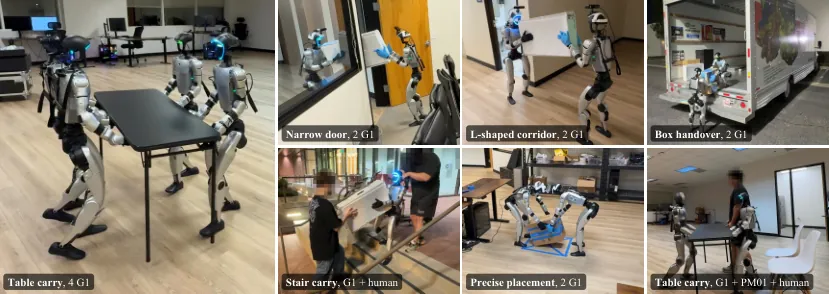
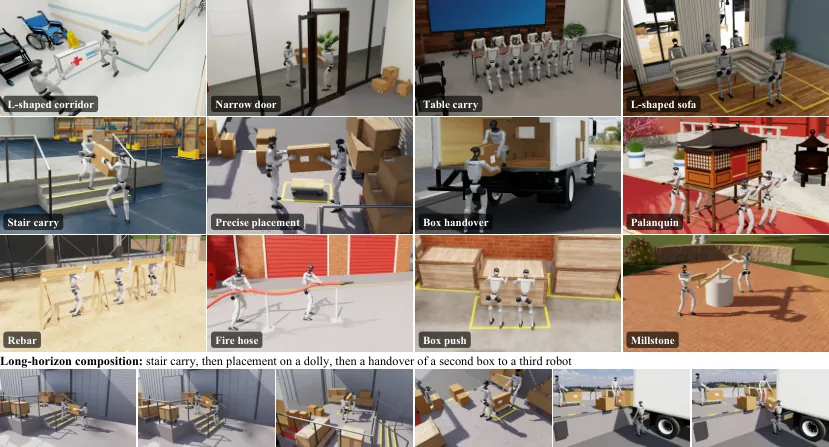
The authors also identify a benchmarking gap. Existing embodied benchmarks usually evaluate one robot, while multi-agent benchmarks rarely involve humanoids whose balance and grasp are coupled through a shared physical object. HH-Bench addresses this gap with 12 tasks and variants for teams of 2 to 10 robots, including heterogeneous groups. Its scenarios include narrow doors, L-shaped corridors, tables, sofas, stairs, handovers, hoses, boxes, and millstones.
Team skills as a discrete coordination language
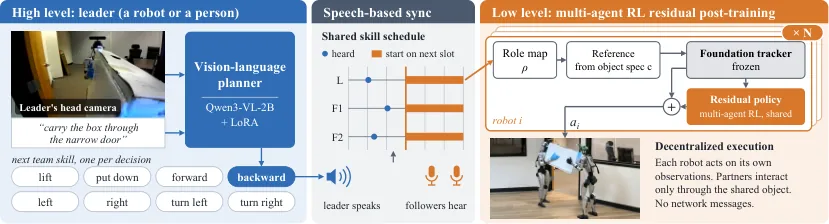
For robot $i$, a role map $\rho_i:\mathcal{K}\to\mathcal{K}$ converts a team skill into a skill instance in that robot's own frame. The robot receives proprioception, a short future reference window, and the object specification $\mathbf{c}=(L,W,H,m)$. It does not receive another robot's joint state or policy output. The tuple records length, width, height, and mass, giving every platform enough information to form a grasp, posture, and load estimate without a shared world model.
The team skill set is denoted by $\mathcal{K}$. At each decision point, the planner selects an element from $\mathcal{K}\cup\{\mathrm{HOLD},\mathrm{DONE}\}$. HOLD keeps the team in a stable state, while DONE terminates the task. This interface transforms a continuous long task into composable units without asking the high-level model to generate joint trajectories.
The paper defines two hub configurations. $S_0$ is a standing robot without the object; $S_1$ is a standing robot holding it. A lift implements $S_0\to S_1$, a put-down implements $S_1\to S_0$, and steps or rotations implement $S_1\to S_1$. Because all skills share the same endpoints, legal skills can be concatenated arbitrarily. The planner therefore does not need a special transition model for each task.
Fixed step lengths and fixed rotation angles create a discrete planning vocabulary. The leader reasons in units such as one forward step, one sideways step, or one rotation segment, while the low-level controller realizes the corresponding reference. This reduces the planner's output space and supports long compositions. A team can carry a box upstairs, place it on a dolly, and then hand a second box to another robot as one sequence of reusable skills.
Low-level control: freeze motion, learn interaction
Learning a full whole-body controller from scratch is sample-inefficient for a physically coupled team. The robot must simultaneously discover balance, stepping, grasping, contact timing, and load sharing while its partner continually changes the forces it receives. Heave-Ho instead starts with SONIC, a frozen humanoid foundation tracking policy. The base policy $\pi_{\mathrm{base}}$ supplies a strong motion prior, and a residual policy learns the additional corrections required for collaboration.
The shared residual actor produces an action by correcting the frozen base action:
$$a_i=\pi_{\mathrm{base}}(o_i)+\pi_\theta\!\left(o_i,\pi_{\mathrm{base}}(o_i)\right).$$
Here, $o_i$ is the local observation available to robot $i$, and $\pi_\theta$ is shared by all robots. Training begins with low action noise so early rollouts remain close to the reliable tracker. The residual then learns the postural and contact adjustments needed to share a load, push together, or transfer an object. The decomposition assigns locomotion priors to one module and team interaction to the other.
The paper trains with multi-agent PPO using centralized training and decentralized execution. A centralized critic receives all agent observations in a fixed order and produces one value per agent:
$$V_\phi(s)\in\mathbb{R}^{N}.$$
At training time, the critic can use team information to reduce value-estimation variance, but each actor still acts only on its local observation. At deployment, the critic is unnecessary and robots exchange no state. Because all actors share parameters, the policy contains no input whose size equals the team count. Adding a partner does not create a new actor.
Rewards combine tracking of the robot's own reference, tracking of the object relative to that reference, hand contact while carrying, and gait terms such as foot clearance and air time. Terminations are coupled: one robot's failure ends the episode for the entire team. This matches the physics of a jointly held object. A failure propagates through the load path, so rewarding other robots as if they could continue independently would optimize a different problem from team success.
Composition is learned by training on long random chains of legal skills rather than one fixed trajectory. Chains cover movement in balanced directions, rotations, and varied waiting times at the hubs, and episodes start at random positions along them. Because the selected skill is encoded only in the reference, one network can move from lift to walking to turning to put-down without switching controllers at a skill boundary.
flowchart TD
    A[Task instruction and leader head camera] --> B[Leader vision-language planner]
    B --> C[Team skill token from K plus HOLD or DONE]
    C --> D[Leader speaks one token]
    D --> E[Followers recognize speech on board]
    E --> F[All robots choose next shared coarse tick]
    C --> G[Robot local role map]
    H[Proprioception] --> I[Frozen base tracker]
    J[Short future reference window] --> I
    K[Object specification L W H mass] --> L[Shared residual actor]
    G --> I
    G --> L
    I --> L
    L --> M[Local joint targets]
    M --> N[Physical interaction through shared object]
    N --> H
    F --> G
Planning and synchronization without packets
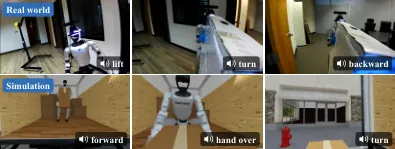
The leader's head-camera image and the task instruction are passed to a vision-language planner, which emits one discrete team-skill token. The implementation fine-tunes Qwen3-VL-2B-Instruct with LoRA rank 32 and alpha 64, giving approximately 140 million trainable parameters. Training uses 24 real demonstrations or 1,000 simulated episodes per task. One decision takes 52.5 ms and 5.3 GiB of memory on a single RTX 4090.
The planner is queried only after a skill has completed, so each decision sees the team at rest. This removes visual variation from mid-motion contacts, but also removes the ability to replan during a skill. A long task becomes a closed loop of looking at a stable state, selecting one team skill, executing it, and looking again.
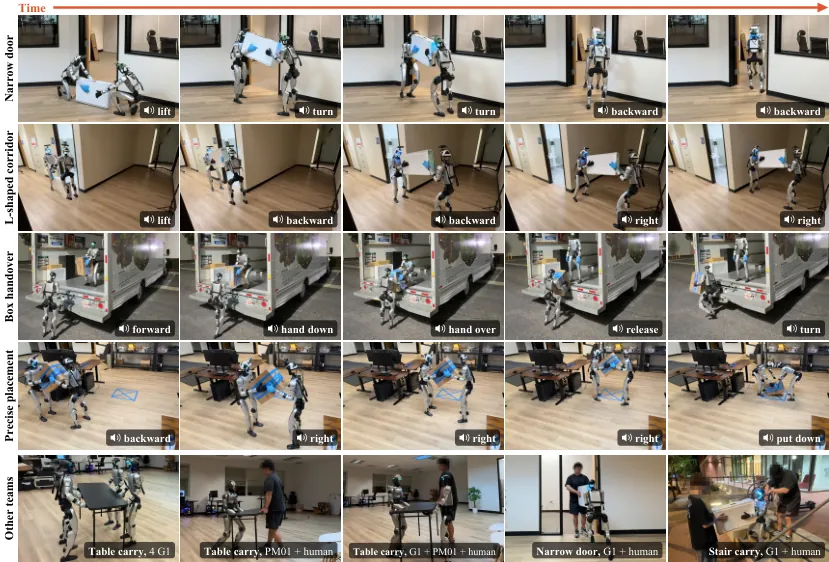
Synchronization separates what the team does from when it does it. The leader speaks the discrete skill token. Every follower recognizes the token with an onboard microphone. Rather than starting immediately, all robots wait for the next slot of a shared coarse control grid, and the leader offsets its own start to compensate for expected acoustic and recognition delay. If delay variation is smaller than a grid interval, every robot selects the same slot and begins at the same time without exchanging a packet.
Leadership is a role, not a fixed robot. Any robot that can host the planner may lead. A person can follow the spoken commands or take over as leader. This creates a low-bandwidth and interpretable interface for heterogeneous teams. Its boundary is equally clear: followers must hear the leader, so noisy rooms and unreliable microphones can make team members choose different start ticks.
Training range and deployment scale
Training runs with 4,096 parallel two-robot teams and up to $10^9$ environment steps per stage. The true object size is randomized by 10 percent and its mass by 20 percent around the nominal specification passed to the policy. The simulator also varies friction, robot properties, external pushes, and actuation delay. The policy therefore learns to adapt its grasp and posture to a range of objects rather than memorizing one exact load.
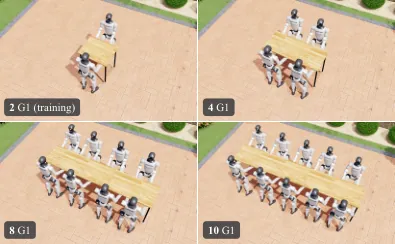
All G1 policies are trained with two identical robots, yet deployment assigns the same trained policy to different slots around an object. Four robots can carry a table as two facing pairs, while eight or ten robots occupy additional positions along a longer table. Each slot defines the local reference and contact target. Partner behavior reaches a robot through object motion and contact force instead of an explicit state message.
Heterogeneous partners use the same skill interface. A person can listen to the spoken skill and move with the team. A PM01 humanoid runs a controller trained with the same recipe on its own body. The paper evaluates G1-human, PM01-human, G1-PM01-human, and four-G1 table teams. This is not one network directly controlling every platform's joints. It is a shared semantic and timing layer with platform-specific low-level execution.
HH-Bench and evaluation design
HH-Bench contains 12 tasks and 18 variants for different team sizes. It covers hand-based lifting and carrying, shoulder carrying, pulling a fire hose, pushing a box or millstone, handing a box down from a truck, and precise placement. Reference lengths range from short interactions to a corridor task lasting about 101 seconds. The benchmark also scales some objects for teams of up to ten robots.
Real-world experiments use Unitree G1 and EngineAI PM01 robots. Policies run from onboard sensing and computers. No motion-capture system supplies closed-loop global state, and no network message is exchanged between robots. High-level planning is evaluated with 10 trials per task. Low-level simulation uses 12 tasks, three seeds, and 512 teams per seed.
A trial succeeds when the team completes the requested task, reaches the target location, and does not drop the object. This is stricter than measuring local object displacement because it requires the full task stages to finish. Stair, narrow-door, and handover trials can fail immediately after a single balance error or interrupted grasp, so the reported success rate reflects long-horizon stability rather than isolated motion quality.
Real trials begin from a nominal configuration with small perturbations. Simulation samples initial states over a wider range that includes difficult layouts. The authors explicitly state that simulation and real-world success rates are not directly comparable. This caveat matters when interpreting the 94.41 percent simulation controller result alongside the overall 92 percent real-team result.
Results: coordination, control, and transfer
The high-level comparison isolates coordination quality. Heave-Ho reaches 86 percent average success, compared with 98 percent for a human operator, 42 percent for zero-shot GPT-6 Astra, and 12 percent for CHORUS. It succeeds on all 10 trials for handover, four-robot table carrying, and sofa placement in simulation, and reaches 6 of 10 for the narrow door and 7 of 10 for the L-shaped corridor in the real world.
| Decision maker | Door | Corridor | Handover | Table | Sofa | Average |
|---|---|---|---|---|---|---|
| GPT-6 Astra zero-shot | 3/10 | 4/10 | 7/10 | 4/10 | 3/10 | 42% |
| CHORUS | 0/10 | 0/10 | 6/10 | 0/10 | 0/10 | 12% |
| Heave-Ho | 6/10 | 7/10 | 10/10 | 10/10 | 10/10 | 86% |
| Human operator | 9/10 | 10/10 | 10/10 | 10/10 | 10/10 | 98% |
The CHORUS result clarifies why synchronization is central. Its failure is not a complete lack of single-robot competence. Each robot runs an independent policy and advances through its own actions without a shared start event. Tasks that require sustained joint carrying break when the copies drift apart. Handover succeeds 6 of 10 times because the robots are tightly coupled only during the short transfer stage.
The low-level ablation shows that motion priors and interaction learning serve different roles. Pure SONIC has 0.22 percent success despite a body error of 58.24 cm, better than the 92.69 cm body error of Heave-Ho without SONIC. It can follow a reference but does not know how to load a shared object. Removing SONIC drops success to 16.78 percent. Independent actors reach 22.05 percent, while the shared-actor Heave-Ho reaches 94.41 percent.
| Controller | Success | Body error (cm) | Object error (cm) |
|---|---|---|---|
| Pure SONIC | 0.22% | 58.24 | 83.20 |
| Multi-HDMI | 28.56% | 68.57 | 66.92 |
| Heave-Ho without SONIC | 16.78% | 92.69 | 89.53 |
| Heave-Ho with independent actors | 22.05% | 35.59 | 35.00 |
| Heave-Ho | 94.41% | 18.62 | 19.59 |
Heave-Ho reduces body error to 18.62 cm and object error to 19.59 cm while raising success to 94.41 percent. The pairing matters. A controller can reproduce a body trajectory while leaving the object far from its target, as the pure SONIC object error of 83.20 cm shows. Centralized training lets the critic evaluate each actor's contribution to a shared physical outcome, while a shared actor pools experience across robots and avoids a parameter set that grows with team size.
Across 100 real-world trials, teams succeed 92 times. Two-G1 teams achieve 9 of 10 on the narrow door, 10 of 10 in the L-shaped corridor, 10 of 10 on box handover, and 9 of 10 on precise placement. Stair carrying is the hardest case at 7 of 10 because each step leaves very little foot-placement margin. Larger and heterogeneous table teams include 8 of 10 for four G1 robots, 9 of 10 for three G1 robots plus a person, 10 of 10 for PM01 plus a person, and 10 of 10 for G1 plus PM01 plus a person. These expanded teams reach 37 of 40 overall.
| Real-world task | Team | Success |
|---|---|---|
| Narrow door | 2 G1 | 9/10 |
| L-shaped corridor | 2 G1 | 10/10 |
| Box handover | 2 G1 | 10/10 |
| Precise placement | 2 G1 | 9/10 |
| Narrow door | G1 + human | 10/10 |
| Stair carry | G1 + human | 7/10 |
| Table carry | 4 G1 | 8/10 |
| Table carry | 3 G1 + human | 9/10 |
| Table carry | PM01 + human | 10/10 |
| Table carry | G1 + PM01 + human | 10/10 |
What the public code actually provides
The inspected repository is at commit 2440493fe1e04554b96eb517a641562b79b650d5. The public implementation currently centers on hh_bench/, which contains 12 tasks, 18 variants, 17 task.json files, Unitree G1 descriptions, object and scene assets, and tools for loading and replaying references. It does not include the policy, planner, training loop, deployment stack, or official success evaluator.
hh_bench/tools/load_task.py lines 22 to 28 load one motion.npz and metadata file per robot. Each reference stores body pose and velocity, joint position and velocity, and left/right hand contact indicators at 50 Hz. This matches the onboard control frequency reported in the paper and gives external users the motion data needed to inspect agents' local trajectories.
hh_bench/tools/replay.py lines 59 to 70 construct robot and object state-writing functions, and lines 79 to 99 write those states frame by frame in Isaac Lab. Joint drives are disabled, so the script displays kinematic reference playback rather than running closed-loop control. The README states this limitation directly. The public code therefore supports asset and task inspection, not reproduction of Table 2.
Limitations and residual risks
The authors state two limitations. Speech synchronization requires a reasonably quiet environment and reliable sound pickup. Training the planner for each new task also requires manually teleoperated demonstrations, which is time-consuming. The data counts of 24 real demonstrations or 1,000 simulated episodes per task show that high-level behavior still depends on task-specific collection.
Three independent limitations follow from the evaluation. First, the preliminary benchmark leaves object masses unset and withholds the exact success protocol and evaluation scripts, so external groups cannot yet reproduce the simulation table. Second, real trials start from nominal states with small perturbations while simulation samples a wider initial distribution, which prevents a direct comparison between the 94.41 percent simulation and 92 percent real result. Third, every partner must hear the leader and the planner acts only when the team is at rest; occluded, extremely noisy, or rapidly changing environments require additional synchronization and replanning mechanisms.
Team scaling is also enabled by shared actors and object-mediated coupling, but the deployment still assigns slots and contact targets around each object. The paper demonstrates compelling slot layouts for tables and other benchmark objects, yet it does not establish automatic allocation for arbitrary team counts, body shapes, or irregular objects. Heterogeneous robots likewise need their own low-level controllers trained with the same recipe, rather than a single monolithic policy issuing joint targets for every platform.
Conclusion
Heave-Ho separates collaboration across two time scales. At the high level, a vision-language planner chooses composable team skills only when the team is at rest, then synchronizes execution with spoken tokens and a shared coarse tick. At the low level, a frozen humanoid foundation tracker supplies stable movement while a shared residual actor, trained with centralized critics and deployed with local observations, learns contact and load sharing. No network packet is needed during execution.
The evidence supports the decomposition. The planner reaches 86 percent average success, the controller reaches 94.41 percent, a two-robot training policy transfers to teams of up to ten, and real-world teams succeed in 92 of 100 trials. The remaining gaps are equally concrete: only 7 of 10 stair trials succeed, a human operator remains better than the planner, and the public repository does not yet allow reproduction of the control results. Heave-Ho establishes a credible decentralized route, while leaving substantial work in robust perception, rapid task authoring, and reproducible release.
Golden quote: Heave-Ho does not ask partners to exchange messages; it asks them to execute one shared skill on one shared object at one shared beat.