PAPER DEEP DIVE
Awaken-HI: Scaling Humanoid Intelligence with Whole-Body Human Experience
A central goal of humanoid robotics is for robots to perform the everyday work people do in homes and workplaces. Existing egocentric video datasets cover many of these activities but provide little synchronized whole-body motion data for learning loco-manipulation at scale. We build Awaken-Human, which pairs approximately 50,000 hours of egocentric stereo video with synchronized whole-body human motion and covers more than 100 skills. Building on this, we also introduce Awaken-HI (Humanoid Intelligence), a vision-language-action model for humanoid loco-manipulation that jointly predicts original human motion and retargeted robot actions through a shared action expert. We show that loco-manipulation skills transfer more effectively from people to humanoids when human trajectories directly supervise the shared action expert. Increasing human pretraining data reduces held-out robot action prediction error according to an empirical scaling law and raises the mean success rate on downstream real-robot tasks. After full-corpus pretraining and T800 adaptation, Awaken-HI achieves a mean success rate of 93.75% across eight individual tasks and outperforms GR00T N1.7 and pi_0.5 in both individual and long-horizon evaluations. The same policy generalizes to objects unseen during robot post-training and to new pairings of familiar objects and destinations.
One-sentence summary
The paper converts about 50,000 hours of egocentric human activity into three coupled targets, namely original human motion, camera-frame wrist poses, and T800 robot actions, so that one shared action expert can learn a human motion prior before 150 hours of real-robot teleoperation adapts it to a physical humanoid.
Why human experience matters
Humanoid manipulation has a data problem that is easy to misstate. A robot is not merely missing desktop trajectories. It has too few demonstrations of walking to an object, changing posture, reaching at a useful height, maintaining balance, manipulating with one or two hands, and then carrying the result somewhere else. These behaviors form long, coupled sequences. A warehouse pick, a home laundry task, or a shelf stocking routine cannot be reconstructed by stitching together a handful of independently sampled grasp poses.
Teleoperation can produce the right action interface, but it is expensive to scale across this breadth. An operator must coordinate a floating or legged base, torso, arms, and grippers while also completing a useful task. Recording failures is often cheaper than recording successes, yet a policy trained mainly on broken demonstrations learns the wrong temporal structure. The paper addresses this bottleneck by asking whether ordinary human activity, recorded in large volume with synchronized body tracking, can provide a useful pretraining distribution.
Video alone is insufficient. Internet footage contains objects, rooms, and instructions, but a raw RGB sequence does not identify the human root, joint angles, hand configuration, camera depth, or the intended robot command. Motion-capture datasets solve part of the geometry problem but have been much smaller. Existing egocentric datasets may contain hundreds of hours of video, but often lack dense body motion, accurate hands, frame-level depth, or validated language descriptions. Awaken-Human is designed to reduce all of these gaps under one capture protocol.
The paper's second question follows from the first. Suppose a human trajectory has been retargeted to a robot. Should the robot policy train only on the resulting robot command, or should it also learn the human movement that produced that command? Retargeting makes motion executable, but it also changes it. Body proportions, joint limits, wrist geometry, gripper design, foot contact, and controller dynamics all leave a residue. If the transformed trajectory becomes the only target, the model loses evidence about how the person coordinated the original task.
Awaken-HI keeps both targets. A robot action branch predicts the 40-dimensional T800 command. A human branch predicts a 161-dimensional representation of the original body and hands. A wrist branch predicts 18-dimensional left and right wrist poses in the camera frame. The branches do not share output coordinates, but they share the vision-language condition, the 37-dimensional proprioceptive state encoder, and a diffusion-transformer action expert. This architecture is the paper's main technical bet: executable robot actions and undistorted human motion can improve one another when they are learned together.
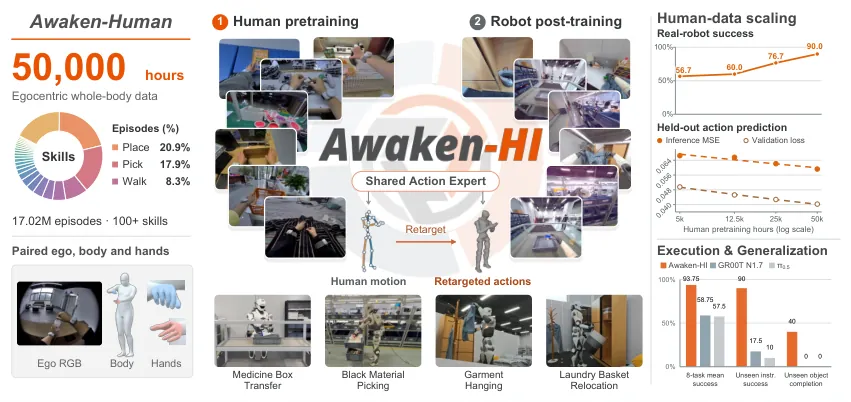
Figure 1: The paper overview. Awaken-Human pairs egocentric stereo video with body motion; Awaken-HI pretrains on human and retargeted targets, then adapts on T800 teleoperation data.
The Awaken-Human corpus
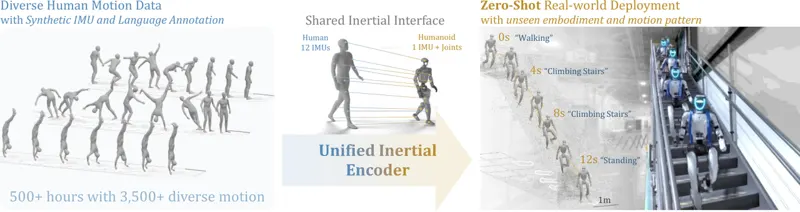
Awaken-Human contains approximately 50,000 hours of egocentric stereo video, 17.02 million episodes, 5.41 billion pose frames, and 11.18 million valid language instructions. It covers more than 100 skills in homes, offices, retail spaces, and storage areas. Capture uses a PICO headset and five body-worn trackers. The rig records stereo RGB, body tracking, task instructions, camera parameters, and device parameters together. This common acquisition setup is important because video, motion, and semantics can remain synchronized at the segment level.
Collectors follow task goals rather than reproducing short laboratory gestures. A person may approach a shelf, crouch, pick up a carton, stand, turn, walk to another room, and place the carton. The full recording retains the transition between these phases. From a robotics perspective, that continuous structure is not incidental context around a grasp. It contains decisions about when to move the base, how much to lean, when to release a support surface, and how to preserve balance while both hands are occupied.
Skill coverage extends beyond pick-and-place to garment folding, wiping, carrying, opening and closing containers, and arranging objects on shelves or tables. The object distribution includes boxes, bottles, food packages, clothing, and household or industrial containers. The point is not that the corpus samples every possible object uniformly. It is that the same recording format captures varied object categories, workspaces, body postures, and action sequences, giving a pretraining model repeated evidence about how human whole-body behavior changes with a task.
The PICO hand tracker does not provide reliable supervision in every frame. Tracking can drop during occlusion or produce positional error and temporal jitter. The authors therefore run an in-house 3D hand reconstruction model over the egocentric video and generate MANO skeletons with 21 keypoints. The reconstruction also yields hand-quality labels based on visibility and related cues. Low-quality segments are excluded, while the retained reconstructed hands replace the original tracker annotation. These hands support both human motion learning and the later alignment of robot end effectors.
Depth is generated from the synchronized stereo pair. The images are undistorted and rectified, Fast-FoundationStereo estimates disparity, and calibrated intrinsics plus the stereo baseline convert disparity into metric depth. The resulting maps are paired with the RGB frame and used as current and future geometric targets during pretraining. The model is not handed simulator ground truth. It sees a learned stereo reconstruction whose quality depends on texture, lighting, occlusion, and the matching model, much like a real deployment pipeline.
Language is produced through model-assisted annotation followed by human review. Instructions describe the overall task, while subtask labels describe a bounded phase within the recording. Review matters because visual-language systems can confuse a nearby object with the manipulated object or label a preparation phase as if the action had already succeeded. The reviewed labels bind the language target to the actual segment, allowing the subtask head to learn temporal phase from image and instruction rather than from an unverified caption.
Curation is performed rather than treating every recorded hour as equally useful. V-JEPA 2 features are extracted and clustered in a shared representation space. Segment semantics and visual clusters guide redundancy removal and adjustment of scene proportions. A held-out validation set is selected using the same visual and semantic information, and the remaining data form nested training subsets. That setup prevents a larger dataset from simply changing the validation distribution and creating an artificial scaling curve.
The four subsets represent 10%, 25%, 50%, and 100% of the corpus, or 5,000, 12,500, 25,000, and 50,000 hours. They share one validation set. The evaluation can therefore ask a cleaner question: when the same model family, optimizer, and general training recipe receive more human experience, do robot action prediction and downstream success improve? This is a stronger design than comparing unrelated datasets at different scales, though it remains a single corpus and a single capture protocol.
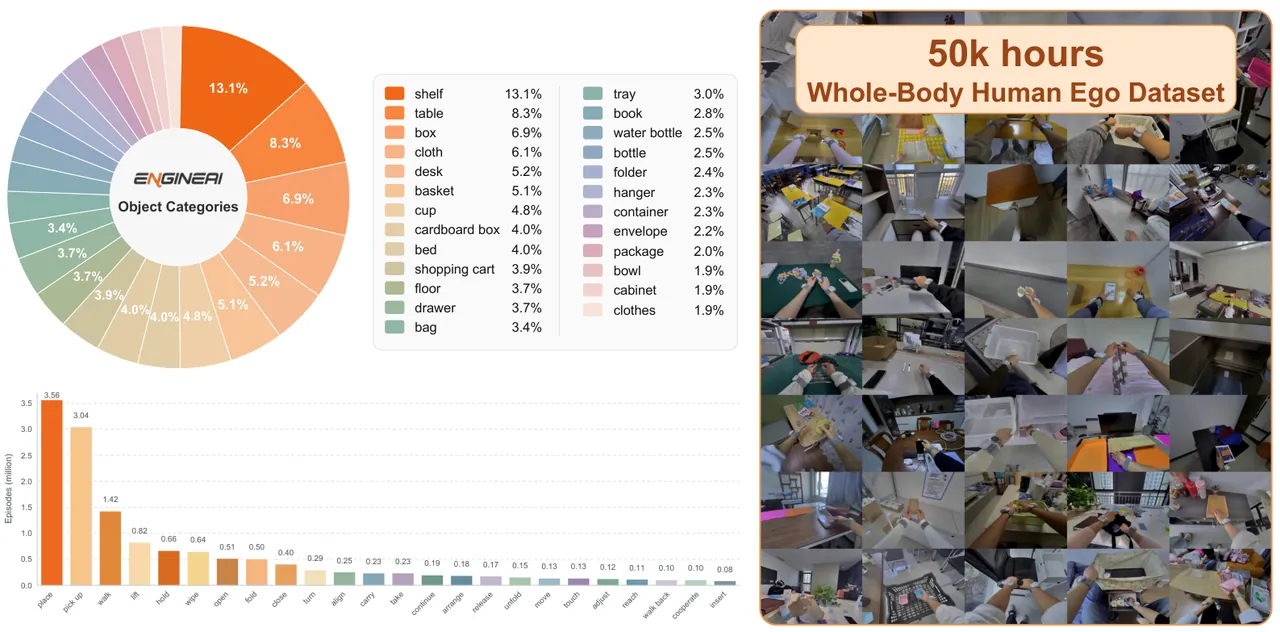
Figure 2: Awaken-Human coverage. The panels show interaction-object categories, episode counts for selected skills, and representative stereo first-person views.
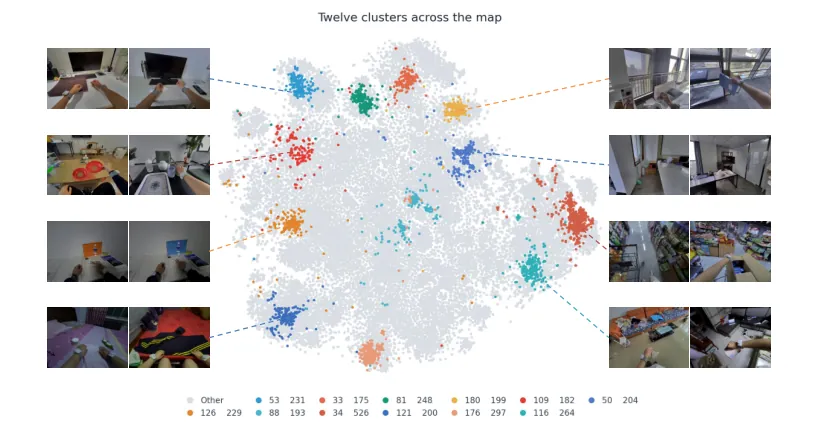
Figure 3: Corpus diversity after curation. V-JEPA 2 video features form distinct clusters, with representative scenes shown beside the t-SNE projection.
Retargeting without discarding the source
The robot action labels come from a T800-specific retargeting pipeline built on GMR. The human skeleton is first scaled to the T800 height. Reconstructed hand motion aligns the end-effector reference, after which the optimizer produces root and joint trajectories. The authors then refine wrist orientation to reduce end-effector misalignment, while bilateral hand commands are mapped from the reconstructed hand configurations. The resulting root displacement, root rotation, 29 joint targets, and two gripper commands form the robot action vector.
The numerical improvement is substantial. Averaged over both end effectors and valid frames, mean position error falls from 16.423 cm with the original GMR pipeline to 2.422 cm with the proposed refinement. Mean orientation error falls from 39.590 degrees to 15.596 degrees. The first number shows that reconstructed hands and wrist optimization provide much better spatial alignment. The second number is equally important: a residual orientation error of roughly 15.6 degrees remains, so retargeting is not a perfect translation of intent.
The pipeline also rejects trajectories with root discontinuities, joint-limit violations, or excessive wrist-alignment error. Such filtering is necessary because an optimizer can satisfy an endpoint objective with an unnatural pose. It may rotate the wrist beyond a comfortable range, jolt the root, or place the body in a configuration that the low-level controller cannot track. A trajectory can look closer to the human hand in position while becoming less suitable for a physical robot.
This is why the human trajectory remains a training target after retargeting. A 40-dimensional robot action specifies the root displacement, root rotation, absolute joint angles, and grippers. Let the future action at offset k be:
$$\mathbf{a}_{t,k}=\left[\mathbf{d}_{t,k}^{\top},\mathbf{r}_{t,k}^{\top},(\mathbf{q}_{t+k}^{a})^{\top},(\mathbf{g}_{t+k}^{a})^{\top}\right]^{\top}\in\mathbb{R}^{40}.$$The policy predicts a horizon of such targets from the head image, language instruction, and measured state:
$$\mathbf{A}_{t}\sim\pi_{\theta}(\cdot\mid I_{t},l_{t},\mathbf{s}_{t}),\qquad \mathbf{A}_{t}\in\mathbb{R}^{H\times 40}.$$Only a prefix is executed before the policy replans from a new observation. This receding-horizon loop has two practical advantages. The model can generate temporally coherent future behavior instead of a disconnected per-step command, and the controller can correct after the world diverges from the prediction. The evaluation still depends on the low-level controller executing these references consistently, which is one reason robot post-training remains necessary.
A shared expert with three output spaces
Qwen3-VL encodes the head RGB image and language instruction. Its features condition the action expert and also feed auxiliary heads for current depth, future depth, and the current subtask. The measured robot state follows a separate path. A state encoder maps the 37-dimensional vector, consisting of six root-orientation dimensions, 29 joint angles, and two gripper states, into the shared token space. This avoids forcing low-level numerical state through a language tokenizer whose representation was not designed for continuous control.
The action expert is a shared DiT. A noisy target sequence is embedded by an input encoder, processed by the DiT with cross-attention to vision-language features, and decoded into the velocity field for a particular target space. Each branch has its own target dimension and decoder, but all branches condition on the same visual scene, instruction, and proprioceptive state. The design allows the network to learn a common conditional representation while preserving the distinct geometry of robot actions and human movement.
The robot branch produces the 40-dimensional action sequence described above. It is the only branch retained for direct robot inference after post-training. The human branch predicts a compact 161-dimensional representation derived from a 541-dimensional skeletal representation that includes visually reconstructed hands. The reduction is not incidental compression for storage. It gives the action expert a manageable target that still spans body and hand motion, with masks indicating which dimensions are valid.
The wrist branch produces 18 dimensions: three position values and a six-dimensional rotation for each wrist, all in the current camera frame. This target is narrower than full body motion but more directly related to where the hand is relative to visible objects and surfaces. It can teach the shared expert what the wrist should look like from the head camera without requiring the network to infer every wrist property through the robot joint mapping.
Current and future depth are predicted by a DPT decoder from a fixed-resolution grid of vision-language features. The target is the stereo-derived depth in normalized log space, and the loss combines a scale-sensitive logarithmic term with SmoothL1. Present depth anchors visible geometry. Future depth forces the representation to account for how movement will change the next view. Neither target supplies ground-truth geometry at deployment, but both shape the representation learned from human video.
Subtask prediction uses the Qwen language head to describe the current stage from the head image and the overall task. Its cross-entropy loss is computed over valid tokens in the reviewed description. This target is easy to underestimate. It encourages the vision-language representation to distinguish preparation, approach, grasp, transport, placement, and completion, which are exactly the stages whose confusion can make a long-horizon action sequence fail.
flowchart LR
    H[Human whole-body capture] --> V[Stereo RGB and instructions]
    H --> M[Body and reconstructed hand motion]
    M --> R[GMR retargeting plus wrist refinement]
    R --> A[40D T800 action branch]
    M --> U[161D original human branch]
    V --> W[18D camera-frame wrist labels]
    V --> Q[Qwen3-VL condition]
    Q --> E[Shared DiT action expert]
    A --> E
    U --> E
    W --> E
    E --> P[150h robot post-training]
    P --> C[Receding-horizon control]
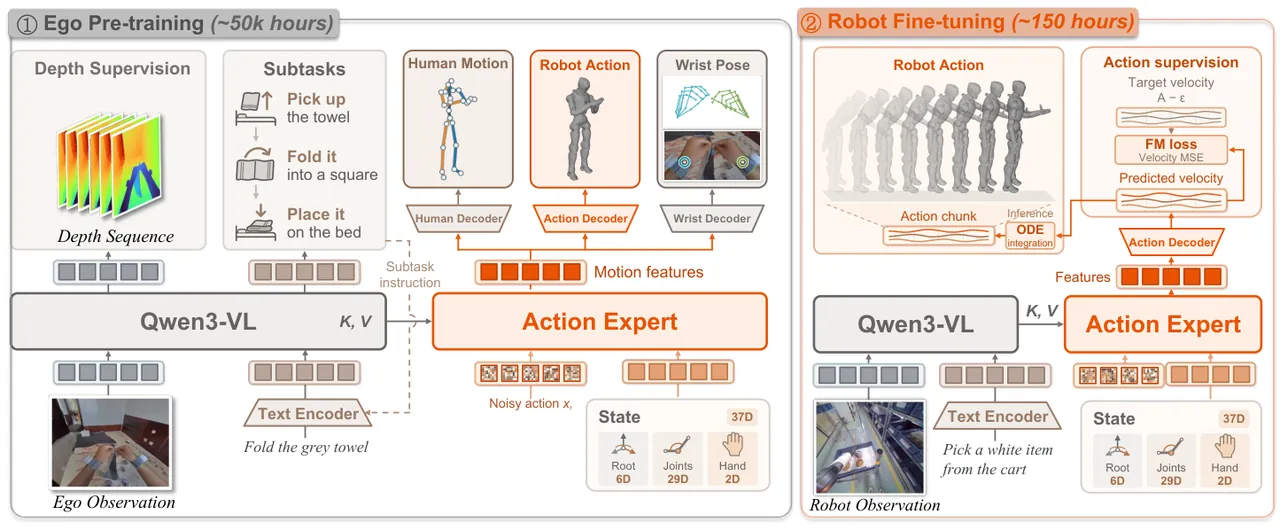
Figure 4: Two-stage training. Human, wrist, and robot-action targets share the action expert during pretraining. Post-training keeps the shared expert and robot-action path for T800 adaptation.
Flow matching and the joint objective
All three action branches use flow matching. For branch b, the target sequence is linearly interpolated between Gaussian noise and the clean target over a learned flow time. At small flow time the sample is mostly noise; at large flow time it approaches the target:
$$\mathbf{X}_{\tau_b}^{b}=(1-\tau_b)\boldsymbol{\epsilon}+\tau_b\mathbf{X}^{b}.$$The network predicts the velocity that points from noise toward the clean target. A validity mask removes missing dimensions from the loss, which matters because hand visibility and human annotation coverage vary across the corpus:
$$\mathcal{L}_{b}=\mathbb{E}\left[\mathcal{R}_{b}\left(v_{\theta}^{b}(\mathbf{X}_{\tau_b}^{b},\tau_b\mid\mathbf{c}_{t})-(\mathbf{X}^{b}-\boldsymbol{\epsilon}),M^{b}\right)\right].$$Robot action prediction is the primary term. The other targets enter with explicit weights for human motion, wrist pose, current depth, future depth, and subtask language:
$$\mathcal{L}=\mathcal{L}_{\mathrm{act}}+\lambda_{h}\mathcal{L}_{\mathrm{human}}+\lambda_{w}\mathcal{L}_{\mathrm{wrist}}+\lambda_{c}\mathcal{L}_{\mathrm{depth}}^{\mathrm{cur}}+\lambda_{f}\mathcal{L}_{\mathrm{depth}}^{\mathrm{fut}}+\lambda_{s}\mathcal{L}_{\mathrm{subtask}}.$$The pretraining data are human demonstrations, with robot states and robot actions obtained through retargeting. The human and wrist branches keep additional information from the source recording. During T800 post-training, the authors retain the shared action expert and robot-action branch and fine-tune all module parameters with the robot-action flow loss. The robot-adaptation stage uses about 150 hours of industrial and household teleoperation data, 30,000 updates, and a global batch size of 256.
This two-stage separation is conceptually simple but operationally important. Pretraining is where broad scene, instruction, hand, and whole-body behavior coverage enters the model. Post-training is where T800-specific controller behavior, gripper response, and contact dynamics enter. Treating post-training as a minor fine-tuning detail would be a mistake. The final policy is not a human model applied directly to hardware; it is a human-pretrained model whose output space has been grounded by robot data.
The scaling analysis describes the relation between data exposure and error. Equivalent epochs are defined as:
$$E=\frac{sB}{N_{\mathrm{train}}}.$$Here s is the number of updates, B is the global batch size, and N is the number of training frames at the corresponding scale. The empirical fit uses a power law of the form:
$$L(D)=AD^{-\alpha}.$$The reported exponents are 0.051 for inference mean squared error and 0.090 for validation loss. These fits summarize four corpus sizes rather than a broad family of data sources. They are evidence for continued benefit within Awaken-Human, not proof that the same exponent transfers to another capture protocol, another robot, or a dataset with different hand and depth quality.
Scaling experiment: what changed with 10 times more data
The scaling runs use the four nested subsets and share initialization, optimizer, and learning-rate settings, with a global batch size of 4,096 and a maximum budget of 100,000 updates. The robot adaptation data stay fixed. This matters because a larger human subset must not secretly receive more T800 demonstrations. Any downstream improvement is therefore associated with the human pretraining distribution rather than with extra robot supervision.
Moving from 5,000 to 50,000 hours lowers inference mean squared error from 0.06649 to 0.05926, approximately an 11% reduction. Validation loss falls from 0.04955 to 0.04025, an 18.8% reduction. The absolute decrease looks small on the normalized action scale, but downstream behavior is more sensitive. A policy can change a contact boundary or wrist approach angle under a small numerical residual, especially near grasp and insertion phases.
The real-robot scaling test focuses on Bimanual Object Storage, Garment Hanging, and Laundry Basket Relocation. Their mean success rate rises from 56.7% at the smallest pretraining scale to 90.0% at the largest. These tasks require more than a single arm trajectory. They involve bimanual coordination, object or fabric geometry, posture changes, and locomotion or repositioning. The result is stronger evidence for transfer than an offline action loss alone, though it covers only three household tasks.
| Pretraining scale | Inference MSE | Validation loss | Three-task mean success |
|---|---|---|---|
| 5,000 hours | 0.06649 | 0.04955 | 56.7% |
| 12,500 hours | Lower than 5,000 on the plotted fit | Lower than 5,000 on the plotted fit | Not reported separately in the abstract |
| 25,000 hours | Lower than 12,500 on the plotted fit | Lower than 12,500 on the plotted fit | Not reported separately in the abstract |
| 50,000 hours | 0.05926 | 0.04025 | 90.0% |
The table deliberately does not invent intermediate point estimates. The full paper plots all four scales, while the abstract and main narrative emphasize the endpoints and the fitted exponents. The important controlled fact is that the endpoint models use the same adaptation pipeline. The important limitation is that four points cannot establish a universal power law, and no confidence intervals are supplied for the fit.
Another useful way to read the scaling result is through data quality. Ten times more video would not help if the additional data were dominated by duplicate scenes or unreliable hands. Curated clustering, language review, reconstructed hands, and stereo depth make each additional hour more learnable. The finding therefore concerns the complete Awaken-Human production system, not the naive proposition that any hour of egocentric video has equal pretraining value.
Eight individual tasks and two long horizons
The real-robot evaluation uses EngineAI T800. Eight individual loco-manipulation tasks each receive ten trials. They include medicine box transfer, picking and shelf stocking of black and white materials, bimanual object storage, garment hanging, and laundry basket relocation. Every method uses one multitask policy rather than a separate policy per task. All models are post-trained on the same roughly 150-hour dataset for 30,000 steps with a global batch size of 256 and run inference on a single RTX 5090.
Awaken-HI achieves a mean success rate of 93.75% across the eight tasks. The corresponding values are 57.5% for pi-0.5 and 58.75% for GR00T N1.7. The gaps are 36.25 and 35.0 percentage points. Awaken-HI reaches 100% on black material picking, black material shelf stocking, white material shelf stocking, and garment hanging. It reaches 90% on medicine box transfer, white material picking, and laundry basket relocation, and 80% on bimanual object storage.
| Task | pi-0.5 | GR00T N1.7 | Awaken-HI |
|---|---|---|---|
| Medicine Box Transfer | 60% | 70% | 90% |
| Black Material Picking | 60% | 40% | 100% |
| Black Material Shelf Stack | 50% | 70% | 100% |
| White Material Picking | 60% | 60% | 90% |
| White Material Shelf Stack | 60% | 80% | 100% |
| Bimanual Object Storage | 40% | 30% | 80% |
| Garment Hanging | 80% | 80% | 100% |
| Laundry Basket Relocation | 50% | 40% | 90% |
| Mean Individual Tasks | 57.5% | 58.75% | 93.75% |
The baselines are not uniformly weak. Pi-0.5 reaches 80% on garment hanging, and GR00T N1.7 reaches 80% on white shelf stocking. Awaken-HI's advantage is largest when a task combines two hands, locomotion, and a change in body configuration. Bimanual storage rises from 30% for GR00T N1.7 to 80% for Awaken-HI, while laundry basket relocation rises from 40% to 90%. These are the task types for which whole-body human pretraining is most plausibly relevant.
The long-horizon evaluation is more demanding. The robot and scene are not reset between component tasks, and success requires completing every stage in order. Awaken-HI reaches 90% on the industrial stocking sequence and 80% on household tidying. Pi-0.5 reaches 10% and 20%; GR00T N1.7 reaches 30% and 10%. The margins show that the result is not confined to short episodes, but the absolute drop from the 93.75% individual-task mean also shows that sequence composition remains difficult.
Ten trials per task provide a useful demonstration but not a production reliability estimate. A reported 100% means ten successes in that evaluation block, not an infinite-run guarantee. Environment wear, object placement variation, controller state, and operator setup can all shift the probability. The paper would need repeated blocks, randomized ordering, and reported intervals before a deployment team could treat the rates as service-level guarantees.
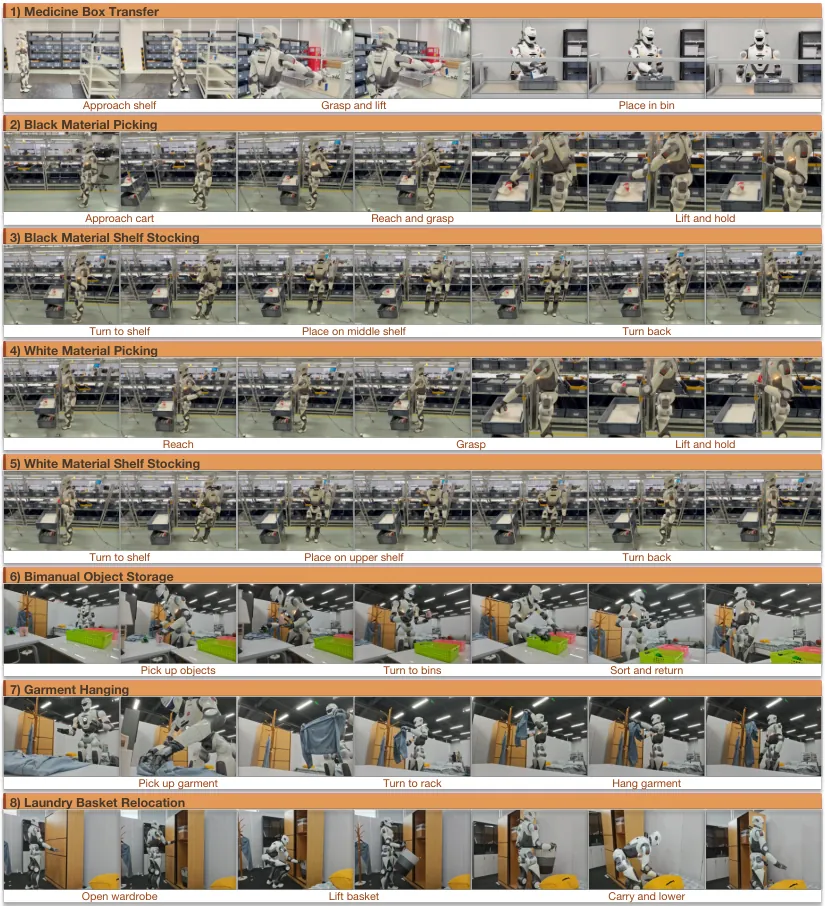
Figure 5: The eight real-robot task settings. The scenes require combinations of walking, posture adjustment, reaching, bimanual coordination, grasping, and placement.
Generalization: recombination is easier than new objects
The first generalization test recombines familiar objects and destinations into four new pairings. Awaken-HI succeeds on 100%, 100%, 80%, and 80% of the four tests. Pi-0.5 reaches 20%, 0%, 10%, and 10%. GR00T N1.7 reaches 40%, 0%, 20%, and 10%. Both baselines fail completely on the second pairing, while Awaken-HI still reaches 100%, which indicates that the policy is not limited to memorized object-destination associations.
The second test removes that advantage of familiar object instances. Tissues and a medicine bottle are unseen during robot post-training. Awaken-HI completes 50% of tissue trials and 30% of medicine bottle trials; both baselines complete 0%. This is genuine object-level generalization, but it is far from open-world reliability. Tissues deform and can collapse during a grasp. A medicine bottle is small, potentially reflective, and sensitive to wrist orientation and contact depth.
| Generalization setting | pi-0.5 | GR00T N1.7 | Awaken-HI |
|---|---|---|---|
| New familiar-object pairing 1 | 20% | 40% | 100% |
| New familiar-object pairing 2 | 0% | 0% | 100% |
| New familiar-object pairing 3 | 10% | 20% | 80% |
| New familiar-object pairing 4 | 10% | 10% | 80% |
| Unseen object: tissues | 0% | 0% | 50% |
| Unseen object: medicine bottle | 0% | 0% | 30% |
The contrast between the two parts of the table is the most informative generalization result. Language recombination is nearly solved on the tested combinations, while physical object adaptation remains weak. The policy can bind an instruction to a different known destination, but an unseen object still demands unfamiliar affordance estimation, grasp selection, and contact control. A large human corpus supplies relevant experience, yet the robot must still discover a safe grasp for a new physical case.
These results also temper the phrase "human experience scales humanoid intelligence." Human experience broadens task and motion priors. It does not magically create tactile sensing, force feedback, or an object-specific grasp controller that was absent from training. The unseen-object scores are useful precisely because they reveal the boundary between semantic transfer and physical generalization.
Ablation: why the extra targets matter
The ablation isolates wrist, human-motion, and depth supervision on a common 5,000-hour pretraining subset. Every variant runs 50,000 pretraining updates on 64 GPUs with a per-GPU batch size of 16 and then receives the same robot post-training. Base learns only retargeted T800 actions. The single-objective variants add one auxiliary target, and Full combines all three. This design separates the value of additional human structure from the value of simply changing model size or robot data.
Before robot adaptation, Base has an action mean squared error of 0.092785. Full lowers it to 0.088804, a 4.29% reduction. Root position error falls from 6.48 cm to 6.23 cm, left wrist error from 9.31 cm to 9.04 cm, right wrist error from 10.09 cm to 9.81 cm, whole-body joint MAE from 7.88 degrees to 7.65 degrees, and leg MAE from 3.73 degrees to 3.47 degrees. All six offline measurements improve, although none changes by an order of magnitude.
The real-robot gap is larger. The three evaluated household tasks yield 0%, 40%, and 0% for Base, a 13.3% mean. Adding human motion produces 30%, 60%, and 40%, a 43.3% mean. Adding depth produces 20%, 70%, and 30%, a 40.0% mean. Full reaches 30%, 80%, and 50%, a 53.3% mean. Full is 40 percentage points above Base and 10 points above the strongest single-objective variant.
| Variant | Action MSE | Root cm | Left wrist cm | Right wrist cm | Body MAE deg | Leg MAE deg | Task results | Mean |
|---|---|---|---|---|---|---|---|---|
| Base | 0.092785 | 6.48 | 9.31 | 10.09 | 7.88 | 3.73 | 0 / 40 / 0 | 13.3% |
| Add wrist | 0.092068 | 6.43 | 9.30 | 10.04 | 7.91 | 3.73 | 20 / 30 / 10 | 20.0% |
| Add human | 0.089660 | 6.35 | 9.12 | 9.83 | 7.72 | 3.58 | 30 / 60 / 40 | 43.3% |
| Add depth | 0.091593 | 6.42 | 9.30 | 9.89 | 7.81 | 3.69 | 20 / 70 / 30 | 40.0% |
| Full | 0.088804 | 6.23 | 9.04 | 9.81 | 7.65 | 3.47 | 30 / 80 / 50 | 53.3% |
Human-motion supervision is the strongest single addition in this block, which directly supports the paper's thesis. It improves every offline metric and raises real-robot mean success by 30 points over Base. Depth is strongest on garment hanging, where it reaches 70%, suggesting that scene geometry helps when a deformable garment must be aligned with a target. Wrist supervision is not uniformly helpful: garment hanging falls from 40% under Base to 30%, even though wrist position errors improve.
That exception is worth retaining in the analysis. More auxiliary supervision can compete for shared capacity or alter the temporal representation. The full objective recovers to 50% on the same task, but a ten-trial result cannot determine whether the dip is a stable causal effect or sampling noise. The ablation demonstrates that the combination is useful; it does not prove that every component helps every task independently.
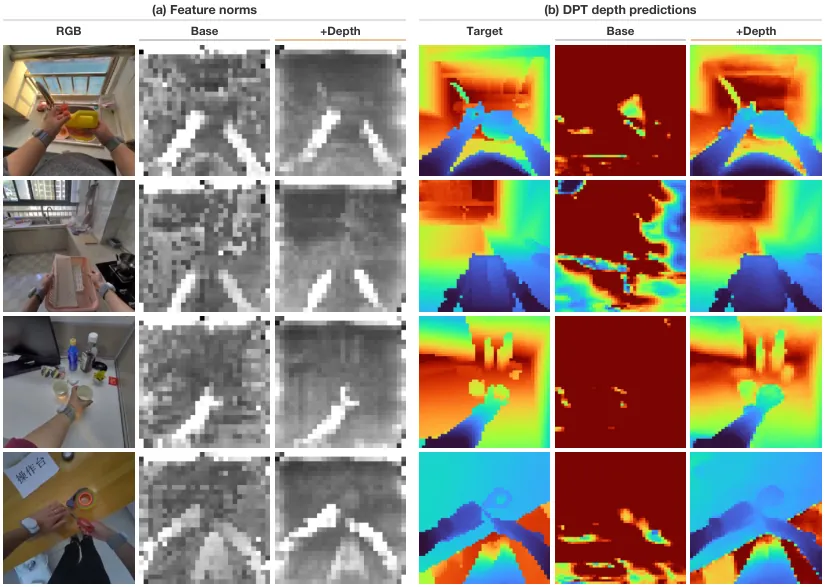
Figure 6: Depth supervision changes the learned feature field. The depth-supervised representation highlights arm structures against the surrounding scene more clearly.
What the paper actually establishes
The strongest evidence is the controlled chain from human scale to offline error to real behavior. More curated human data lowers held-out robot-action error, and the same larger scale raises success on three fixed downstream tasks. The ablation then changes the target structure while holding pretraining scale and posts-training fixed, and the human-motion target produces the largest single gain. These results are mutually consistent with the proposed explanation.
The paper also establishes a practical architecture for mixing source and transformed supervision. The three branches do not merely average different labels. Their outputs remain separate, so a robot action is never forced to reconstruct a human skeleton dimension by dimension, and a human branch is never forced into robot joint limits. A shared expert learns relationships across the targets while the decoders preserve their semantics. This is a more defensible design than treating retargeting as lossless.
It does not establish that human video replaces robot demonstrations. The final policy is post-trained on 150 hours of T800 data. That stage supplies the controller-specific mapping that human recordings cannot provide. The paper's own ablations also use robot post-training after every pretraining variant. Without it, there is no verified result for direct SIM-to-real transfer or for executing the human branch on a different embodiment.
It does not establish cross-robot generality. Every real result is on T800. The action target is defined around a 29-joint body, bilateral grippers, and a particular low-level controller. Transfer to another humanoid would require new retargeting, new state and action dimensions, and new post-training data. The shared architecture may be reusable, but the empirical evidence covers one robot.
It also does not establish resolved open-world manipulation. Unseen tissues and medicine bottles remain below 50% completion. Those failures align with the physical difficulty of deformable and small objects, not simply a language-model limitation. A policy that recognizes the instruction can still fail because the grasp is wrong, the wrist orientation is off, or contact changes the object before the placement phase.
Limitations and open questions
The first limitation is the remaining retargeting mismatch. Position error is low enough to support useful transfer, but 15.596 degrees of average orientation error is substantial for narrow grasps. The wrist branch helps the model preserve local geometry, yet the source labels themselves still contain a robot-specific distortion. Better controller-aware retargeting would test whether the human branch becomes even more valuable when the robot target is cleaner.
The second limitation is single-embodiment validation. T800 is the only robot used for post-training and evaluation. The paper cannot distinguish a benefit that comes from general human motion from a benefit that depends on the chosen joint mapping, gripper shape, and controller. A second humanoid with different proportions and degrees of freedom would be an important test.
The third limitation is statistical resolution. Four dataset scales are fitted with a power law, but there are no confidence intervals or repeated data subsets at each scale. Individual and generalization tasks are usually evaluated in ten trials. Real-robot success can vary with scene setup and object condition. The reported margins are large enough to be meaningful, but the exact percentages should not be treated as stable population estimates.
The fourth limitation is uneven task coverage in the scaling and ablation studies. The scaling success curve follows three household tasks, while the ablation uses another three-task set. The eight-task evaluation is broader, but the causal evidence linking scale or auxiliary targets to every skill is not equally strong. Long-horizon industrial and household sequences are only two combined tasks, not a broad matrix of sequence lengths.
The fifth limitation is data provenance and quality. Hands are reconstructed by a separate model, depth comes from stereo matching, language starts from model annotation, and retargeting depends on an optimizer. Errors in these stages enter the training targets. The paper reports quality filtering and human review, but it does not provide an end-to-end error analysis for every annotation component or a study of how residual annotation quality affects scaling exponents.
The sixth limitation concerns release and reproduction. The public project and dataset links are available, but the README states that code, inference implementation, model weights, and the simulation platform are not yet fully released. This reading can inspect the paper, figures, and stated data description, but it cannot independently reproduce the training run or robot controller. No source-code correspondence is claimed here because the relevant implementation is not public.
Conclusion
Awaken-HI advances a concrete hypothesis about humanoid data: the value of human recordings is not exhausted by converting each motion into a robot trajectory. Retargeting is the bridge to execution, while the original motion is the bridge back to human coordination. The model uses one expert to learn both, then relies on real-robot post-training to bind that knowledge to T800. The reported scaling, task, generalization, and ablation results support this hypothesis within the tested setting.
The broader lesson is that data scale and data transformation must be designed together. Fifty thousand hours of untracked video would not provide robot labels. Fifty thousand hours of robot-ready labels without source motion would still lose information. The paper's contribution is the full chain: capture, hand reconstruction, stereo depth, reviewed language, wrist-aware retargeting, coupled flow targets, and real-robot adaptation. Each stage is necessary for the final policy to make contact with the world.
The next research step should be to separate the generality of the idea from the specificity of T800. Testing new humanoids, controller-aware labels, tactile and force supervision, and repeated real-robot trials would show whether human experience can become a durable pretraining substrate rather than a valuable result for one platform. Until those tests exist, the paper's strongest conclusion remains bounded but important: in this corpus and on this robot, original human motion adds information that retargeted robot actions alone do not contain.
Original human motion remains useful precisely because retargeting makes a trajectory executable without making it identical to the action that generated it.