Skip to content
Tags

#Motion Generation (11)

Learning Whole-Body Humanoid Locomotion via Motion Generation and Motion Tracking

Learning Whole-Body Humanoid Locomotion via Motion Generation and Motion Tracking

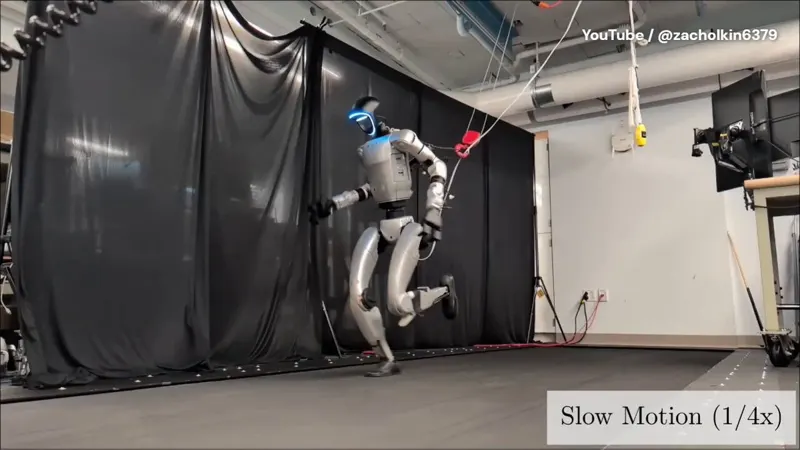
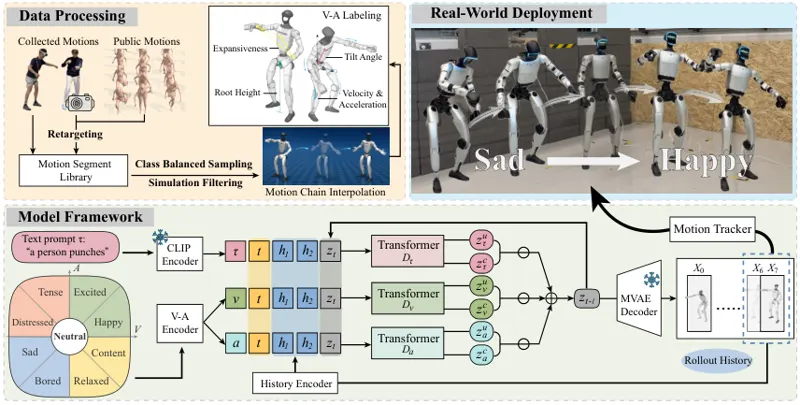
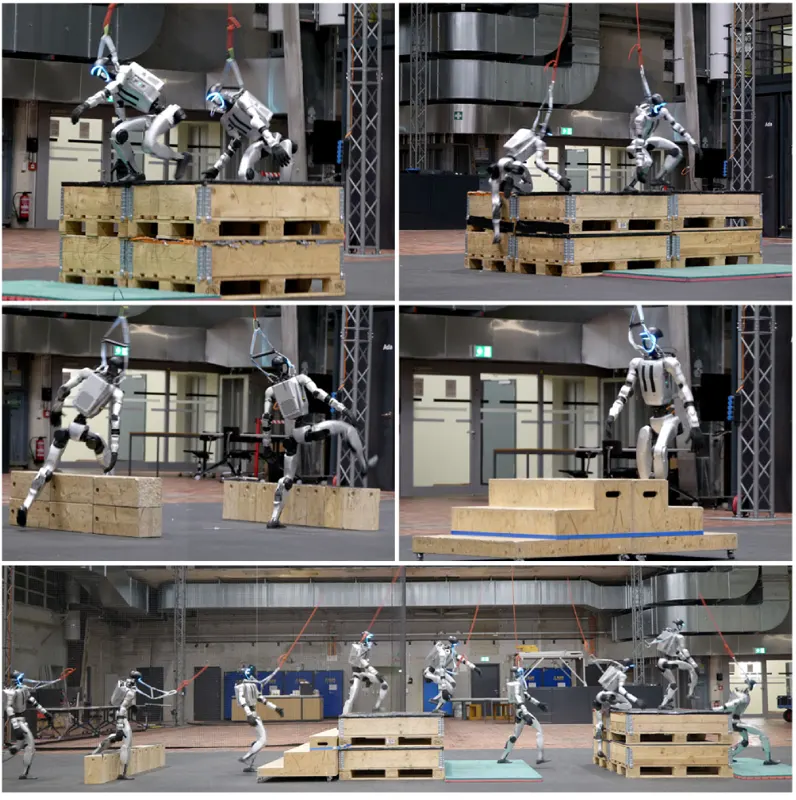
Whole-body humanoid locomotion is challenging due to high-dimensional control, morphological instability, and the need for real-time adaptation to various terrains using onboard perception. Directly applying reinforcement learning (RL) with reward shaping to humanoid locomotion often leads to lower-body-dominated behaviors, whereas imitation-based RL can learn more coordinated whole-body skills but is typically limited to replaying reference motions without a mechanism to adapt them online from perception for terrain-aware locomotion. To address this gap, we propose a whole-body humanoid locomotion framework that combines skills learned from reference motions with terrain-aware adaptation. We first train a diffusion model on retargeted human motions for real-time prediction of terrain-aware reference motions. Concurrently, we train a whole-body reference tracker with RL using this motion data. To improve robustness under imperfectly generated references, we further fine-tune the tracker with a frozen motion generator in a closed-loop setting. The resulting system supports directional goal-reaching control with terrain-aware whole-body adaptation, and can be deployed on a Unitree G1 humanoid robot with onboard perception and computation. The hardware experiments demonstrate successful traversal over boxes, hurdles, stairs, and mixed terrain combinations. Quantitative results further show the benefits of incorporating online motion generation and fine-tuning the motion tracker for improved generalization and robustness.

Zewei Zhang, Kehan Wen, Michael XuApr 19, 2026
HumanoidWhole-body locomotionMotion GenerationApr 19, 2026
STeP: Signal Temporal Logic for Precise Specifications for Action Generation with Vision Language Models

STeP: Signal Temporal Logic for Precise Specifications for Action Generation with Vision Language Models

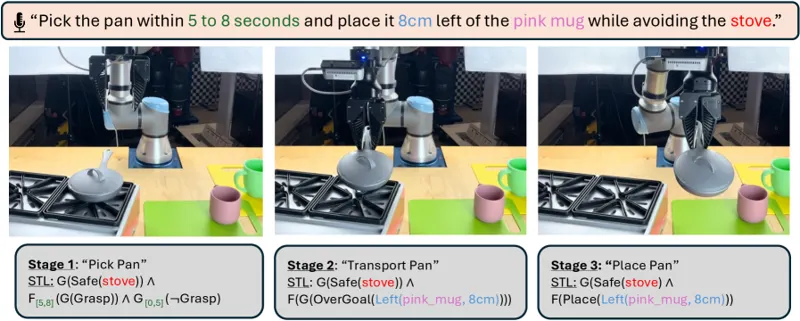
Vision-language-action (VLA) models have shown impressive generalization, but often lack interpretability and can struggle to follow precise natural language instructions that encode spatial, temporal, and logical requirements. We propose a hierarchical framework that uses Signal Temporal Logic (STL) as a shared representation connecting high-level language understanding with low-level robot execution. A high-level policy leverages a VLM to decompose language instructions into high-level subtasks, generate STL specifications for each subtask, and choose a low-level policy for executing each subtask. The STL specifications translate language-derived intent into precise constraints, and the low-level policy selection determines whether those constraints are enforced directly through STL-guided model-predictive control or monitored during execution of a learned policy for perceptually complex, or contact-rich behaviors. By integrating STL into plan validation, low-level policy, subtask monitoring, and replanning, our framework enables language-derived plans to be checked, optimized, and revised at runtime using a common formal structure. We evaluate the approach on a real-world tabletop domain, demonstrating how formal specifications can improve the precision, reliability, and interpretability of language-conditioned robot planning.

Kasra Torshizi, Anukriti Singh, Sidharth MathurJul 20, 2026
Vision-language modelsTemporal LogicMotion GenerationJul 20, 2026