PAPER DEEP DIVE
VIRAL: Visual Sim-to-Real at Scale for Humanoid Loco-Manipulation
VIRAL is a visual sim-to-real framework from NVIDIA GEAR and CMU: a privileged RL teacher masters long-horizon loco-manipulation with a delta action space, staged rewards, and reference state initialization, then a student policy using only RGB is distilled at scale on 64 GPUs via a DAgger-BC mixture, with dexterous-hand SysID, camera extrinsics alignment, and four-axis visual randomization. Deployed zero-shot on a Unitree G1, it succeeds on 54 of 59 real trials at 20.2 s per cycle — faster than expert teleoperation — and generalizes across nine environment variations. Ablations show compute scale is a passing grade, not an accelerator; code, models, and the full reward table are open-sourced.
When "Learn in Simulation, Perform on Hardware" Finally Works for Full-Body Humanoids
Humanoid robots are stuck in an awkward middle zone on the way to real deployment: loco-manipulation — walking while manipulating. Sim-to-real for legged locomotion is mature, but manipulation still leans on massive real-robot teleoperation data; merging the two on a high-DoF humanoid makes "treat it as a data problem" prohibitively expensive. A 15-person team from NVIDIA GEAR, CMU, UC Berkeley and others (co-first authors Tairan He and Zi Wang) answers with VIRAL (arXiv:2511.15200): learn humanoid loco-manipulation entirely in simulation and deploy zero-shot to real hardware — a Unitree G1 with pure RGB observations completes 54 consecutive walk-place-grasp-turn cycles, succeeding on 54 of 59 real trials at 20.2 seconds per cycle, 1.2 s faster than a teleoperation expert with 1,000+ hours of experience.
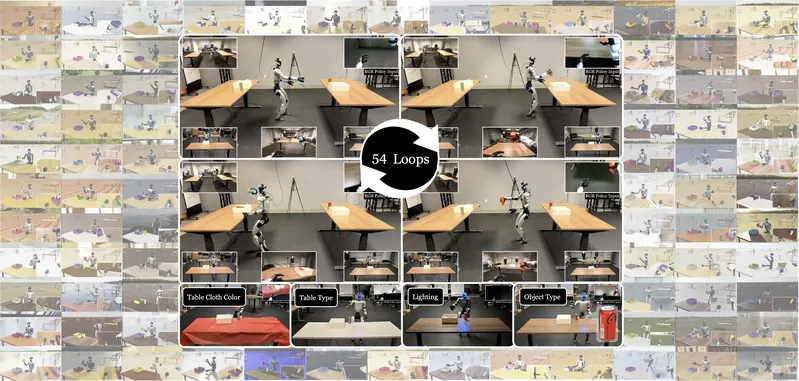
The value of this paper is not a new algorithm — the authors say so plainly: "Our goal is not to propose yet another novel RL or sim-to-real algorithm, but to provide a technical recipe on the full stack required to make RGB-based humanoid loco-manipulation work in practice: what designs matter, where they fail, and how they interact." For teams deploying humanoids, this is close to a copyable engineering manual.
First, unpack the difficulty. Loco-manipulation is a sim-to-real hard nut because it steps on both fields' pain points at once. Legged policies, though mature, are nearly all "blind" — proprioception suffices for walking but cannot tell where the object is or whether the tray is empty. Tabletop manipulation has teacher-student distillation precedents (the paradigm after OpenAI's Dactyl), but all on fixed bases and narrow tasks. On a humanoid the dynamics couple: the center of mass shifts during grasping, any finger jitter during single-foot support gets amplified into whole-body imbalance, and walking paths must adjust to object positions in real time. Learning this coupled dynamics together with vision in simulation and transferring it to hardware is the full problem VIRAL tackles.
The Recipe: Teacher-Student Privileged Learning with WBC as the API
VIRAL trains its controller in two stages. Stage one trains a privileged RL teacher: with full simulator state (object poses, stage flags, placement targets), the teacher runs render-free physics on 16 L40S GPUs and outputs high-level commands to a pretrained whole-body control (WBC) policy. Stage two distills the teacher into a student that sees only proprioception plus RGB, trained with large-scale visual simulation on 64 L40S GPUs using tiled rendering in Isaac Lab. The full flow:
flowchart LR
    subgraph P1["Phase 1: RL (16 GPUs, render-free)"]
        SP["Privileged state obs
object poses / stage / targets"] --> T["Privileged teacher π_teacher
PPO"]
        T -->|"Δv, Δω, Δq_arm, Δq_finger"| W["WBC policy (HOMIE)
whole-body control"]
        W -->|"joint targets q"| PD["PD controller → torque τ"]
        PD --> ENV[("Simulation")]
        ENV --> SP
    end
    subgraph P2["Phase 2: visual distillation (64 GPUs, tiled rendering)"]
        RGB["RGB + onboard proprioception"] --> S["Student policy
DAgger & BC mixture"]
        T -.->|"action labels"| S
    end
    P2 --> DEP["Zero-shot deployment
Unitree G1 hardware"]
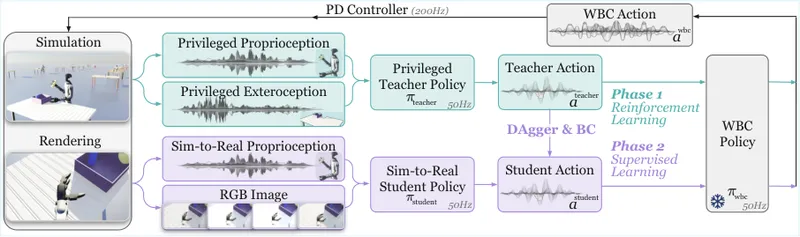
The teacher's four elements define Phase 1:
| Design element | Content | Why it matters |
|---|---|---|
| Stage-based rewards | Task split into walking / placing / grasping / turning; $r_t=\sum_{i=0}^{4}w_i\mathbb{1}[s_t=i]\,r^{(i)}_t$ with per-stage shaping terms | Avoids betting exploration on one sparse reward |
| Delta action space | Outputs increments $\Delta$ accumulated into WBC commands instead of absolute joint targets | Substantially accelerates and stabilizes RL; the absolute-action variant simply fails in ablation |
| WBC as API | Reuses the HOMIE whole-body controller; teacher only issues high-level commands; not tied to a specific WBC | Constrains actions to a safe, reliable region; reduces reward engineering burden |
| Reference state initialization (RSI) | 200 teleoperated simulation demos as a reset buffer; every episode starts from a demo snapshot | Without RSI the teacher stalls below 10% success; with it, ~95% |
RSI deserves its own note: with RL from scratch on a long-horizon task, the policy must stumble into success before it ever receives reward. VIRAL uses human-provided grasp/place poses as priors so the policy practices every stage of the task from the first episode — buying out brittle reward tuning with human priors. This is the most lopsided comparison in the Section 4.1 ablation (<10% vs ~95%). Its interplay with the delta action space matters too: delta representation bounds consecutive action differences, shifting the output semantics from "where the hand should be" to "how much the hand should move this step" — good for reward shaping and exploration stability. The two ablations stack; remove either and the teacher fails to learn.
How Detailed Is the Reward Table? Even "Don't Flail Your Fingers While Single-Foot" Has Its Own Penalty
The appendix reward table is the most "engineering" part of the paper: the total reward is a stage-weighted sum with 30+ shaping terms. A representative selection:
| Reward term | Expression | Weight | Stage(s) |
|---|---|---|---|
| Walking toward object | $\exp(-4(\|p_{\text{robot}}-p_{\text{GraspObj}}\|-0.45)^2)$ | 2.0 | 0–4 |
| Lift goal | $\min(h_{\text{GraspObj}}-h_{\text{table}},\,0.15)$ | 200.0 | 3–4 |
| Hand-object distance | $\exp(-10\max_k\|p^{(k)}_{\text{finger}}-p_{\text{GraspObj}}\|_2)$ | 20.0 | 3–4 |
| Object lean penalty | $|\phi_{\text{GraspObj}}|+|\theta_{\text{GraspObj}}|$ | −500.0 | 0–3 |
| Finger velocity during single-foot support | $\|\dot{\mathbf{q}}_{\text{finger}}\|_2\,\mathbb{1}_{\text{single-foot}}$ | −3000.0 | 1–3 |
| Object-hand z velocity mismatch in grasp | $|v^z_{\text{GraspObj}}-v^z_{\text{hand}}|\,\mathbb{1}_{\text{in-grasp}}$ | −3000.0 | 1–3 |
| Termination | $\mathbb{1}_{\{\text{termination}\}}$ | −2000.0 | 0–4 |
Note the weight magnitudes: lifting pays +200, flailing fingers during single-foot support costs −3000 — heavy penalties crush dangerous actions while moderate positive rewards shape desired behavior. Such design is intrinsic to loco-manipulation: legs walk, hands grasp, objects tumble in the physics engine, and a single loss of control ruins the episode. The five-stage decomposition also makes debugging localizable: if the policy stalls in one stage, inspect that stage's condition functions and shaping terms instead of facing a black-box total return — staged rewards are both a training technique and a source of engineering maintainability.
Student Training: A Hybrid That Takes the Best of DAgger and BC
Student distillation optimizes a unified MSE objective:
$$\rho^{o}=\alpha\,\rho^{o}_{\pi_{\text{teacher}}}+(1-\alpha)\,\rho^{o}_{\pi_{\text{student}}},\qquad \mathcal{L}_{\text{distill}}=\mathbb{E}_{o_t\sim\rho^{o}}\left[\left\|\pi_{\text{teacher}}(o^{\text{teacher}}_t)-\pi_{\text{student}}(o^{\text{student}}_t)\right\|_2^2\right]$$
DAgger and BC differ only in where observations come from: teacher rollouts give clean, near-optimal demonstrations that rapidly imprint strong priors (BC's benefit); student rollouts expose the learner to states outside the teacher's ideal distribution — exactly where deployment-time error correction comes from, preventing compounding errors. The ablation shows pure BC (α=1) lowers loss fast but yields a brittle policy that performs poorly in Isaac-to-MuJoCo cross-engine evaluation and on hardware; α=0.5 slows optimization slightly yet substantially improves deployment success — the default is half-and-half. The vision backbone is DINOv3 with perceptual history (LSTM beats single-step MLP). The cross-engine detail deserves expansion: Isaac and MuJoCo differ in contact solvers and integration schemes, so holding performance across engines means the policy learned dynamics close to reality rather than one simulator's solver quirks — harder evidence of generalization than single-engine simulation success. On the distributed side the team wrote a custom TRL with Accelerate support; visual simulation is at least an order of magnitude slower than render-free physics, so without near-linear cluster scaling, 64-GPU student training would be impossible — LLM-community training infrastructure moved directly into robot simulation.
The Sim-to-Real Triad: SysID, Camera Alignment, Visual Randomization
Visual domain randomization is the student's main battleground: image quality (brightness/contrast/hue/Gaussian noise/blur), dome-light environments, floor/table/object/robot materials and colors, camera extrinsics, and camera latency are all randomized. The ablation (Figure 13) shows turning off all randomization drops success by 35.1% (normalized 0.649); removing any single component — materials, lighting, or extrinsics — also degrades performance. The three are complementary in preventing overfitting; none can be dropped.
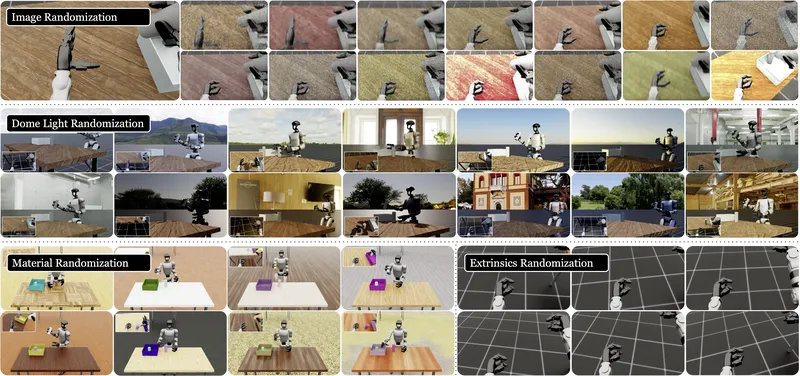
Dexterous-hand SysID: the G1's three-finger hand uses high gear ratios — unlike quasi-direct-drive leg motors, the friction and backlash of high reduction simply do not exist in default simulation. The team defines a real grasp-release primitive, replays the identical sequence in simulation, and runs system identification over armature, stiffness, and damping to align simulated joint trajectories with measurements; the before/after overlays are unambiguous. Camera alignment: intrinsics match the manufacturer's specs, while extrinsics — varying across G1 units due to mechanical tolerance and drifting over time on the same robot — get a lightweight real-to-sim calibration by visually matching rendered and real images, with extrinsics randomization as backstop during training. This "randomization + alignment" combo is the standard visual sim-to-real playbook, but the paper backs every detail with an ablation. One easily overlooked deployment constraint: all inference runs on a single RTX 4090 workstation, no cloud model involved — the policy is a compact DINOv3 encoder plus policy head, not a VLA giant. Control frequency and latency are thus guaranteed, a clear contrast with the "slow-thinking VLA" route: VIRAL demonstrates that with sufficient randomization and alignment on the simulation side, a small fast specialized policy can bring loco-manipulation to near-expert level.
Scoreboard: 54 of 59 Trials, Faster Than the Expert
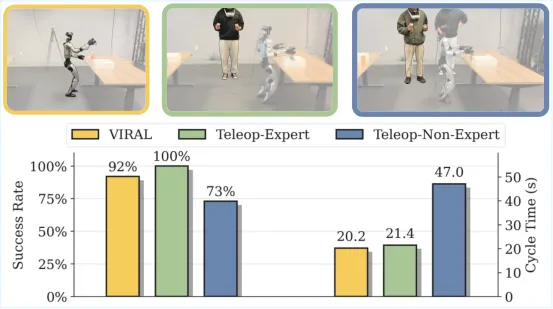
The hardware platform is a 29-DoF Unitree G1 with 7-DoF three-finger hands, sensing from a single Intel RealSense D435i, inference on an i9-14900K + RTX 4090 workstation. Robustness: continuous loco-manipulation (walk between two tables, place, grasp, turn) succeeds on 54 of 59 trials (91.5%). Against humans: an expert teleoperator (1,000+ hours) hits 100% success at 21.4 s per cycle; VIRAL runs 20.2 s — near-expert success while being faster; a non-expert manages only 73% at 47.0 s, dominated on both axes.
| Comparison | VIRAL (autonomous) | Teleop expert | Teleop non-expert |
|---|---|---|---|
| Success rate | 91.5% (54/59) | 100% | 73% |
| Cycle time | 20.2 s | 21.4 s | 47.0 s |
| Observation | Onboard RGB + proprioception | Human vision | Human vision |
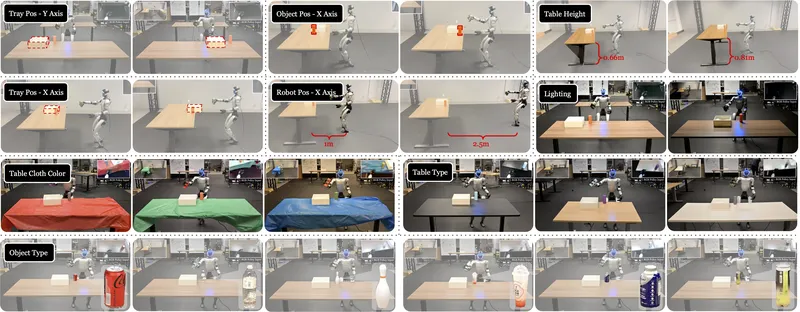
Generalization: nine variation families — tray/object XY displacement, table height, tablecloth color, table type, lighting, object category — all pass without tuning (Figure 8), credited to training-time domain randomization: the policy has "seen" wilder variants in simulation than the test set throws at it. The project-page videos add an even more telling scene: the team brought the robot to a public venue where visitors rearranged the environment freely, and the policy kept completing the task — for real deployment, "still works in a new place" says more about maturity than "works precisely in the lab".
Ablations: Compute Is Not an Accelerator, It Is the Passing Grade
The paper's most counterintuitive result is the scaling study: low compute does not mean slow, it means failure. Scaling teacher training from 1 to 16 GPUs, 1–2 GPU runs plateau far below target and never reach high success; 8–16 GPUs consistently drive above 90%. Student distillation from 1 to 64 GPUs shows the same: more GPUs bring faster convergence, smoother loss curves, lower success variance, and slightly higher final success — large-scale parallel experience collection buys richer state coverage, which converts directly into robustness. The authors' verdict: large-scale simulation is not merely beneficial but often necessary for long-horizon humanoid loco-manipulation. Other ablations: DINOv3 beats weaker encoders; history (LSTM) consistently beats single-step; multi-object training beats cylinder-only on all ten test objects.
Read together, the ablations yield a ranked "minimal viable recipe": RSI and delta actions are the teacher's survival line (without them it never learns), the randomization mix is the student's sim-to-real survival line (turn it off, lose 35%), compute scale is the whole pipeline's survival line (1–2 GPUs plateau immediately). The rest — DINOv3, LSTM history, DAgger ratio — are gains from "works" to "works well". For teams reproducing this, that ordering is more useful than the paper itself: confirm the three survival lines first, then optimize.
Code Correspondence: Every Element Is Findable in the Open Stack
The official repository github.com/NVlabs/GR00T-VisualSim2Real (built on Isaac Lab, custom TRL, and Hydra) releases teacher training, student distillation, evaluation, and ONNX export. Element-by-element mapping:
| Paper design | Source location | Notes |
|---|---|---|
| Delta action space | gr00t/rl/envs/base_task/delta_action_base.py | _delta_actions accumulation, delta_action_scale, and clipping logic all present |
| Staged rewards and advancement | gr00t/rl/envs/base_task/staged_task_base.py:19-37 | stage_reward_cond_funcs / stage_advance_cond_funcs attach per-stage rewards and advancement conditions |
| DAgger student distillation | gr00t/rl/trl/trainer/distill_trainer.py | load_teacher_actor, teacher_obs channel, rollout context management |
| HOMIE task environment and rewards | gr00t/rl/envs/loco_manip/walk_stand_place_grasp_turn_homie.py | Right-arm qpos targets (hold/front) and the camera-extrinsics curriculum (_update_camera_extrinsics_curriculum) live here |
| Dome light randomization | gr00t/rl/isaac_utils/playground/env_rand/domelight.py | Matches Figure 3's dome-light randomization |
The training framework is a customized HuggingFace TRL (paper reference [68]) scaled across nodes via Accelerate — porting LLM-community distributed training infrastructure into robot simulation is itself a signal worth noting.
Four Coverage Gaps: The Authors' Own Cold Water
Section 6 is remarkably sober by robotics-paper standards, listing four coverage gaps before sim-to-real can generalize: physics coverage — the long tail of everyday physics (scooping rice, grasping noodles, cutting garlic) may cost more to model than collecting real data; task coverage — thousands of household chores are a content-generation bottleneck, and simulation is limited by human imagination ("unknown unknowns" like pet interference cannot be pre-simulated); reward and policy coverage — reward engineering is "a delicate art that does not scale", dense rewards bias toward local optima while sparse rewards fail to bootstrap, and the authors concede that for specific tasks "a few days of high-quality teleoperation data can often outperform months of sim-to-real engineering"; hardware coverage — unmodeled friction, backlash, thermal throttling, and sensor noise in dexterous hands keep precision-finger policies from transferring. Conclusion: sim-to-real's sweet spot is safe evaluation and bounded-state-space skills; full coverage of general loco-manipulation is "out of reach for the near future".
Read at industry scale, these four paragraphs draw the boundary between two routes. Imitation learning puts the burden on data: the reward is implicitly provided by human demonstrators, bypassing the specification problem, at the price of prohibitively expensive mobile teleoperation. Sim-to-real puts the burden on engineering: data is free and unlimited, but every new physical scenario, task, and reward must be pre-built by engineers. VIRAL itself is the best footnote to this argument — its "walk-place-grasp-turn between two tables" is a bounded-state-space, rigid-body, stage-shapable task squarely inside sim-to-real's sweet spot, and its 54/59 result was achieved inside that sweet spot. As for rice-scooping and dishwashing, the authors do not sugarcoat: the current paradigm cannot reach them yet.
Closing
VIRAL's lessons come in twos. On engineering, it proves that RGB-only humanoid loco-manipulation sim-to-real is reproducible on today's stack — if you can afford 64 simulation GPUs, do the SysID and camera alignment, and blanket every visual dimension with randomization. On strategy, it gives the "real data vs simulation data" debate a calmer framework: simulation wins on marginal cost and safety, loses on long-tail physics and task-diversity engineering, and the tiebreaker is the boundedness of the task family. The 54-time-successful G1 and the 30-row reward table together mark the true state of humanoid sim-to-real in late 2025 — a cyclic task run to near-expert level, with four openly acknowledged gaps from "general". For practitioners, the most valuable takeaway is not the number 54 but the replicable path behind it: a privileged teacher learns behavior, a visual student learns observations, and randomization absorbs reality's imperfections — fill all three to the brim, and zero-shot hardware deployment stops being a miracle and becomes the natural output of a process.