Gemini 4 Argon 面向机器人:贯穿控制、Real2Sim 与自我改进的物理推理模型
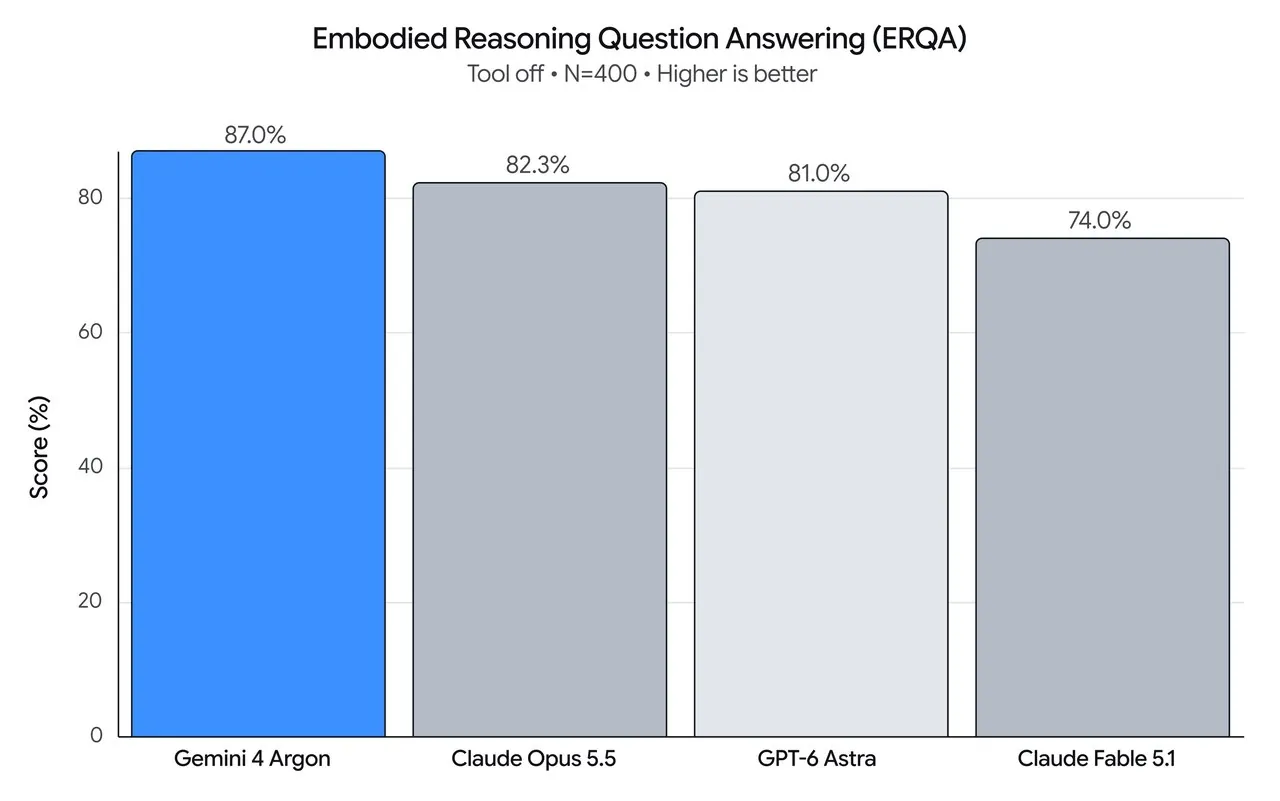
Gemini 4 Argon 以纯推理在 ERQA 取得 87%,并以 12 组提示词覆盖机器人控制、Real2Sim、物理理解与自我改进:MuJoCo 数字孪生、零样本控制、事后标注与真机迭代改进。
Gemini 4 Argon 在物理理解、代码生成与视觉-语义推理上实现了一次阶跃式进步——它打通了机器人技术栈上的一系列新工作流,并加速通往物理 AGI 的进程。
这一能力跃迁可以在 Embodied Reasoning(ERQA)基准上看到:该基准测试模型在 3D 环境中理解并求解物理与空间问题的能力。仅凭纯推理、不借助任何工具,Argon 取得 87% 的成绩,超过所有其他前沿模型。
作为通用物理推理模型,Argon 可以覆盖机器人生命周期的各个环节。本文给出 Argon 在四个关键方向上的代表性提示词:
- 机器人控制 → 结合 MuJoCo 练习的移动操作、零样本机器人控制、以及对视频世界模型的闭环引导。
- Real2Sim → 从机器人相机画面、第一人称人类视频或手绘纸面草图,重建物理标定过的仿真孪生。
- 物理理解 → 智能体式多模态事后标注,包括对灵巧性的细粒度理解、稠密价值函数与进度估计。
- 研究与自我改进 → 借助仿真改进动作,以及在真机硬件上的迭代自我改进。
用 Argon 解锁机器人控制
1. Spot 移动操作:踩脚踏垃圾桶丢易拉罐
Argon 控制一台 Boston Dynamics Spot® 四足机器人(12 自由度腿部 + 6 自由度机械臂)学习一项新技能:踩下脚踏式垃圾桶的踏板,把易拉罐丢进去。Argon 先为脚踏垃圾桶建一个带关节的 MuJoCo 数字孪生,在仿真里练习动作,然后再去踩真实的踏板、把易拉罐丢进敞开的桶里。
提示词:
There's a Diet Coke can behind you and another on the black table on your left.
Use the spot-mobile-manipulation skill to pick them up and trash them in the black foot-pedal bin.
Before stepping down on the pedal, verify in the front cameras that your front-right foot target is centered on the pedal, and use a 2-agent verification swarm (foot-verifier and hand-verifier) to verify both the foot-pedal step and the 3D hand-in-bin alignment before releasing.
2. 零样本控制
Argon 控制一条简单的机械臂,把倒下的马克杯扶正,并把揉皱的纸巾放进杯子里。Argon 借助视觉坐标参照系与动作原语,经过多个回合的推理完成该任务。
提示词:
[Attached: wrist_cam.png, obs.json]

Task: Get the robot arm to reorient the mug upright and put the napkin inside the mug.

## Execution Discipline
- Simply output 1 sentence observation followed immediately by your `curl` command (with `# Plan:` on Turn 1 and `# Thought:` on every turn). Everything needed is in `obs.json` and the calibrated reticle/grid drawn on `wrist_cam.png`.

## Visual Coordinate Reference (Annotated on wrist_cam.png)
- `+X` (UP in image): Away from robot base | `-X` (DOWN): Towards robot base
- `+Y` (LEFT in image): World left         | `-Y` (RIGHT): World right
- `+Z`: Height above table                | `Yellow numbers`: World (X, Y) in centimetres (2 cm grid at `grid_z`)
- `Cyan + crosshair`: Current 3D pinch center
- `Cyan [ + ] brackets`: Current jaw opening and closing line
- `Green line`: Current object long-axis orientation (`yaw_deg`: 0° = vertical along +X, 90° = horizontal along +Y)
- `pitch_deg = 90°`: Straight down (-Z) top-down grasp/place; `pitch_deg < 60°`: Tilted coaxial approach along finger axis

## Closed-Loop Turn Workflow
1. Inspect current state & view `wrist_cam.png`:
   `curl -s http://127.0.0.1:8081/obs` (returns `ee_pos`, `holding`, `status`, `workspace`, `wrist_cam_path`).
2. Select VLM call granularity upfront on Turn 1:
   - Coarse (2–4 calls): `look_at` -> `grasp` -> `place` -> `done`
   - Pre-Grasp Hover Verify (4–7 calls): `look_at` -> `goto(z=0.04)` (verify cyan `[ + ]` brackets straddle target) -> `grasp` -> `place_until_contact` -> `done`
   - Fine Visual Servoing (8–20 calls): `look_at` -> `grasp` -> pre-pose `goto` -> closed-loop `move_by` / `move_until_contact` -> `done`
3. Send motion primitives (`POST /plan`) and verify visually after every turn in the updated `wrist_cam.png`. If `status == "grasp_failed"`, call `robot.look_at(...)` to re-observe and recover closed-loop.

## Code-as-Policies Primitives (`POST http://127.0.0.1:8081/plan`)
robot.look_at(x=0.35, y=0.13, z=0.14, grid_z=0.015)
x, y = robot.deproject(u=0.52, v=0.48, z_plane=0.015)
robot.grasp(x=x, y=y, z=0.015, yaw_deg=-35, pitch_deg=90)
robot.place(x=0.24, y=0.06, z=0.075)
robot.place_until_contact(x=0.24, y=0.06, z=0.015, max_lag=0.012, relief=0.002)
robot.goto(x=0.28, y=0.05, z=0.04, arc_z=0.14, pitch_deg=25, azimuth_deg=90, roll_deg=0, speed=0.10)
robot.move_by(forward=0.025, dz=-0.002, dpitch_deg=-3, droll_deg=5, speed=0.04)
robot.move_until_contact(dz=-0.06, speed=0.03, max_lag=0.012, relief=0.002)
robot.open_gripper() / robot.close_gripper() / robot.home() / robot.done()
3. Omni 控制
Argon 在 Gemini Omni 世界模型中引导机器人,把散落的五块 Scrabble 字母牌(G, R, A, N, O)重新排成整齐的一行,拼出 A-R-G-O-N。Argon 不是给一条静态提示词,而是以闭环视觉回路进行引导:它撰写带时间戳的动作提示词,检查 rollout 的中间关键帧,并不断修正自己的提示词。
提示词:
Goal: {task_goal}

You are steering a video world model (Gemini Omni) in an iterative visual feedback loop. Inspect the attached frames from the latest rollout and write the next timestamped action prompt for the video world model:
- Break complex motions into one simple, single-direction action at a time.
- Keep inactive hands retracted and avoid blocking the camera's view of objects in the workspace.
- Explicitly state which areas of the workspace become empty after an object moves.
- Use [MM:SS.mmm] timestamps for each action beat and wrap your output in <omni_prompt> tags.

Example format (sample timestamps only, not the full prompt):
<omni_prompt>
[00:00.000] Character A's left hand rests at the side while the right hand reaches toward the target object.
[00:02.500] Character A's right fingertips push the object smoothly into the center of the table, leaving its starting area empty.
[00:05.000] Character A's right hand opens and retracts to the side so all placed objects remain in clear view of the camera.
</omni_prompt>
用 Argon 解锁 Real2Sim
1. 从机器人视角到仿真
Argon 观看一段真实机器人遥操作 episode,并构建数字孪生:它获取或创建在外观与接触行为上都与真实物体一致的仿真资产,供灵巧手操作。Argon 在一个迭代的视觉推理回路中调整资产与场景,使仿真的画面与接触事件和真实录制数据对齐。
提示词:
[Attached: robot_rollout_episode]

Build a MuJoCo scene of the robot and reconstructed task objects. When each episode is replayed frame by frame, by driving the robot joints toward the logged observation.state with joint-space PD.

Iterate using two verification objectives:
(1) Visual match: MuJoCo renders from the head_left, left_wrist, and right_wrist cameras line up with, and look like, those real observations.
(2) Physical match: the simulated contact force/torque on each Sharpa fingertip, in the sensor frame, matches the logged tactile_force in timing, magnitude and direction.

What you can tune happens before simulation starts:
(1) Static object assets: realistic geometry, collision shapes, mass, inertia, friction and joints, with appearance close to the real objects, plus the initial object poses at t = 0.
(2) Offline-planned robot commands, changed only in frames where the real fingertips are near an object. Each command must stay within 0.55 rad (arm joints) and 0.65 rad (hand joints) of the logged teleop trajectory. Everywhere else, replay the logged trajectory unchanged.

No sim cheating: task objects may move only through real MuJoCo contact with the robot hands and the environment (mj_step).
Not allowed after t = 0: changing MjModel parameters; applying external forces or torques to objects; welds or equality constraints; feedforward torques beyond joint-space PD; setting or rolling back object qpos/qvel; disabling or excluding collisions; reporting contact forces that don't come from the MuJoCo solver (for example, copying the logged tactile readings).

Immediately present the reconstructed scene and rollout results as an interactive HTML session viewer with one page per episode, showing:
- At the bottom: A synced timeline (play, scrub, speed control) that drives every panel.
- On the left panel: An interactive 3D Blender scene showing the simulated robot and objects, showing contact points and force arrows as replay progresses.
- On the right panel: Real vs. sim camera views side by side for all 3 cameras. Real vs. sim finger force visualizations.
2. 从人类视角到仿真
给定一段操作任务的第一人称人类视频,Argon 识别与任务相关的物体,用复合凸分解网格替换粗糙的包围盒,以表达凹形容器的内部可放置性,并把人手轨迹重定向到 MuJoCo 接触物理中一台 76 自由度双臂人形机器人(每只手为 22 自由度五指)上。
提示词:
[Attached: egocentric_human_video.mp4, candidate_sim_views.png, hand_3d_keypoints.json]

You are building a physically solvable 500 Hz MuJoCo manipulation environment (`scene.xml`) and studio Blender render that faithfully reproduces the tabletop task shown in `egocentric_human_video.mp4` on a bimanual humanoid robot with 22-DoF dexterous five-fingered hands:

1. Scene Reconstruction & Camera Calibration:
   - Identify only the manipulation-relevant objects (the grasped target object and the receiving container or landmark) and triangulate their 3D tabletop coordinates from the egocentric camera intrinsics/extrinsics.
   - Replace crude bounding boxes with compound convex-decomposed 3D meshes so concave containers (nested bowls, recessed wooden trays, open bins) support physical interior placement.

2. 500 Hz Dexterous Motion-Fitting Stress Test:
   - Retarget the 3D human wrist and finger keypoints to the humanoid's 7-DoF arm and 22-DoF hand joints, and step the trajectory in MuJoCo at 500 Hz (dt = 0.002s) with zero kinematic weld constraints.
   - Verify opposing thumb-and-finger force closure, clean object lift (> 2 cm), and stable final placement inside or beside the target landmark.
3. 从草图到仿真
借助 Argon,开发者可以拍一张粗糙的纸笔草图——画着一台 Apollo 2 人形机器人沿抛物线掷球、推倒桌上 3-2-1 堆叠的箱子——Argon 会自动构建 GPU 加速的 mujoco_warp 场景,合成平衡的 76 自由度全身与五指投掷轨迹,在闭环物理中验证 6/6 全部击倒目标,并导出 Blender 4.5 Cycles 渲染。
提示词:
[Attached: hand_drawn_throw_sketch.jpg]

Translate this hand-drawn sketch into a physically verified humanoid simulation in `mujoco_warp` and a raytraced Blender Cycles video:

1. Scene & Kinematic Setup from Sketch:
   - Parse the spatial layout from `hand_drawn_throw_sketch.jpg`: place the 76-DoF humanoid (32-DoF body equipped with two 22-DoF five-finger dexterous hands) at the origin facing a table holding a 3-2-1 pyramid of 6 rigid target boxes, with a projectile sphere grasped in the right five-finger hand.

2. Whole-Body Balance & Dexterous Throw Synthesis:
   - Synthesize a 50 Hz whole-body throwing trajectory (140 steps, 2.80 s) across four phases: (1) stable stance & 5-finger power grasp closure, (2) torso/shoulder wind-up with ankle-hip Center-of-Mass compensation, (3) forward whipping acceleration, and (4) synchronized 22-DoF five-finger opening at peak hand velocity so the ball launches on a ballistic arc into the pyramid's second-tier center of mass.
   - Verify in `mujoco_warp` contact physics that the humanoid maintains upright balance (< 3 cm pelvis drift) and knocks down all 6 target boxes.
用 Argon 解锁物理理解
1. 事后标注与数据质量
Argon 对灵巧操作具有精确的物理理解,能从视频中给出细粒度分割与文本标注。Argon 能识别糟糕的操作片段,例如停顿、不稳定抓取与失手。给定一段双臂 ALOHA 2 机器人用 136 秒把一张正方形纸折成折纸狐狸的俯拍视频,Argon 产出时间对齐的四层事后标注层级:episode 目标(G1)、6 个连续语义子任务(G2)、17 个接触级原子原语(G3),以及自动质量控制(QC)重加权——在打滑与重试等非进展回路期间保持任务进度平坦。
提示词:
[Attached: Aloha2_Origami_20250309.mp4]

Produce a time-aligned multi-granularity hindsight annotation JSON with four levels:
1. G1_episode_instruction: Concise imperative sentence describing the overall manipulation goal.
2. G2_subtasks: Contiguous semantic subtask phases specifying which arm(s) anchor vs. fold/rotate the object.
3. G3_atomic_primitives: Fine-grained contact-level primitives (3–15s) aligned with grasp closure, crease sweeps, release, or retry attempts.
4. quality_control_and_reweighting: Hold task_progress_pct flat during non-progressing slip/delamination retry loops and downweight them (0.15x–0.25x) for Behavior Cloning.
2. 找出异常球
为了用机器人复现经典的 12 球天平谜题,Argon 构建了一个双臂 Franka FR3 的 MuJoCo 环境:12 个外观完全相同的台球(其中一颗秘密偏重或偏轻),加一台带关节的 Roberval 双盘天平。随后它编写一个仅靠视觉的闭环求解器:从立体 RGB 相机三角定位球的位置,在每次称量后以视觉读取天平倾斜,并在 3 次称量内把异常球隔离到「重(红)」或「轻(蓝)」托盘中。
提示词:
# Prompt 1 — Physics-Accurate MuJoCo Environment & Benchmark Generation
Make a MuJoCo environment where a dual-arm robot (two 7-DoF Franka FR3 arms with parallel-jaw grippers on a shared tabletop) is tasked to solve the classic 12-ball balance scale weight puzzle from https://www.mathsisfun.com/pool_balls_solution.html.
1. Create 12 visually indistinguishable pool balls in a 2x6 starting rack (11 standard 150 g, 1 odd ball either 270 g or 30 g).
2. Build a functional two-pan Roberval balance scale at the center of the table with parallelogram equality constraints (`mjEQ_JOINT`) so the Left (Gold) and Right (Teal) pans stay horizontal, plus Red (Heavy) and Blue (Light) submission trays.
3. Track distinct settled weighings (`weighing_count`) and reward `1.00` for isolating the true odd ball in the correct Heavy/Light tray within <= 3 weighings.

# Prompt 2 — Closed-Loop Vision-Only Solver
Implement an independent closed-loop policy relying strictly on stereo RGB camera inputs (`head_camera_left_rgb_image`, `head_camera_right_rgb_image`) and robot proprioception (`add_privileged_task_observations=False`):
1. Segment the 12 balls, Gold/Teal pans, and Red/Blue trays in both stereo views and triangulate their 3D coordinates.
2. Visually read the balance scale tilt after each weighing from stereo vertical pixel disparity (+1 = left heavier, -1 = right heavier, 0 = balanced).
3. Rotate the gripper wrist yaw by 90 degrees when grasping/placing inside the narrow scale pans to clear the raised rims, and isolate the odd ball into the Red or Blue tray within <= 3 weighings.
3. 价值函数
Argon 是机器人任务的通用价值函数。在人类 UMI 数据集中一段 60 秒的双臂套环分拣 episode 上,Argon 迭代检查接触转换前后同步的头部、左夹爪、右夹爪相机画面,生成稠密价值函数/任务进度预测,并把轨迹分解为 28 个具有正、中性、负进度斜率的片段。
提示词:
[Attached: umi_head.mp4, umi_left_gripper.mp4, umi_right_gripper.mp4]

Look at 3 videos of human wearing a gripper performing activities from head, left, right gripper views. Look at the videos thoroughly and give a detailed plot of progress at the task (with positive, neutral, negative slope), identifying important segments in the video and labeling the activities. Look at individual frames or subsegments of the video if necessary to get a better understanding.
用 Argon 解锁研究与自我改进
1. 借助仿真改进动作
Argon 能在仿真中生成新数据,以提升通用视觉-语言-动作(VLA)模型的表现。从一张真实桌面的单张 RGB 照片出发,Argon 自主构建标定的 MuJoCo 仿真孪生、定义新任务,并合成闭环运动生成器,在仿真中采集 4,500+ 条域随机化 episode——把真机评测基准的成功率从 56% 提升到 75%,完成时间从 35s 降到 24s。
提示词:
[Attached: real_tabletop_photo.jpg]

You are given a single overhead RGB camera photo (`real_tabletop_photo.jpg`) of a bimanual robot workspace (two 7-DoF Franka FR3 arms with parallel-jaw grippers and 4 RGB cameras) facing a table arranged with photobooth party props.
1. Reconstruct procedural 3D meshes and compound MuJoCo collision primitives for all 9 party props matching their real-world dimensions, colors, and resting poses, including spring-hinged deformable crown panels for the soft plush cap.
2. Define a 77-task single-arm and bimanual curriculum (pick-and-place, uprighting, directional pushing, mid-air handovers, bimanual scoop-and-push, and pipelined table clearing).
3. Synthesize a closed-loop IK trajectory generator across ±10 cm pose randomization, verify `reward == 1.0` in MuJoCo physics, and export 4,500+ episodes for VLA fine-tuning.
2. 视觉抓取放置的自我改进
在一条简单的 6 自由度机械臂上,Argon 通过尝试与自我反思,迭代地同时改进抓取放置任务的执行速度与放置精度。
提示词:
# Stage 1 — Measure Objects & Dry-Run Plan (No Hardware Motion)
Stage 1: measure objects — find the objects and plan the whole motion. The arm does not move in this stage.

A. I put a LEGO brick and a box on the table in front of the arm, and the wooden box to one side. Find the brick and the wooden box in the image. And also in the real world. Show this in an annotated image.

B. A dry-run plan (no hardware). Write the planner to pick and place the lego block. Print the plan table, draw all poses onto the overhead image, and stop. Do not move the robot.
Report with evidence.

# Stage 2 — Pre-Pick Hover & Wrist-Camera Verification
Stage 2: Put the gripper above the brick without touching it, and verify with the wrist camera that the arm and the vision agree. Please record executions with both cameras (compressed video is OK).

# Stage 3 (Autonomous Pick-and-Place → Self-Improvement → Optimization):
1. Execute autonomously: Turn the Stage 1 dry run into a real grasp, lift, and place into the wooden box. Run it yourself subject to safety rules from AGENTS.md.

2. Self-improve: When an attempt fails, diagnose it yourself. Review your own logs and wrist/overhead footage, find the root cause, check the fix in a dry run, and retry.

3. Optimize on feedback: Once it succeeds, make it at least 2× faster within safety limits (rule R5) unless I authorize more, or give feedback.
3. 一条提示词在 MuJoCo WebAssembly 中复现机器人论文
每篇论文只需一条提示词,Argon 阅读机器人控制论文手稿与任何已发布的 checkpoint,把物理模型与闭环控制器(从 DeepLoco 的 7 网络分层运动控制、HUSKY 的 50 Hz PPO actor,到 Whole-Body MPC 的 Web Worker iLQR)移植进自包含的 MuJoCo WebAssembly 浏览器实验室,并在无头 Chromium 中验证。
提示词:
[Attached: paper.pdf, optional author_checkpoints/ or urdf_assets/]

Reproduce the paper "<Paper Title & arXiv ID>" from scratch in MuJoCo WebAssembly and deploy a self-contained browser lab + visual essay:
1. Match the paper's exact physics timestep, actuator gains (kp/kv), torque limits, and kinematic constraints in MuJoCo XML, and run real neural inference or Web Worker iLQR in JavaScript at the paper's exact control rates.
2. Build `index.html` (Spatial UI simulator with camera presets, live telemetry plots, and disturbance injection) and `scrollytelling.html` (interactive visual essay).
3. Run a headless Chromium (Playwright) verification loop asserting 0 console errors and non-zero task progress over 300+ frames.
用 Argon 推进具身智能
Argon 打通了代码、视觉感知、物理仿真与具身机器人控制。通过对多视角视频、3D 几何、接触力学与本体感知遥测的原生推理,Argon 理解的不只是场景里有哪些物体,而是它们如何与智能体发生物理交互、从而完成全身灵巧任务。Gemini 4 Argon 是加速通往物理 AGI 之路的重要里程碑。构建这种核心智能,我们的目标是让机器人能够与人类并肩工作、解决复杂挑战。
开始使用
今天就可以在 Google 的开发者平台上开始使用 Gemini 4 Argon 构建应用:
- Google AI Studio:面向 Google AI Ultra 订阅者开放。
- Gemini API:在 AI Studio 的 Gemini API 付费档中可用。在 Interactions API 中使用
gemini-4-argon,google-genaiSDK 首日即支持。 - Google Antigravity:面向 Google AI Ultra 订阅者。在 Google Antigravity 中选择 Gemini 4 Argon(
gemini-4-argon)作为当前模型,即可进行复杂规划、/goal运行与多智能体编排。
来源:Gemini 4 Argon for Robotics——Google for Developers Blog,2026-10-13,作者 Kanishka Rao。文中图片与视频均来自原文。
原文来源:Google for Developers Bloghttps://developers.googleblog.com/gemini-4-argon-for-robotics/