Skip to content
WORLD MODELS · TIMELINE

World Models: 36 Years from Internal Models to WAMs

1990–2026 · Five lineages · 33 milestones

Early explorationLatent-space eraVideo generation · Physical AI · VLAWAM unification1990200020102018202020222023202420252026Model-based RL · Latent DynamicsVideo-generation World ModelsJEPA Predictive EmbeddingsVLA · World Action ModelsEmbodied / Physical World ModelsWorld Models1990 · SchmidhuberPILCO2011 · Deisenroth & RasmussenWorld Models2018 · Ha & SchmidhuberPlaNet2018 · DeepMindMuZero2019 · DeepMindDreamer2019 · Hafner et al.DreamerV22020 · Hafner et al.TD-MPC2022 · Hansen et al.DreamerV32023 · Hafner et al.I-JEPA2023 · Meta AIGAIA-12023 · WayveUniSim2023 · GoogleSora2024 · OpenAIGenie2024 · DeepMindV-JEPA2024 · Meta AI1X World Model2024 · 1X TechnologiesGenie 22024 · DeepMindCosmos2025 · NVIDIAV-JEPA 22025 · Meta AIGenie 32025 · DeepMindRT-22023 · Google DeepMindOpenVLA2024 · Stanford et al.π02024 · Physical IntelligenceGR00T N12025 · NVIDIAHelix2025 · Figure AIWAMs Survey2026 · Fudan University · Shanghai Innovation Institute · NUSACT2023 · StanfordRDT / H-RDT2024 · Tsinghuaπ0.52025 · Physical IntelligenceOpenVLA-OFT2025 · Stanford · BerkeleyGR00T N1.72026 · NVIDIAXiaomi-Robotics-02026 · XiaomiGigaWorld-Policy-02026 · GigaWorld Team
The x-axis is non-linear (1990–2017 compressed). Hover a node for details.← swipe to explore the full timeline →
WAM PHYLOGENY · 2023–2026

Branching Evolution: From VLA to World Action Models

61 site-collected papers · four lineages · taxonomy per arXiv:2605.12090

Vertical axis is paper date (non-linear; the dense 2026 band is expanded). WAM unifies VLA's p(a|o,l) and world models' p(o′|o,a) into the joint distribution p(o′,a|o,l), splitting into cascaded (imagine, then act) and joint (one model generates both) families; the bottom band is the RoboDojo arena snapshot (Aug 2026, 34 models). Hover for details; click a node to open the paper.
PAPERSep 18, 2026

VT-Bridge: Bridging Pretrained Foundation VLAs to VTLAs via Lightweight Residual Adaptation

Vision-Tactile-Language-Action (VTLA) models have demonstrated clear advantages over Vision-Language-Action (VLA) models in contact-rich manipulation. However, developing VTLA models is severely constrained by the massive amounts of vision-tactile data and computational resources required. To address this bottleneck, we propose VT-Bridge, a lightweight residual adaptation strategy that bridges pretrained foundation VLAs to VTLAs. Rather than training a VTLA model from scratch or modifying the original architecture of a pretrained VLA, VT-Bridge employs an identical lightweight residual-adapter architecture across VLA backbones and uses backbone-specific weights to refine actions at the robot execution frequency. This design substantially lowers the data and training barriers. Specifically, it requires up to 50 vision-tactile demonstrations per task to fine-tune a VLA backbone and train a 0.98M-parameter residual adapter. Experiments with three representative VLA backbones (π₀, π_0.5, and SmolVLA) across four contact-rich manipulation tasks further demonstrate its consistent effectiveness across VLA architectures. On average, VT-Bridge raises the task completion rate from 11.7% with task-level VLA fine-tuning alone to 62.9%. Together, these findings demonstrate the broad applicability, effectiveness, and accessibility of VT-Bridge for contact-rich manipulation. The project page is available at https://hoxnocha.github.io/vt-bridge-web/.

Yansong Wu, Tuo Yang, Rongping Zhao

Tactile SensingVLA
GTA-2: Modular VLM Framework for Zero-Shot Robot Manipulation That Beats pi0.5 Without Demonstrations
VIDEOSep 18, 2026

GTA-2: Modular VLM Framework for Zero-Shot Robot Manipulation That Beats pi0.5 Without Demonstrations

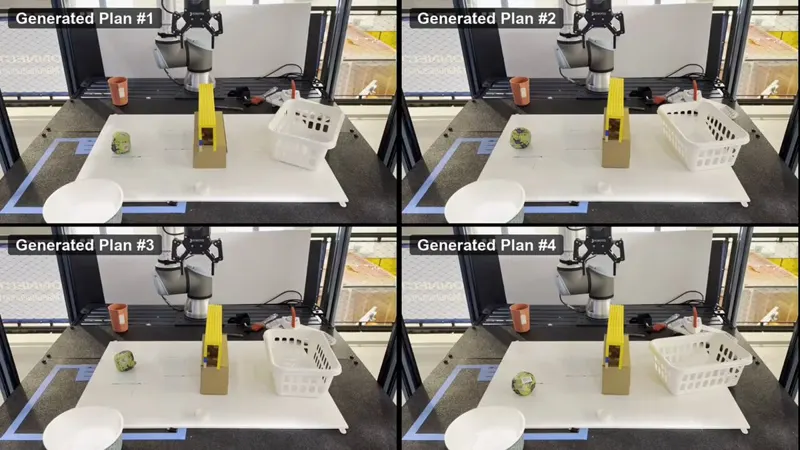
Leo Kharon posted a 100-second walkthrough of GTA-2 (Grounded Task Axes, Version 2), a modular vision-language-model framework plus benchmark for zero-shot robot manipulation that generates new manipulation behaviors from a natural-language instruction with no task-specific demonstrations, policy training or fine-tuning. Four specialized VLM agents run in sequence: decompose the task into ordered subtasks, generate an abstract skill from object-centric task-axis components, assign numerical parameters, and ground keypoints and axes in the image. The design deliberately separates reasoning about what the task means from the geometry and control that execute it: a manipulation is represented as semantic subtasks plus task-relevant keypoints and axes, controller compositions and scene-dependent parameters, so a failure can be corrected at one stage without retraining. The capture walks the five-stage interface (Task Decomposer, Skill Generator, Parameter Setter, Keypoint Module, Robot Script); the decomposed subtasks read as move above the ball, close the gripper, lift and carry it over the white basket, then release, and parameters such as a 30 cm lift height are generated before the robot script runs. Real-arm footage shows four generated plans executed on a tabletop scene with a yellow object and a white basket. The headline claim: GTA-2 beats pi0.5 with zero robot demonstrations.

As an Amazon Associate, we earn from qualifying purchases.